Sunday, October 30, 2016

Diwali: The Festival of Lights

Hey guys!

Today I'm doing a special holiday post. That's because it's Diwali – the Hindu Festival of Lights!

If you're not familiar with the name, you may have also seen it spelled as Dewali, Divali, or Deepavali. I'll be sticking with Diwali in this post, but depending on where it is celebrated it can be called by different names. Diwali is celebrated all over the world, wherever Hindus worship. The holiday marks the beginning of the New Year for Hindus in northern India.

I regret to say that I had never heard of Diwali until about two months ago. I went to look at something on Etsy and they were advertising gifts for Diwali. I was immensely intrigued, and I've truly enjoyed looking into it! Diwali is a beautiful festival.

Here's some of what I've learned:

Gambling and games of chance are a major part of the festivities of Diwali. Stories in Hindu mythology tell of mortals gambling with the gods, or of the gods gambling with one another. When humans gamble during Diwali, it is hoped that Lakshmi, the goddess of wealth, beauty, and luck, will grant them some of her good fortune.

Besides gambling, Diwali celebrations are marked by two truly beautiful visual celebratory acts. The first are a series of patterns called alpanas. Only some regions of India make alpanas part of their celebration, but some of the places which do hold yearly competitions to find the most beautiful. Aplanas are designs painted on the floor, traditionally using a flour-based substance. I've also seen a similar style of floor art called rangoli. These patterns are believed to bring good luck the household...and they are beautiful.

(This pattern was called "simple".  I can't imagine painting something like that - let alone a more complicated pattern!)

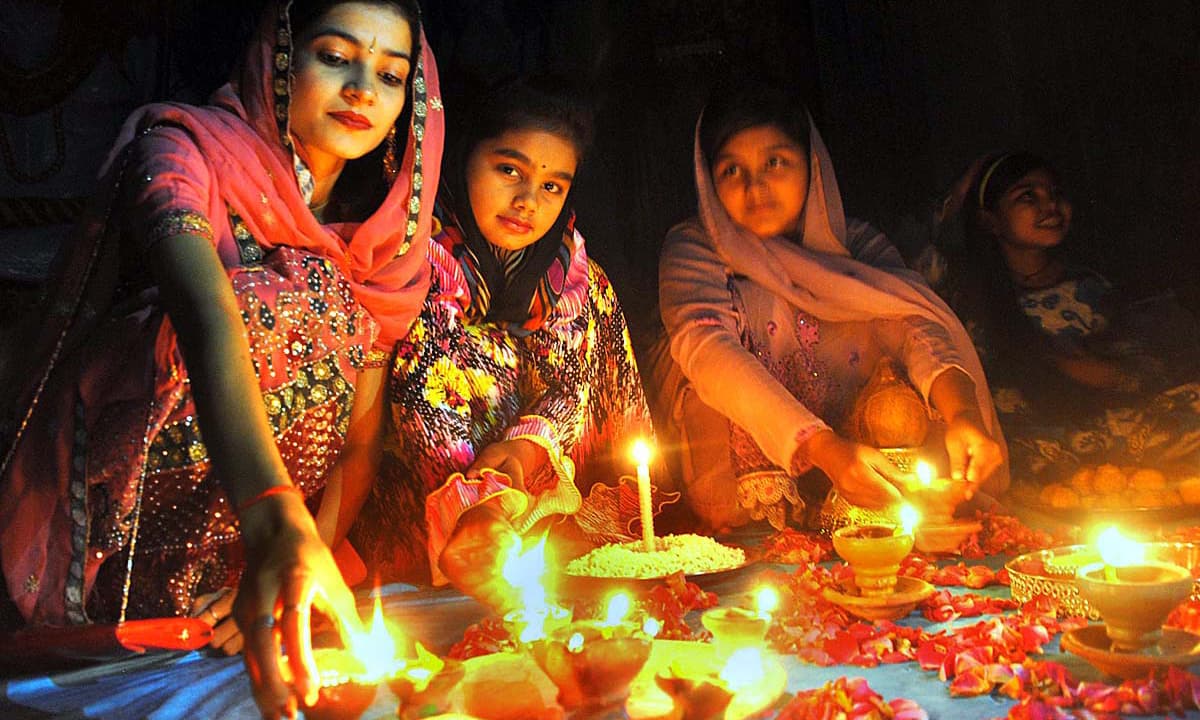
Yet it is the second act for which Diwali is perhaps most famous. Throughout the celebration, there are lights everywhere. In recent years electric bulbs have begun to be used, but fires, candles, and oil-based lamps are still used. Enormous firework displays are also common.

Depending on where Diwali is being celebrated, the reasons for the lights vary. I've heard stories say that the lights were lit to welcome a great war hero home; other locations line paths with torches to help guide the spirits of departed ancestors to the afterlife; still others say that the lights are lit to celebrate a mighty god leading the world out of darkness. However, the tale I've heard most often revolves around Lakshmi. It says that the lights are lit to guide the goddess to the houses of her worshipers so that she might bless them.


During the festival of Divali in October or November, Lakshmi roams the Earth in search of a place to spend the night and bestow her gifts. All over India hundreds of little oil lamps are lighted and placed around houses and rooftops and even in ponds and streams to attract her to them. The whole of India is like a fairyland, glittering and twinkling in devotion.”

Variations of Diwali are celebrated all over the world by Hindus, with the celebration taking on its own unique customs based on the country of celebration. An example is Tihar, a holiday similar to Diwali which is celebrated in Nepal. Though Tihar also honors sacred animals, it maintains many of the festivities of Diwali. Most similar is the practice of gambling and games of chance during Tihar (both of which are illegal during the rest of the year, but are allowed during the holiday) and the lighting of oil lamps to welcome Lakshmi, goddess of wealth, into a family's home.

If you're celebrating Diwali this year, I wish you a very happy one - and I'd love to see pictures!  Want to learn more about the festival?  Check out this link!


Tomorrow is another holiday, so if you'd like to read my post about Halloween/Day of the Dead/Samhain, check it out here.

I'll see you guys next week!

Monday, October 24, 2016

Three Travelers and a Dream for Bread

Hello all! I hope your Monday is going well so far.

Today we're taking a quick look at a folk tale. A friend of mine sent it to me – thanks for the idea, Katie! I hadn't read this particular story before, but I've heard several similar ones.

A common trend in folktales is that the underdog is frequently the victor. The idiot often trumps the wise men. The beggar marries a princess. The youngest son bests his brothers and becomes king. In almost all of these stories, it is either the kindness or the intelligence of the underdog which causes them to win the day.

The same is true in this folktale.

There were once three men traveling together. One was poorer than the others, and they looked down on him somewhat. Their journey took some time, and one night they found that they were almost out of food. Between the three of them they only had enough flour to bake one loaf of bread.
 
Now, a single loaf of bread would not be enough food if it was split between three people. After setting the bread to bake, one of the richer fellows came up with an idea. He declared that they would go to bed, and whoever had the best dream could eat the bread in the morning.
 
These terms were agreed to by all three, and they went to sleep.

However, the poorer man was cunning. He guessed that his traveling companions were trying to trick him so that they would get the loaf of bread. Rather than falling asleep, he waited until the other two had drifted into slumber. Then he arose, ate the loaf of bread, and returned to bed.

When the morning came one of the travelers sat bolt upright. He woke the other up and exclaimed that he had had the most amazing dream. The man claimed that in his sleep two angels had come to him, and had raised him up to the gates of heaven. Surely his was the most marvelous dream – and therefore deserving of the bread!

His companion disagreed. He claimed that he too had been approached by two angels in his sleep...but they had split open the earth and taken him to the bowels of hell. Obvious it was his dream which deserved the bread!

Little did the two know that their poor traveling companion had been listening to both of their stories – he was still laying as if asleep. Eager to claim the bread, the duo awoke him.

The poor man opened his eyes and exclaimed in shock that the two had returned. They were confused, and informed him that they hadn't gone anywhere. But the cunning man shook his head and told them that they had both been taken in the night. One had risen to heaven with two angels; the other had descended into hell with two others.

Seeing that they were both gone, and thinking it unlikely that either would return, the poor man had eaten the bread and gone back to bed.

And so it was that his traveling companions were outsmarted by their own “dreams”!

What did you guys think? I love the humor in the tale. There are many variations of this story.  If you'd like to read some of them, you can find more here.

I'll see you next week with a special holiday post!

Monday, October 17, 2016

Ganymede: Beauty and Cups

Alright, so today's post was going to be about a totally different topic, but then I had a package show up this morning with this little cutie:
This is Ganymede, a plush version of a bird from Blizzard's video game Overwatch.  Ganymede is the friend of a giant robot named Bastion.  If you feel like having your heartstrings tugged, I'd highly suggest watching the story of their friendship in this video.

Why am I telling you about Overwatch?  Well, Blizzard has a tendency to utilize mythology in their video games.  (So much so that I did an entire series of posts on the myths of World of Warcraft!)  Sometimes they put references to entire myths within their story; at other times, all they draw on is a name.

Ganymede is one such name.

In Greek mythology, Ganymede was a mortal who drew the attention of the mighty god Zeus.  The young lad lived the life of a shepherd.  One day, Zeus looked down from Mount Olympus and happened to see Ganymede.  The human was the most beautiful he had ever seen, and Zeus just had to have him.

Now, Zeus isn't exactly known for his self control.  As soon as he saw Ganymede he transformed himself into an eagle, swooped down, picked the lad up, and carried him off to the home of the gods.


Most of Zeus' conquests come to a tragic end.  The story of Ganymede is quite different, in that the boy was actually granted immortality.  He became the cup bearer of the gods, keeping their glasses full during feasts.

In fact, Zeus is actually at his most compassionate in the story of Ganymede.  Usually the god only thinks of himself, but for some reason he took notice of the grief of Ganymede's father at the kidnapping of his son.  Zeus sent the lad's father a gift of two mighty horses.
(Okay, so horses might not make up for a stolen child - but still, it's more than Zeus normally does for grieving families!)

Two quick facts about Ganymede:

It is said that Zeus made the lad into a constellation - Aquarius.  Aquarius has been associated with drinks in several different mythologies.  The Egyptians viewed it as connected to the Nile River.  The Mesopotamians considered Aquarius to be the constellation of Enki/Ea, holding a vase filled with water.


Usually when Zeus has sex with a character in mythology, it's pretty obvious.  Of course, that's because he usually gets them pregnant.  It's been debated whether or not Zeus' relationship with Ganymede was sexual.  I won't jump into that debate, but I can tell you that 1) Hera, Zeus' wife, was exceptionally jealous of Ganymede and his beauty. 2) Of the four moons that Galileo discovered of the planet Jupiter, three are named after Zeus' mistresses - Io, Callisto, and Europa.  The fourth is named Ganymede.


I hope you guys enjoyed this post!  Any Overwatch players out there?

See you next week!

Monday, October 10, 2016

The Hounds of Hel

Today we're going to be looking at several different mythologies: Egyptian, Greek/Roman, and Norse. All of these mythologies have their similarities, but the one I'm focusing on today is their portrayal of dogs. All of these cultures have myths associating dogs with the afterlife. In particular, all of them have named dogs who serve as guardians to the afterlife.

Ready? Let's get started.

The Egyptians worshiped a deity named Anubis.  Anubis has the body of a man and a canine head. The Egyptians often associated Anubis with graveyards. Although he is sometimes depicted as escorting dead souls to the afterlife, the deity's role is primarily that of a gatekeeper and judge. The Egyptian afterlife, ruled over by Osiris, is guarded by Anubis. To enter into the afterlife, a person's heart was placed on a scale opposite the feather of truth.
 
 
If the scales balanced out, or the heart was lighter, Anubis judged them worthy and allowed them into the afterlife. If the heart was heavier, however...well, then the person was unworthy. They were tossed aside to be devoured by a sort of hippo-crocodile-lion thing (it's as unpleasant as it sounds).

Let's change cultures, shall we?
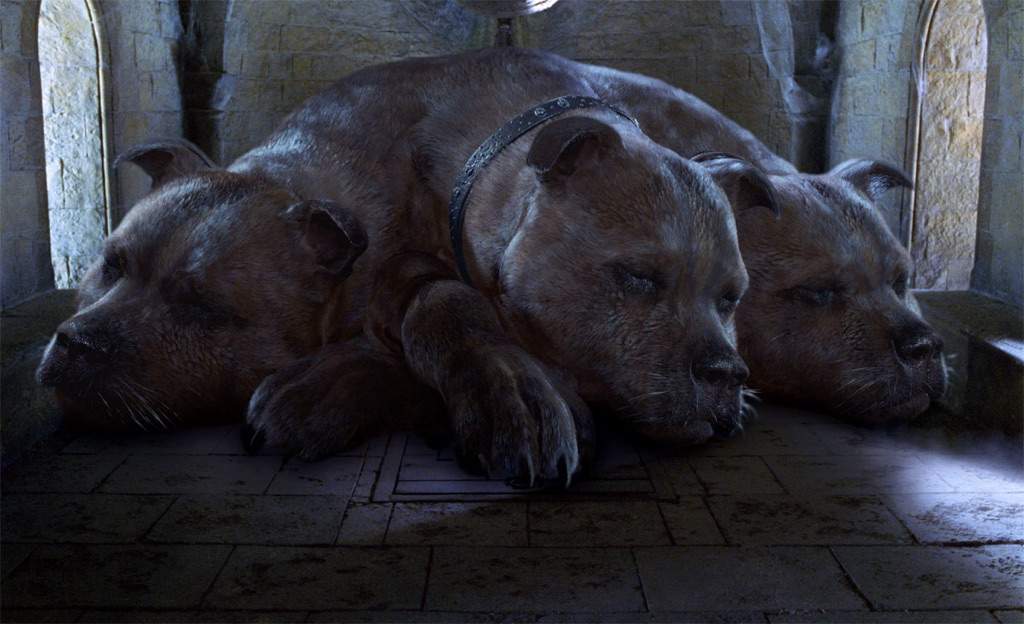
Perhaps the best known Hound of Hel is the Greek Cerberus. Frequently depicted with three heads (though sometimes with only two), Cerberus is the fearsome hound who guards the entrance to the Greek afterlife. His master is Hades.
 
 
Cerberus prevents the living from entering or exiting the underworld, but there are a few times where he has failed in this task. Hercules himself bested Cerberus, and was therefore allowed to leave the underworld. Music is as effective on the hound as brawn, however. The great poet Orpheus was able to enter the underworld in search of his dead wife by playing his harp, lulling Cerberus into letting him pass.
 
(Three headed dog? Harp? Can't imagine why that sounds familiar!)
 
The Romans also included Cerberus in their myths, one of a few characters whose names did not change. Roman mythology adds another person to the list of those who have made it past the guard dog of the underworld: Aeneas. In this story by Virgil, Cerberus is bested not with strength or with music, but with treats. Every dog likes a good treat, right? Turns out a barley cake soaked in mead is the way to this giant puppy's heart.
 
So Egyptian, Greek, and Roman mythologies all have dogs who guard the gates of the underworld. This could be explained by the proximities of the cultures to one another. After all, all three mythologies share quite a few similarities. But the Norse culture is pretty far from the Mediterranean. Because of this, I find it fascinating that they have:

Garm!

 
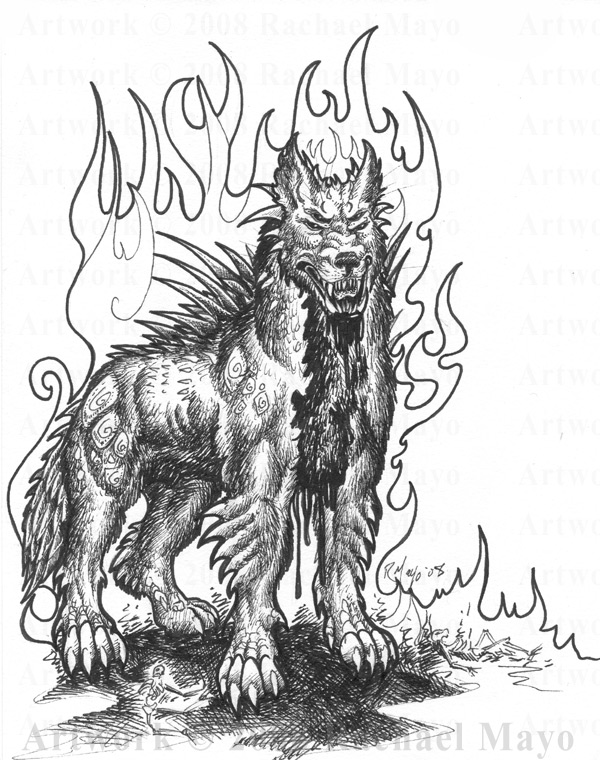
Garm is the guardian of Hel, the Norse underworld for those who did not die a valiant death. His mistress is Hel herself. Garm is described as a fearsome hound whose fur is coated in blood. When Ragnarok comes, Garm will do battle with Tyr, and both will die in battle.

Most interesting to me is the fact that Garm can be calmed...by being given a piece of bread. Sounds pretty similar to the Roman take on Cerberus! Dogs and their treats, right?

What do you guys think? Know of any other cultures that have dogs connected to the underworld?

Sunday, October 2, 2016

Treebound is Published!

Hey guys!

Chosen of the Gods: Treebound has been published!  You can order it here on Amazon.  It's available as both a paperback and a Kindle.  If you buy the physical copy, you get the ebook for half price!


If you read Treebound, I'd hugely appreciate a review!  I always love hearing what my readers think of my work.

Haven't read my other books?  To celebrate Treebound's release, you can get a free Kindle copy of Hammerfall and Lovesick through today (October 2nd)!

Thank you all so much for your support!  I can't tell you how much it means to me.

I'll see you next week with a post about several mythologies, wherein I look at a common myth - the Hound of Hell!

Monday, September 26, 2016

Ibeji: Divinity in Twins

Hey guys!

I wanted to discuss a few things before I get started with the post.  First off, we passed 20,000 pageviews over the weekend!  This is a milestone I've been looking forward to, so it was very exciting.  Thank you so much to all of my readers!  When I started this blog almost two years ago, I never expected it to reach so wide of an audience.  It's amazing to see how many people remain interested in mythology.  Thank you, and I look forward to another 20,000!

Next: Today is going to be my last post about African folktales for the time being.  Next week I'll have a special announcement post.  After that, I plan to spend the month of October hopping between various mythologies and/or fairy tales.  Beginning in November I'll begin a series of posts about Polynesian mythology, which I am very excited to look into.  I hope you guys enjoy!

For today's post, let's take a look at an interesting practice in the Yoruba culture of Africa involving twins.

"Ibeji" is the name for the Yoruba god of twins.  It is also the Yoruba word for twins.  Because twins are so uncommon, they are seen as having a little bit of the divine within them.  The spirits of twins are said by the Yoruba to occupy both the mortal world and the realm of the animals.  Twins are said to share one spirit.


The rarity of twins is reflected in the attitude of the Yoruba towards them.  Childbirth is said to be twice as difficult for twins, but the fortunes of the family increase by twice as much as they would if only one child were born.  Because the Ibeji are considered semi-divine, great care is taken to not anger them.  Ibeji are doted upon and their whims are appeased by their parents.  If the twins are displeased, the god Ibeji might take note and cause the parents to become unlucky.

The most fascinating thing about Yoruba twins is the practice of ere ibeji.  An ere ibeji is a small statuette carved when a twin dies.  Should only one twin pass on, the living twin claims responsibility of the statue.  It is their job to care for the ere ibeji as if their counterpart were still living.  The statue is bathed once a day, and food is offered to its mouth with each meal.  Essentially, the surviving Ibeji lives the lives of both.

(The surviving twin, pictured with the ere ibeji of their deceased sibling.)

If both twins should die, two statues are carved, and it becomes the mother's duty to care for both of them as if her children were still living.

(Some museums keep old ere ibeji on display.)

This entire concept fascinated me as soon as I read about it.  I lucked out and found a number of articles about the Ibeji in my college's online database.  There the matter became even more interesting.  You might have noticed that I've been using the present tense when talking about the Ibeji - this is deliberate.  The Yoruba culture still regards twins as having control over a family's fortunes.  When an Ibeji dies, an ere ibeji is still created.  However, the Yoruba have begun using photographs in place of carvings in some cases.  The surviving twin is photographed twice, once as themself and once, mirrored, as the deceased Ibeji.  The photographs are then blended together to make it appear as though both twins are pictured.

What do you guys think of the Ibeji?  The thought of twins sharing one spirit (and of one having to live out the life of the deceased) made me think of the Weasley twins from Harry Potter.

I'll see you next week!

Monday, September 19, 2016

Anansi: Tricking His Way to Stories

There was a time before Anansi was the keeper of the stories. In fact, he had to undergo a series of trials in order to earn the role of storyteller. Let me tell you the tale:

In the beginning all of the stories of the world were kept by Nyame, the sky god. Anansi wanted to be able to tell stories, so he went to Nyame and asked to buy the stories from him. Nyame warned him that the price was steep, but Anansi still pushed for them. The sky god agreed that the stories would belong to Anansi if the spider could bring him a nest of hornets, a giant python, and a mighty leopard.
 

Anansi set out on his quest, confident in his abilities. He began with the hornets. First the spider found a hollow gourd and cut a small hole in it. He went to where the hornets lived and poured water all over the nearby trees and himself. Thoroughly soaked, Anansi incredulously asked the hornets why they were staying in the rain. He held up the gourd and offered it to them as shelter from the storm. The grateful hornets flew in one by one. When they had all filed in, Anansi plugged up the hole. He delivered the hornets to Nyame.

The next challenge was the python. Anansi greeted the enormous snake and struck up a conversation with him. The spider claimed that he and his wife had gotten into a debate – was the python larger or smaller than a pole which lay nearby? The snake obligingly offered to lay near the pole so that Anansi could measure him against it and see which was longer. The spider asked if he could tie the python to the pole, to make sure that both lay straight.

In the end, of course, the python was strapped to a pole. It was all too easy for Anansi to carry him off to Nyame.

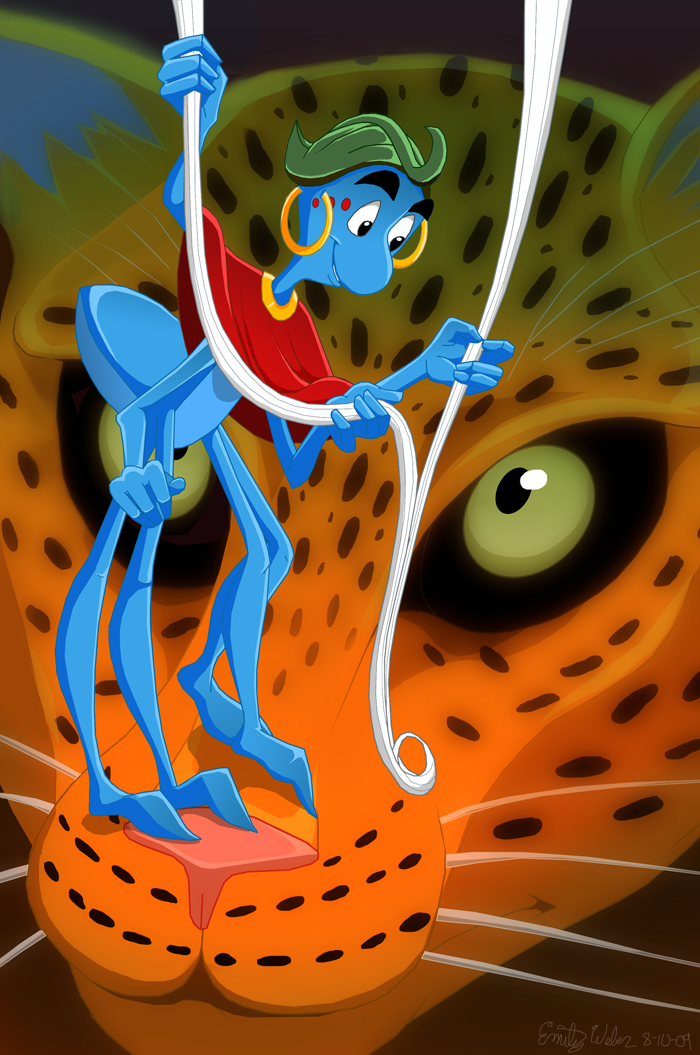
The last animal needed was the leopard. Anansi dug a deep pit in the ground, then covered it with branches and leaves so that it was invisible. When the leopard walked over it, the branches gave way and he fell. Anansi “just so happened” to be walking along, and offered to help rescue the leopard.


The spider bent a tree over so that its top touched the ground, and tied it off. He tied another rope around the tree and dropped the other end into the hole with the leopard. The cat, thinking it would lead to his freedom, followed Anansi's instructions and tied the rope around his tail.
 
As soon as he had, Anansi cut the rope holding the tree to the ground. It sprang back into the air – and it took the leopard with it!

Anansi found the cat dangling from the tree by his tail. It was a simple matter then to capture him.
When he returned to Nyame with the leopard, the sky god could not deny that Anansi had met all of his terms. He gave all of his stories to Anansi.
 
That is the story of how the spider got his tales.

Alright, I promised you guys I'd take a look at some of the appearances of Anansi in pop culture. He appears in some of the works by author Neil Gaiman (who's absolutely brilliant and you should totally check out if you haven't!). The books American Gods and Anansi Boys both deal with the spider trickster.

It's been years since I've seen it, but the Gargoyles animated television show had a few episodes where a spider named Anansi appeared. I hadn't realized when I watched it, but Gargoyles actually draws a lot from various mythologies and folktales. Avalon and the character of Oberon (most well-known for his Shakespeare character) both make appearances in the show. I'll have to go back and watch it again to see what else does!

The last set I'll mention in this post is comics. Both DC and Marvel have incarnations of Anansi. The DC version interacts with the character of Vixen, and his actions are pretty fitting for a (mostly) benevolent trickster. The Marvel version appears a few more times, and his appearances are frequently tied into the Spider Man stories. Though I haven't read it myself, I'm told Anansi was actually the first Spider Man.


Thanks for reading, guys! And, since I neglected to mention it elsewhere in my post...Arrr, maties! Happy Talk Like a Pirate day! I hopes ye're havin' a good time, and doin' somethin' piratical and awesome! Avast!

I'll see you next week!