Showing posts with label Ragnarok. Show all posts

Monday, September 18, 2017

Tyr: Can I Give You A Hand?

Hallo, reader!

As I mentioned last week, I sprained my hand and have been wearing a brace. I'm right-handed, so not being able to use it has been quite a challenge for me. Around the time the injury occurred, I was watching season three of Game of Thrones...and this happened:


It got me to thinking about heroes who lose hands. It's not an uncommon theme, particularly in fantasy and science fiction. A hero who has talent with a blade loses a hand or an arm, and must overcome the difficulties to continue their quest. You see it with Jaime in Game of Thrones; with Tenel Ka, one of my favorite characters from the Star Wars books, who loses most of one arm; with Luke in Return of the Jedi, at the hands of his father. Lindsey in Angel has a hilariously evil replacement hand. Wormtail in Harry Potter sacrifices his own hand for Voldemort, and is rewarded with a magical one in return. Let us not forget Captain Hook, or his more likeable persona, Killian Jones. Ash in the Evil Dead series replaces his missing digits with a chainsaw (it seems the most logical choice).  The list goes on and on.


But why is this particular appendage so frequently lost? Well, it does make the most sense from a writer's point of view. Losing a foot or a leg would be equally dramatic, but would leave the hero at a severe disadvantage (unless they got an especially good prosthetic, a la John Kennex in Almost Human (or are rocking a peg leg, like Captain Barbossa)). So leg loss does occur, but far less frequently than hands. Loss of fingers is another option; take Captain Davos in Game of Thrones, or Frodo in Lord of the Rings. Still, losing a few fingers is far less dramatic than losing an entire hand. Eyes are another option, and are sometimes lost – for instance, Nick Fury in Marvel, or Odin in Norse mythology.

'tis but a flesh wound!

And it is to Norse mythology that I now turn, because I believe one specific character is part of the reason why losing hands is such a popular fantasy trope.

Enter Tyr, god of valour, courage, and (sadly) oathbreaking. (The more I look into this, the more I realize just how much Jaime Lannister was inspired by Tyr!) He's mostly known as a warrior deity associated with victory.
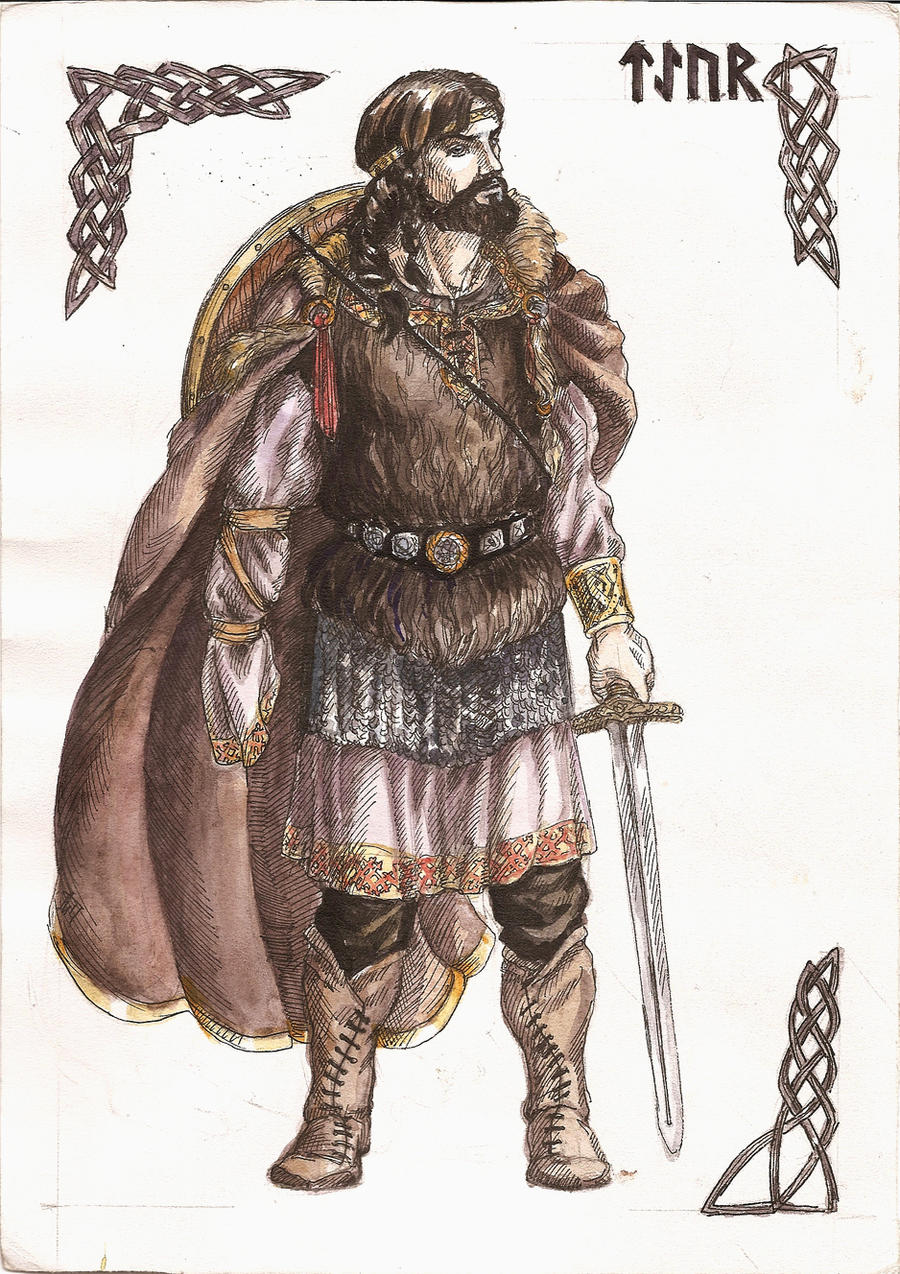

Tyr begins the myths as a mighty warrior still in possession of both his hands. Then, everything changes when the giant wolf known as Fenrir attacks. Fenrir, also called the Fenris Wolf, is a giant wolf. He's also one of the children of Loki, along with Jormungandr, the snake who wraps around the world, and Hel, goddess of...well, Hel. Charming bunch, right?

Much like his siblings, Fenrir is known to the gods as a bringer of great evil. He's tied to various prophecies about Ragnarok, the Doom of the Gods. Knowing this, the gods cast Loki's spawn into various prisons. Hel is banished to Hel, Jormungandr devours his tail as he encircles the world...and Fenrir is brought back to the home of the gods.

There, seeing how strong the wolf grows daily, the gods realize that they have to bind him. A mighty link of chains is forged. They approach Fenrir with the fetter, and offer the wolf a challenge. They have heard that he is strong and mighty – is he powerful enough to break through the chains?

Unfortunately, Fenrir inherited his cunning from his father, the Trickster. He knows his own strength, and is confident that he can break the bonds. The wolf allows the gods to bind him, and then effortlessly breaks through his bonds.

The gods were horrified, and more determined than ever to chain Fenrir. The best of their smiths were able to forge a chain twice as strong as the first. Again the gods challenged Fenrir. Again the wolf deemed the chain susceptible to his great strength. And, again...the bonds were shattered.

Their own abilities already at their limits, the gods turned to others for help. A commission was given to the dwarves, who wrought a chain of their own from six ingredients. Yet these bonds were unlike the others – instead of metal, it was made of the lightest silk.

When the gods brought the silken cord before Fenrir, the wolf suspected trickery. He agreed to allow the gods to bind him, but only if one of the gods was offered as collateral. Tyr agreed to place his hand in the mouth of Fenrir. If the gods' challenge was in good faith, then no harm would come to the god. However, if Fenrir was unable to free himself, and if the gods left him bound...well, one of their mightiest warriors would be down a hand.


Tyr agreed to this deal, knowing full well what the outcome would be. The gods bound Fenrir with the silken chains. The wolf shook and pulled, heaved and fought – but he could not break free.

The gods did not help him. In vengeance, he bit off the hand of Tyr. And so Tyr became the god of perjury, among his other titles.

But the story does not end there, dear readers. Norse mythology is full of foreshadowing, and every little thing turns out to have meaning in the end. When Ragnarok arrives, Fenrir shall at last have grown strong enough to escape his bonds. He shall meet Odin on the battlefield – and there, he shall kill him.


And what of Tyr? Though a mighty warrior, the god is weakened by the loss of his hand. He shall fight in Ragnarok, but ultimately fall. The loss of his hand will prove too great of an obstacle for him to overcome.

So what do you guys think? Is Tyr the first in the long line of the handless-hero tradition? Which hero is your favorite?

Until next week!
Monday, April 17, 2017

Thor: Ragnarok Trailer Breakdown

Greetings readers!  I hope you had a lovely Easter.  If you're interested, I did a post about the Easter Bunny's origins a year ago; you can read it here.

Today I thought that I would try something a little bit different for a blog post.  This past week has been a very good one for trailers, between Detroit, The Last Jedi, and Thor: Ragnarok.  As a huge Marvel fan, I was very excited by the trailer for the new Thor...but, as a huge mythology nerd, I was even more excited.  That trailer packed so much mythology into under two minutes, and I fangirled pretty hard at some of what was included.

But then I thought - I have a blog where I talk about mythology.  Why not do a breakdown of the trailer?  But, instead of focusing on the Marvel aspects, why not point out all the similarities to classical Norse mythology?

And so, without further ado, let's jump into the trailer!


First of all: The name.  In Norse mythology, Ragnarok is literally "The Doom of the Gods".  In traditional mythology, Ragnarok ends with most of the Norse pantheon (and all but a handful of mortals) dead.  The name of the movie alone is setting the stage for a cataclysmic event.

Thor drops into the trailer right away.  Mythological Thor isn't the brightest lightning bolt in the sky, but he's always game for a fight, and he fights hard to defend those close to him.  Marvel movie Thor is pretty much the same in that aspect.

What really interested me were the red, glowing eyes and mouths that can be seen six seconds into the preview.  In mythology, Ragnarok comes at the hands of the denizens of Muspelheim - fire Jotunn.  These giants are led by a being named Surtr, and it's at their hands that the world ends in fire.  The few seconds these dark figures are in the trailer doesn't say much about them, but it has me wondering if they might be the fire Jotunn. (Frost Jotunn have already appeared in the first Thor movie, and their world was explored by Thor and his companions.  It wouldn't surprise me to have the fire Jotunn show up, and I'm wondering if Thor might be hanging upside down in Muspelheim.)  If so, it's another way the trailer is tying back to Ragnarok.

The next character to appear in the trailer also supports Ragnarok; her name is Hela.  This is the Marvel version of the Norse goddess Hel, who rules over (if her name didn't give it away) Hel, the Norse variant on the underworld.  Mythological Hel is the goddess of death, as well as being the child of Loki.  When Ragnarok arrives in mythology, the forces of Hel (led by Loki) rise up from the underworld and fight against the gods.

The trailer certainly sets Hela up to be a major villain.  She destroys Mjolnir with what looks like very little effort.  Then she is shown standing in front of the armies of Asgard, home of the gods.  "Asgard...is dead." she declares dramatically, and then fire sweeps throughout Asgard, destroying everything.  (Fire!  Again, it all ties back to Ragnarok.)  I'm very much looking forward to seeing what role she plays in the movie.

Next you have Thor being dragged away by a beautiful warrior woman.  This woman is called Valkyrie in the Marvel comics, and she too has a mythological counterpart.  I'll shamelessly borrow a line from my book to describe the valkyrie:

"The valkyr were the angels of the battlefield, fearsome women warriors who could sense the approach of death and were tasked by Odin to aid his chosen side in battle. When a warrior died they bore him up to the Halls of Valhalla, the Hall of the Slain, where he would join the ranks of the Einherjar. There he would be waited upon by the valkyr and never know sorrow until the coming of Ragnarök.”

Now, I highly doubt that Thor is dead in the trailer, and the arena he winds up in doesn't look much like any afterlife.  However, it's worth noting that the Hall of the Slain, where all the valorous dead wound up, was known for its feasting, drinking, and brawling.  To have a character named Valkyrie dragging Thor to a place where he's forced to fight isn't too far off from mythology.  In addition, her very name is already setting this character up to fight on Thor's side against the bad guys during Ragnarok.  She seems to be a pretty competent fighter, so I'm looking forward to that.

A few of the characters from previous Thor movies make a cameo in the trailer.  Heimdall, the watcher of Asgard, is there - and so is Loki.  Now, it's no surprise that they chose to show Loki in the trailer, since he seems to be a fangirl favorite of Marvel.  The inclusion of Heimdall could just be a coincidence, one of many characters from the Thor franchise that they just so happened to pick.  However...the myth nerd in me says otherwise.  I think his inclusion, along with Loki, was a deliberate foreshadowing.

In the myths, during Ragnarok Heimdall plays an important role.  The watcher was never particularly fond of mythological Loki, a trickster whose mischief often went a few steps too far.  When Loki eventually was responsible for the murder of a god, Heimdall helped track him down and imprison him.  During Ragnarok, Loki breaks free of his bonds and fights against the gods.  Heimdall counters him.

In the myths, Heimdall and Loki kill each other.

I can't see Marvel killing off Loki.  (At least, not permanently, at any rate.)  Tom Hiddleston is a huge asset to them, and as previously mentioned, Loki has a lot of fangirls.  My best friend is one of them, and I know she would riot if her favorite character died. (Just like I did when my favorite Marvel character was killed off by Loki...)

However, I can see Heimdall being killed off.  It would lend additional emotional weight to the story.  His sacrifice could inspire Thor to fight harder.  And it would help to show again the villainous side of Loki, who tends to swing between villain and anti-hero in the movies.

And those are my thoughts on the trailer!  It's a lot of text for less than two minutes of video, haha.  I'm not sure if any of my speculation will pan out, but it's always interesting to me to see what they choose to draw on from the myths.  What are you guys' thoughts?

Monday, June 15, 2015

Freyr: Slain by the Fire (of Love)

Most of us can relate to having a crush.

Most of us can probably also relate to doing something stupid to impress said crush.

I personally went through a phase where I pretended to despise country music because the object of my affection hated it. Sorry, Stephen - I actually really, REALLY like country music. For a different crush, I tried to make it seem like I thought the Transformer movies were works of fine art instead of two-and-a-half hour long explosions of sound and metal with questionable story and acting.  Don't get me wrong, I liked the first one well enough - it was the ones after it that I had some problems with.

You guys probably have similar stories of things you’ve done - or tried to do - to garner the attention of your crush.

Well, not even the gods are immune to that sort of behavior. Case in point: Freyr, the Norse god of plants and fertility. Freyr is famous for a story in which he pines (heh - plant god, pines. Heheh!) away for a beautiful woman he has only glimpsed from afar. Unfortunately, he does something pretty stupid to win her over...and in the long run, it costs him his life.

In fact, the whole world dies because of Freyr’s mistake.

I hope none of us can relate to that!

In last week’s post I talked about the similarities between the goddesses Frigg and Freya. Freyr and Freya are siblings, and they’re not quite like the other gods. Several tales call them “Vanir”, whereas the other gods are referred to as “Æsir”. The Vanir hail from the Norse realm of the elves, Alfheim. In fact, Freyr was the Lord of Alfheim.

As I said before, Freyr is the Norse god of fertility and plants. He is also attributed as being the god of the sun, the rain, and the harvests. Freyr possessed several magical relics. Perhaps the best known is the boar Gullinbursti - the image of this boar is frequently found on shields and armor of Norse warriors. 


Gullinbursti was made out of gold, and his skin reflected the light of the sun, allowing crops to grow. Gullinbursti is also credited with teaching man how to plough the ground, because his tusks dug up furrows in the ground in which seeds could be planted.

The second relic of Freyr is the ship Skidbladnir, a truly magical vessel. It was capable of holding all of the armies of the gods, yet could fold up incredibly small and fit into Freyr’s pouch.


The ship also possessed the ability to sail on sea, air, or land.  Why am I picturing this?


Freyr’s final relic - and the most important one - was his magical sword. The blade was endowed with the ability to fight against the giants without anyone needing to hold it. This sword had long been prophesied to be incredibly important during Ragnarok, the doom of the gods. During Ragnarok, Freyr was foretold to fight against this guy:

Surtr, leader of the fire giants.

With his sword, Freyr might have been able to defeat Surtr. Unfortunately, the Norns knew long before he did that the fertility god would give away his sword for love of a woman, dooming himself to fall at the hands of Surtr.

This is the story which I wish to tell you.

Once, while the other gods were off on some business, Freyr decided to climb onto Odin’s throne. From here all of the realms could be seen, and the god was able to oversee everyone and everything. It was while he was in this chair that Freyr happened to glimpse a woman named Gerda, daughter of one of the giants. Her beauty so dazzled him that Freyr immediately fell in love with her.

Unfortunately, Freyr also knew that he would never be able to woo Gerda. After all, she was a giantess, enemies of the gods! What chance could their relationship ever have?

Because of this, Freyr fell into a deep depression. He pined for Gerda so badly that he could not eat, drink, or sleep. The god was so distracted by his love for Gerda that he failed to tend to his heavenly duties. As such, the crops began to fail on the earth. Nature grieved with the god, so the plants all started to die.

At these events Freyr’s father, already worried for his son, grew frantic. He sent Freyr’s loyal friend and servant Skirnir to find out what was wrong. Freyr confessed his love for Gerda, but also his knowledge that he could never possibly hope to have her.

Skirnir refused to give up so easily. He offered to go in Freyr’s stead to win over the beautiful maiden. After a while Freyr agreed to let him try, and lent Skirnir his sword to keep him safe on his journey.

His friend immediately set off, and eventually came to the home of Gerda and her father. Skirnir was granted an audience, where he told Gerda of Freyr’s love for her. However, Gerda was one of the frost giants - and her heart was as cold as ice. She was unmoved by Skirnir’s pleas on his friend’s behalf.

Noticing this, Skirnir changed tactics. He offered Gerda gold and jewels if she would return with him and become Freyr’s bride. Once again, the frost giant turned him down.

Desperate, Skirnir began to threaten the maiden. When threats of death did not phase her, he threatened to curse her to a life of eternal misery and loneliness. That struck a note of fear in Gerda, who relented and agreed to return with Skirnir and marry Freyr. (Gentlemen, please don’t take your cues from Skirnir. Threatening a lady is NOT an appropriate way to woo her.)

It is here that Skirnir makes a very foolish mistake - a mistake that Freyr does not chastise him for when he returns. In olden days there was a tradition called a bride price - sort of like a reverse dowry. The man who wished to marry gave a gift to the parents of the woman he sought. Essentially, he bought her off of them.

(I read a great Marvel fanfiction a while ago in which Thor approaches Dr. Selvig, Jane’s father figure, and gives him a few hundred cattle in exchange for Jane’s hand in marriage. Of course, he’s working in Stark Tower at the time, so Iron Man walks downstairs in the morning and sees a TON of cattle randomly standing there. Hilarious! Hopefully that helps you to picture a bride price.)

Skirnir offers Freyr’s sword as the bride price for Gerda.

So, I suppose Skirnir is the one to blame for everyone dying during Ragnarok. But still! Freyr sent him off to represent him, and gave him the sword for the journey. He doesn’t even try to get the sword back when Skirnir returns without it! What fools we are for love...

Anyway, Gerda and Freyr are married soon after, and the giantess quickly falls in love with the god. The poem this story is contained in was interpreted as the sun (Freyr) melting the frozen earth (Gerda’s heart), which is kind of sweet, and beautiful.

What happens next? Not so much.

During Ragnarok, Freyr has no weapon with which to face Surtr. Depending on the story, he fights with his bare hands, a tree branch, or an antler. None of those fare very well against fire.


Surtr wins. We all die.

But at least Freyr got the girl, right?

I hope you guys enjoyed the post! I love that the gods are as fallible in love as we mortals are. It makes them easier to relate to, and also probably made those who worshipped them feel less foolish when they acted stupid to win someone over - after all, they were just following the example of the gods!

Got any requests, questions, or comments? Feel free to enter them below, or to email me! I’ll be back with another post next week, though it’s still a mystery (to you and me both!) what it’ll be! See you then!

Monday, November 17, 2014

Ragnarok: The Parts They Play

Most of the characters I’ll be mentioning in this post have already been introduced in my previous posts. And now that I’ve talked with you about all of these fabulous characters, let’s kill them off! Well, alright, not all of them. Just Loki, Odin, Thor, and most of the rest of the pantheon. Oh, and humanity, of course!

Ragnarok is said to first be experienced by the humans, because they experience three years during which the whole world is at war. After the war will come a Fimbul winter, which is about as long as a winter in Game of Thrones. The evil wolves Skoll and Hati catch and eat the Sun and Moon, both of which are gods. After this the stars fall from the sky, leaving total darkness.

The World Tree Yggdrasil soon begins to shake, causing massive earthquakes. These quakes set Loki free from his imprisonment, along with his wolf son, Fenrir, and Garm, the hound of Hel. Three massive roosters crow to alert the gods, the giants, and the dead that Ragnarok has come.

While the gods and the Einherjar, the valiant dead warriors who dwell in Valhalla, prepare for battle, Odin goes to consult Mimir. The Norns meet him there, their thread of life torn apart. No one knows what Mimir says to Odin, but he returns with a grim face and leads his army to war.

But who are they fighting, you might ask? Their foe is an army of the evil dead from Hel, led by Loki and his children, along with a creature named Surt, who is a fire god or fire giant depending on the text.

The two armies meet on the plains of Vigrid. Odin is quickly killed by Fenrir, who is then slain by one of Odin’s sons. Jormungand, who has broken free, is killed by Thor, who dies of the serpent’s venom. Loki and Heimdall, the watchman of the gods, kill each other. Tyr, a god who had lost one hand when Fenrir was being imprisoned, kills Garm but is in turn slain by him. Frey, a fertility god, fights Surt and is killed by the fire giant. With all of his foes defeated, Surt then sets the nine realms on fire, ultimately destroying them and himself.

So basically, the world ends in fire and in darkness - and not just our world, but all of the worlds. Super depressing, right?

Luckily for, well, everyone, there is a rebirth after all of this. The Sun had given birth to a daughter before her death, who takes her place as a new Sun. Thor’s two sons survive, as do other gods, including some of Odin’s brothers. From out of the ruins of Yggdrasil step a human man and woman, who were sheltered by the Tree. These survivors repopulate Asgard and Midgard. The forces of darkness had been slain during Ragnarok, so evil does not plague them now.

And that, my dear readers, is Ragnarok and its aftermath. Still depressing that just about everyone died, but at least there’s a light at the end of the tunnel.

My next post will wrap up our discussion of Norse mythology for now, and then we move on to more familiar territory - Greek mythology! You know the drill: questions or comments can go below or be emailed to me. I’ll see you guys at the next post!