Showing posts with label Chinese. Show all posts

Monday, April 10, 2017

The Haunted Pavilion

(Pictures to follow later - sorry everyone, I'm swamped with school.)

Hey guys! I hope you had a great week!

This will be my last post dealing with Chinese mythology for a while. For this post, I wanted to look at one of the stories from Chinese folktales in which not all is as it seems to be. Let's look at the story first, and then I'll talk about it afterward.
 
China is a huge country, and in olden days travelers would have to walk for days or more to get between towns. Because of this, pavilions were built alongside roads – think of them as a sort of motel. Whoever owned the pavilion would provide a meal for a weary traveler, and they could sleep inside it before continuing on their journey the next day. Sounds nice, right?

Unfortunately, there was one pavilion in which no one wanted to sleep. It was...haunted.

Anyone who slept within that pavilion was found dead the next morning, an expression of terrible agony contorting their face. Because of this, travelers sensibly began to avoid the pavilion.

Until one day, when a traveling scholar happened along. He was warned by the couple who managed the pavilion that it was haunted. The tales were told to him, and the scholar was pressed to move on, to find somewhere else to sleep.

Instead of being afraid, the scholar was intrigued. He decided to stay in the pavilion overnight to see if he could solve the mystery. The pavilion's managers tried to talk him out of it, but his mind was made up.

So they brought him food and then hastily retreated back to the safety of their own home. The scholar ate his meal and then settled down with a book. Darkness fell.

Quite a while after night had fallen, the scholar's reading was interrupted by footsteps outside. He could just barely see someone garbed all in black approaching the front of the pavilion. They stopped, and called out a greeting to the master of the pavilion. From inside, a voice returned the greeting. The mysterious guest asked who it was staying inside the pavilion, and the pavilion master responded that it was a scholar...but, unfortunately, he was reading and still awake. The strange guest let out a sigh of disappointment and left.

The scholar, now more cautious than he had been, returned to his book.

Some time later another figure, this one wearing a red hat, approached the pavilion. It too greeted the pavilion master, and inquired as to the man within. Like the first, it let out a sigh of disappointment and left when it heard that the scholar was still awake.

Once the second figure had gone, the scholar crept outside of the pavilion. He approached the front and called out a greeting to the master of the pavilion. Like the others had done, the scholar inquired as to who was “inside” the pavilion, and was told that it was a scholar who was reading and, unfortunately, still awake.

The scholar sighed like the others, but then he changed the dialogue. He asked who the figure in black had been, and the pavilion master replied that it had been the black sow who lived in a house nearby. When asked who the figure in the red hat was, the pavilion master responded that it was the rooster from yet another house. The scholar then asked who the pavilion master himself was, and was told that it was the old scorpion who lived within the pavilion.

The scholar snuck back to his spot in the pavilion, and was very careful to not fall asleep for the remainder of the night.

When the humans who ran the pavilion approached in the morning, they were shocked to find the scholar still alive. Their surprise grew when he asked for a sword, saying that he could solve all of their problems. He had figured out who was haunting the pavilion.

The sword was brought, and the scholar got down to business. He went first to one corner of the pavilion, where the manager's voice had seemed to emanate from. Inside a crack in the wall was a massive, angry scorpion, who was swiftly killed by the scholar. Next he went to two houses in the village. At one he killed a black sow, and at another he butchered a red-crested rooster.

The scholar explained his actions to the villagers, telling them how the demons had identified themselves. From that day on, the pavilion was no longer haunted. No more travelers died there, and it was once again a safe haven for those on the road.

And that's the story!

There are a lot of tales in Chinese mythology in which humans (or demons) are not what they seem to be – but rather are animals in disguise. We've already talked about the Heavenly Maidens, who can take the form of a crane or of a human. Unlike some other stories, these women are wed by men who know exactly what they are. There are stories of beautiful girls who are wooed and married, only for their husbands to later find out that they're foxes in disguise. Though the foxes often love their mortal husbands, these tales often end in tragedy. Then there are stories where a creature – a massive snake, for instance – takes human form and seduces a mortal to achieve her own ends.
I hope you guys enjoyed this look at Chinese mythology! I know I did. I'll see you next week!

Monday, April 3, 2017

The Monkey King: Journey to the West

Hey guys! Today I'm going to be wrapping up my series of posts about the Monkey King.

When we last saw Sun Wukong, things were looking pretty rocky for the Monkey King (pun fully intended). He had angered the heavenly host so much that they had gone to war with him. Unfortunately, the monkey proved to be a competent adversary, and was able to handily defeat the armies of heaven. At this point the Jade Emperor called upon a higher power, begging the Buddha to come and stop the Monkey King. When Sun Wukong failed to best the challenge of Buddha, he was imprisoned under a mountain for five hundred years.

Today's post is going to focus on what happened when those five hundred years were up. Unfortunately, it'll be a very brief overview. The entire adventure embarked upon by Sun Wukong can be read in the book Journey to the West, and is much too long for me to cover in a day (or even in a few posts). The entire history of the Monkey King I've discussed so far is basically just the prologue to the story. Still, I'll do my best to provide a rundown here so as to provide some closure to the story of the Monkey King.

 
Five hundred years after Sun Wukong was imprisoned, it was decided that the holy sutras of Buddhism needed to be retrieved from India and brought to China. Guanyin, the bodhisattva of mercy, chose a monk by the name of Xuanxang to make the pilgrimage to the west. (Xuangxang was actually a historical monk who did set out on a pilgrimage to India, and returned to China with holy teachings.)
 
However, Guanyin knew that the journey would be dangerous. Many demons and monsters would seek to stop Xuanxang from completing his task. To this end, she also found several noble guardians to ally with the monk. One of these guardians was the Monkey King.

It is telling that it is Guanyin who chooses the traveling companions, because she represents mercy. The whole story focuses upon compassion, mercy, and redemption. Each individual chosen to aid Xuanxang is flawed.


As my other posts about him showed, Sun Wukong was wild, rebellious, and possessed of both ego and temper. He had been imprisoned for these flaws by the Buddha himself.

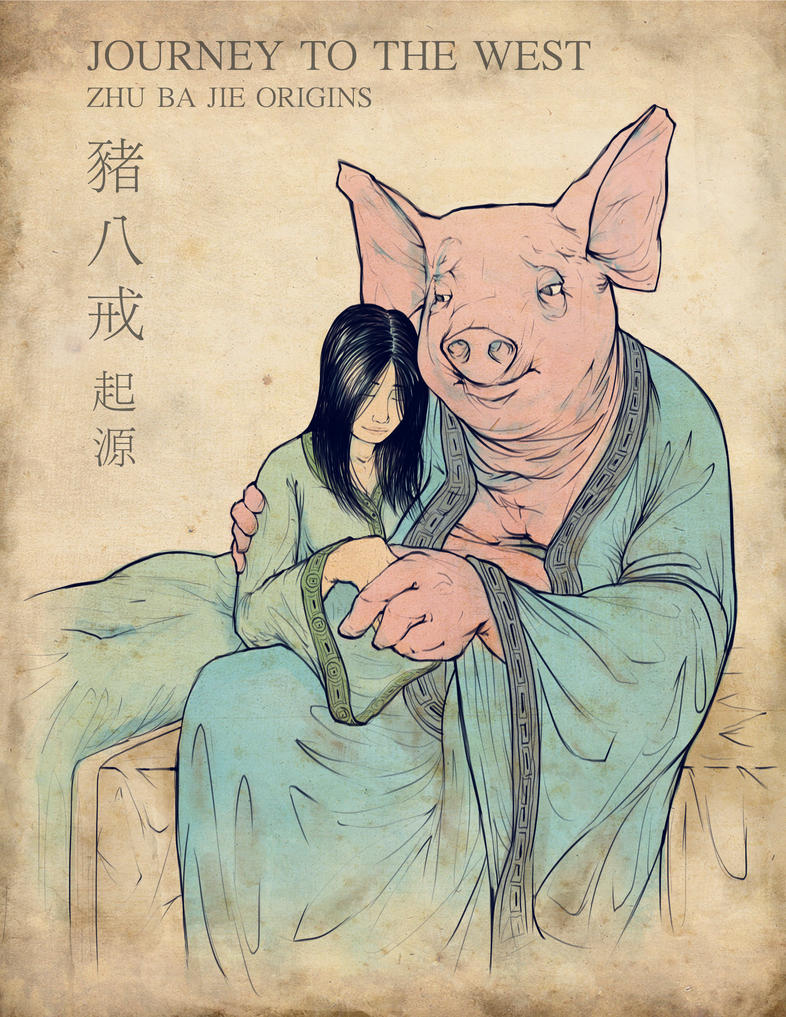
Zhu Bajie was another of the companions, and he was both lazy and gluttonous. He had flirted with a major goddess, and been banished for his insatiable lust.


Sha Wujing had been exiled for angering the Jade Emperor by breaking a precious object, and reincarnated as a man-eating demon. He wore the skulls of a group of holy men he murdered.

The last companion was Yulong, the son of a mighty dragon king. Yulong had destroyed his father's pearl (a symbol of longevity and wisdom among the dragons) in a fit of anger, and had been sentenced to death for his crime. He spent most of Journey to the West transformed into a horse to aid the others.

(A very unlikely group of heroes, to be sure. I'm reminded of the DC/CW tv show Legends of Tomorrow: “We are a team of outcasts and misfits. So please, don't call us heroes. We're legends.”)


In an epic journey spanning dozens of chapters, Xuanxang and his companions set out for India. They were constantly set upon by monsters and demons, who sought to kill the monk and devour his flesh. Each time Xuanxang's co-travelers managed to save the monk. Their journey took over a decade, but after much fighting (and some bickering betwixt one another), the group arrived at the temple in India and claimed the sutras. They then returned to China, delivering the sutras into the hands of the temple.

Each of the individuals were rewarded for their efforts. Yulong became a naga, a magical being who was a combination of dragon and man. Zhu Bajie was granted the status of altar cleanser, meaning that he got to eat all of the scraps of food left at altars – a wonderful holy position for someone with such a great love of eating. Sha Wujing achieved nirvana, attaining a position similar to that of a saint in Catholicism.

But the greatest rewards were for both Xuanxang and Sun Wukong. Sun Wukong's impetuousness had been tamed, and he had given his life into service to a higher power. The monk and the Monkey King were both given the gift of enlightenment, and were raised to the positions of Buddha. Ironically, this meant that the monkey finally achieved his goal – he was given a rank equal to that of anyone in heaven.
 
And so ends the tale of the Monkey King.
 
I hope you guys enjoyed it!
 
 
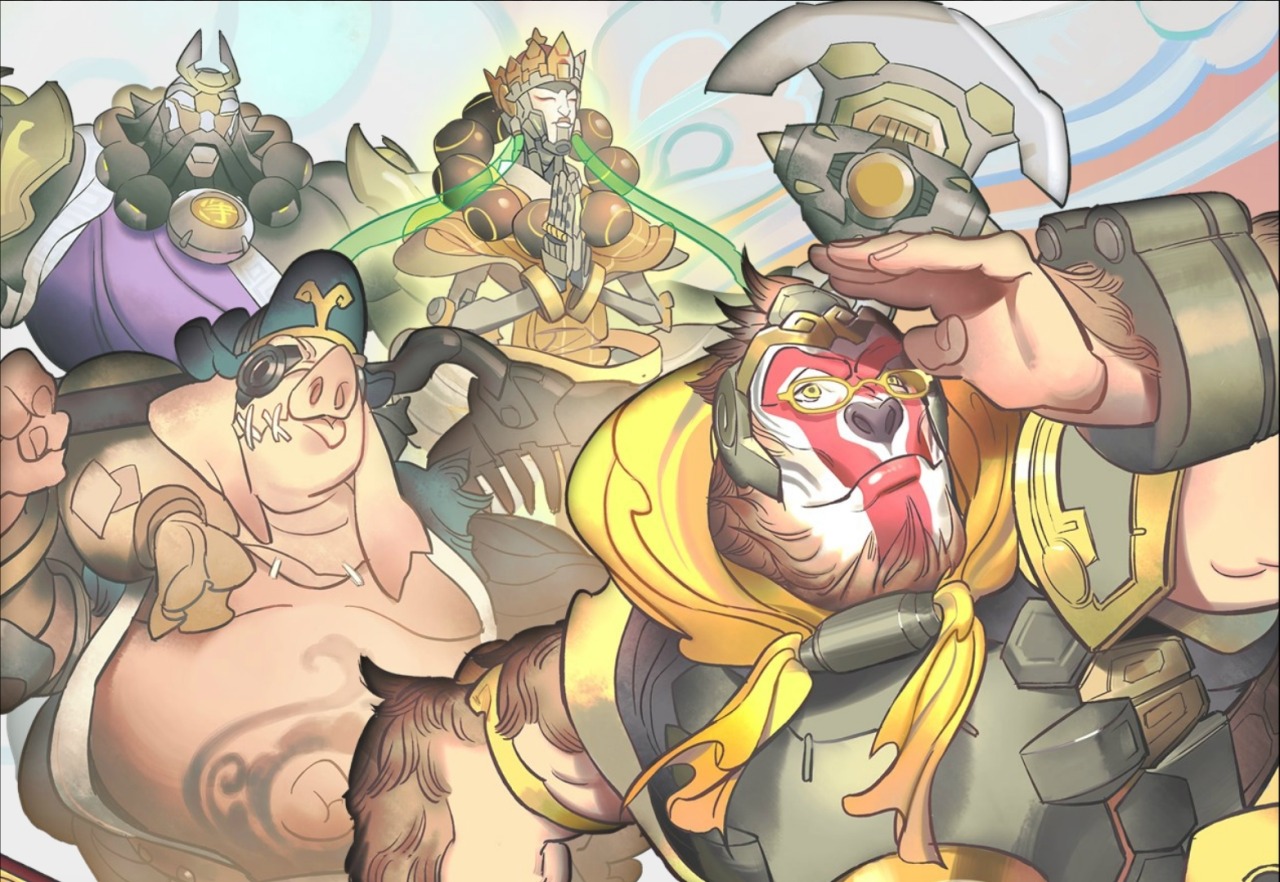
(Overwatch did a series of skins based on Journey to the West for their Lunar Festival event.  They also did an animated comic, which can no longer be found on their website.  However, some wonderful person uploaded it to YouTube, so you can watch it here.  It's adorable.)

I'll see you guys next week!

Monday, March 27, 2017

The Monkey King: The Edge of the Earth

When we left off last week, the Monkey King's actions had become too much for the Jade Emperor and his court. The gods had attempted to stop Sun Wukong, but he had handily bested their armies and escaped. Unable to do anything through their own actions, the gods appealed to the mightiest being of all...Buddha.

(Religion in ancient China is very similar to that of Rome, or Japan, or any number of non-Judeo-Christian countries. New gods were often brought to the country through trade routes. Rather than getting rid of the old gods, they were shuffled around to make room for the new religion's joining them. When Buddhism arrived in China, the old gods remained – but Buddha was added to many of the stories as the supreme power.)
 
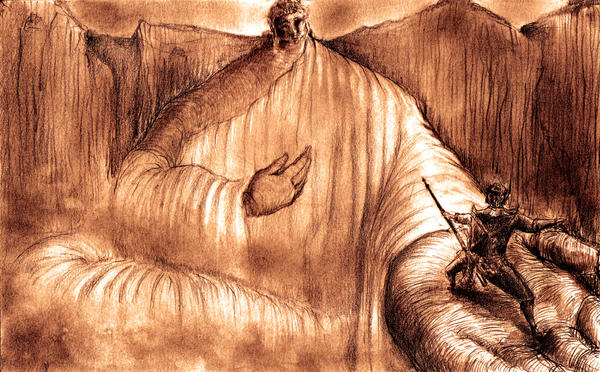
When he heard the dilemma of the gods, Buddha set out to help. He approached the Monkey King and offered him a bet. Buddha challenged Sun Wukong, saying that the Monkey King couldn't stand in the palm of his hand and leap off of it. The Monkey King laughed and took up the challenge.

 
He leapt into the palm of Buddha. He sprang into the air, somersaulting as he did so. It was a truly impressive leap – Sun Wukong traveled thousands of miles in one bound. When he finally landed the Monkey King found himself standing next to five massive pillars rising from the mists. It looked like the edge of the earth, with nothing visible beyond the pillars. That showed Buddha! The Monkey King had traveled so far he'd nearly jumped off of the world!
 

Sun Wukong signed his name upon one of the pillars, to prove he had been there.


Then he jumped back the way he had came, once again soaring for thousands of miles. When he landed, he was back in the Buddha's palm.  But when the Monkey King declared that he had won the bet, Buddha only laughed at him.

The mighty Buddha declared that Sun Wukong had never even left his hand. He told the monkey to look closer at his fingers. When the Monkey King did so, he discovered writing on one of them – the same marks the Monkey King had made upon the “pillar”!  It had been the Buddha's finger all along!

Having lost the bet, Sun Wukong was imprisoned beneath a mountain for five hundred years. The Buddha had solved the Jade Emperor's problem.
 
We'll talk about what happened to the Monkey King after his 500 year sentence was complete next week. See you then!

Monday, March 20, 2017

The Monkey King: An Immortal Nuisance

Hello all, and happy spring!

When I left off last week, the Monkey King, a hero of Chinese mythology, was making mischief. Sun Wukong had defeated many immortals in combat. In addition, he had traveled to the underworld and crossed out the name of every monkey from the register of the dead, giving hell no claim over him. Reports were reaching the Jade Emperor of the Monkey King's exploits, and something had to be done...
 
In point of fact, the Monkey King had already been causing an enormous headache for the Jade Emperor. When the emissaries from the underworld approached the chief deity to complain about Sun Wukong's latest exploits, it was the straw which broke the camel's back. The Jade Emperor sent out a summons for the Monkey King, asking him to come to heaven and appear before the Jade Emperor himself.

Sun Wukong leapt upon the opportunity to enter heaven. Once there, he was thrilled to be offered a position among the gods by the Jade Emperor himself! The Monkey King was gifted the title of “Keeper of the Heavenly Stables”, and asked to look after the heaven's horses. He took his responsibility very seriously (or, at least, as seriously as the Monkey King took anything).
 
 
However, the title was a sham. In truth, the Jade Emperor merely wished to keep the Monkey King in heaven where he was close at hand, and easier to keep an eye on. Though Sun Wukong imagined himself the equal of the gods with his new, fancy title, he was little more than a glorified stable boy.
 
Eventually, the Monkey King realized that his title counted for nothing. Enraged, he stormed into the Jade Emperor's court. Sun Wukong declared that he would no longer be the Keeper of the Heavenly Stables. Instead, he wanted a new title, one that made him the equal of the gods. The Monkey King declared himself the “Great Sage, Equal of Heaven”. When the Monkey King defeated several of heaven's greatest warriors in combat, the gods were forced to recognize his new title.

Still, the Jade Emperor tried to keep the Monkey King uninvolved with heavenly affairs. He tasked him with guarding the gardens in which grow the peaches of immortality.

In hindsight, this was not the wisest choice.

I don't know how many of you have fruit trees growing near you. I have a citrus tree in my backyard. When it blooms in the spring, as it's doing now, it smells absolutely divine. Almost as good as the flower blossoms are the ripe fruits sitting in the hot summer air. It's a tantalizing smell which makes me crave citrus. Most fresh fruits are the same: lemons, cherries...peaches.

You see where this is going?

The Monkey King was on duty guarding the gardens one day when the smell overwhelmed him. He couldn't resist; he just had to sink his teeth into a juicy peach. And why stop with just one? By the time Sun Wukong was beginning to feel sated, most of the ripe fruits had been devoured.


Unfortunately, this was about the time when a group of heavenly maidens appeared to harvest the fruits.

Great timing, right?

The women were infuriated that the stupid monkey had eaten the peaches of immortality. As they ranted at him, they unintentionally let slip that the peaches were needed for a fancy banquet taking place later that afternoon. All of the high-ranking gods had been invited...but the Monkey King had not received an invitation.

He wasn't too pleased about that. In fact, he was furious.

Sun Wukong incapacitated the heavenly maidens and immediately set out for the banquet. He arrived before the other guests and found all of the food laid out. The Monkey King set to work.

He ate the peaches of immortality. He swallowed the pills of longevity. He drank the Emperor's wine. The Monkey King worked his way up and down the banquet table, sampling anything and everything – whatever he felt like.

When the Jade Emperor saw the mess that Sun Wukong had made of the banquet, his patience was at an end. He commanded the armies of heaven to subdue the Monkey King. Though he was perfectly capable of defeating several opponents at once, Sun Wukong was hopelessly outnumbered.

But the Monkey King had some tricks up his sleeves (fur?). He plucked a hair from his tail, blew on it, and whispered a word. The hair immediately transformed into a copy of the monkey. He repeated this trick with a whole handful of hairs, and soon Sun Wukong himself was standing back, watching the armies of heaven fight his copies.


The battle went on for some time, but eventually a great Bodhisattva (the title for a prestigious follower of Buddha, one who has achieved enlightenment but has chosen to remain on earth rather than enter nirvana, in order to help guide others to enlightenment) was able to render him unconscious.

The Jade Emperor demanded that the Monkey King be killed, but that was impossible. Born from stone, his skin had already been tough. Between all of the peaches he had eaten and the pills of longevity he had consumed, Sun Wukong was pretty much invincible.

One of the gods suggested that Sun Wukong be locked in a cage and slowly burned. Fire would still be an effective tool against the monkey, and his ashes could be used to recreate the pills of longevity for the gods to consume. This plan was agreed to. However, Sun Wukong woke up partway through the process and escaped the cage. Thoroughly fed up with heaven, he made his escape.

By now the Jade Emperor was filled with wrath at the mere thought of the Monkey King. Something had to be done to stop him! However, his own forces had scarcely been enough to knock Sun Wukong unconscious the first time. In order to stop the monkey, he would need help from a force even more powerful...

To be continued! I'll see you guys next week.


Monday, March 13, 2017

The Monkey King: From Birth to "Death"

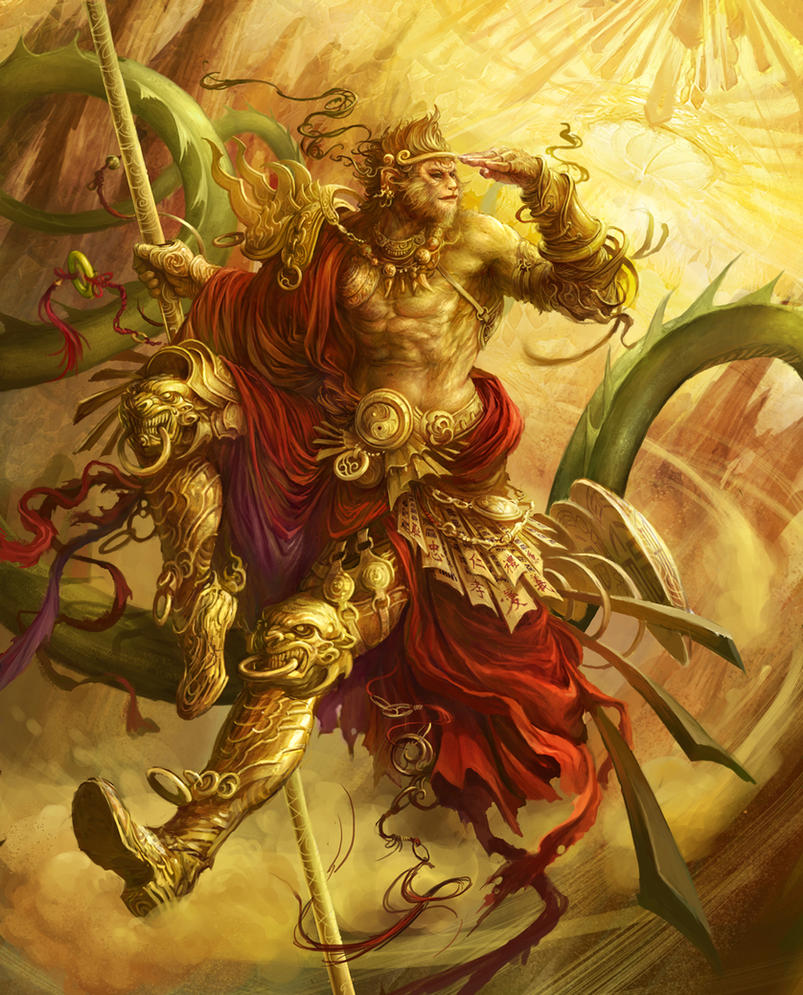
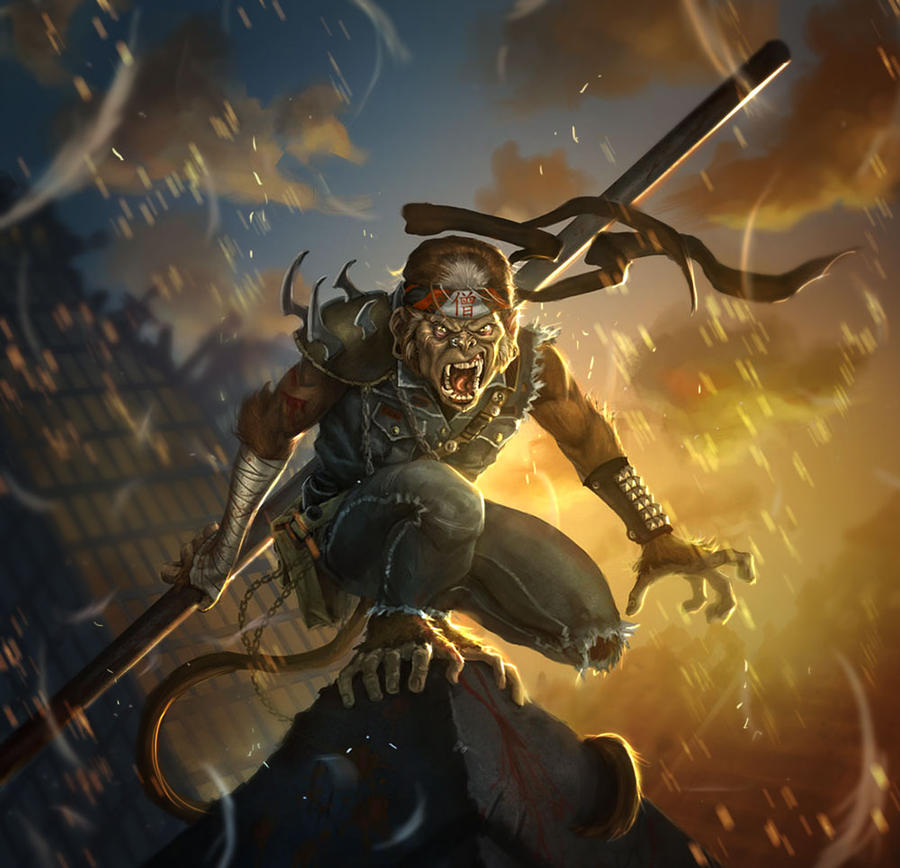
Hey guys! Today I'm going to begin a series of posts about the Monkey King. The Monkey King, also known as Sun Wukong, is one of the most beloved characters from Chinese mythology. His tale blends elements of classical mythology, Taoism, and Buddhism, along with a roaring good time and a fantastic sense of humor. The Monkey King is the Trickster of Chinese mythology, though he has more in common with the (usually) benevolent Hermes of the Greek mythos than he does with the nefarious Loki from the Norse myths. The full story of Sun Wukong can be found in the story Journey to the West, but I'll highlight some of his exploits for the next several weeks.

Shall we begin the story of the monkey?

Long ago, on the Mountain of Flowers and Fruit, there stood a great stone. The stone had rested on that mountain since the formation of the earth. One day, however, the stone changed: it grew a womb. Months later the stone cracked, revealing an egg inside. From this egg hatched a monkey – or, rather, a Monkey.


The Monkey wandered the mountain and eventually found a group of wild monkeys. They had many adventures, including one in which the Monkey found the tribe a home in a cave behind a waterfall. For this, he was named their king.

As time passed, the Monkey King grew skilled in the martial arts. He acquired a magical golden staff, which was able to grow or shrink to whatever size he desired. When not using it in combat, the Monkey King would shrink his staff to the size of a needle and tuck it behind his ear.


The Monkey King fought many demons and monsters, triumphing over them all. Eventually, however, a fight came which no mortal can triumph over. The forces of Hell came to claim the Monkey King, for the time had come for his death.

Of course, the Monkey King refused to go quietly. They had to drag him to Hell, and the Monkey King protested all the while. When they were within the underworld he grabbed the small needle which lay behind his ear, transforming it once more into his mighty staff. The Monkey King fought the forces of the underworld and triumphed, giving them a sound thrashing.


When his foes lay groaning at his feet, the Monkey King did the unexpected: he charged further into Hell. Your average person would want to escape the underworld, right? Well, not the Monkey King. He knew that his name was in the register of the dead. If he escaped, it would be only a matter of time before they came for him again. Besides, the Monkey King cared deeply about his tribe of monkeys. He didn't want death to claim them either.
 
So Sun Wukong charged into the courts of Hell and demanded to see the judges of the dead. They cowered before him as he ordered them to produce the register of the dead. Seeing his name within it, along with the names of all of the monkeys, the Monkey King flew into a rage. He seized a bottle of ink and a brush. All of the names were crossed out with broad strokes of the brush.

His work complete, the Monkey King stormed out of the underworld. He awoke back in his home with the other monkeys, who insisted that their king had been dreaming. But Sun Wukong knew the truth, and rested easily knowing that death no longer held sway over any of the monkeys.

But all was not well, for word had reached the Jade Emperor of the impertinent Monkey King. Complaints had already been trickling in for some time, for Sun Wukong had picked fights with many an immortal being. When the emissaries from the underworld came to the Jade Emperor to complain, he knew that something had to be done about the Monkey...

I'll end there for today, and I'll see you guys next week!


Monday, March 6, 2017

Pan Hu: The Princess and the Dog

Hey guys! Today's post is a relatively short story, in part because I've been wanting to tell it and in part because midterms are here. I'll have a special treat for you next week – the first of my posts about the Monkey King!

Today's story is about a dog named Panhu. The character plays an important role in the King Pan Festival. Some cultures in China trace their lineage back to Pan Hu's ancestry. Let's dive into the myth!

Once there was a mighty king in China. There came a time when his queen developed a most dreadful earache. The king sent for physicians and wizards, until at last one was able to solve his wife's ailment. The man extracted a small golden worm from the queen's ear, and the pain immediately went away.

Instead of killing it, the queen was intrigued by the worm. She put it on a plate and covered it in a small jar, leaving some food and drink out for the creature. Several days passed. When next the queen checked on the worm, she discovered that a small dog rested upon the plate – the worm had transformed!
 
The dog was named after the plate and the jar, resulting in the name of Pan Hu. He grew rapidly, until he was soon nearly the size of a man on his back legs. The king was quite fond of Pan Hu and kept him always by his side.

Because of this, Pan Hu learned of some of the king's problems. A neighboring kingdom was at war with him, and it didn't look as if the king could win. He had put out a bounty on the enemy king, promising to reward the hand of his daughter in marriage to whoever killed the other king and brought his head as proof. Unfortunately, due to the enemy king's military prowess, no one was willing to try.

Well...no human, any way.

Upon hearing of the bounty, Pan Hu disappeared for several days. The king was very worried, for no one knew where he had gone. Imagine his surprise when, several days later, Pan Hu reappeared – carrying the head of the king's worst enemy!

(Not all versions of the story tell of how Pan Hu defeated the enemy king. One which I have gives an explanation I quite enjoy, however – one similar to the Greek Trojan horse. Pan Hu went straight to the enemy king's castle. Upon seeing him, the king declared that his opponent's favorite dog had deserted him, and that it was obviously a good omen of his impending victory. A celebration was held. Pan Hu waited until the whole castle was drunk, then beheaded the king and went on his way.)

A great feast was held in celebration, with the best cuts of meat reserved for Pan Hu. Despite this honor, the dog refused to partake in the feast, and instead sulked in the corner. The king abruptly remembered his promise to marry his daughter to whoever defeated his opponent. He went before Pan Hu and tried to explain. Surely the dog did not expect to marry the princess? After all, she was a human, and he was a...well, a dog!

Much to the king's surprise, Pan Hu spoke to answer him! The dog explained that if it was only his animal form which was preventing the marriage, it could be easily fixed. If Pan Hu was placed beneath a golden bell and left there for seven days, without anyone looking at him, he would become a man.

The king agreed to this, and the dog was placed beneath a golden bell. Six days passed without incident, but partway through the seventh the princess herself grew worried about Pan Hu. No food or drink had been left with him, and she did not want the dog to waste away. She lifted the bell ever so slightly to slip a drink underneath –
– and the spell was broken.

 
The transformation had mostly finished, leaving Pan Hu with the body of a man. However, his head remained that of a dog. Despite this, the king honored his agreement and married his daughter to Pan Hu. The princess and Pan Hu went on to have many children, whose descendants are the Yao of China.
 
I hope you guys enjoyed the story! I love that a dog succeeded where no mortal man could.

See you next week!

Monday, February 27, 2017

Houyi, Chang'e, and the Elixir of Immortality

Hey guys! I hope everyone is doing well.

So far in my series of Chinese posts we've looked more at folklore than at mythology. Because of that, today's post is going to focus on a myth from an early period of Chinese history.

Heaven in Chinese mythology is a dwelling place for not only the gods, but for immortals and spirits as well. One of these immortals, Houyi, would be called upon to save the world from a most unusual calamity. Either the Jade Emperor or another god (depending on which version of the story you read) had ten sons. One day these sons decided to transform themselves into ten suns. Now, I live in Arizona. One sun already provides more than enough heat, thank you very much – and I don't even live in the hottest place on earth! Twice the heat would be unbearable, but ten times?

It didn't take long for the suns to begin to effect the earth. Plants withered and died. Lakes and rivers began to evaporate. The ground scorched, and people began to die.

The Jade Emperor knew that something had to be done, and so he called an immortal to aid him. This immortal was Houyi, and he was renowned for his skill in archery. The Emperor tasked Houyi with stopping the ten sons/suns, and saving the world.

Unfortunately, he was a little bit unspecific in how Houyi was to stop them.
 
The immortal archer descended to earth and began to do what he did best. He knocked an arrow to his bow, took aim, and fired. Whoosh! One sun fell from the sky, dead. Houyi drew another arrow. Another sun fell.

 
He repeated this process until only one sun was left in the sky. (According to some versions of the tale, someone saw that Houyi had no intentions of ceasing fire and so snuck up behind him to remove an arrow from his quiver, leaving him with only enough to take down nine of the suns.) After all, one sun is necessary for both warmth and for light.

Houyi returned to heaven, expecting to be thanked for having saved the world. Instead, he found himself facing punishment.

The father of the sons/suns had not expected the archer to kill his children. He was horrified, and grew wrathful in his rage. As punishment, Houyi was stripped of his immortality. The archer was not to bear this punishment alone – his wife, Chang'e, was also made mortal. Then the two were banished to earth.

Life on earth was hard for the couple. Houyi was particularly grieved by how difficult it was for his beautiful wife. Chang'e was used to the luxuries of heaven, not the hardships of earth. More than anything, he wanted to return her to her rightful place as an immortal.

Luckily, Houyi had heard of an elixir which could do just that – one made from the peaches of immortality (which we'll discuss more when I do my post on the Monkey King). This elixir was kept by an immortal named the Queen Mother of the West, who resided on earth on Mount Kunlun.

Houyi set out to find the Queen Mother and to beg the elixir from her. He successfully made his way to her palace and presented his case to the Queen Mother. She was sympathetic, and offered him the elixir of immortality. However, she also gave him a warning. There was just enough elixir that he and Chang'e could split it, granting both immortality – but they would be forced to live on earth, never returning to heaven. If one person drank the entire elixir, then they could have eternal life in heaven once again.
 
Houyi thanked her and returned home with the elixir. He was a good husband, and was not even tempted to drink the elixir all by himself. Sharing it with Chang'e would allow both to live forever, and that was enough for him.
 
Now, depending on which version of the story you read, Chang'e's next actions vary. In some cases Houyi did not tell her about the elixir before he was called away from the house. She found it in her curiosity, and drank the entire thing, not knowing that none would be left for her husband. In other versions of the story, Houyi told Chang'e everything. Not content with immortal life if she must live it on earth, Chang'e drank the entire elixir, wishing to be returned to the splendor of heaven...even if it means going without her husband.

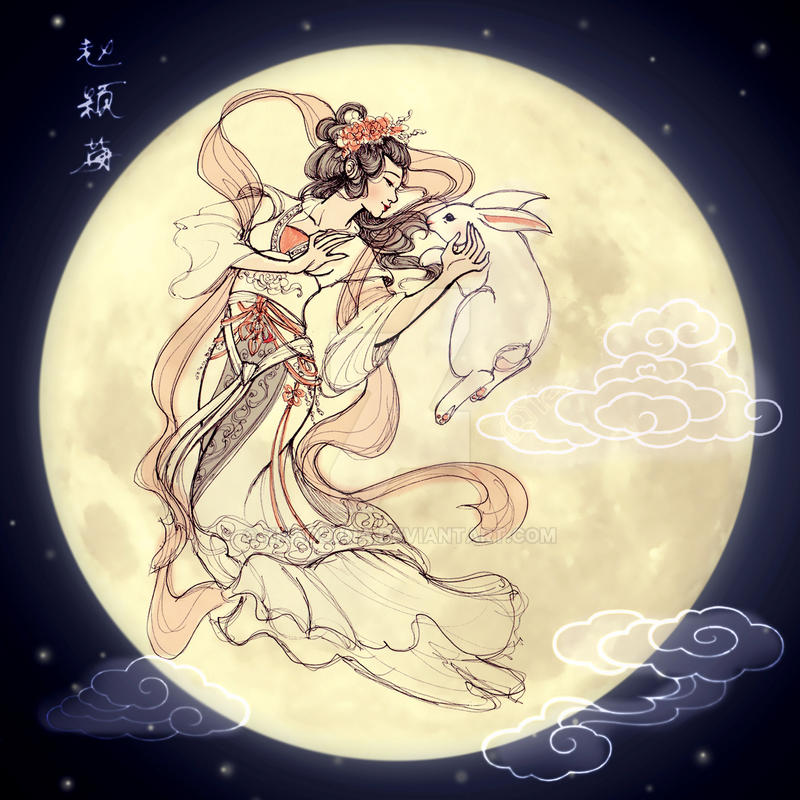
In either case, the results are the same. After drinking the elixir, Chang'e's body grew light and airy. She began to float through the air, literally rising into the heavens. Yet Chang'e and Houyi had been banished from heaven due to the wrath of a mighty god. She could not return there. With nowhere else to go, Chang'e floated to the surface of the moon, and that is where she has made her home ever since.  She isn't alone up there - there's also a rabbit who lives on the moon.


A couple of fun facts before I finish this post:

In some versions of the story, Chang'e was transformed into a toad as punishment for her actions.

The Mid-Autumn Festival in China sees offerings laid out to the moon. This story is very important to that festival.

Two probes and a rover sent to the moon by China have all been named after Chang'e.

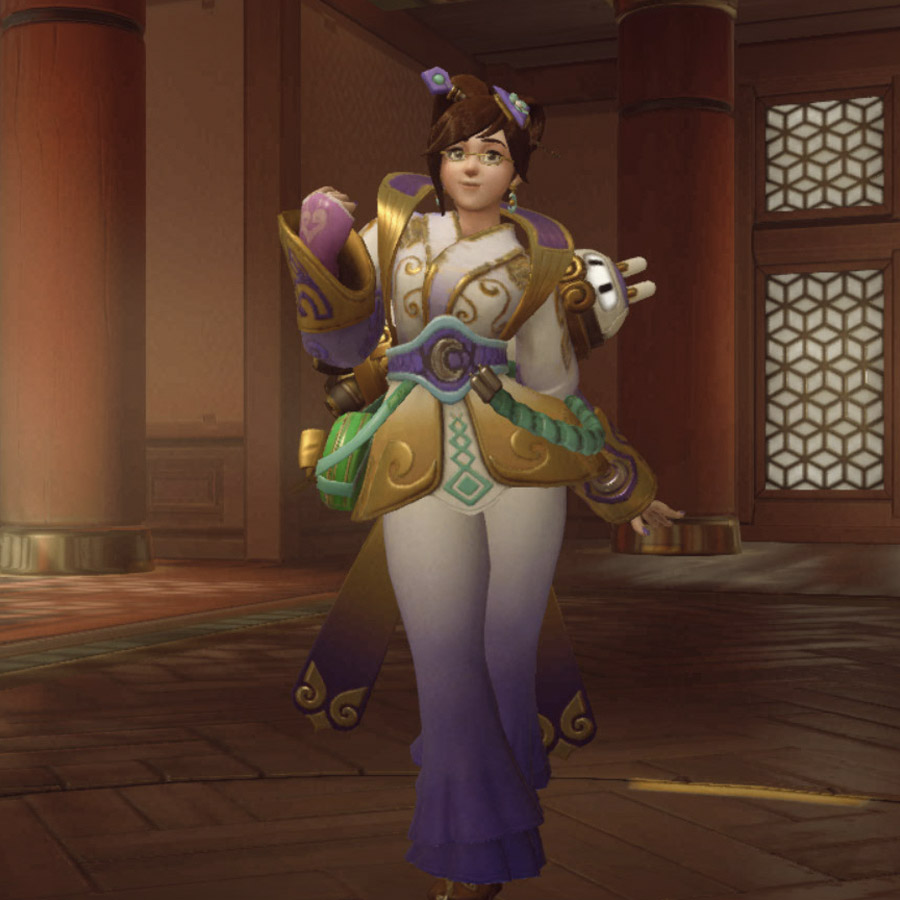
There is a white and purple variant on the Chinese New Year skin for Mei in Overwatch named after Chang'e.

 
I hope you guys enjoyed the story! I'll see you next week!

Sunday, February 19, 2017

Crane Maidens: The Cowherd and the Weaving Girl

Hey guys!  I hope you all had a lovely week, and a fantastic Valentine's Day.  Keeping in theme with that holiday, today's story is one of the great love stories of China.

Within Chinese mythology there frequently appear stories of the Crane Maidens. These young women are sometimes referred to as “fairies”, but were considered to be the daughters of the gods. Crane Maidens come to earth in the form of a crane (hence the name), but shed their feathery coats and become beautiful young women to bathe.


Their coats they leave on the side of the lake. Any man who can seize one of their feathered coats can trap the maiden in human form and claim her for his wife. A similar story can be found in African mythology (and in stories from many other cultures all over the world).

Frequently, the Crane Maiden stays with her mortal husband long enough to have a child. Sometime after the birth of a baby, the Maiden finds her feathered coat, which her husband has kept hidden from her. She puts it on and returns to heaven, leaving her husband and child behind.
 
However, the story I wish to focus on today is that of The Cowherd and the Weaving Girl – in which the husband follows the Crane Maiden when she returns to heaven.
 
Shall we begin?
 
Once there was a young cowherd named Niulang. When his parents died the young man's brothers took the best part of the inheritance, leaving Niulang with nothing but a small set of land and an old ox. Niulang was a diligent worker, and he made the best of a tough situation. He frequently spoke to his ox, considering it to be a friend.
 
One day after work Niulang confessed to the ox that he was lonely. He had no one to share his work or his life with, save for the loyal ox. Much to his surprise, the ox spoke, presenting him with an answer! It told him of a nearby pool, and told Niulang to go there and wait for the Heavenly Maidens to descend. Once they had begun to bathe, Niulang was to steal one woman's feathery clothes. She would be unable to fly away, and would remain on earth to be his wife.
 
Niulang followed his ox's advice, and settled in near the pool to wait. True to the ox's words, a flock of cranes descended from the skies. One by one they shed their clothes, transforming into beautiful young maidens. They left their clothes by the side of the pool as they entered to bathe. Niulang waited until they were all in the water, then snuck over and seized one of the sets of clothes.
 
The women burst into a frenzy, running from the water for their coats. They pulled them on and transformed into birds before his eyes, quickly taking to the sky. Soon only one maiden was left, standing naked and alone. It was her clothes which Niulang held.
 
He spoke kindly to the girl, Zhinu, and asked her to be his wife. She agreed, and the husband and wife returned to work Niulang's farm together.
 
 
Zhinu turned out to be a talented weaver, and the income her wares brought made their life a comfortable one. In time, she gave birth to a son and a daughter.
 
Yet their happiness was to be shortlived. One day the old ox spoke to Niulang again. It told him that it would soon die, but that it wished to do him one more good turn in its life. The ox asked that after it had died, Niulang would take its hide. The animal promised that it would help him one day. Niulang agreed, and once the faithful old beast had passed away he skinned it and kept its hide.
 
Soon after, the cowherd had cause to use the hide. The day came when his wife told him that it was time for her to return to heaven. She had been gone for too long, and the Jade Emperor, chief among the gods, would be looking for her. Sure enough, emissaries from heaven soon arrived to return her home. Zhinu put on her coat of feathers and followed them back to heaven, leaving her husband and children behind.
 
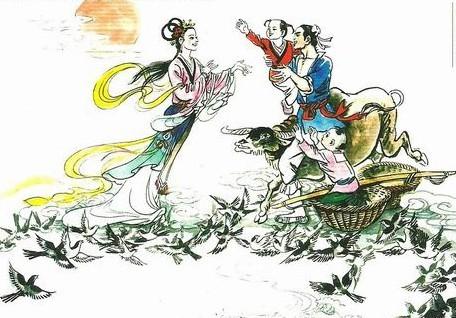
But Niulang was unwilling to be parted from his beloved wife. Remembering the ox's words, he threw the hide over his shoulders. The cowherd slung a pole over his shoulders, attaching a basket to either end of it. In each basket he put one of his children. Thus prepared, he set out to follow his wife.
Niulang followed her almost all the way to heaven, but he found his path blocked by a massive river of stars – the Milky Way. There was no way for Niulang to cross the river, but his wife waited for him on the other side of it.

 
Seeing their distress, the gods eventually took pity on the couple. One day out of every year, they allow the cowherd and the weaver girl to cross the river and see one another. On this day, thousands of magpies take to the air and form a bridge across the Milky Way so that the couple can cross.


This day is celebrated in China as the Qixi Festival.

 
If you look at the sky, you can still see Niulang and Zhinu waiting for one another. Two bright stars sit on either side of the Milky Way – Altair and Vega. Two smaller stars near Altair represent Niulang's children, still waiting for their mother in the baskets their father carries.
 
I hope you guys enjoyed the story! I'll be back next week with another tale from Chinese mythology.

Monday, February 6, 2017

The Dragon King's Daughter

Hey guys!  How's your February going so far?

I wanted to begin by taking a look at the role of the dragon in Chinese mythology. Western myth and folklore has traditionally painted dragons in a very different way. They are massive beasts, ones who hoard treasure. They frequently kidnap royalty, or wreak terror over nobility's countryside. Western dragons are often portrayed as fire-breathers.

Chinese dragons stand in sharp contrast to this. It's true that they are very large, but their great intelligence belies the term of beast. Dragons in Chinese mythology are frequently depicted with a giant pearl clutched in one taloned hand, or chasing after one. It's tempting to say that this is proof that they hoard treasure, but in reality the pearl represents wisdom. Chinese dragons are associated with nobility nearly as often as Western dragons are...but that's because the dragons of the Chinese myths are considered to be nobility. In their homes they take the form of humans – very wealthy, impeccably dressed humans. (Dragons traditionally make their homes in rich palaces beneath the water. Several folktales portray these palaces as having a timeless quality quite similar to the fae in Celtic mythology. A man who spends time in those halls may leave, only to find several decades have passed in what he thought was a mere month's stay!) And forget breathing fire – the Chinese considered dragons to be tied to water. These elegant creatures have some control over lakes, rain, flooding...even such mighty forces as the great typhoon.

(I couldn't help it, I'm sorry.)

There's an old story called The Dragon King's Daughter which paints a very good picture of Chinese dragons. It begins with a man named Liu Yi, who was a student headed to the capitol of Chang'an for examinations. Along the way he came across a very beautiful young woman on the side of the road. Despite her great loveliness, the girl was herding sheep, and she appeared to have been crying. Liu Yi immediately dismounted his horse and asked if there was anything he could do to help her.


She was touched by his kindness, and proceeded to tell Liu Yi her story. The woman was the daughter of a dragon king,one who ruled over Lake Dong Ting. Her father had married her off to the son of another dragon lord. Her husband was a worthless sort, one who constantly neglected the girl – but she could not complain to his parents, and had no way of contacting her father. If he but heard of her troubles, she knew that he would come and rescue her. Guessing that Liu Yi was headed for Chang'an, she asked if he would be willing to deliver a message to her father on his way past.

Liu Yi was anxious to help the girl, and promised to do everything in his power to get her message to her father. He made his farewells, saying that he hoped they would meet again.

The man headed for Lake Dong Ting as quickly as he good. There he was met by a servitor who rose out of the lake's waters. Liu Yi told the man that he wished to speak to the king. Immediately the servitor raised a hand and parted the waves. Liu Yi was directed to close his eyes. He did so, and the servitor led him.

When the mortal opened his eyes several minutes later, he was inside a palace. It was covered in precious stones and pearls, with plants decorating the halls. A regal figure entered and introduced himself as the dragon king, then asked what had made a human brave the journey to the dragon's dwelling.

The dragon king's daughter had given Liu Yi a letter to deliver to her father. He passed it to the man, explaining who had given it to him and why. The dragon immediately began to read his daughter's letter, and then began to cry. He was distraught that his daughter had suffered so greatly without his knowledge. The king was also immensely grateful that a human, a stranger, had been willing to help his child.

The king was not the only one crying. The other courtiers had begun to weep when they heard the news. As soon as the king was finished reading the letter was taken to the queen's chambers, and soon the sound of she and her ladies weeping could also be heard. At this the king started and hastily dried his tears. He dispatched an attendant to make the ladies stop crying – and quickly, before the prince of Qiang Tang heard!

Liu Yi curiously inquired as to who this prince was. The dragon king explained that the prince of Qiang Tang was his younger brother. He was possessed of a mighty temper, and had caused many floods in his home. The Jade Emperor had temporarily confined him to the dragon king's home in an effort to make him behave.


No sooner had the explanation been made than a great roaring echoed through the chamber. The doors slammed open, and a red dragon rushed into the hall, still bellowing so strongly that the palace shook. Thunder and lightning traveled in his wake. He was gone out the other door almost as quickly as he had appeared. Liu Yi was terrified, but the dragon king comforted him, explaining that the dragon was his brother, and that his wrath was not for Liu Yi.

It took some convincing for Liu Yi to be willing to stay after such a terrible sight, but eventually the dragon king persuaded him to join him for refreshments.

Not long thereafter a gentle breeze was heard throughout the hall. Soon a group of young women entered, chatting among themselves. One in particular was very beautiful, and she was the most richly dressed of the group. Liu Yi realized that it was the girl he had spoken to, the princess who had sent him on his quest. The dragon king stood and embraced his daughter, beaming at her return. She and the other women soon retired to another set of chambers.


Not long after a dignified, elegantly-garbed man entered the room. He was introduced to Liu Yi as the prince of Qiang Tang – the fearsome dragon who had roiled through the chamber earlier! He thanked Liu Yi for his help in his niece's return. When the dragon king inquired, the prince explained what had happened. He had headed straight for Jing River, where the other dragon lived, and the two had fought on its shores. Upon the defeat of his foe, the prince had gone to visit the Jade Emperor to explain his actions. The Jade Emperor forgave him for his violence when he heard of the circumstances, and would not hold his actions against him. Still, the prince begged for his brother's forgiveness, for he had been quite rude earlier...and, he suspected, had frightened their mortal guest.

 
(When pressed for details, the prince admitted that he had killed six hundred thousand people in his battle with the other dragon. Nearly three hundred miles of fields had been flooded. As for his foe...well, he had eaten him. The dragon king was appalled by this, but the prince seemed quite content.)

A feast was held the next day, and Liu Yi was heaped with gifts of pearls and precious rocks for his help in the matter. The prince of Qiang Tang seemed to have taken quite a liking to Liu Yi, and after several cups of wine he came up to him with a proposition. He wanted to link the two families together, and proposed that Liu Yi marry the princess. After all, it was obvious that the human was in love with her, and the princess owed him a debt for having been rescued thanks to him. Though his words were polite, the dragon prince attempted to intimidate Liy Yi into accepting the offer.

The human thought quickly, and was able to assuage the dragon prince with his clever words. Though it was true that he loved the girl, he was worried that the prince of Qiang Tang would not look on the idea so fondly when he was sober. In addition, he was but a mortal, and the girl was a dragon princess. Liu Yi was able to decline without offending the prince, and the two remained good friends.

On the next day, Liu Yi began to regret having turned down the marriage proposal. Saying goodbye to the dragon princess was difficult and left him with a heavy heart. When she bowed to him, she repeated his words from the first day he had met her - “I hope that we shall meet again.”

Years passed. The gifts of the dragon king had made Liu Yi wealthy, and he was able to settle into a nice home. He married, but not long after his wife died. Once again he married, but this girl too died shortly thereafter. Then a matchmaker came and told him of a woman he thought suitable. She had previously been married to a family near the Jing River, but her husband had passed away. Upon hearing her virtues praised by the matchmaker, Liu Yi agreed to wed her.

The couple were very much in love. They had a child together, and one night after the woman asked him if they remembered how they had first met. Liu Yi was filled with a sneaking suspicion, and said that he had never forgotten the dragon princess whom he had helped. His wife confessed that she was the princess, and that she had fallen in love with him.

The couple lived together in joy for many years. Eventually, the dragon's princess took Liu Yi back to her father's lake. The two entered it together, and have lived beneath its waters ever since.


I hope you guys enjoyed the story!  Oh, if you were wondering - the sheep the dragon princess was herding?  They were actually storm elementals, part of the wind and the rain.  I always found that part interesting!

I'll be back next week!  See you then.
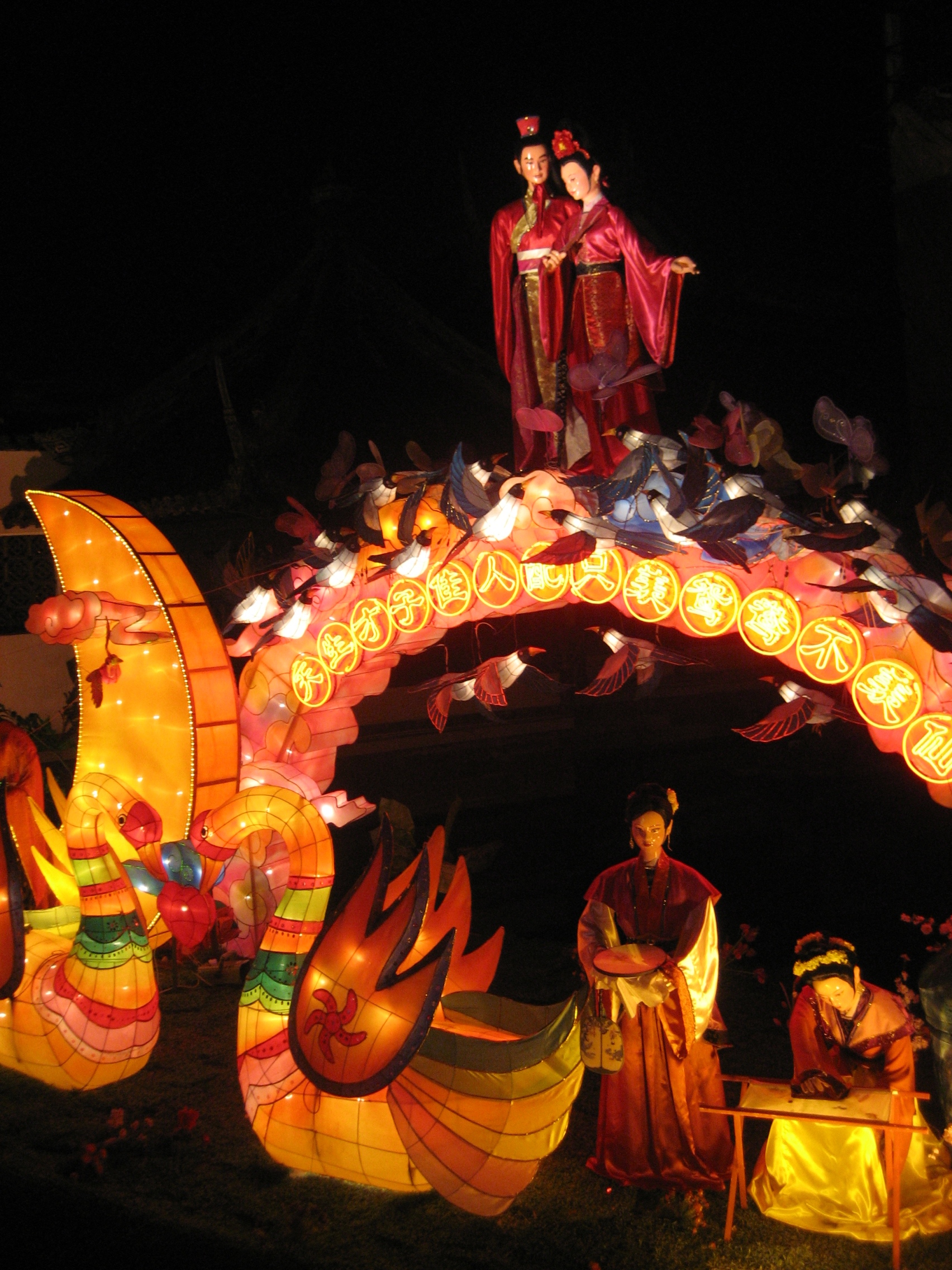
Monday, January 30, 2017

Intro to Chinese Mythology

I hope everyone had a happy Lunar NewYear!  I certainly did - I've been playing a ton of Overwatch's holiday event, and I got to test out For Honor.  In keeping with the holiday, today we're going to begin a series on Chinese mythology. Without further ado, let's start the Intro!

Chinese mythology has a very large number of deities. These deities have a hierarchy, with one god – the Jade Emperor – at the top, and everyone else falling into various ranks of importance beneath him. Within this hierarchy there are also smaller divisions of gods. For instance, the gods of the storm – lightning, thunder, etc. – form their own cabinet of sorts, with varying ranks of importance.

Because China is so large, and there are so many dialect variations, the gods have been called by numerous names throughout time. There are a lot of spelling variations, but I'll do my best to go with the most commonly used name.

Within Chinese mythology there exists an elixir that grants immortality, made with peaches grown by a goddess. This elixir has allowed several beings who were not originally gods to attain immortality. Perhaps the best known of these beings is the Monkey King. Originally a regular monkey, he was able to steal some of the elixir and gain eternal life – much to the dismay of much of the pantheon! He went on to have many adventures; some of them helped the gods, while others must have caused the deity version of a facepalm.
 
(My favorite representation of the Monkey King is from the movie The Forbidden Kingdom. I grew up watching a lot of Jet Li's older, more serious action movies – so to see him smiling and laughing was really strange for me! The movie is a gorgeous portrayal of Chinese mythology; plus, Jackie Chan and Jet Li!!! I'd recommend giving it a watch if you haven't.)
 
Outside of the gods, two other sorts of inhuman beings are commonly found in Chinese mythology.
 
Shapeshifters make frequent appearances. There are foxes who can turn themselves into human form, much like the kitsune of Japanese mythology. Heavenly maidens (beautiful celestial young girls) turn themselves into cranes as easily as slipping on a robe (literally). Some of these beings are benevolent and aid mankind, while others seek their own benefits.


Spirits of one sort or another are also common. They can take many forms, and serve many functions.  They're similar to shapeshifters in that they can also assume human form, in addition to whatever their natural form might be.  Rivers and other bodies of water are associated with dragons in Chinese mythology, who are the spirits of that water.
 
(Haku from Spirited Away is a gorgeous animated example of this.)
 
Much like the shapeshifters, the spirits can be good, self-serving...or evil. There are many folktales about shrines or abandoned houses possessed by dark spirits who terrorize and haunt the surrounding area. Sometimes these spirits are manifestations of animals such as scorpions. I'll cover one such tale in a couple of weeks.
 
There are three themes which are exceptionally prevalent throughout Chinese mythology. They are as follows:

Tales of valor in battle.

Tales of duty to family.

Tales of devotion to the gods.

All three of these traits were considered important in ancient China (and, to some extent, in modern China as well). As such, many myths and folktales reinforced them.

Much like Japanese mythology, the Chinese myths eventually see a significant change – one that occurred when Buddhism entered the country and gained popularity. The Chinese pantheon of gods remains, but is frequently superseded in the stories by Buddha and his devotees. Pious monks become popular characters in stories after the introduction of Buddhism. Characters who follow the noble principles are placed on high pedestals, particularly those who are willing to sacrifice of themselves to help others.

I'm very much looking forward to diving into Chinese mythology with you guys! I hope you've enjoyed this introduction. See you next week with our first story!

Monday, January 23, 2017

Chinese New Year

Greetings, all!

As promised, I've got a special holiday post for you today. It'll be a little shorter than intended, because I've injured my wrist and typing is rather painful at the moment. Still, I'll do my best to give this wonderful festival the post it deserves.

 
This coming Saturday, January 28th on the Roman calendar, kicks off the beginning of the Chinese New Year. I say the beginning because it's a lunar month's worth of festivities. Preparations for this festival began towards the end of December on what is called the Little New Year. The celebration will conclude this year on February 11th with the Lantern Festival.

(An important note before I begin – the Lunar New Year is celebrated in a number of countries, including Taiwan, Malaysia, and Tibet. However, since I'm beginning my series of posts on Chinese mythology next week, and since Chinese celebrations of the Lunar New Year are what I'm most familiar with, I'm going to be focusing on that this post.)

Let's start with the Little New Year.

One of the most important deities in China is the Kitchen God. This god is one of the oldest in Chinese mythology, and so has been worshiped under many names. Nearly every house has a shrine to him in their kitchen. He serves a purpose much like the Greek Hestia, for the Kitchen God watches over the family from his hearth, which is regarded as the center of the home. The stove is regarded as the Kitchen God's dwelling.

The Kitchen God has a very special responsibility. Throughout the lunar year he observes the family from his stove. Then, on the night of Little New Year, he travels to heaven to report on the family to the Jade Emperor – the greatest god in China. Offerings are made to the Kitchen God before he goes on his journey. In reality, these offerings are often bribes. Honey and wine are given to him to sweeten his tongue, in the hopes that his words will be kinder than the truth. If a family worries that this may not be enough, more drastic measures are taken. Sticky, gooey foods are offered to the Kitchen God before his departure, which serve to glue his mouth shut. When he is asked by the Jade Emperor how his family has acted throughout the year, all he can do is nod.


Firecrackers are lit off during Little New Year to speed the Kitchen God on his way to heaven. These fireworks are a common theme throughout the Chinese New Year. They are set off during all three stages of the festivity. Part of the reason for this is that fireworks make a lot of noise, and both light and loud noises are supposed to help ward off evil spirits.

There are a lot of traditions in the celebration of the Chinese New Year. I'd like to briefly talk about three:

The Gate Gods are often hung as paintings on the panels of front doors during the Chinese New Year. They are protectors of mankind and are viewed as guardians of the home. These dual gods have many stories revolving around them, but the most popular is as follows. The Gate Gods are said to be two famous Chinese soldiers from the Tang dynasty. During that time period there was an emperor who was plagued by demons during his sleep. Hearing of this, two brave soldiers volunteered to stand guard outside the emperor's bedchamber, so that no demons could possibly disturb him while he slept. The demons were so afraid of the soldiers that they never saw them, and the emperor was able to sleep peacefully for the first time in weeks. He ordered likenesses of the soldiers to be painted and hung outside his bedchamber, allowing the soldiers to return to their duties...and the emperor to continue to be protected.


The Chinese New Year is a time for paying off one's debts. There are three festivals in China which include debt-paying as part of their traditions. During the Chinese New Year, debt-paying allows one to literally start the New Year with a clean slate.

Lastly, birthdays! While some families choose to celebrate birthdays on the day a child was born, much of China celebrates during the Chinese New Year. Every New Year, everyone in China becomes a year older. All birthdays are celebrated on the same day.

Beginning with the Little New Year, the Chinese New Year ends with the Lantern Festival. The Lantern Festival has a number of festivities that are unique to it, though it continues the trend of fireworks, feasting, and the color red (which is considered lucky) that its two counterparts share.

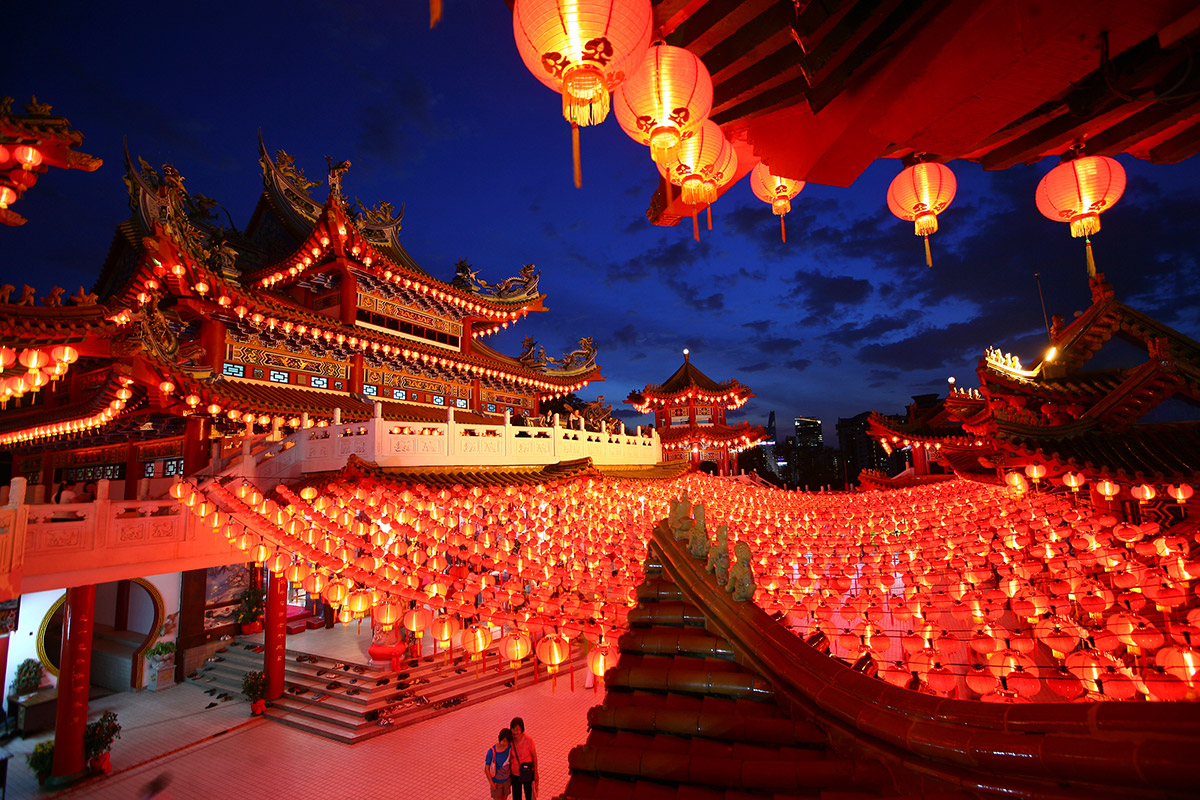
Part of the celebration of the Lantern Festival, as you might have guessed from its name, includes decorating with and lighting lanterns. You know the scene from Tangled, where the entire kingdom lets loose a lantern into the sky? It's absolutely gorgeous, but I've always found the Chinese Lantern Festival even more breathtaking.


Often confused by Westerners, the Lantern Festival is also when both the Dragon Parade and the Lion Dance take place. The Dragon Parade is lengthy – one of my source books makes mention of a Dragon Parade in San Francisco that stretched 160 feet long. The dragon is made of brightly colored cloth and held up by wooden rods. Men carry it throughout the streets, their movements making it appear to flow and glide.


In contrast, the Lion Dance is composed of only two people. One wears the front half of a lion suit, the other its rear.


Why these two animals? The lion is not native to China, but animals were sometimes sent to emperors as gifts from the Persians. Given its association with the emperor, the lion was regarded as an animal of protection. Dragons in China are associated with water, often streams and rivers. It is also tied to rain. The Chinese New Year marks the end of winter and the beginning of spring, and so the dragon represents the coming of spring showers.

Chinese New Year is this Saturday. Happy Year of the Rooster, everyone!
 
I'll be back next week to begin my Intro to Chinese Mythology!