Showing posts with label Underworld. Show all posts

Monday, March 13, 2017

The Monkey King: From Birth to "Death"

Hey guys! Today I'm going to begin a series of posts about the Monkey King. The Monkey King, also known as Sun Wukong, is one of the most beloved characters from Chinese mythology. His tale blends elements of classical mythology, Taoism, and Buddhism, along with a roaring good time and a fantastic sense of humor. The Monkey King is the Trickster of Chinese mythology, though he has more in common with the (usually) benevolent Hermes of the Greek mythos than he does with the nefarious Loki from the Norse myths. The full story of Sun Wukong can be found in the story Journey to the West, but I'll highlight some of his exploits for the next several weeks.

Shall we begin the story of the monkey?

Long ago, on the Mountain of Flowers and Fruit, there stood a great stone. The stone had rested on that mountain since the formation of the earth. One day, however, the stone changed: it grew a womb. Months later the stone cracked, revealing an egg inside. From this egg hatched a monkey – or, rather, a Monkey.


The Monkey wandered the mountain and eventually found a group of wild monkeys. They had many adventures, including one in which the Monkey found the tribe a home in a cave behind a waterfall. For this, he was named their king.

As time passed, the Monkey King grew skilled in the martial arts. He acquired a magical golden staff, which was able to grow or shrink to whatever size he desired. When not using it in combat, the Monkey King would shrink his staff to the size of a needle and tuck it behind his ear.


The Monkey King fought many demons and monsters, triumphing over them all. Eventually, however, a fight came which no mortal can triumph over. The forces of Hell came to claim the Monkey King, for the time had come for his death.

Of course, the Monkey King refused to go quietly. They had to drag him to Hell, and the Monkey King protested all the while. When they were within the underworld he grabbed the small needle which lay behind his ear, transforming it once more into his mighty staff. The Monkey King fought the forces of the underworld and triumphed, giving them a sound thrashing.
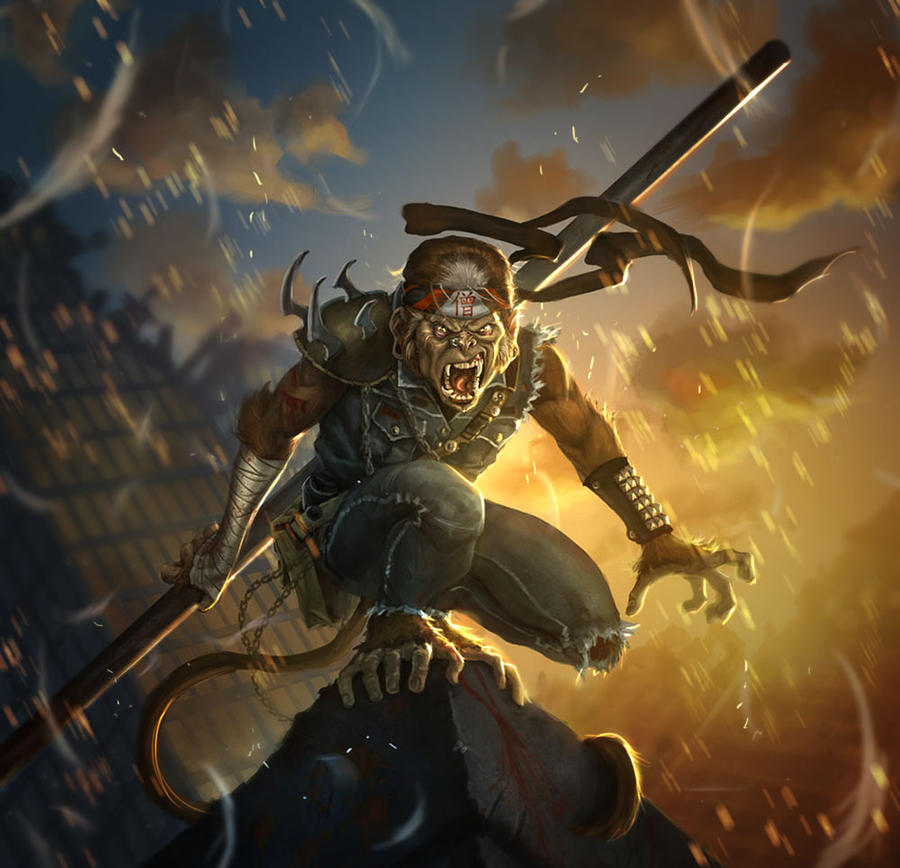

When his foes lay groaning at his feet, the Monkey King did the unexpected: he charged further into Hell. Your average person would want to escape the underworld, right? Well, not the Monkey King. He knew that his name was in the register of the dead. If he escaped, it would be only a matter of time before they came for him again. Besides, the Monkey King cared deeply about his tribe of monkeys. He didn't want death to claim them either.
 
So Sun Wukong charged into the courts of Hell and demanded to see the judges of the dead. They cowered before him as he ordered them to produce the register of the dead. Seeing his name within it, along with the names of all of the monkeys, the Monkey King flew into a rage. He seized a bottle of ink and a brush. All of the names were crossed out with broad strokes of the brush.

His work complete, the Monkey King stormed out of the underworld. He awoke back in his home with the other monkeys, who insisted that their king had been dreaming. But Sun Wukong knew the truth, and rested easily knowing that death no longer held sway over any of the monkeys.

But all was not well, for word had reached the Jade Emperor of the impertinent Monkey King. Complaints had already been trickling in for some time, for Sun Wukong had picked fights with many an immortal being. When the emissaries from the underworld came to the Jade Emperor to complain, he knew that something had to be done about the Monkey...

I'll end there for today, and I'll see you guys next week!


Monday, December 12, 2016

Maui and the Vagina of Death

Alright guys.  I try very hard to keep my posts kid friendly - which can be difficult, considering how sex and violence filled most mythologies are.  For this post...well, there really wasn't any way to make it PG.  You have been warned!

My final post about Maui is also the story of the demigod's death.  In the past several weeks, we've talked about a lot of the hero's exploits.  He raised the islands from beneath the sea; he stole fire for mankind; he tamed the sun.  All of these are pretty impressive accomplishments.

Unfortunately, Maui let his achievements go to his head.  He became very proud of all that he had done, and began to think himself invincible.


Now, at this point in time, things were a little different than they are now.  Mankind was mortal, but no one had died yet.  The goddess of the underworld, Hine-nui-te-pō, existed - but she hadn't yet taken anyone from the realm of the living.


When Maui heard of Hine-nui-te-pō's existence, he took it as a challenge.  For a hero so great as he, one who had accomplished so much already...well, defeating death ought to be easy, right?

Wrong.

Maui set out and found the place where Hine-nui-te-pō made her home.  He knew exactly what he had to do.  The ritual was...interesting, to say the least.

When a person enters this world, they exit their mothers womb.  Life therefore comes out of the vagina, right?  Well, in order to defeat death, Maui needed to reverse that ceremony.  He needed to climb into Hine-nui-te-pō's vagina, through her womb, and out of her mouth.  If he could do this, death would be defeated, and everyone would be immortal.

I'm not joking.  That was his plan.

Now, there were a couple of problems right off of the bat.  First off (in my mind, at least)...how was he even going to fit?  Second, was she just going to lay there and let him try this?  And lastly...did I mention that her vagina was lined with sharp, jagged obsidian teeth?

Yeah, this sounds like a great idea!

Maui arrived at Hine-nui-te-pō's lair and found the goddess fast asleep.  Well, that made life easier!  He wouldn't have to worry about sneaking up on her.  All he had to do was to make sure she didn't wake up.

In some versions of the story, Maui was accompanied by his brothers.  In others, there were birds sitting on a nearby tree.  Whichever it was, the demigod explained his plan to them.  He then warned the spectators that, whatever happened, they must not laugh.  If they laughed, Hine-nui-te-pō would awaken, and Maui would be killed.

The brothers/birds agreed.  Maui stripped and approached the goddess.

(For those of you who are curious and don't mind a NSFW image, you can find one here.)

At first everything seemed to be going well.  First Maui shoved his head inside Hine-nui-te-pō (who somehow remained asleep throughout this).  Next came his arms, then his shoulders.  At last he had made it halfway in!

Unfortunately, the spectacle proved to be too much for the brothers/birds.  They had been swallowing their laughter for as long as they could, but they could hold it in no longer.  One of them let out a loud chortle.

Immediately Hine-nui-te-pō awoke.  Her muscles clenched and her thighs slammed together.  The obsidian teeth of her vagina cut Maui in half.

And so it was that Maui's adventures ended.  He was the first being to die, and with his demise, death entered the world and from there on out would claim mortals.  To add insult to injury...the mighty hero was slain by a vagina.

I hope you guys enjoyed the story, and this look into Polynesian mythology!  Maui is a hilarious character.  What did you think of him?

See you next week!

Sunday, April 3, 2016

Pluto (The God, Not the Planet)

Pluto is an interesting character in Roman mythology.  He has been equated to Hades, the Greek god of the dead - and, while the two certainly have similarities and tales in common, there are also quite a few distinctions.  For starters, Hades is usually portrayed as solely the god of the dead in the Greek myths.  Pluto maintains this duty, but is also given rule over all things beneath the earth...which includes a lot of gemstones and precious minerals.  As such, Pluto is the god of wealth.


Pluto shares Hades' story of taking a bride.  You can read the full Greek version here, but the Roman myths change the names to Pluto, who takes Proserpina (Greek: Persephone) for his wife, whose mother Ceres (Greek: Demeter) then searches the world for her.

One of the things that intrigues me the most about Pluto are the number of names he bears in Roman mythology.  Pluto is also often referred to as Dis, or as Orcus.  I have read works that state that these are actually three distinctive gods, with each ruling over a certain thing - Pluto ruling over the underworld, Dis the god of wealth, and Orcus the bringer of death.  Others say that these three names each refer to the same being, simply representing a different aspect of the god.


I have also read theories that Pluto was not actually the name of the god of the underworld, but the name people applied to him so that they could speak it out loud.  You see, talking about the god of death by name was considered very unlucky.


(Not particularly relevant to the post, but I had to.)
 
This is part of why there are not as many depictions of Pluto - or of Hades, for that matter - in ancient art.  Death was something that people didn't want to talk about and didn't want to depict.  It's entirely possible that Pluto was a name they used to refer to death without actually using his name...in modern terms, much like saying "You-Know-Who" instead of "Voldemort".

Whatever the case, Pluto is definitely intriguing.

One of my favorite stories about Pluto is actually shared in both Greek and Roman mythology.  It involves the poet Orpheus, who was the finest musician of his age.

Orpheus had recently been married to a beautiful woman named Eurydice, with whom he was very much in love.  All was well for a short time, but one day while out in the woods she happened to step on a snake.  She was bitten, and the poison very quickly killed her.

The man was crushed by the death of his beloved.  He mourned her through his music, and soon an idea struck him.  Orpheus sought out the gates of the underworld and descended to the palace of Pluto.  He took up his lyre and began to play and sing, beseeching Pluto to release his beloved's spirit and return her to life.


I'll let Ovid take over:

"These words, accompanied on the plucked string, so moved the bloodless spirits that they wept...Then, for the first time ever, overcome by the effects of the song, the Furies wept, nor could Persephone reject his prayer, nor he who rules the underworld deny him; Eurydice was called up from her place among the newly dead..."

(I find it very interesting to note that Pluto is not mentioned by name.  Instead, he is "he who rules the underworld".)

The story ends in tragedy, of course.  It's actually quite similar to the Japanese tale of Izanagi and Izanami.  Orpheus was given strict instructions to not look back at his wife's spirit until they had ascended from the underworld.  Right before they exited he began to doubt and glanced back, and she was forced to remain dead due to his lack of faith.

 
Still, I think it's a beautiful story. I love that Pluto, god of the dead, a deity most people find fearful, was moved to tears by the power of love and willing to return a woman to life to be with her beloved.

I'll end my post with that, and see you guys next week!

Monday, February 16, 2015

Ishtar: All's Fair in Love and War

Ishtar is the Mesopotamian goddess of love and war. Her Sumerian name is Inana (sometimes spelled Inanna). As I mentioned in my Intro, I’m not actually sure who Ishtar’s father is; various stories and tablets list multiple gods as her father. Some of these tablets openly contradict one another, with a possible father from one tablet being Ishtar’s consort in another. Whoever he is, Ishtar’s father is definitely one of the more important gods in the Mesopotamian pantheon. Ishtar also has a sister: Ereshkigal, queen of the Underworld.

There’s an interesting story that revolves around Ishtar and Ereshkigal. For some reason, Ishtar decides that she wants to go to the Underworld. Rather than politely asking her sister if she can come and visit, Ishtar demands entrance, threatening to break down the gates of hell if she is not allowed in. (This is pretty much par for course with Ishtar. She isn’t exactly a sweet, kind goddess...)

Ereshkigal is understandably infuriated by Ishtar’s threats. She tells her servants to allow Ishtar to enter, but to do so in the most humiliating manner possible. At each of the seven gates of the Underworld, Ishtar is forced to remove a piece of clothing - leaving her stark naked by the time she passes through the last gate. (I imagine this looking rather like Cersei Lannister’s walk of shame in A Dance With Dragons. This is interesting, because Cersei and Ishtar have another thing in common - the Lannister crest and the symbol of Ishtar are both lions. Was this deliberate on George R. R. Martin’s part?)

Ishtar is quite peeved by the time she comes face to face with her sister. She insults Ereshkigal without thinking of the consequences. The Underworld goddess immediately orders Ishtar to be tortured and killed as punishment. (No love lost in that relationship!)

With the goddess of love dead, all mortal beings on earth stop having sex. Ea, king of the gods, is quite worried by this development. He sends an emissary to the Underworld to ask for Ishtar’s life to be returned to her. Ea makes sure to warn the emissary to follow the proper protocol and to be very respectful of Ereshkigal.

Ereshkigal is angered by the emissary’s request, but she can find no fault in his actions. This prevents her from denying his request. Ereshkigal grudgingly brings Ishtar back to life. The goddess ascends from the Underworld, with a piece of her clothing being returned to her at each of the seven gates.

The story does not end there; to be returned to the world of the living, Ishtar must find someone to take her place in the Underworld. To ensure that Ishtar complies with this rule, Ereshkigal sends an enforcer squad of demons along with her.

To Ishtar’s credit, she does not damn the first person she sees. Every person she runs into turns out to be a true friend, someone who honestly grieved for her while she was dead. In growing desperation, Ishtar returns home - where she finds her husband Tammuz (also called Dumuzi) seated on her throne with dry eyes. He had not mourned her passing. As revenge for his lack of compassion, Ishtar turns him over to the demons, who drag him back to the Underworld as her replacement.

Luckily, Tammuz had someone in his life who mourned for him. His sister Belili (Sumerian: Geshtinanna) was so struck with grief by his passing that she begged to be allowed to take his place. The gods eventually decided to split the year between the two siblings - each would spend six months in the Underworld per year, leaving the other to live freely during that time.

As you can probably tell from this story, Ishtar is not the most loving of goddesses - which seems strange for a goddess of love. She hates her sister, has a seemingly loveless marriage with Tammuz...perhaps it would be more accurate to call Ishtar a sex goddess than a love deity. Scholars believe that prostitution was a form of worship at Ishtar’s temple, which might back up this idea of sex rather than love. (Such a thing was not uncommon; the Greek goddess Aphrodite had a temple where one could worship by buying a prostitute.)

I’ll talk a little bit more about Ishtar and her many conquests in a few posts, when we get into the Epic of Gilgamesh. Until then, I’d love to know what you think of her! Feel free to comment below or email me. If you missed my special post on Valentine’s Day, you can check it out here - it talks about Lovesick, my second book, which is coming out this November!

I plan on doing three posts dealing with the Epic of Gilgamesh, beginning on Friday. The first will talk about Gilgamesh and Enkidu; the second, Gilgamesh’s response to Ishtar propositioning him; the third, Gilgamesh and his search for eternal life. I hope to see you then!

Monday, February 9, 2015

Ereshkigal and Nergal: Another Underworld Romance

Yes, those really are the names of two of the Mesopotamian gods. No, I’m not making this up.

I know I said in my Intro that I would mostly be calling the gods by their Akkadian names. The name Nergal is actually what the Sumerians called the god (his Akkadian name is Erra), but the tablet that contains the story of these two deities is called Nergal and Ereshkigal, so I’m sticking with the name Nergal to avoid confusion.

At this point you’re probably wondering who Ereshkigal and Nergal are. Ereshkigal is the Mesopotamian goddess of the Underworld; her sister, Ishtar, is the goddess of love. (This will be relevant later.) Nergal is a god who is sometimes associated with pestilence or the sun. Their story is probably my favorite in Mesopotamian mythology. It is almost exactly the reverse of the Greek tale of Hades and Persephone - for in it, Ereshkigal lures Nergal to the Underworld, seduces him, and intices him to stay with her as her consort.

Interested? I hope so! This post was written specially for this week, since it fits rather nicely with the upcoming holiday of Valentine’s Day. The story of these two gods is very much a traditional romance tale (though at times it can read a bit like an erotic romance novel!). Unfortunately, a lot of the tablet Nergal and Ereshkigal is damaged or missing, so we don’t know the whole story. Here is the parts of the tale that we do know:

The Mesopotamian gods are having a huge party when Anu, father of the gods, realizes that his daughter Ereshkigal is not present. Her duties prevent her from leaving the Underworld, just as his duties prevent him from traveling to see her. Not wanting his daughter to miss out on the fun, Anu sends a messenger to the Underworld.

The messenger gives Ereshkigal her father’s regards, and asks her to send her vizier to the party to choose a present for the goddess. Ereshkigal is pleased by this and immediately sends Namtar, her vizier, to the party. Once there, all of the gods are very respectful of Namtar - all, that is, save for Nergal. Nergal refuses to kneel before the vizier even though all of the other gods are doing so. He is admonished for his lack of respect by his father, Ea. As a punishment, Ea sends Nergal down to the Underworld. He is very clearly warned that he must not sit on a chair, eat, or bathe while there. Most important of all, Nergal must not, under any circumstances, have sex with Ereshkigal.

Care to guess which of those rules Nergal breaks?

To his credit, Nergal actually lasts a while before he forgets Ea’s warnings. He remembers not to sit, refuses to eat or drink, and won’t let the servants bathe him. Unfortunately, the god loses all self-control when Ereshkigal puts on a pretty dress and starts flirting with him. They immediately retire to her bedchamber...where they stay for the next six days.

Yeah.

On the seventh day, Nergal remembers that he wasn’t supposed to sleep with Ereshkigal. He flees back to heaven, where an irritated Ea ritually cleanses Nergal in the hopes of preventing Ereshkigal’s minions from recognizing him.

This is very wise of Ea. When Ereshkigal hears that Nergal has left her, she is furious. (Hell hath no fury like a woman scorned...especially when that woman rules over hell!) She sends Namtar to her father with a message. Ereshkigal points out that she has never been like other girls. Her sister, Ishtar, always had a man on her arm - but Nergal was Ereshkigal’s first lover. She then loses her calm and warns Anu that if Nergal is not returned to her, she will open the gates of hell and allow the dead to eat the living.

The Walking Dead...Mesopotamian style.

Anu is understandably nervous at Ereshkigal’s threat. He allows Namtar to search amongst the gods for Nergal. Unfortunately, Ea’s ritual cleansing worked; Namtar is unable to recognize Nergal, and must return to Ereshkigal empty-handed.

Equally unfortunate is the fact that the tablet is damaged here, leaving us unsure of what happens next. When the story can be read again, Nergal is furious with Ereshkigal - and, for some reason, he is storming the gates of hell. Nergal fights his way through the seven gates single-handedly, and pushes through to the courtyard of the queen. He stands before Ereshkigal and laughs mockingly, before seizing the goddess by the hair and dragging her from her throne.

Just when you’re sure something terrible is going to happen, Nergal pulls Ereshkigal to him and kisses her passionately! The duo then retire to her bedchamber, where they stay for another seven days.

I’m not making this up.

The last part of the tablet is mostly illegible, but it seems to show Anu making Nergal the king of the Underworld. Other Mesopotamian tablets back up this idea, since they show Nergal ruling over the dead alongside Ereshkigal.

Whatever the case, I hope you enjoyed reading about Ereshkigal and Nergal! Their story cracks me up; I love that romance novels existed even in the Mesopotamian times. I also adore the similarities to the Greek story of Hades and Persephone - though the Greeks definitely have the more family-friendly version!

As always, please post below or email me with any comments or thoughts you have. I’ll be back on Friday with another special Valentine’s Day post - this one dealing with Ereshkigal’s sister Ishtar, goddess of love and war! See you then!

Monday, January 5, 2015

Izanagi and Izanami: Escape from Yomi

According to the Shinto myths, Izanagi and Izanami were not the first gods. Other primordial beings existed before they did. However, Izanagi and Izanami are responsible for the creation of many of the other Kami, and it was they who created Japan. As such, I’d like to talk about the duo.

Originally the world was made of a kind of sludge-y water. Izanagi and Izanami stood upon the bridge of heaven - a rainbow - and stirred the sludge with a jeweled spear. When they pulled the spear from the water, some dripped down the spear and created the first island.

Izanagi and Izanami descended to this island and were wed. However, during the ceremony Izanami, the woman, spoke first. Due to this, their first child was born deformed. The other gods conferred and told Izanagi and Izanami to repeat their wedding ceremony, but to have the male speak first this time. Izanagi and Izanami complied, and all was well.

The duo gave birth to many children. These included the islands of Japan (sounds like a painful labor...) and numerous gods of the elements - waterfalls, trees, and the like.

Tragedy struck when Izanami became pregnant with Kagutsuchi, the god of fire. His flames burned her during childbirth, and Izanami died.

Izanagi immediately chopped Kagutsuchi into pieces (such a wonderful father, right?), but it was too late - his wife was gone. In his grief, Izanagi decided to go to Yomi, the Japanese land of the dead, to bring his wife back to life.

Yomi is a dark and gloomy place. Izanagi was able to find Izanami, but he could not see her face. Izanami agreed to return to the land of the living, but asked her husband to not look at her. She left him for a brief time, ostensibly to grab something, but an impatient and worried Izanagi followed her and lit his comb as a candle.

What he saw horrified Izanagi, for his wife was decayed and covered with maggots. (I’d probably be horrified too!) Izanami had eaten the food of the dead, and thus could not leave Yomi - for she had become a part of it.

Enraged that Izanagi had seen her, Izanami chased him through the underworld, sending demons to block his path. Izanagi escaped by throwing three peaches he found at the demons (who apparently don’t like fruit), chasing them away. Izanami almost caught Izanagi at the outskirts of Yomi, but he was able to roll a boulder over the entrance, forever sealing her inside.

Furious, Izanami swore that she would kill a thousand humans a day to punish Izanagi. The god responded that he would give life to fifteen hundred humans a day to thwart her. It was in this way that Izanagi and Izanami came to embody life and death.

I hope you enjoyed reading about Izanagi and Izanami! They’re an interesting duo, and their story bears remarkable similarities to the Greek myth of Orpheus, along with the fairy tale The Witch. I also find it interesting that the three mythologies we’ve looked at so far each have a female goddess of the Underworld - the Norse Hel; the Greek Persephone, who shares the rule of the Underworld with her husband Hades; and now Izanami. Izanami’s tale also proves wrong the old saying “Hell hath no fury like a woman scorned” - it obviously does!

As always, feel free to email me or comment below. I’ll be back on Friday with a post about Amaterasu and her interactions with her trickster brother, Susano. See you guys then!

Friday, December 5, 2014

Hades: Duty Amidst Debauchery

The Greek pantheon is almost always depicted in some form of debauchery. This makes sense: Hermes is the god of thieves, Ares the god of bloody combat, Dionysus the god of wine. On the female side is Aphrodite, goddess of sex. It’s to be expected that the pantheon would indulge in these things, given that their members embodied them.

Hades does not participate in the revelries of the other gods.

It always amused me that Disney chose Hades to be the villain of Hercules - I think that’s part of why I never liked the movie. In my opinion, Hades is the best of the gods. He is just, dutiful, and faithful - three things which can rarely be said of the rest of the pantheon.

Hades gets a bad rap for two reasons. First of all, he’s the god of death. This is hardly ever a popular thing to be the god of, despite the fact that everyone will eventually become his subject. However, the Greek afterlife was not a horrible place - at least not for everyone.

To start with, Hades was made ruler of the Underworld by chance. After the Greek pantheon overthrew the Titans, who had ruled before them, the three godly brothers drew lots to determine who would rule where. Zeus drew the sky, Poseidon the ocean, and Hades the Underworld. Instead of complaining, Hades took his lumps and went to rule over the dead, seldom leaving his realm.

The Greek Underworld was divided into three main sections. The dead were presided over by three judges, who ruled on which section of the Underworld the dead would be sent to. Those who had committed truly evil acts were sent to Tartarus, where they would be punished according to the crimes they had committed while alive. Those who had not done evil, but also had not done great good, wandered the Fields of Asphodel for all eternity. These Fields were a place of mundane existence where the dead just sort of wander around. The dead drank from a river that made them forget their past lives before being sent to the Asphodel Fields. The last major place in the Underworld was Elysium, where those who had done heroic acts in life went to party their afterlife away.

So you see that the Underworld Hades ruled was not a terrible place. What you did in life was what you got in death. It was a fair system; the judges gave you what you deserved.

The second reason for people’s dislike of Hades involves his betrothal to Persephone. In most of the more modern depictions of this event, the story is called “The Rape of Persephone.”

Now, of course such a name would lead to negative responses! The word rape carries hugely negative connotations, and rightly so. However, the event with Persephone was misnamed. Let me explain.

In my post about Zeus, I mentioned that he slept with the goddess Demeter. This union produced Persephone. Zeus later promised to give Persephone to Hades as his wife. However, Zeus did not see fit to mention this to either Demeter or Persephone - so the daughter of Zeus was unprepared when Hades came to claim his bride.

One of the most famous pictures of this event - again titled “The Rape of Persephone” - depicts Hades hauling Persephone off in his chariot against her will. Nowadays such a thing seems terrible and wrong. However, this was a common way to take a bride in ancient cultures.

One of the best examples of this is Rome (if you don’t mind my stepping away from Greece for a moment). When Rome was first built, there were very few women in the city. Rome attempted to make marriage arrangements with its neighbors, notably the Sabines. When this failed, Roman men kidnapped the Sabine women and made them their wives. (If you’ve seen Seven Brides for Seven Brothers, this event was the basis of the song “Sobbin’ Women”.) The kidnapping of the Sabine women is called the “Rape of the Sabine Women” - because the Romans used the same word for “rape” as they did for “abduction”. Early translators simply used the wrong form of the word.

I hope you can see that Hades’ abduction of Persephone was not such a terrible thing in olden times. Her father had betrothed her to Hades, and taking a woman back to your home was a common marriage practice, even if it was against her will. Women didn’t have much say in anything back then. The fault in the matter actually lies with Zeus for not having informed Persephone and her mother of her betrothal to Hades.

Once the issues of Persephone’s abduction and being god of the dead have been set aside, Hades doesn’t seem like such a bad guy. He remains faithful to Persephone despite her loathing of him, and makes peace with Demeter for taking her daughter (even though it was Zeus’ fault). He does his job fairly, and is not unkind - even allowing the mortal Orpheus a chance to bring his wife back from the dead. Hades does not get drunk, does not sleep around, and does not participate in wild parties like the rest of the gods do. In short, he’s a decent guy.

Perhaps the reason the Greeks didn’t talk more about Hades was because they thought he was boring compared to the rest of the pantheon!

I hope I’ve given a decent defense of Hades’ character - maybe even made you like him. If you agree, disagree, or want to chime in about anything else, hit me up below or through email!

I’ll see you guys next post - make sure and keep an eye on your valuables as we talk about the god of thieves!

Monday, November 3, 2014

Hel^2: A Person and a Place

In my last post I talked about Loki, and I mentioned that he had a daughter named Hel. As you probably figured out, Hel is not the most wonderful person - but to understand her, you first need a bit of backstory.

Loki actually had a total of six children. Two were born by his Asgardian wife, Sigyn, but they both end up dead. The important four children are Sleipnir, Jormungand, Fenrir, and Hel. Sleipnir is an eight-legged horse borne by Loki after he turned himself into an attractive mare to distract a horse (don’t ask.) The fastest of all horses, Sleipnir became the mount of Odin, king of the gods. My favorite part from the first Thor movie is when Odin comes to save Thor and his friends from the frost giants. If you look closely, the horse he’s on has eight legs! I love it when Marvel gets it right!

Loki’s other three children come from worse parentage (than a horse. Seriously.) They were borne by the ogress Angrboda, whose name translates to “bringer of distress”. Given that all three of her children play a huge role in Ragnarok, I would say she was aptly named!

The gods apparently agree with me on that point. Having received a prophecy saying that the three kids spell disaster, the gods lock them all away. Jormungand, a GIANT serpent, is forced to bite his own tail and is thrown into the ocean or river that surrounds the world. Fenrir, a less big but still giant wolf, is chained to a rock - which leaves Loki's final child, Hel.

Loki’s other two children by Angrboda each had a monstrous quality to them, and Hel is no different. Possessing the body of a woman, half of her is said to be beautiful, the other half dead. Depictions of her in artwork often show half her face as missing skin, or being full out skeletal. Odin’s punishment of her differs from that of her brothers in that she is banished to a portion of one of the realms we haven't discussed, Niflheim...and made its Queen. The area later becomes known as the Kingdom of Hel, or simply Hel.

There were two regions to the Norse afterlife. To counter the depressing-ness of Hel, which I’ll cover in a moment, was Valhalla. Valhalla was located in Asgard, and it translates to the “hall of the slain”. Warriors who were slain in battle were carried there by beautiful warrior women called Valkyries. These women would then don dresses and serve the men food and drink until Ragnarok. Rough life...er, death, right?

Hel was for those who did not die valiantly. Accounts list it as being the afterlife for those who die of sickness or of old age, and for those who are evil or oath-breakers. The Kingdom of Hel is said to be guarded by a fearsome hound named Garm, which presents an interesting parallel to the Greek Cerberus. A river within Hel is said to be full of not water, but swords, knives and daggers that the dead must wade through. Murderers, oath-breakers, adulterers, and people who talk in movie theaters are imprisoned in a building whose walls and roof are made of woven snakes who constantly drip poisonous venom....

You get the idea, right? Hel is not a fun place.

Interestingly enough, Hel the person is not depicted as outright evil. Last post I talked about how she offered to bring Balder back to life if everything wept for him, rather than refusing to offer even that slim chance. However, regardless of whether Hel is an evil person, she and her kingdom will play an important part in Ragnarok.

There you have a brief introduction to Hel!...and to Hel. Comments? Questions? Feel free to post below, or to email me! Want to know more? I’ve got some great books listed on my first post. Stay tuned for more stories from Norse mythology, including a look at Thor!