Hey guys! Today's post is a relatively short story, in part because
I've been wanting to tell it and in part because midterms are here.
I'll have a special treat for you next week – the first of my posts
about the Monkey King!
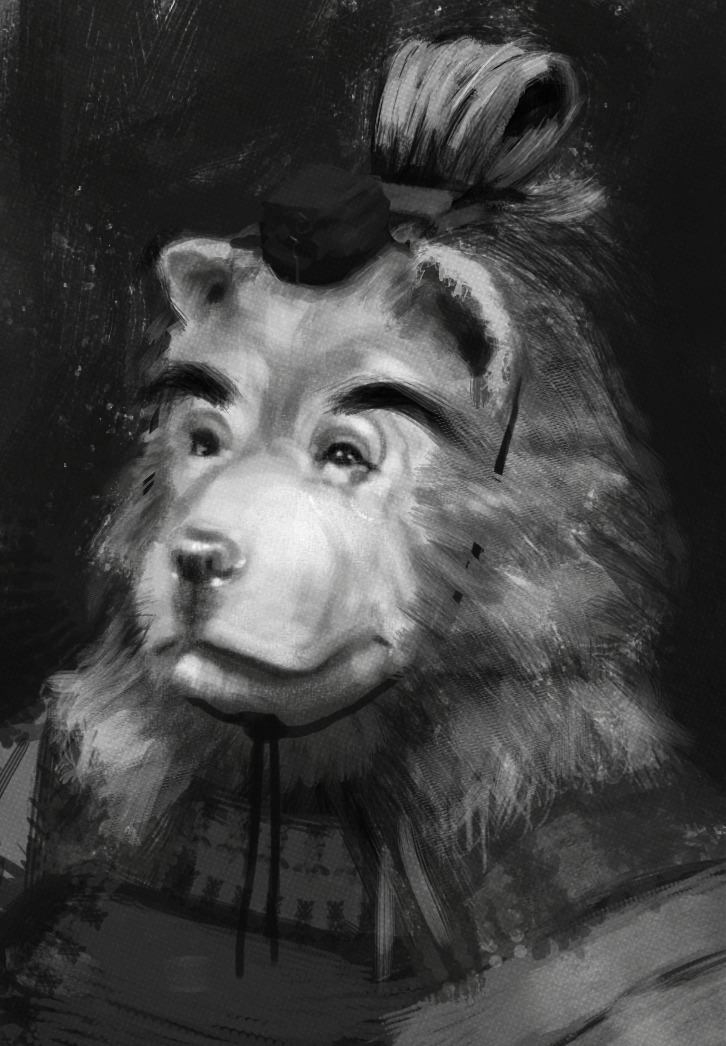
Today's story is about a dog named Panhu. The character plays an
important role in the King Pan Festival. Some cultures in China
trace their lineage back to Pan Hu's ancestry. Let's dive into the
myth!
Once there was a mighty king in China. There came a time when his
queen developed a most dreadful earache. The king sent for
physicians and wizards, until at last one was able to solve his
wife's ailment. The man extracted a small golden worm from the
queen's ear, and the pain immediately went away.
Instead of killing it, the queen was intrigued by the worm. She put
it on a plate and covered it in a small jar, leaving some food and
drink out for the creature. Several days passed. When next the
queen checked on the worm, she discovered that a small dog rested
upon the plate – the worm had transformed!
The dog was named after the plate and the jar, resulting in the name
of Pan Hu. He grew rapidly, until he was soon nearly the size of a
man on his back legs. The king was quite fond of Pan Hu and kept him
always by his side.
Because of this, Pan Hu learned of some of the king's problems. A
neighboring kingdom was at war with him, and it didn't look as if the
king could win. He had put out a bounty on the enemy king, promising
to reward the hand of his daughter in marriage to whoever killed the
other king and brought his head as proof. Unfortunately, due to the
enemy king's military prowess, no one was willing to try.
Well...no human, any way.
Upon hearing of the bounty, Pan Hu disappeared for several days. The
king was very worried, for no one knew where he had gone. Imagine
his surprise when, several days later, Pan Hu reappeared – carrying
the head of the king's worst enemy!
(Not all versions of the story tell of how Pan Hu defeated the enemy
king. One which I have gives an explanation I quite enjoy, however –
one similar to the Greek Trojan horse. Pan Hu went straight to the
enemy king's castle. Upon seeing him, the king declared that his
opponent's favorite dog had deserted him, and that it was obviously a
good omen of his impending victory. A celebration was held. Pan Hu
waited until the whole castle was drunk, then beheaded the king and
went on his way.)
A great feast was held in celebration, with the best cuts of meat
reserved for Pan Hu. Despite this honor, the dog refused to partake
in the feast, and instead sulked in the corner. The king abruptly
remembered his promise to marry his daughter to whoever defeated his
opponent. He went before Pan Hu and tried to explain. Surely the
dog did not expect to marry the princess? After all, she was a
human, and he was a...well, a dog!
Much to the king's surprise, Pan Hu spoke to answer him! The dog
explained that if it was only his animal form which was preventing
the marriage, it could be easily fixed. If Pan Hu was placed beneath
a golden bell and left there for seven days, without anyone looking
at him, he would become a man.
The king agreed to this, and the dog was placed beneath a golden
bell. Six days passed without incident, but partway through the
seventh the princess herself grew worried about Pan Hu. No food or
drink had been left with him, and she did not want the dog to waste
away. She lifted the bell ever so slightly to slip a drink
underneath –
– and the spell was broken.
The transformation had mostly finished, leaving Pan Hu with the body
of a man. However, his head remained that of a dog. Despite this,
the king honored his agreement and married his daughter to Pan Hu.
The princess and Pan Hu went on to have many children, whose
descendants are the Yao of China.
I hope you guys enjoyed the story! I love that a dog succeeded where
no mortal man could.
So far in my
series of Chinese posts we've looked more at folklore than at
mythology. Because of that, today's post is going to focus on a myth
from an early period of Chinese history.
Heaven in
Chinese mythology is a dwelling place for not only the gods, but for
immortals and spirits as well. One of these immortals, Houyi, would
be called upon to save the world from a most unusual calamity.
Either the Jade Emperor or another god (depending on which version of
the story you read) had ten sons. One day these sons decided to
transform themselves into ten suns.
Now, I live in Arizona. One sun already provides more than enough
heat, thank you very much – and I don't even live in the hottest
place on earth! Twice the heat would be unbearable, but ten
times?
It
didn't take long for the suns to begin to effect the earth. Plants
withered and died. Lakes and rivers began to evaporate. The ground
scorched, and people began to die.
The
Jade Emperor knew that something had to be done, and so he called an
immortal to aid him. This immortal was Houyi, and he was renowned
for his skill in archery. The Emperor tasked Houyi with stopping the
ten sons/suns, and saving the world.
Unfortunately,
he was a little bit unspecific in how
Houyi was to stop them.
The
immortal archer descended to earth and began to do what he did best.
He knocked an arrow to his bow, took aim, and fired. Whoosh!
One sun fell from the sky, dead. Houyi drew another arrow. Another
sun fell.
He repeated this process until only one sun was left in
the sky. (According to some versions of the tale, someone saw that
Houyi had no intentions of ceasing fire and so snuck up behind him to
remove an arrow from his quiver, leaving him with only enough to take
down nine of the suns.) After all, one sun is necessary for both
warmth and for light.
Houyi
returned to heaven, expecting to be thanked for having saved the
world. Instead, he found himself facing punishment.
The
father of the sons/suns had not expected the archer to kill
his children. He was horrified, and grew wrathful in his rage. As
punishment, Houyi was stripped of his immortality. The archer was
not to bear this punishment alone – his wife, Chang'e, was also
made mortal. Then the two were banished to earth.
Life
on earth was hard for the couple. Houyi was particularly grieved by
how difficult it was for his beautiful wife. Chang'e was used to the
luxuries of heaven, not the hardships of earth. More than anything,
he wanted to return her to her rightful place as an immortal.
Luckily,
Houyi had heard of an elixir which could do just that – one made
from the peaches of immortality (which we'll discuss more when I do
my post on the Monkey King). This elixir was kept by an immortal
named the Queen Mother of the West, who resided on earth on Mount
Kunlun.
Houyi
set out to find the Queen Mother and to beg the elixir from her. He
successfully made his way to her palace and presented his case to the
Queen Mother. She was sympathetic, and offered him the elixir of
immortality. However, she also gave him a warning. There was just
enough elixir that he and Chang'e could split it, granting both
immortality – but they would be forced to live on earth, never
returning to heaven. If one person drank the entire elixir, then
they could have eternal life in heaven once again.
Houyi
thanked her and returned home with the elixir. He was a good
husband, and was not even tempted to drink the elixir all by himself.
Sharing it with Chang'e would allow both to live forever, and that
was enough for him.
Now,
depending on which version of the story you read, Chang'e's next
actions vary. In some cases Houyi did not tell her about the elixir
before he was called away from the house. She found it in her
curiosity, and drank the entire thing, not knowing that none would be
left for her husband. In other versions of the story, Houyi told
Chang'e everything. Not content with immortal life if she must live
it on earth, Chang'e drank the entire elixir, wishing to be returned
to the splendor of heaven...even if it means going without her husband.
In
either case, the results are the same. After drinking the elixir,
Chang'e's body grew light and airy. She began to float through the
air, literally rising into the heavens. Yet Chang'e and Houyi had
been banished from heaven due to the wrath of a mighty god. She
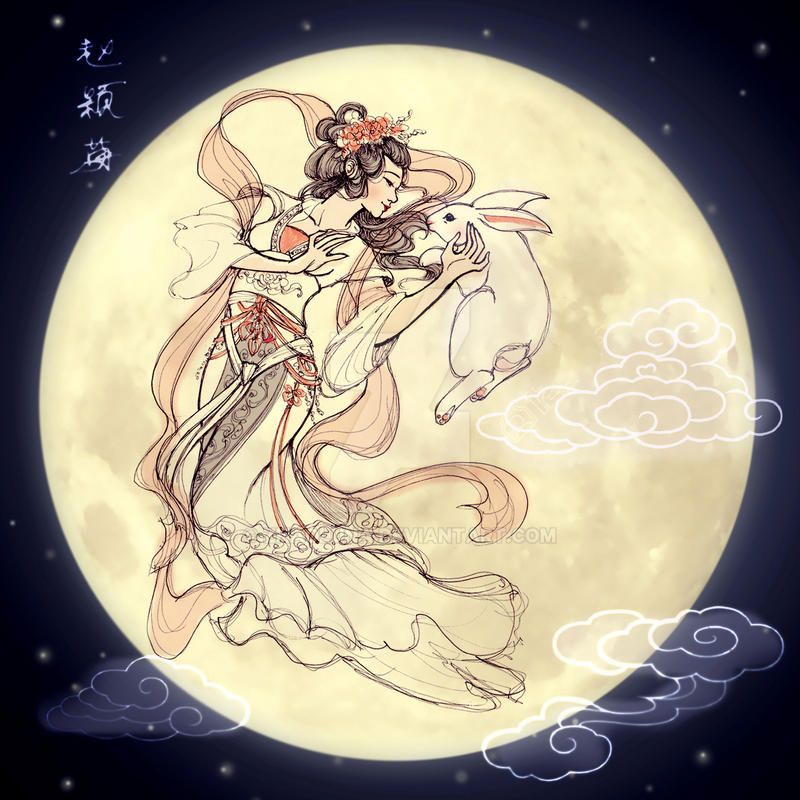
could not return there. With nowhere else to go, Chang'e floated to
the surface of the moon, and that is where she has made her home ever
since. She isn't alone up there - there's also a rabbit who lives on the moon.
A
couple of fun facts before I finish this post:
In
some versions of the story, Chang'e was transformed into a toad as
punishment for her actions.
The
Mid-Autumn Festival in China sees offerings laid out to the moon.
This story is very important to that festival.
Two
probes and a rover sent to the moon by China have all been named
after Chang'e.
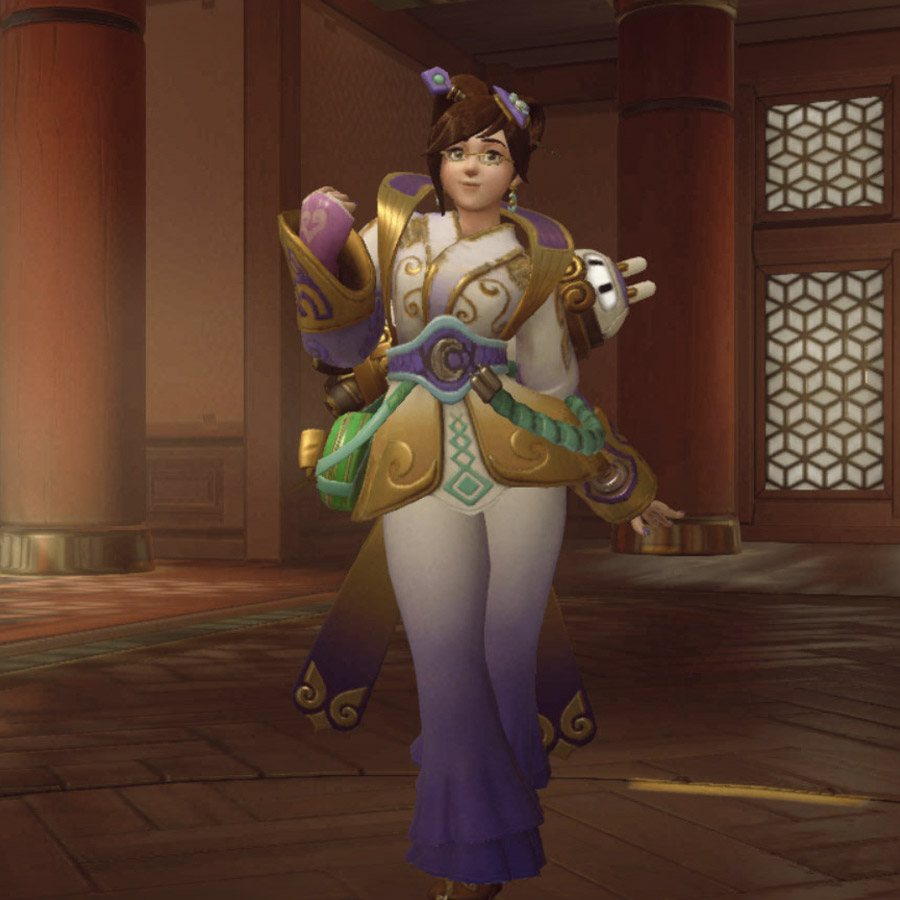
There
is a white and purple variant on the Chinese New Year skin for Mei in
Overwatch named after Chang'e.
I
hope you guys enjoyed the story! I'll see you next week!
Hey guys! I hope you all had a lovely week, and a fantastic Valentine's Day. Keeping in theme with that holiday, today's story is one of the great love stories of China.
Within Chinese
mythology there frequently appear stories of the Crane Maidens.
These young women are sometimes referred to as “fairies”, but
were considered to be the daughters of the gods. Crane Maidens come
to earth in the form of a crane (hence the name), but shed their
feathery coats and become beautiful young women to bathe.
Their
coats they leave on the side of the lake. Any man who can seize one
of their feathered coats can trap the maiden in human form and claim
her for his wife. A similar story can be found in African mythology
(and in stories from many other cultures all over the world).
Frequently, the
Crane Maiden stays with her mortal husband long enough to have a
child. Sometime after the birth of a baby, the Maiden finds her
feathered coat, which her husband has kept hidden from her. She puts
it on and returns to heaven, leaving her husband and child behind.
However, the
story I wish to focus on today is that of The Cowherd and the Weaving
Girl – in which the husband follows the Crane Maiden when she
returns to heaven.
Shall we begin?
Once there was a
young cowherd named Niulang. When his parents died the young man's
brothers took the best part of the inheritance, leaving Niulang with
nothing but a small set of land and an old ox. Niulang was a
diligent worker, and he made the best of a tough situation. He
frequently spoke to his ox, considering it to be a friend.
One day after
work Niulang confessed to the ox that he was lonely. He had no one
to share his work or his life with, save for the loyal ox. Much to
his surprise, the ox spoke, presenting him with an answer! It told
him of a nearby pool, and told Niulang to go there and wait for the
Heavenly Maidens to descend. Once they had begun to bathe, Niulang
was to steal one woman's feathery clothes. She would be unable to
fly away, and would remain on earth to be his wife.
Niulang followed
his ox's advice, and settled in near the pool to wait. True to the
ox's words, a flock of cranes descended from the skies. One by one
they shed their clothes, transforming into beautiful young maidens.
They left their clothes by the side of the pool as they entered to
bathe. Niulang waited until they were all in the water, then snuck
over and seized one of the sets of clothes.
The women burst
into a frenzy, running from the water for their coats. They pulled
them on and transformed into birds before his eyes, quickly taking to
the sky. Soon only one maiden was left, standing naked and alone.
It was her clothes which Niulang held.
He spoke kindly
to the girl, Zhinu, and asked her to be his wife. She agreed, and
the husband and wife returned to work Niulang's farm together.
Zhinu
turned out to be a talented weaver, and the income her wares brought
made their life a comfortable one. In time, she gave birth to a son
and a daughter.
Yet their
happiness was to be shortlived. One day the old ox spoke to Niulang
again. It told him that it would soon die, but that it wished to do
him one more good turn in its life. The ox asked that after it had
died, Niulang would take its hide. The animal promised that it would
help him one day. Niulang agreed, and once the faithful old beast
had passed away he skinned it and kept its hide.
Soon after, the
cowherd had cause to use the hide. The day came when his wife told
him that it was time for her to return to heaven. She had been gone
for too long, and the Jade Emperor, chief among the gods, would be
looking for her. Sure enough, emissaries from heaven soon arrived to
return her home. Zhinu put on her coat of feathers and followed them
back to heaven, leaving her husband and children behind.
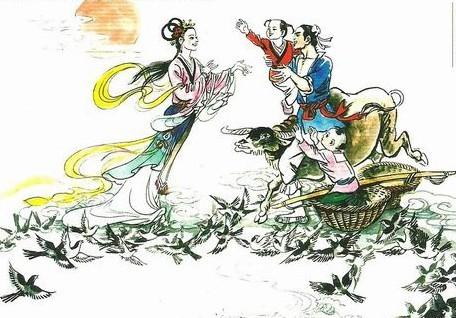
But Niulang was
unwilling to be parted from his beloved wife. Remembering the ox's
words, he threw the hide over his shoulders. The cowherd slung a
pole over his shoulders, attaching a basket to either end of it. In
each basket he put one of his children. Thus prepared, he set out to
follow his wife.
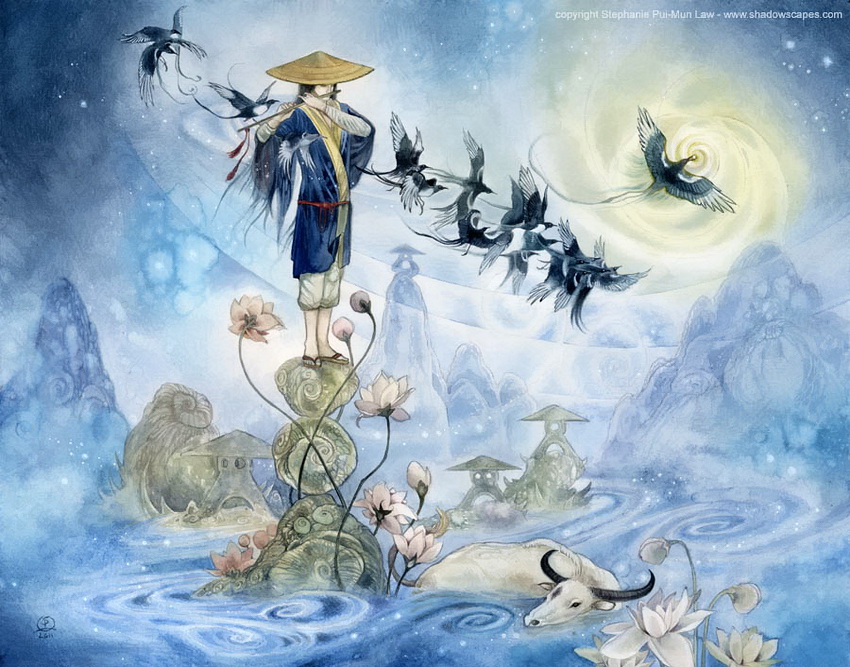
Niulang followed
her almost all the way to heaven, but he found his path blocked by a
massive river of stars – the Milky Way. There was no way for
Niulang to cross the river, but his wife waited for him on the other
side of it.
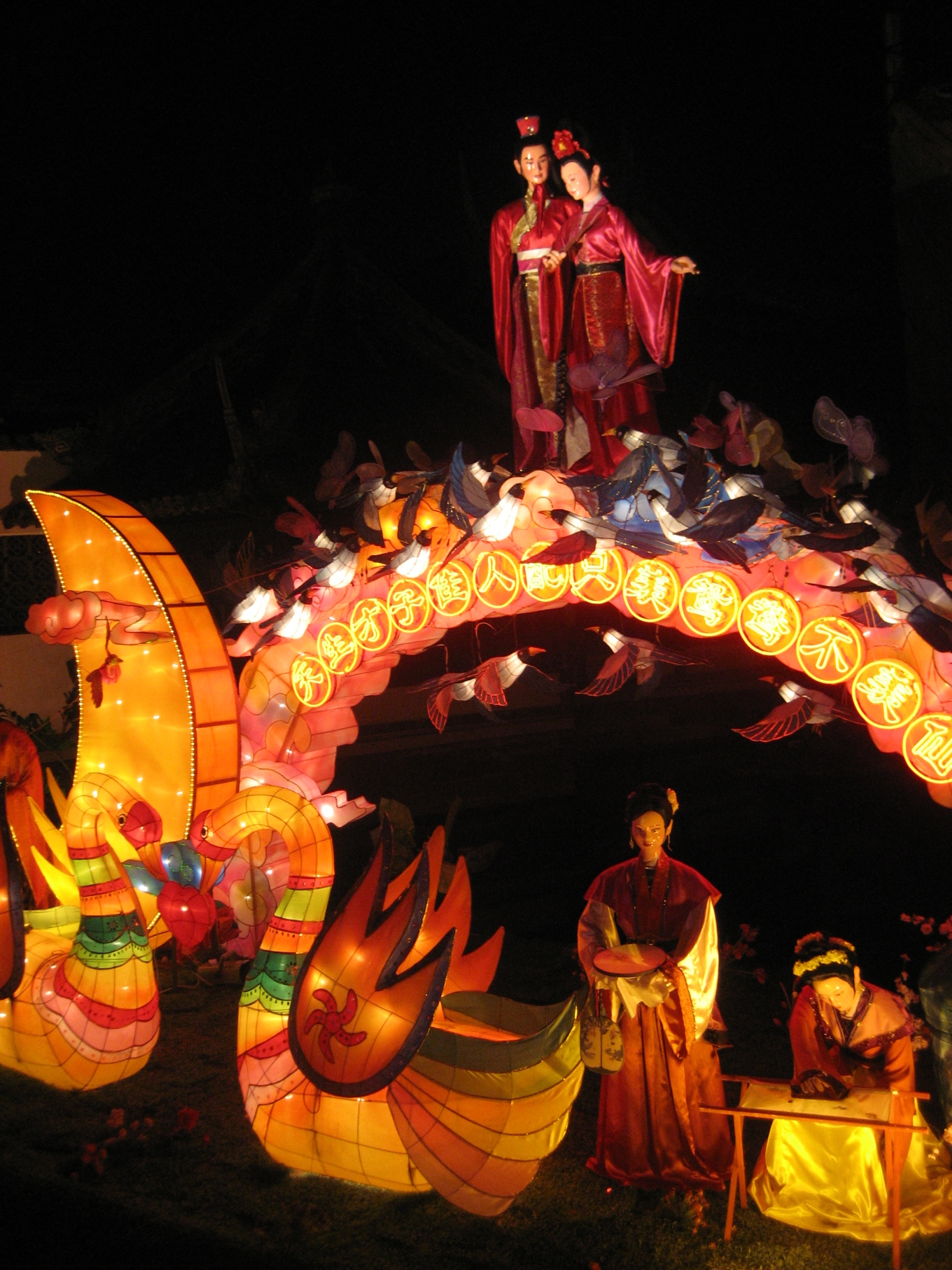
Seeing their
distress, the gods eventually took pity on the couple. One day out
of every year, they allow the cowherd and the weaver girl to cross
the river and see one another. On this day, thousands of magpies
take to the air and form a bridge across the Milky Way so that the
couple can cross.
This day is celebrated in China as the Qixi
Festival.
If you look at
the sky, you can still see Niulang and Zhinu waiting for one another.
Two bright stars sit on either side of the Milky Way – Altair and
Vega. Two smaller stars near Altair represent Niulang's children,
still waiting for their mother in the baskets their father carries.
I hope you guys
enjoyed the story! I'll be back next week with another tale from
Chinese mythology.
I apologize for the brevity of today's post. I had completely forgotten that I hadn't written anything up for tomorrow's holiday - Valentine's Day! Since I'm sick and studying for multiple tests, you get a short post today. I'll return next week with a longer one (and a return to Chinese mythology).
Last year I wrote a post about the origins of Valentine's Day, which actually began as the Roman feast of Lupercalia. You can read that post here if you're interested.
If you're looking for the official Catholic view of Saint Valentine, for who the holiday is named, might I recommend this page?
Lastly, Valentine's Day is celebrated in many countries thanks to how widespread Catholicism is. You can read about the different ways the holiday is celebrated in other countries here - which includes a link to a Chinese folktale that I'll be talking about next week!
Wherever you are, however you celebrate, I hope you have a lovely Valentine's Day. I myself will be preparing for an exam and playing copious quantities of For Honor.
See you next Monday!
(I seem to have made a tradition of posting cheesy Star Wars valentines.)
I wanted to begin by taking a look at
the role of the dragon in Chinese mythology. Western myth and
folklore has traditionally painted dragons in a very different way.
They are massive beasts, ones who hoard treasure. They frequently
kidnap royalty, or wreak terror over nobility's countryside. Western
dragons are often portrayed as fire-breathers.
Chinese dragons stand in sharp contrast
to this. It's true that they are very large, but their great
intelligence belies the term of beast. Dragons in Chinese mythology
are frequently depicted with a giant pearl clutched in one taloned
hand, or chasing after one. It's tempting to say that this is proof
that they hoard treasure, but in reality the pearl represents wisdom.
Chinese dragons are associated with nobility nearly as often as
Western dragons are...but that's because the dragons of the Chinese
myths are considered to be
nobility. In their homes they take the form of humans – very
wealthy, impeccably dressed humans. (Dragons traditionally make
their homes in rich palaces beneath the water. Several folktales
portray these palaces as having a timeless quality quite similar to
the fae in Celtic mythology. A man who spends time in those halls
may leave, only to find several decades have passed in what he
thought was a mere month's stay!) And forget breathing fire – the
Chinese considered dragons to be tied to water. These elegant
creatures have some control over lakes, rain, flooding...even such
mighty forces as the great typhoon.
(I couldn't help it, I'm sorry.)
There's an old
story called The Dragon King's Daughter which paints a very good
picture of Chinese dragons. It begins with a man named Liu Yi, who
was a student headed to the capitol of Chang'an for examinations.
Along the way he came across a very beautiful young woman on the side
of the road. Despite her great loveliness, the girl was herding
sheep, and she appeared to have been crying. Liu Yi immediately
dismounted his horse and asked if there was anything he could do to
help her.
She was touched by
his kindness, and proceeded to tell Liu Yi her story. The woman was
the daughter of a dragon king,one who ruled over Lake Dong Ting. Her
father had married her off to the son of another dragon lord. Her
husband was a worthless sort, one who constantly neglected the girl –
but she could not complain to his parents, and had no way of
contacting her father. If he but heard of her troubles, she knew
that he would come and rescue her. Guessing that Liu Yi was headed
for Chang'an, she asked if he would be willing to deliver a message
to her father on his way past.
Liu Yi was anxious
to help the girl, and promised to do everything in his power to get
her message to her father. He made his farewells, saying that he
hoped they would meet again.
The man headed for
Lake Dong Ting as quickly as he good. There he was met by a servitor
who rose out of the lake's waters. Liu Yi told the man that he
wished to speak to the king. Immediately the servitor raised a hand
and parted the waves. Liu Yi was directed to close his eyes. He did
so, and the servitor led him.
When the mortal
opened his eyes several minutes later, he was inside a palace. It
was covered in precious stones and pearls, with plants decorating the
halls. A regal figure entered and introduced himself as the dragon
king, then asked what had made a human brave the journey to the
dragon's dwelling.
The dragon king's
daughter had given Liu Yi a letter to deliver to her father. He
passed it to the man, explaining who had given it to him and why.
The dragon immediately began to read his daughter's letter, and then
began to cry. He was distraught that his daughter had suffered so
greatly without his knowledge. The king was also immensely grateful
that a human, a stranger, had been willing to help his child.
The king was not
the only one crying. The other courtiers had begun to weep when they
heard the news. As soon as the king was finished reading the letter
was taken to the queen's chambers, and soon the sound of she and her
ladies weeping could also be heard. At this the king started and
hastily dried his tears. He dispatched an attendant to make the
ladies stop crying – and quickly, before the prince of Qiang Tang
heard!
Liu Yi curiously
inquired as to who this prince was. The dragon king explained that
the prince of Qiang Tang was his younger brother. He was possessed
of a mighty temper, and had caused many floods in his home. The Jade
Emperor had temporarily confined him to the dragon king's home in an
effort to make him behave.
No sooner had the
explanation been made than a great roaring echoed through the
chamber. The doors slammed open, and a red dragon rushed into the
hall, still bellowing so strongly that the palace shook. Thunder and
lightning traveled in his wake. He was gone out the other door
almost as quickly as he had appeared. Liu Yi was terrified, but the
dragon king comforted him, explaining that the dragon was his
brother, and that his wrath was not for Liu Yi.
It took some convincing for Liu Yi to
be willing to stay after such a terrible sight, but eventually the
dragon king persuaded him to join him for refreshments.
Not long thereafter a gentle breeze was
heard throughout the hall. Soon a group of young women entered,
chatting among themselves. One in particular was very beautiful, and
she was the most richly dressed of the group. Liu Yi realized that
it was the girl he had spoken to, the princess who had sent him on
his quest. The dragon king stood and embraced his daughter, beaming
at her return. She and the other women soon retired to another set
of chambers.
Not long after a dignified,
elegantly-garbed man entered the room. He was introduced to Liu Yi
as the prince of Qiang Tang – the fearsome dragon who had roiled
through the chamber earlier! He thanked Liu Yi for his help in his
niece's return. When the dragon king inquired, the prince explained
what had happened. He had headed straight for Jing River, where the
other dragon lived, and the two had fought on its shores. Upon the
defeat of his foe, the prince had gone to visit the Jade Emperor to
explain his actions. The Jade Emperor forgave him for his violence
when he heard of the circumstances, and would not hold his actions
against him. Still, the prince begged for his brother's forgiveness,
for he had been quite rude earlier...and, he suspected, had
frightened their mortal guest.
(When pressed for details, the prince
admitted that he had killed six hundred thousand people in his battle
with the other dragon. Nearly three hundred miles of fields had been
flooded. As for his foe...well, he had eaten him. The dragon king
was appalled by this, but the prince seemed quite content.)
A feast was held the next day,
and Liu Yi was heaped with gifts of pearls and precious rocks for his
help in the matter. The prince of Qiang Tang seemed to have taken
quite a liking to Liu Yi, and after several cups of wine he came up
to him with a proposition. He wanted to link the two families
together, and proposed that Liu Yi marry the princess. After all, it
was obvious that the human was in love with her, and the princess
owed him a debt for having been rescued thanks to him. Though his
words were polite, the dragon prince attempted to intimidate Liy Yi
into accepting the offer.
The human thought quickly, and was able
to assuage the dragon prince with his clever words. Though it was
true that he loved the girl, he was worried that the prince of Qiang
Tang would not look on the idea so fondly when he was sober. In
addition, he was but a mortal, and the girl was a dragon princess.
Liu Yi was able to decline without offending the prince, and the two
remained good friends.
On the next day, Liu Yi began to regret
having turned down the marriage proposal. Saying goodbye to the
dragon princess was difficult and left him with a heavy heart. When
she bowed to him, she repeated his words from the first day he had
met her - “I hope that we shall meet again.”
Years passed. The gifts of the dragon
king had made Liu Yi wealthy, and he was able to settle into a nice
home. He married, but not long after his wife died. Once again he
married, but this girl too died shortly thereafter. Then a
matchmaker came and told him of a woman he thought suitable. She had
previously been married to a family near the Jing River, but her
husband had passed away. Upon hearing her virtues praised by the
matchmaker, Liu Yi agreed to wed her.
The couple were very much in love.
They had a child together, and one night after the woman asked him if
they remembered how they had first met. Liu Yi was filled with a
sneaking suspicion, and said that he had never forgotten the dragon
princess whom he had helped. His wife confessed that she was the
princess, and that she had fallen in love with him.
The couple lived together in joy for
many years. Eventually, the dragon's princess took Liu Yi back to
her father's lake. The two entered it together, and have lived
beneath its waters ever since.
I hope you guys enjoyed the story! Oh, if you were wondering - the sheep the dragon princess was herding? They were actually storm elementals, part of the wind and the rain. I always found that part interesting!
I hope everyone had a happy Lunar NewYear! I certainly did - I've been playing a ton of Overwatch's holiday event, and I got to test out For Honor. In keeping with the holiday, today we're going to begin a
series on Chinese mythology. Without further ado, let's start the
Intro!
Chinese mythology has a very large
number of deities. These deities have a hierarchy, with one god –
the Jade Emperor – at the top, and everyone else falling into
various ranks of importance beneath him. Within this hierarchy there
are also smaller divisions of gods. For instance, the gods of the
storm – lightning, thunder, etc. – form their own cabinet of
sorts, with varying ranks of importance.
Because China is so large,
and there are so many dialect variations, the gods have been called
by numerous names throughout time. There are a lot of spelling
variations, but I'll do my best to go with the most commonly used
name.
Within Chinese mythology there exists
an elixir that grants immortality, made with peaches grown by a
goddess. This elixir has allowed several beings who were not
originally gods to attain immortality. Perhaps the best known of
these beings is the Monkey King. Originally a regular monkey, he was
able to steal some of the elixir and gain eternal life – much to
the dismay of much of the pantheon! He went on to have many
adventures; some of them helped the gods, while others must have
caused the deity version of a facepalm.
(My favorite representation of the
Monkey King is from the movie The Forbidden Kingdom. I grew up
watching a lot of Jet Li's older, more serious action movies – so
to see him smiling and laughing was really strange for me! The movie
is a gorgeous portrayal of Chinese mythology; plus, Jackie Chan
and Jet Li!!! I'd recommend
giving it a watch if you haven't.)
Outside
of the gods, two other sorts of inhuman beings are commonly found in
Chinese mythology.
Shapeshifters
make frequent appearances. There are foxes who can turn themselves
into human form, much like the kitsune of Japanese mythology.
Heavenly maidens (beautiful celestial young girls) turn themselves
into cranes as easily as slipping on a robe (literally). Some of
these beings are benevolent and aid mankind, while others seek their
own benefits.
Spirits
of one sort or another are also common. They can take many forms,
and serve many functions. They're similar to shapeshifters in that they can also assume human form, in addition to whatever their natural form might be. Rivers and other bodies of water are
associated with dragons in Chinese mythology, who are the spirits of
that water.
(Haku
from Spirited Away is a gorgeous animated example of this.)
Much
like the shapeshifters, the spirits can be good, self-serving...or
evil. There are many folktales about shrines or abandoned houses
possessed by dark spirits who terrorize and haunt the surrounding
area. Sometimes these spirits are manifestations of animals such as
scorpions. I'll cover one such tale in a couple of weeks.
There
are three themes which are exceptionally prevalent throughout Chinese
mythology. They are as follows:
Tales
of valor in battle.
Tales
of duty to family.
Tales
of devotion to the gods.
All
three of these traits were considered important in ancient China
(and, to some extent, in modern China as well). As such, many myths
and folktales reinforced them.
Much
like Japanese mythology, the Chinese myths eventually see a
significant change – one that occurred when Buddhism entered the
country and gained popularity. The Chinese pantheon of gods remains,
but is frequently superseded in the stories by Buddha and his
devotees. Pious monks become popular characters in stories after the
introduction of Buddhism. Characters who follow the noble principles
are placed on high pedestals, particularly those who are willing to
sacrifice of themselves to help others.
I'm
very much looking forward to diving into Chinese mythology with you
guys! I hope you've enjoyed this introduction. See you next week
with our first story!
As promised, I've got a special holiday
post for you today. It'll be a little shorter than intended, because
I've injured my wrist and typing is rather painful at the moment.
Still, I'll do my best to give this wonderful festival the post it
deserves.
This coming Saturday, January 28th
on the Roman calendar, kicks off the beginning of the Chinese New
Year. I say the beginning because it's a lunar month's worth of
festivities. Preparations for this festival began towards the end of
December on what is called the Little New Year. The celebration will
conclude this year on February 11th with the Lantern
Festival.
(An important note before I begin –
the Lunar New Year is celebrated in a number of countries, including
Taiwan, Malaysia, and Tibet. However, since I'm beginning my series
of posts on Chinese mythology next week, and since Chinese
celebrations of the Lunar New Year are what I'm most familiar with,
I'm going to be focusing on that this post.)
Let's start with the Little New Year.
One of the most important deities in
China is the Kitchen God. This god is one of the oldest in Chinese
mythology, and so has been worshiped under many names. Nearly every
house has a shrine to him in their kitchen. He serves a purpose much
like the Greek Hestia, for the Kitchen God watches over the family
from his hearth, which is regarded as the center of the home. The
stove is regarded as the Kitchen God's dwelling.
The Kitchen God has a very special
responsibility. Throughout the lunar year he observes the family
from his stove. Then, on the night of Little New Year, he travels to
heaven to report on the family to the Jade Emperor – the greatest
god in China. Offerings are made to the Kitchen God before he goes
on his journey. In reality, these offerings are often bribes. Honey
and wine are given to him to sweeten his tongue, in the hopes that
his words will be kinder than the truth. If a family worries that
this may not be enough, more drastic measures are taken. Sticky,
gooey foods are offered to the Kitchen God before his departure,
which serve to glue his mouth shut. When he is asked by the Jade
Emperor how his family has acted throughout the year, all he can do
is nod.
Firecrackers are lit off during Little
New Year to speed the Kitchen God on his way to heaven. These
fireworks are a common theme throughout the Chinese New Year. They
are set off during all three stages of the festivity. Part of the
reason for this is that fireworks make a lot of noise, and both light
and loud noises are supposed to help ward off evil spirits.
There are a lot of traditions in the
celebration of the Chinese New Year. I'd like to briefly talk about
three:
The Gate Gods are often hung as
paintings on the panels of front doors during the Chinese New Year.
They are protectors of mankind and are viewed as guardians of the
home. These dual gods have many stories revolving around them, but
the most popular is as follows. The Gate Gods are said to be two
famous Chinese soldiers from the Tang dynasty. During that time
period there was an emperor who was plagued by demons during his
sleep. Hearing of this, two brave soldiers volunteered to stand
guard outside the emperor's bedchamber, so that no demons could
possibly disturb him while he slept. The demons were so afraid of
the soldiers that they never saw them, and the emperor was able to
sleep peacefully for the first time in weeks. He ordered likenesses
of the soldiers to be painted and hung outside his bedchamber,
allowing the soldiers to return to their duties...and the emperor to
continue to be protected.
The Chinese New Year is a time for
paying off one's debts. There are three festivals in China which
include debt-paying as part of their traditions. During the Chinese
New Year, debt-paying allows one to literally start the New Year with
a clean slate.
Lastly, birthdays! While some families
choose to celebrate birthdays on the day a child was born, much of
China celebrates during the Chinese New Year. Every New Year,
everyone in China becomes a year older. All birthdays are celebrated
on the same day.
Beginning with the Little New Year, the
Chinese New Year ends with the Lantern Festival. The Lantern
Festival has a number of festivities that are unique to it, though it
continues the trend of fireworks, feasting, and the color red (which
is considered lucky) that its two counterparts share.
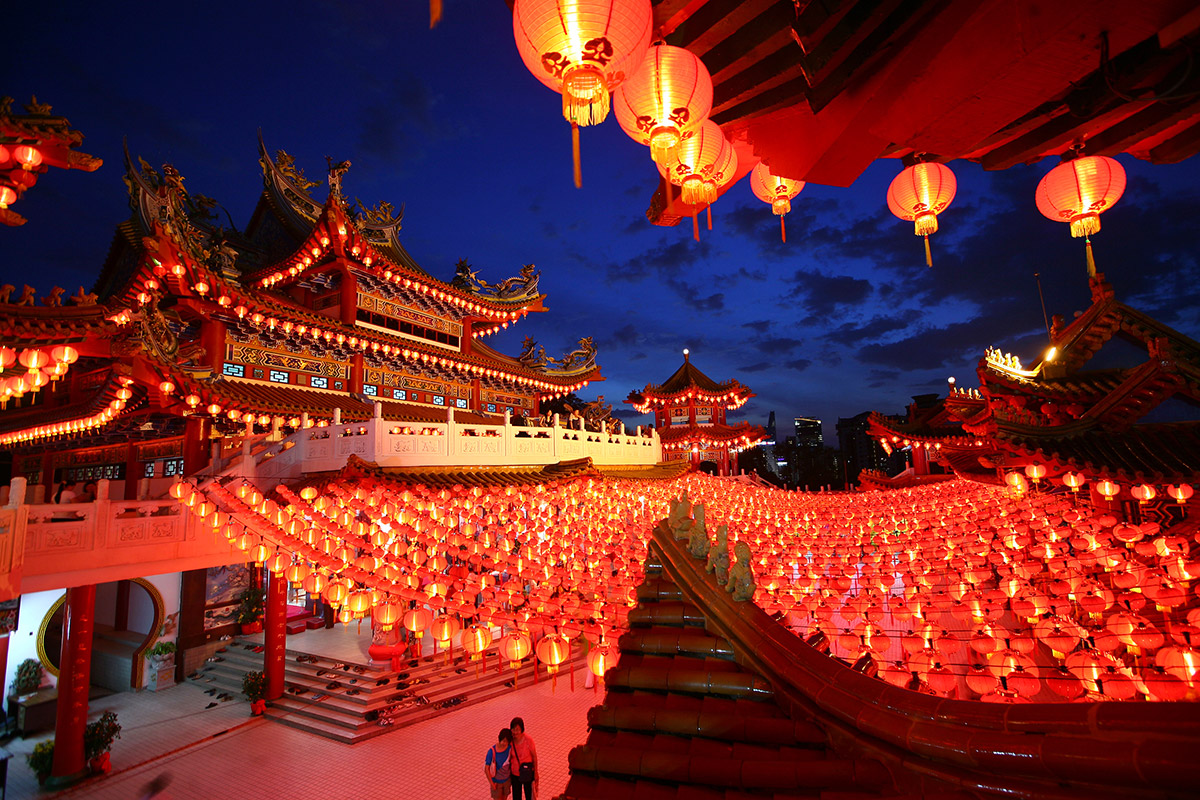
Part of the celebration of the Lantern
Festival, as you might have guessed from its name, includes
decorating with and lighting lanterns. You know the scene from
Tangled, where the entire kingdom lets loose a lantern into the sky?
It's absolutely gorgeous, but I've always found the Chinese Lantern
Festival even more breathtaking.
Often confused by Westerners, the
Lantern Festival is also when both the Dragon Parade and the Lion
Dance take place. The Dragon Parade is lengthy – one of my source
books makes mention of a Dragon Parade in San Francisco that
stretched 160 feet long. The dragon is made of brightly colored
cloth and held up by wooden rods. Men carry it throughout the
streets, their movements making it appear to flow and glide.
In contrast, the Lion Dance is composed
of only two people. One wears the front half of a lion suit, the
other its rear.
Why these two animals? The lion is not
native to China, but animals were sometimes sent to emperors as gifts
from the Persians. Given its association with the emperor, the lion
was regarded as an animal of protection. Dragons in China are
associated with water, often streams and rivers. It is also tied to
rain. The Chinese New Year marks the end of winter and the beginning
of spring, and so the dragon represents the coming of spring showers.
Chinese New Year is this Saturday.
Happy Year of the Rooster, everyone!
I'll be back next week to begin my
Intro to Chinese Mythology!