I have a book which contains many, many stories about the origins of fire. These stories come from countries all over the world, and it's fascinating to me to read them and see all of the similarities and differences within them. The book contains stories from more than a dozen tribes and cultures in Africa, and all of them are unique.
This particular story comes from two different books that I have. I'm not sure which tribe it can be credited to, but it is my favorite story about fire from African folktales.
The story goes that there was once a time where mankind had no fire. They had nothing to provide light at night; no way to warm themselves against the chill; no manner in which to cook their food. (Think about it! No juicy, medium steak - no baked potatoes!) It was a dark, cold, and flavorless time.
One day, a hunter was out in the wilderness when he saw a gray cloud rising from the ground ahead. Having never seen anything like it, the man went to take a look. It took him a long time to get there, because the cloud's origin lay beyond the horizon. Night fell as he journeyed, but to his surprise a bright light shone up ahead, allowing him to continue his travels. At last he reached his destination.
He had been following smoke, and what was emitting it was a warm light which flickered and danced.
The hunter guessed that the light was a great chieftain, and he bowed before it with respect. The light introduced itself as fire. It offered the man warmth and a place to stay the night, in exchange for his feeding it some of the branches and grass which lay nearby. The man readily agreed.
Food was also provided for him. An animal had been gazing spellbound at the dancing flames. The man was able to take it unawares. When he had killed it, the fire told him that he should cook the meat. The hunter had no idea what the flames meant, but listened and did as he was told. He soon discovered that roasted meat tasted far better than raw.
An idea came to the man. He asked the fire if he could take it with him back to his village. He promised to keep it well-fed in exchange for its warmth, light, and cooking capabilities.
But the fire refused. It argued that if it traveled it would bring great danger to the land and to all living things. The flames made the man promise that he would never tell another living soul about its existence.
The man promised, and the next day he returned home.
He kept his word, not even telling his wife about the fire. Unfortunately, his wife was a curious sort. When her husband gave her some cooked meat he had brought with him she immediately wanted to know where it had come from. He never told her the source, but her curiosity did not die away.
The man returned frequently to visit the fire, and on one such visit the wife sent a neighbor to follow him. The second man found the hunter sleeping in front of the fire. Astonished, he seized a log from the flames and ran back to the village to show the wondrous thing he had found.
As he ran, the fire's dire prophecy began to come true. Sparks fell from the flickering log, landing in the savannah. Small fires sprang to life and grew. The flames ate at the log and eventually licked down far enough to burn the second man's hand. He screamed in pain and dropped the fire, which caught on the ground below.
(I'm picturing the scene in the Jungle Book - and with good reason! That story drew heavily upon African folktales.)
The raging wildfire grew and spread, destroying several villages. At last it reached the banks of a river and was stopped. The fires died away...but they left destruction in their wake.
The villagers had survived by wading across the river. They returned to find their homes destroyed. However, the fire had left some good in its wake - some food left sitting out had been cooked, greatly improving its flavor. Clay pots had hardened and become much more durable. Despite its deadly nature, there was usefulness in the flames.
The hunter escaped unscathed, safe by his resting place near the fire. It explained to him what had happened. Fire had now been brought to man. It listed its many uses to the hunter, and explained that it would serve mankind well and faithfully. However, the flames also warned that they must be treated with respect...or else they would destroy.
Some cultures in Africa tell a similar story, but the wildfire started by a wild dog who, a stick tied to its tail caught on fire.
It's a story that I think demonstrates the danger of fire left unattended or used recklessly. Given that it was likely told to children beginning at an early age, the warning is intentional. I live in Arizona, and while Tucson rarely gets terrible fires we have had several in nearby areas. The dangers of even a single flame in the dry desert are great. I can't imagine how terrible they must be on the plains and savannahs of Africa.
What did you guys think of the story?
Sunday, August 14, 2016
Monday, August 8, 2016
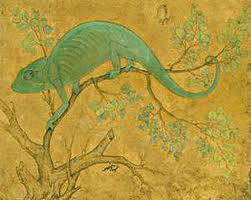
Chameleon: Slow and Steady Results in Death
Perhaps you've heard the saying, "The
early bird gets the worm."
This folktale from the Zulus of Africa has a slightly different take on that proverb: "The early lizard delivers death."
In the beginning the Zulu deity, known simply as the Great One, created the world. He populated it with men and women formed from reeds. The Great One then created the sun and the moon, and lastly all of the animals.
This having been done, the Great One called upon the chameleon known as Unwaba.
The god commanded Unwaba to go to mankind and tell them that they would live forever. Tasked with delivering news of their immortality, Unwaba set out. However, chameleons are rather slow critters. They trod along slowly yet steadfastly. This was exactly how Unwaba moved.
While the chameleon slowly trekked along, the Great One changed his mind. (Gods are, across most mythologies, incredibly fickle and prone to mood swings.) The Great One decided that he did not want mankind to live for forever. In fact, he desired nothing other than himself to be immortal. The land animals, the fish, the birds...everything would eventually die.
With this in mind, the Great One sent out yet another messenger, the lizard Intulo. Intulo was tasked with delivering the news that all must one day pass.
Because of the slowness of the chameleon, death entered the world.
Chameleons often play the role of messenger in African folktales. As I said in my Intro, African animals in these stories often have a point to make about mankind. In this case, I would hazard a guess and say that it is best not to dawdle when carrying news of utmost importance.
Interestingly enough, Intulo makes an appearance in modern pop culture. One of the Final Fantasy games (I believe XI?) has a giant lizard players can fight named Intulo. I found this rather intriguing.
I'll see you guys next week!
This folktale from the Zulus of Africa has a slightly different take on that proverb: "The early lizard delivers death."
In the beginning the Zulu deity, known simply as the Great One, created the world. He populated it with men and women formed from reeds. The Great One then created the sun and the moon, and lastly all of the animals.
This having been done, the Great One called upon the chameleon known as Unwaba.
(I couldn't help but use Disney's Pascal for a picture. He's the cutest chameleon!)
The god commanded Unwaba to go to mankind and tell them that they would live forever. Tasked with delivering news of their immortality, Unwaba set out. However, chameleons are rather slow critters. They trod along slowly yet steadfastly. This was exactly how Unwaba moved.
While the chameleon slowly trekked along, the Great One changed his mind. (Gods are, across most mythologies, incredibly fickle and prone to mood swings.) The Great One decided that he did not want mankind to live for forever. In fact, he desired nothing other than himself to be immortal. The land animals, the fish, the birds...everything would eventually die.
With this in mind, the Great One sent out yet another messenger, the lizard Intulo. Intulo was tasked with delivering the news that all must one day pass.
It became a race,
because whichever message was delivered first would be the one which
stuck. A god's word, once passed on to his subjects, becomes law.
Had Unwaba been the first to make his announcement, mankind would
have lived forever.
Unfortunately,
Unwaba did not know that he was participating in a race. He
continued his steady journey. Intulo the lizard, being considerably
faster than the chameleon, sped ahead of him and was the first to
arrive at the village of man.
By the time Unwaba
showed up, the dreaded news had already been delivered. Mankind was
doomed to one day die. His own message now inconsequential, Unwaba
turned and headed wordlessly back into the forest.
Because of the slowness of the chameleon, death entered the world.
This story is told
in various forms throughout many of the cultures of Africa.
Sometimes the chameleon races against animals other than a lizard –
a hare, for instance. Always, the outcome is the same: death.
Chameleons often play the role of messenger in African folktales. As I said in my Intro, African animals in these stories often have a point to make about mankind. In this case, I would hazard a guess and say that it is best not to dawdle when carrying news of utmost importance.
Interestingly enough, Intulo makes an appearance in modern pop culture. One of the Final Fantasy games (I believe XI?) has a giant lizard players can fight named Intulo. I found this rather intriguing.
I'll see you guys next week!
Monday, August 1, 2016
Chosen of the Gods: Treebound - Coming Soon!
Hello readers!
I'm interrupting my series on African folktales with some exciting news.
Book three in my Chosen of the Gods series is complete, and is coming soon!
Below is an exclusive look at the synopsis of the book. Enjoy, and I'll see you next week!
After years of research, the relic bearers have been unable to decipher the prophecies about the mysterious Doom Bell. Time is running out, and the situation looks dire. Skuld, a powerful being as old as time itself, has gone missing.
Old friends reunite and join with new faces in an effort to save the world once again. Can the Order cease its squabbles and work together to protect its members? Will the pantheons be able to overcome their differences and unite in the face of this new threat?
It's up to Liam and Tom to find and rescue Skuld.
If they cannot defeat this enemy, no one can...
I'm interrupting my series on African folktales with some exciting news.
Book three in my Chosen of the Gods series is complete, and is coming soon!
Below is an exclusive look at the synopsis of the book. Enjoy, and I'll see you next week!
Doom approaches.
After years of research, the relic bearers have been unable to decipher the prophecies about the mysterious Doom Bell. Time is running out, and the situation looks dire. Skuld, a powerful being as old as time itself, has gone missing.
Old friends reunite and join with new faces in an effort to save the world once again. Can the Order cease its squabbles and work together to protect its members? Will the pantheons be able to overcome their differences and unite in the face of this new threat?
It's up to Liam and Tom to find and rescue Skuld.
If they cannot defeat this enemy, no one can...
Chosen of the Gods: Treebound - coming October 2016!
Monday, July 25, 2016
Intro to African Folktales
Hello all!
I know that I said in my previous post that I would be beginning a series on African mythology. That having been said, some of my readers might be wondering why I have titled this post an intro to African folktales rather than to mythology.
African mythology is an immensely expansive term. The other mythologies I've discussed thus far have been fairly straightforward. Most of the gods of Egypt were worshiped throughout all of Egypt. The same is true of the Norse gods – their followers generally all held to the same deities and stories. Some variances did occur, such as the prominence of Demeter in a certain region of Greece (where worship of her sometimes was more important than worship of Zeus), or the worship of the Egyptian goddess Isis in Rome. However, I could say with some certainty that a country worshipped x, y, and z gods.
The same cannot really be said of African mythology, making it a lot more complicated to explain.
Part of the problem lies in the vast number of tribes of Africa. Most tribes have their own religion. Some have the same, or similar, deities and stories. Others are vastly different. I have a book that is a collection of stories on the origin of fire from around the world. The chapter on African stories about the origin of fire contains no less than twenty variations, all of them quite different from one another. That's just one story, one common example – the rest of the mythology is the same.
All of this rather long-winded explanation boils down to one thing: African mythology is too wide of a topic for me to feel comfortable covering. I know a few stories from many different tribes, but if I were to discuss deities and myths from specific tribes I would want to do a series of posts on, say, Zulu mythology. To discuss the whole of African mythology is simply not something that I feel I am qualified to do – at least, not without a lot more research!
However...folktales are another matter entirely.
African folktales are blended with their mythology throughout all of the different cultures that I know of, and there tend to be a lot more similarities in the folktales than there do in the myths. The folktales of African cultures are generally designed to teach lessons, and they do so largely through the use of animals with personalities similar to those of humans. Throughout Africa one can usually find that elephants represent royalty, lizards often are the messengers of the gods, hyenas are dangerous and hunger for human flesh...there are distinctive characteristics for each animal, and those characteristics tell a cautionary moral tale for the human listeners.
In the coming weeks I'll be doing posts on several folktales from various parts of Africa, during which time I'll talk about a lot of the different animals. I'm really looking forward to this, because it is very different from anything else I've done for the blog so far.
I know that I said in my previous post that I would be beginning a series on African mythology. That having been said, some of my readers might be wondering why I have titled this post an intro to African folktales rather than to mythology.
African mythology is an immensely expansive term. The other mythologies I've discussed thus far have been fairly straightforward. Most of the gods of Egypt were worshiped throughout all of Egypt. The same is true of the Norse gods – their followers generally all held to the same deities and stories. Some variances did occur, such as the prominence of Demeter in a certain region of Greece (where worship of her sometimes was more important than worship of Zeus), or the worship of the Egyptian goddess Isis in Rome. However, I could say with some certainty that a country worshipped x, y, and z gods.
The same cannot really be said of African mythology, making it a lot more complicated to explain.
Part of the problem lies in the vast number of tribes of Africa. Most tribes have their own religion. Some have the same, or similar, deities and stories. Others are vastly different. I have a book that is a collection of stories on the origin of fire from around the world. The chapter on African stories about the origin of fire contains no less than twenty variations, all of them quite different from one another. That's just one story, one common example – the rest of the mythology is the same.
Another problem lies in the influence
of other religions. Parts of Africa were heavily colonized by
Christians, who converted the locals. This effected the local
beliefs, changing the stories of their mythology. Other parts of
Africa were home to a large Muslim population, which had the same
effect. Still, there remain pockets, particularly in the jungles of
Africa, where small tribes have kept their stories intact and
relatively unchanged for hundreds of years.
(The best image I could find on Google to show you just 100 of the different regional groups within Africa. There are many, many more.)
All of this rather long-winded explanation boils down to one thing: African mythology is too wide of a topic for me to feel comfortable covering. I know a few stories from many different tribes, but if I were to discuss deities and myths from specific tribes I would want to do a series of posts on, say, Zulu mythology. To discuss the whole of African mythology is simply not something that I feel I am qualified to do – at least, not without a lot more research!
However...folktales are another matter entirely.
African folktales are blended with their mythology throughout all of the different cultures that I know of, and there tend to be a lot more similarities in the folktales than there do in the myths. The folktales of African cultures are generally designed to teach lessons, and they do so largely through the use of animals with personalities similar to those of humans. Throughout Africa one can usually find that elephants represent royalty, lizards often are the messengers of the gods, hyenas are dangerous and hunger for human flesh...there are distinctive characteristics for each animal, and those characteristics tell a cautionary moral tale for the human listeners.
(Perhaps the most famous is Anansi, the spider who is the storyteller in African folktales, and relies upon his wits to get him out of difficult situations.)
In the coming weeks I'll be doing posts on several folktales from various parts of Africa, during which time I'll talk about a lot of the different animals. I'm really looking forward to this, because it is very different from anything else I've done for the blog so far.
I'll see you guys next Monday!
Monday, July 18, 2016
Trolls: Stay Away From da Voodoo
Hello all!
To finish off our look at the mythologies in World of Warcraft, this week we're looking at one of the most complicated spiritual systems within the game: the worship of the loa.
I
hope you guys enjoyed this post! What do you think of troll
religion? The loa are a pretty fascinating bunch. If you'd like to
see Vol'jin interact directly with them, providing a fantastic look
at troll culture, I'd highly recommend the book Vol'jin:
Shadows of the Horde by
Michael Stackpole. (It's also a great look at the culture of the
Pandaren!)
To finish off our look at the mythologies in World of Warcraft, this week we're looking at one of the most complicated spiritual systems within the game: the worship of the loa.
The loa are known to other races, like the night elves, by
the name “Wild Gods”. They are powerful, highly intelligent
animals who are nigh immortal and were some of the first to wander
Azeroth (the actual world of World of Warcraft). These deities each
possess distinctive personalities and traits. Some are kind and
nurturing; many act as guardians of the wilderness, or specific
creatures within the wild; some are vengeful and bloodthirsty.
Many denizens of Azeroth worship the
Wild Gods by one name or another. Druids are particularly respectful
of the Wild Gods, and four of the Wild Gods are revered in Pandaria
under the name of “the August Celestials”. However, their most
prominent followers can be found amongst the trolls, who call the
Wild Gods the loa.
Worship of the loa has been integral
to the trolls since before their first civilizations dawned. “The
loa came and granted trolls their very nature, bargaining in return
for eternal supplication and worship.” They guided troll culture
for millennium, and even granted some of their power to trolls the
loa deemed worthy. Troll culture included a number of priests
devoted to the loa. The highest, most honored religious devotees who
undergo and pass set trials are known as Shadow Hunters. Shadow
Hunters are in direct communion with the loa, able to pass into the
realm of shadows to speak face-to-face with their gods. It is upon
Shadow Hunters that the loa bestow their greatest gifts, and so troll
societies look up to Shadow Hunters as spiritual leaders and prophets
of a sort. The current leader of the trolls (and of the Horde),
Vol'jin Darkspear, is a Shadow Hunter.
The
loa are a very diverse bunch of gods, representing a number of
animals and traits. Bwon'samdi is the guardian of the dead, who
welcomes all trolls into his realm. He is a bloodthirsty god,
preferring his sacrifices to be worthy opponents slain in battle.
Interestingly enough, Bwon'samdi has only been seen in spiritual
form, in which he resembles a troll.
Elortha
no Shadra is a massive red spider whose physical form is worshiped by
a tribe of trolls. She is also known as Venom Mother and Silk
Dancer. All spiders are the children of Elortha no Shadra. This loa
has been known to send visions of the past, present, and future to
her devotees amongst the trolls.
Some
members of the loa are more bloodthirsty than others. One such is
Hakkar, who puts even the blood lust of Bwon'samdi to shame. Hakkar
demanded sentient sacrifices in his honor. His hunger grew with
every being killed in his name, until eventually a group of trolls
realized that his thirst for blood would not end, even with the
destruction of every living being. They killed or banished all
trolls who worshiped Hakkar, and even defeated the physical avatar of
the loa himself. Despite this, Hakkar's loyal followers continued
their devotions to him and raised a temple they dubbed Atal'Hakkar.
The bloodthirsty nature of the god so disturbed the denizens of
Azeroth that even the green dragons took note. They sank the temple
deep into the surrounding swamps and set themselves up to guard it,
preventing worship of Hakkar from ever resuming in his temple.
The
sacrifice of sentient beings was not limited to Hakkar alone – many
of the loa were pleased to receive such offerings during the height
of troll power. However, as the years passed, the great troll
civilizations dwindled. One tribe, the Darkspears, eventually joined
up with the Horde. The other races in the Horde were disturbed by
some of the troll practices, including sentient sacrifice and
cannibalism. (Eating one's enemies was believed to imbue the
consumer with their strength.) Such practices were termed “voodoo”
by the trolls. To stay within the Horde, the Darkspear tribe adapted
their religious practices. Cannibalism was done away with entirely,
and the sacrifices to the loa were changed to animal sacrifices.
Hence, many troll non-player characters in WoW will give the dialogue
of “Stay away from da voodoo!” when clicked upon, a reminder to
not return to the practices they gave up when they joined the Horde.
However, this change was only amongst the Darkspear tribe – other
troll tribes continue their practices without change.
If
players in WoW are interested, they can interact directly with a
number of the loa in a zone called Zul'Drak. A lengthy quest chain
within Zul'Drak surrounds the deities. The trolls in this area have
been threatened by the undead within the surrounding areas. They
realize that a source of great power lies around them, contained
within the gods they have long worshiped. To gain access to this
power, the trolls are killing the loa. One of the loa, Har'koa,
recruits the player to aid them in stopping to trolls and saving
their brethren. The story, and the models, are absolutely fantastic.
It's
worth noting that the religious practices – and, in fact, the
entire culture – of the trolls is heavily based upon ancient Latin
American civilizations. Just as there were three great empires that
rose in that area (the Aztecs, the Mayans, and the Incas), the trolls
had several mighty tribes who created vast empires (the Zandalari,
the Gurubashi, the Drakkari, and the Amani). Below is a picture of
the Zandalari capital of Zuldazar, whose architecture draws heavily
from Latin American influence.
The
gods in Latin America tended to have heavy ties to animals, much like
the loa. Human sacrifice was not uncommon, particularly amongst the
Aztec empire. In addition, as I mentioned in a previous post, the
similarities between the Latin American god Quetzalcoatl and the loa
Quetz'lun are great, particularly when looking at a comparison of
their temples.
This'll be my last post about Warcraft mythology for the time being. I hope you guys enjoyed the look at WoW lore! There are several races whose beliefs I still haven't talked about, ranging from the playable race of Forsaken, to cultures such as the Jinyu and Kalu'ak, to the insanity-inducing Old Gods. I definitely plan to do another series of posts at some point!
Starting next Monday I'll be taking some of the myths and folktales of Africa. Tune in next week for my Intro!
Labels:
Aztec,
Loa,
mythology,
Troll,
World of Warcraft
Monday, July 11, 2016
Dwarves: By the Makers
The
races in World of Warcraft that I've talked about so far have varied
in how they interact with their gods. The draenei are able to see
the naaru and even speak with them directly, and the orcs share a
similar relationship with the elementals. The August Celestials have
actively worked alongside the pandaren to help guide them and protect
them throughout their history. Humans can tap into the power of the
Light, though they are unable to communicate with it. Night elves
worship Elune, despite never having seen her, and are blessed in
return by her gifts. The tauren strive to please the Earth Mother,
believing that they catch glimpses of this deity in all aspects of
nature.
Then
there's the dwarves.
The
dwarven race on Azeroth is interesting in that it knows exactly what
beings created it, but chooses to worship the deities of other races.
The two primary religions amongst the dwarves are shamanism and the
path of the Light. Neither the elements nor the Light were what
created the dwarven race, however. That distinction lies with a race
known to the dwarves as the Makers.
While
most races take their gods on faith, the dwarves long ago embarked on
a quest to find those who made them and learn more about these
“Makers”. With the support of Magni Bronzebeard, king of the
dwarves, an organization called the Explorers’ League set out to
find proof of the dwarves’ origins. One of the most famous and
successful explorers of this league is Brann Bronzebeard, brother of
the king himself.
Piece
by piece, one artifact or dig site at a time, the Explorers' League
was able to put together the story of the creation of the dwarves.
In fact, they (and players) are able to interact directly with some
of the Makers in the game, helping the dwarves to better understand
their past.
In
World of Warcraft, a race of mighty beings known as the Pantheon
exist. The Pantheon wander throughout the universe seeking out life
forms like themselves – for each member was once a world, one which
gained sentience and eventually woke up to begin their roamings.
Life forms like the Pantheon who are still sleeping are known as
“world souls”, and one such world is Azeroth itself.
When
the Pantheon discovered Azeroth they found it under attack by the Old
Gods – forces of the Void, the ancient enemy of the Light. (I've
mentioned them briefly in an earlier post; they're rather similar to
the various insanity-inducing gods in Lovecraft's works.) Desperate
to keep the dormant world soul safe from the corruption of the Old
Gods, the Pantheon set out to destroy them. However, they feared
that they could not combat the Old Gods without damaging the world
too much, given their size and power. To this end, the Pantheon
created a race of beings they called the keepers.
It
is the keepers who are known to the dwarves as the Makers.
Though
many were lost in the battles which followed, the keepers were
eventually victorious over the Old Gods and their forces. Most were
killed, while the Old Gods themselves were imprisoned deep within
specially constructed jails. The Pantheon, satisfied, decided to
return to their cosmic wanderings. They left Azeroth in the hands of
the keepers, and tasked them with keeping it safe.
(The
keepers in WoW are based heavily upon different real world
mythologies – and I mean heavily.
A simple look at their names proves my point: There's Ra, Odyn,
Loken, and Thorim...oh, and Thorim has a big lightning hammer named
Krolmir. Yes, I'm serious. It amuses me greatly.)
While
the Old Gods had been defeated, there remained other threats to
Azeroth that the keepers sought to eliminate. A few straggling
forces from the armies of the Old Gods yet remained; corruption from
the Old Gods themselves had seeped into the land and needed to be
dealt with. In addition, Azeroth itself had been badly damaged in
the battles between the Old Gods and the keepers. It needed to be
repaired.
To
these ends, the keepers decided to make new life forms out of stone
to aid them in retaking and restoring Azeroth. The first to be made
were the anubisath, the mogu, and the tol'vir.
Each of these races
was to serve a different purpose. Giants had already been made
during the war with the Old Gods. Additional species were later
formed, also from stone: the earthen and the mechagnomes.
It
is here that the dwarves first enter the picture, because they began
as earthen. The earthen were tasked with carving out mountains,
mines and valleys for Azeroth.
(In
fact, this post also gives you the origins of the gnomes – they
started out as mechagnomes, who were inventors of fantastic
machinery.)
With
the task of protecting Azeroth in the hands of their creations, the
keepers largely became absorbed in their own matters. Freya wandered
Azeroth, with new plant life springing up in every realm she touched.
During this time she met and befriended the Wild Gods – deities
worshiped by a myriad of races, including the pandaren and the
trolls. Tyr fought battles against the forces of a mighty dragon,
ultimately losing his hand in the process. (This hand was to serve as
the namesake for the Light's Knights of the Silver Hand.)
Unfortunately,
there was also dissent amongst the ranks of the keepers. Odyn was
jealous that Ra had been left in charge by the Pantheon, and so he
split off from the other keepers and created his own kingdom, the
Halls of Valor. Ra himself remained unaware of this fact, having
departed his brethren to guard against the return of the forces of
the Old Gods in the south.
Petty
squabbles between one another, along with their own duties, kept the
keepers from seeing a larger threat until it was far too late.
The power of the Old Gods is great, and the mighty prisons which held
them were not enough to entirely stop them. One god, Yogg-Saron, was
able to worm his way into the keeper Loken's mind. Loken had long
been in love with his brother Thorim's wife, Sif. They had been
having an affair for quite some time, but Yogg-Saron prompted Loken
to tell Thorim of their relationship. Sif vehemently opposed this
plan, and when Loken insisted she broke off their relationship.
Consumed with jealousy, Loken killed her.
Loken
instantly regretted what he had done, but it was too late. Fearing
the wrath of his brother, he sought to cover up Sif's death.
(Thorim discovering his wife's body.)
It was
then that Yogg-Saron's plan became truly nefarious. The Old God took
the form of Sif and appeared to Loken, offering him forgiveness.
“She” then told her lover just what he needed to do to avoid
being brought to justice.
Loken
feared not only the other keepers, but also the eventual return of
the Pantheon. To hide his small act – the killing of Sif – he
decided to completely sabotage the entire operation of the keepers.
It definitely wasn't the smartest thinking on his part, but, in his
defense, he was being
manipulated by an ancient and evil being bent on the extermination of
life itself.
Under
“Sif's” guidance, Loken went to the machine which was responsible
for the creation of the keepers' helpers. Known as the Forge of
Wills, it had made the earthen, the mogu, and all of the other stone
beings who helped the keepers. Loken made an army of his own in
order to combat the keepers...but, while he did so, Yogg-Saron
sabotaged the Forge. From then on, any creatures made by it were
tainted with an affliction which would come to be called the “Curse
of Flesh”.
A
long saga follows, in which Loken wages war on his own kind.
Eventually, all that remain of the keepers shut themselves away in
isolation, leaving their creations alone on the world. It's somewhat
depressing, and since this post is rather long I'll have to encourage
you to look into it on your own.
As
far as the dwarven part in the tale goes, the earthen found
themselves without their Makers. Determined to still carry out their
duties, they did their best for a long time. Eventually, however,
the earthen found themselves becoming afflicted with the Curse of
Flesh. Their stone skin began to turn to flesh, weakening them
greatly. Hoping that their Makers would return to cure them, many of
the earthen were placed into hibernation, watched over by the
mechagnomes.
Due
to the chaos caused by Loken, the Makers never showed up to aid the
earthen. When they eventually awoke, it was as creatures entirely of
flesh. The earthen had become dwarves. They set out from the ruins in which they had hibernated and created a kingdom for themselves, the capitol of which is Ironforge.
(In
fact, the Curse of Flesh infected all of the creatures formed by the
keepers. In time, the mechagnomes became the fleshy gnomes of
today's Azeroth. The mogu, the anubisath, the tol'vir...all of them
became creatures of flesh and blood, though those three longed for
the return of their mighty stone-formed bodies.)
My
favorite part about this whole story is the way it ties together the
different zones. The various creations of the keepers are spread
throughout all of Azeroth. The dwarves fill the middle part of the
continent called the Eastern Kingdoms. The tol'vir and the anubisath
roam the bottom of the continent of Kalimdor. Giants, earthen, and
mechagnomes can be found all over the continent of Northrend. The
mogu roam the continent of Pandaria.
(In
fact, this post ties in quite nicely with my one about the pandaren.
I spoke there about a mogu emperor known as the Thunder King, who
gained his powers from a mighty being. That being was the keeper Ra,
who was taken by surprise after his long years of self-imposed exile.
He was imprisoned by the Thunder King, who siphoned off the keeper's
powers.)
I
hope you guys enjoyed the post! I'll be back next week to wrap up my WoW series with the story of the trolls - which was actually the first one I wrote for this set. See you then!
Monday, July 4, 2016
Tauren: Walk With the Earth Mother
Hey guys! I hope you're all doing well. Happy Independence Day to all of my American readers; enjoy your BBQ and fireworks responsibly, please!
Today's post is relatively short, but I wanted to talk briefly about the religion of the tauren in WoW. While the draenei are the goat people of World of Warcraft, the tauren are most certainly the cows.
Their culture is simple yet elegant, and has always been one of my favorites in game. There are strong ties in both culture and religion between the tauren and Native Americans. In addition, the tauren capital city remains, in my opinion, the most gorgeous city in World of Warcraft.
However, Mu'sha and An'she are but two parts of a larger whole. The primary focus of worship in the tauren culture is the Earth Mother. All of their other gods reflect aspects of this chief goddess. Mu'sha and An'she are the two eyes of the Earth Mother - though An'she was ripped from her face, and is now chased by his lunar counterpart.
The Earth Mother is the physical embodiment of nature. She can be seen in the plants, the rivers, the oceans, the skies, the stars...all aspects of the world. She represents the land. Respect for the Earth Mother is shown by respecting the land and all upon it. As such, the tauren use a subsistence strategy of living, taking only what they need to survive. Mining and logging for profit are viewed as desecration of the land, and thus of the Earth Mother. The same is true of needless killing of the land's creatures, which is abhorred by the tauren.
Today's post is relatively short, but I wanted to talk briefly about the religion of the tauren in WoW. While the draenei are the goat people of World of Warcraft, the tauren are most certainly the cows.
Their culture is simple yet elegant, and has always been one of my favorites in game. There are strong ties in both culture and religion between the tauren and Native Americans. In addition, the tauren capital city remains, in my opinion, the most gorgeous city in World of Warcraft.
(Thunder Bluff, the main city of the tauren.)
The tauren in World of Warcraft have a
pantheon with several deities, each of them representing some aspect
of nature. I mentioned in my night elf post that the tauren revere
the moon goddess, Mu'sha. They tell the story of when a Wild God
named Apa'ro became trapped in the stars. Mu'sha saw Apa'ro and fell
in love with him. She promised to free him, if he would give her his
love in return. The child of Apa'ro and Mu'sha is Cenarius, a
demigod with strong ties to nature who trains druids.
(Baby Cenarius sleeping against Apa'ro, with Mu'sha looking on. Too cute to not post!)
Another god in the tauren religion is
An'she, the god of the sun. An'she provides powers to tauren priests (called Seers) and paladins (the Sunwalkers).
However, Mu'sha and An'she are but two parts of a larger whole. The primary focus of worship in the tauren culture is the Earth Mother. All of their other gods reflect aspects of this chief goddess. Mu'sha and An'she are the two eyes of the Earth Mother - though An'she was ripped from her face, and is now chased by his lunar counterpart.
The Earth Mother is the physical embodiment of nature. She can be seen in the plants, the rivers, the oceans, the skies, the stars...all aspects of the world. She represents the land. Respect for the Earth Mother is shown by respecting the land and all upon it. As such, the tauren use a subsistence strategy of living, taking only what they need to survive. Mining and logging for profit are viewed as desecration of the land, and thus of the Earth Mother. The same is true of needless killing of the land's creatures, which is abhorred by the tauren.
In their mythology, the Earth Mother is said to have created the earth, the sun, and the moon. She is also said to be the maker of the tauren. Many of this bovine race show their devotion to the Earth Mother by becoming either druids or shaman, connecting them intrinsically with nature and the earth.
Interestingly, there's a reference in World of Warcraft to the Sky Father. If I recall correctly, it's mentioned in quest dialogue during a holiday. Once a year, during a week in summer there is a holiday in-game called the Children's Week. During this week players can adopt an orphan from their respective faction (either Alliance or Horde). This orphan has a series of adventures they want to go on, and the player is responsible for accompanying them. Grunth, the Horde orphan, wants to go and see a tauren ceremony honoring their fallen chieftan, Cairne Bloodhoof. I believe it is during the funerary rites that the Sky Father is mentioned - if memory serves, by Cairne's son Baine. There's little more information out there about the Sky Father, but I think it's interesting that he exists, balancing the female nature of the Earth Mother.
What do you guys think of the tauren?
I have two more posts written up about the various species in World of Warcraft, and after that will be making a return to real world mythology. I'll be back next week with a post about the dwarves of WoW. See you then!
Subscribe to:
Posts (Atom)