Greetings, everyone!
Before we start, I’d like to welcome all of my new readers! (And welcome back all of the old, of course!) I was quite surprised to have several hundred pageviews this weekend. It’s lovely to have you here, and I hope you stick around!
Today we’re covering my favorite fairy tale: The White Cat. The White Cat is a variant of a German fairy tale called Puddocky. In Puddocky, many of the characters are frogs. These frog characters became cats when a French woman named Madame d’Aulnoy retold the story in the 1600’s. Her version contained a more detailed backstory for the princess, as well as more elaborate and ornate descriptions of clothing, buildings, etc. It is this story that I’m going to tell, though The White Cat that I am familiar with is a version collected by Andrew Lang.
(Andrew Lang was a collector of fairy tales in the late 1800’s. He had a collection of books called the Fairy books that each contained dozens of fairy tales and folk tales. If you’re lucky, a used bookstore might have paperback versions of these. The White Cat story that I know was contained in his Blue Fairy Book; it used to be available as a hardback through Barnes & Noble, but I’m not sure if it is anymore. You can also check ebay, but be warned: old versions of the Fairy books can go for hundreds of dollars. However, if you’re interested, the paperback versions tend to sell for fairly cheap.)
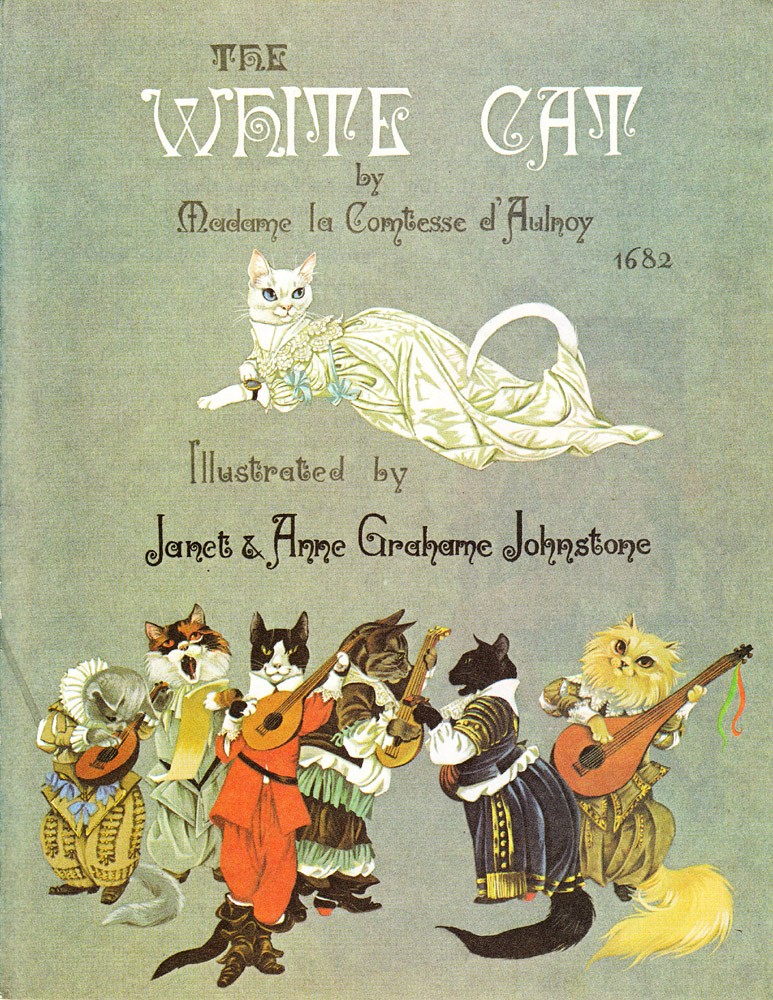
Now that that’s done, let’s begin! Below is the cover image for The White Cat. The artists who illustrated it also did drawings for several other fairy tales, which I find to be absolutely beautiful.
Once upon a time there was a king who had three sons. They were each intelligent and courageous, and when they had grown the king began to fear that they would attempt to seize his throne. To assuage his fears, the king decided to send his sons on pointless tasks that would occupy them and keep them far away from his kingdom.
The king gathered his three children together and assigned them a quest. The king said that he wanted to retire to the countryside once one of them took his throne; of course, it would be lonely to be there alone, so he wanted them to each find him a little dog. It had to be beautiful and small. In one year, the king would choose the tiniest, prettiest dog from those his sons brought to him, and the son who had brought it would be named king.
The princes were quite surprised by this quest, but they agreed to go forth and find a dog for their father. The sons were each quite good-natured and loved one another. The eldest did not even argue that the kingship was his by birthright. Instead, they held a large party with all of their friends and then set off separately, with the promise that they would remain friends no matter who won the crown.
It is the adventures of the youngest son that The White Cat focuses on, and so it is his story that I shall tell you. For a time he traveled far and wide, finding a multitude of dogs that he thought suitable for his father. Each time he bought a dog, thinking it the prettiest or smallest of all, he would find another even tinier or more beautiful! The son would then find a home for the dog he already owned and buy a new pup.
This continued for some time. Then, one night, the prince found himself entering a large forest. (Because where else would you go to find a dog?) He became quite lost, and was even more turned about when a great storm began. The prince was able to see a light somewhere far in the distance, and he followed it through the forest in hopes of finding shelter.
Imagine the prince’s surprise when the light led to a grandiose castle! The walls were of delicate porcelain, and they had been painted with all of the stories of the world. The prince dearly wanted to stay and look at them, but he was soaked to the bone and the storm showed no signs of letting up. He rang the doorbell (hung upon a chain of pure diamonds, of course) and the doors immediately swung open.
The prince had another surprise when floating disembodied hands came through the door, gently grabbed him, and began to push him inside. (I’m picturing the Addams Family...who knew Thing had others like him?) The hallway he entered was carved of precious stone; as he stood there, voices just as disembodied as the hands told him not to be afraid of the hands, who were there to do his bidding.
Now quite unafraid, the prince allowed the hands to escort him through the castle. Each room was carved of a different precious stone, and many rich things lay within - enough to bewilder even a prince, who had grown up amongst such things! He was taken to a room where a fire was lit, and the hands changed the prince into rich clothing.
Clean and quite recovered from the storm outside, the prince was escorted once again by the hands. They took him to a room with a table laid for dinner for two. The walls of this room were covered in paintings that told the stories of Puss and Boots, and other cats of note. As the prince was marveling at this, a door opened and in came almost a dozen cats, each carrying musical instruments and sheets of music! They set up and began to play, mewing and drawing their claws across the strings of their instruments.
The prince, of course, blocked his ears to drown out the noise.
Once more the door opened, and in glided a beautiful little white cat, escorted by two bodyguards. She greeted the prince and introduced herself as the queen of the cats. To the prince’s relief, she also told the musicians to stop playing, since the prince was unable to understand their songs.
The white cat seated herself across from the prince, and dinner was served.
To the prince’s relief, his meals were said to be cooked in a kitchen separate from the one that had prepared the white cat’s mice and rats. In fact, his food was quite delicious, and the prince very much enjoyed himself. He and the white cat chatted as they ate, and he found her company quite enjoyable. Eventually the prince noticed a locket that she wore upon one wrist. The prince asked to see what was inside, and was shocked to find a portrait of a man who looked just like him! The white cat seemed saddened at the image, so the prince refrained from asking her about it.
After dinner the white cat took the prince to another room, where a group of cats put on a theatre performance for them. Then the white cat bid him goodnight, and the prince was escorted back to his room by the floating hands.
The next day the prince was taken on a grandiose hunt put on by the white cat and her court. Upon returning to the castle the prince was given a drink; within it was a magic potion that made him forget all about his father’s quest.
Fortunately the prince was well taken care of. For nearly a year the white cat kept him at her castle, where she doted upon him and made many forms of entertainment available. The prince was quite content, and would likely have stayed there forever. As the deadline for the king’s task was approaching, the white cat called the prince to her and reminded him of his mission.
The prince was horrified. He had only a few days left to return home, and he was sure that his brothers had by now found beautiful dogs! The white cat reassured him and told him that she had a pretty little dog he could bring to his father. She handed him an acorn and told him that the dog was contained within, but that he must not open it until he was at his father’s court.
Of course, the prince thought she was mocking him. What dog could possibly fit inside an acorn? The white cat merely smiled and held the acorn up to his ear, where the prince was able to hear a distinct bark. Amazed, the prince thanked her for her gift. He offered to bring her back to his kingdom, but the white cat sadly declined.
With little time left, the prince mounted a horse provided by the white cat (a magical wooden horse, of course.) and raced off to meet his brothers. He brought with him the tiny acorn, along with a turnspit dog (a dog bred for servitude. It essentially ran upon a hamster wheel that was hooked up to a cooking appliance - called a turnspit - that was designed to cook meat) as a decoy.
When the prince caught up with his brothers they were glad to see him...though they laughed at the dog he had brought. Each brother had a lovely, little dog with them. They shared a chariot on their ride to the castle, and the turnspit ran behind it and got all covered in mud.
The court was thrilled when they saw the dogs the two eldest brothers had brought with them. The king could not decide which was prettier, and the brothers were already working out a deal to split the kingdom between them when the youngest prince stepped forward. He held out the acorn and opened it before the king. Within the acorn was a tiny cushion, and upon that cushion there was a miniscule, beautiful dog. It began to dance before the king, who was speechless.
The youngest prince was obviously the winner of the king’s contest, but the king was still loath to give up his throne. Instead he sent his sons out once again, this time in search of a piece of muslin so thin and fine that it could be drawn through the eye of a needle. In one year, the brother who returned with such a piece of fabric would be crowned king.
Having already traveled for a year, the older brothers were somewhat dismayed by the king’s request. They agreed only because it gave them another chance to win the crown. For his part, the youngest prince did not complain, and instead rode straight back to the castle of the white cat.
The cat, who had not been expecting his return, was asleep in a little basket - but she woke when the prince came in, and asked him why he had returned. The prince explained his situation to her, and despaired of ever finding a piece of muslin so fine. The white cat told him not to worry, as she had some very fine spinner cats in the castle who might be able to manage the task.
The year passed much as the one before had, with entertainments and wonderful times. The prince began to try and guess who the white cat was, and how it was that she could speak. In response she would only shake her head, and reply that she could not tell him.
Eventually the year was almost up, and the white cat told the prince that it was time for him to return to his father’s castle. This time she gave him an escort of a hundred chariots and a thousand guards. His own chariot was made of gold and drawn by horses trapped out in diamonds. The white cat gave the prince a walnut, and told him not to open it until he was before the king.
The prince thanked the white cat for her kindness, and told her that he would stay with her forever if she would ask it of him. She shook her head and told him to go, so the prince kissed her paw and set off.
At the court, the two eldest brothers had already arrived and were showing off their pieces of muslin. They had tested them before bringing them home, and had found that the cloth could pass through a needle if its eye was large enough. Unfortunately, the king was prepared for this and had ordered a needle brought that had the smallest eye possible. The brothers were quite upset about this and were beginning to complain when the youngest prince arrived with much fanfare.
The prince greeted his family, who were amazed at his escort, and then took the walnut from his pocket. He opened it before his father, only to find a hazel nut within. The prince opened this too, but found a cherry pit inside. By now the court had begun to laugh. Confused, the prince cracked the pit and found a kernel. Within that was a grain, and in that was a millet seed. As the king chuckled, the prince began to question if the white cat was making fun of him.
At this he felt a cat scratch his hand. Thinking it was the white cat telling him to open the millet seed, he cracked it open and found a piece of muslin. The prince pulled it out, which took a while - the fabric was 1500 feet long! (The story gives the measurement as 400 ells. An ell is 45 inches. 45 inches x 400 = 18000 inches. 18000 inches / 12 = 1500 feet. Regardless of what measuring system you use, that is a LOT of cloth!) The muslin was woven with many colors and patterns, and was absolutely magnificent. At the sight of it the king and the two other princes grew pale, for they knew that it was unquestionably the finest fabric in the world.
However, the king still wasn’t ready to give up his throne. He turned to his sons and told them that he had one final quest for them. Whoever could return in one year with the most beautiful princess for a bride would be crowned king - for, of course, the new king must be married.
Once again the prince did not argue, but instead hopped back in his chariot and took off to see the white cat. This time she was expecting his return, and had the path strewn with flowers for him. The prince told her of how he had fairly won the crown, but that his father still refused to part with it. Upon hearing of his latest quest, the white cat told him not to worry. She and her court would keep an eye out for a lovely princess.
The year passed enjoyably, though the prince had begun to try harder than ever to figure out who the white cat was. She still refused to tell him, and the prince was no closer to answers than he had been when the year began. The day before the princes were due to present their brides, the white cat told the prince that she could give him a lovely princess to take home. However, the prince had to do whatever she told him for this to happen.
When he agreed, the white cat told the prince to cut off her head!
(Don’t ask me why, but this actually isn’t that uncommon for fairy tales. Animals are often beheaded at their own request in order to help their humans. It’s quite strange and gruesome, but it happens a lot...)
The prince, of course, refused. By this time he had spent nearly three full years with the white cat. He was quite fond of her, and the concept of killing her was horrifying to him. He begged her to ask something else of him, but the white cat shook her head and insisted. Eventually the prince was forced to comply. Unable to watch, he struck the head off of the white cat (I told you, horrifying!)!
And then...something happened. From the beheaded white cat sprang a beautiful human woman! The prince was so astonished by this that he could do nothing but stare...and, while he stared, the doors to the chamber opened and in flowed a huge number of knights and court ladies, all of them carrying the skin of a cat! They surrounded the woman and congratulated her on having returned to her human form. She allowed this for a short time before asking them to leave she and the prince alone.
Once the room was empty, she explained her backstory to the prince. Her mother had traded the princess to a group of fairies in exchange for some of their fruit. The fairies raised the princess in a tall tower, and were quite kind to her, but she was never allowed to leave. One day a prince happened upon her tower and the two began to chat. He returned every day, and she eventually agreed to marry him. She was in the act of escaping when one of the fairies happened to come by to visit. The prince was killed, and the princess was transformed into a white cat, along with all of her parent’s court. The servants of the castle were simply transformed into hands.
The princess’ curse could only be broken if a prince who looked exactly like her former love would fall in love with her, the princess explained. The prince was quite overjoyed at this news, and declared his love for her immediately. The princess, who returned his affection, agreed to marry him. The two set off for the king’s castle in a splendid company studded in jewels and precious metals.
As you might imagine, the former white cat was more beautiful than either of the princesses that the prince’s brothers had brought home. Luckily, she had a solution that left the whole family happy. The white cat possessed a total of six kingdoms. She offered to give the king a kingdom in addition to his own, and to give one to each of the brothers; this would still leave she and the prince three kingdoms to rule over.
With this deal, there was a grand triple marriage. The princes set out to rule their respective kingdoms, and they all lived happily ever after.
Oh my goodness, I forgot how long this fairy tale is! If you love details, I recommend reading the original version. I cut out most of the descriptions, which are immensely rich and complicated.
I hope you enjoyed the story of The White Cat! It is probably my favorite fairy tale. I adore the fact that it has a male protagonist; many fairy tales do, but you don’t see many of them in modern adaptations. Being a cat lover, I of course love the concept of a whole court of cats! I also find the similarities to Beauty and the Beast and Rapunzel fascinating.
If you have questions or comments, please feel free to post below or email me! I’ll be back next week with another fairy tale!
Tuesday, April 14, 2015
Monday, April 13, 2015
New Post Tomorrow
I'll have my post about The White Cat up sometime tomorrow. I apologize for the delay; I had stomach surgery over the weekend and am still recovering.
Monday, April 6, 2015
Beauty and the Beast
Hello again, readers! I hope everyone had a lovely Easter weekend!
This post I’d like to talk about one of my favorite fairy tales: Beauty and the Beast. Most of you are probably familiar with the story, but modern adaptations of it vary greatly from the original tale. For instance, Disney’s addition of Gaston to the movie (which is my second favorite Disney movie, if anyone is interested), or the fact that most films have Belle as an only child instead of having sisters. The core elements remain the same, but minor details are changed with every retelling. As such, I’d like to talk about the original story. Beauty and the Beast was written in the 1700’s by a French woman named Jeanne-Marie Leprince de Beaumont. The tale is as follows:
Once upon a time there was a wealthy merchant who had three daughters. The youngest of them, Belle, was the most beautiful and pure of heart. One day when the sisters were all fully-grown the merchant lost his ships at sea - and with them, his wealth. Used to living the high life, the sisters are suddenly forced to move to a farm and do manual labor. Belle bears this with remarkably good grace, but her sisters hate the work and complain all the time.
Eventually Belle’s father hears that one of his ships has appeared in port. He decides to travel back to the city to see if any of its cargo is intact. The father asks his daughters what they want him to bring back from the city. The two eldest ask for jewels and rich clothing; Belle requests a rose, since their farm has none.
When the father arrives at the port he is dismayed to find that all of the ship’s goods have been seized to repay his debts. Left with no money and nowhere to stay, he sets out to return home. Along the way he becomes lost in a great forest; seeking shelter from a storm, the father stumbles upon an enormous castle. The doors all somehow open as he approaches them, and he heads inside to find the master of the house. Instead the father finds a dining room with a rich meal laid out. When no one arrives, he eats the meal and spends the night on the couch.
The next morning the merchant has another meal and sets out to leave the castle. As he approaches the gate he notices a large, beautiful rose garden. Remembering Belle’s request, he cuts one of the roses to take home to her - only to be confronted by a hideous Beast!
The Beast is furious that the merchant has betrayed his hospitality by stealing one of his roses. He threatens to kill the man, but the girl’s father explains that he only picked the rose to fulfill a promise to his daughter. His explanation calms the Beast, who agrees to let the father return to his daughters and give Belle the rose...but only if the father will come back to the Beast’s castle.
When Belle’s father agrees, the Beast sends him back to the girls with saddlebags full of jewels and rich clothing. The Beast also forces the merchant to promise not to tell Belle of his agreement to come back. Of course, Belle eventually pries the story out of him when he returns home. Determined not to let her father go back to the Beast, Belle goes in his stead.
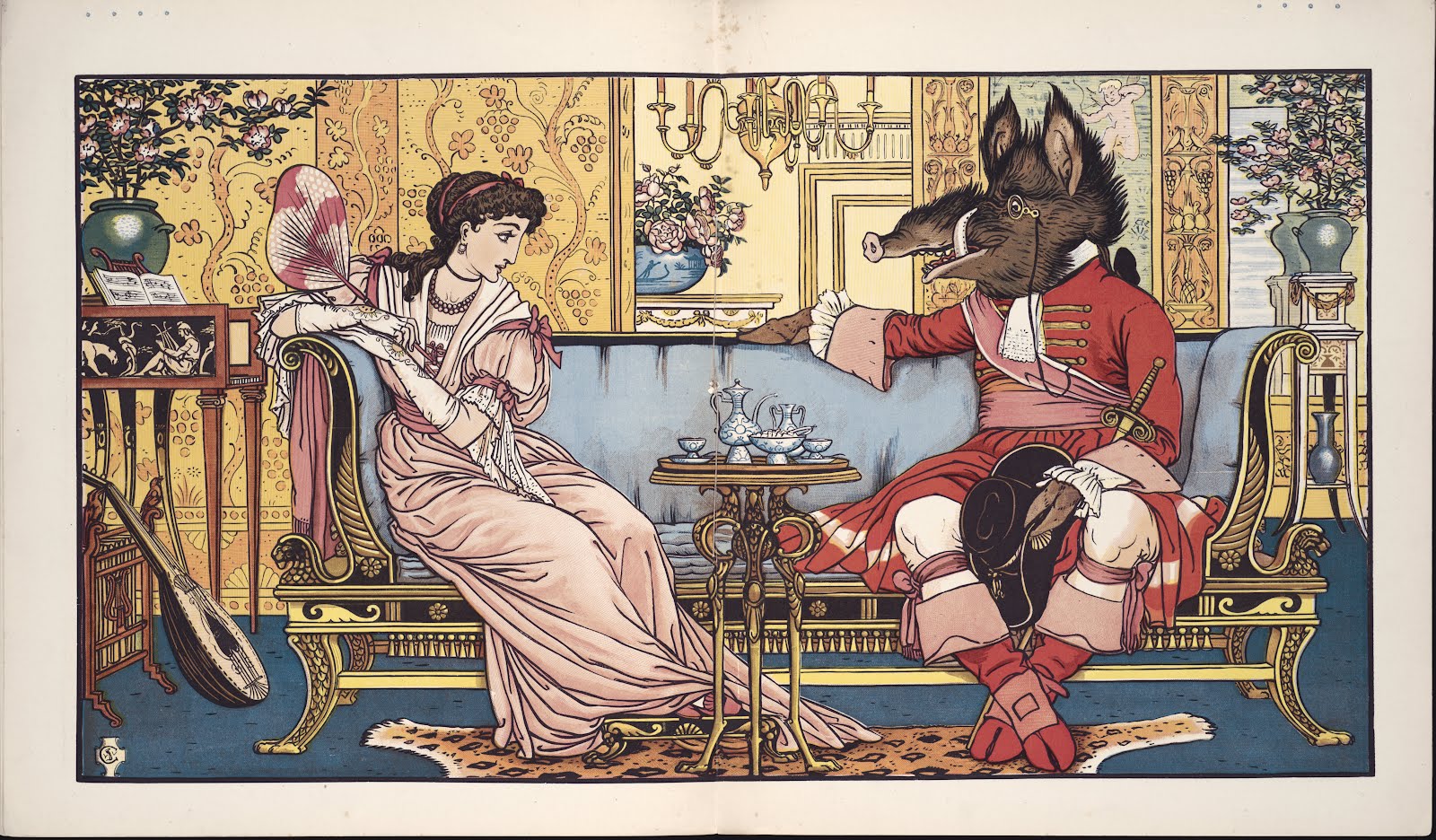
The Beast welcomes Belle to his castle, and proves to be quite civilized. He holds long conversations with her each day, gives her fine clothing, and declares her the mistress of his castle. Every night they share a meal together, and it is here that I must attach a picture.
This was one of the first illustrations of the Beast. Isn’t he adorable?!
*Ahem*, anyway! Each night after dinner the Beast asks Belle to marry him, and each night she declines. After her refusal Belle goes to bed, where she dreams of a handsome prince who asks her why she won’t marry the Beast. Belle responds that she only loves the Beast as a friend. Convinced that the Beast is holding the prince prisoner, Belle searches for him during the day, but never finds him.
Eventually Belle becomes homesick and begs the Beast to let her see her family. He agrees, but asks that she stay no longer than one week. When Belle agrees he sends her off with a magic mirror, which lets her see the Beast’s castle, and a magic ring that will instantly return her to the castle if she twists it on her finger three times.
Belle quickly arrives at her home and is overjoyed to see her father and sisters. Her sisters are shocked to see the finery Belle is dressed in, and quickly become jealous of her life at the castle. When they hear that Belle has promised to only stay with them for a week, they cajole her into staying for one extra day. The sisters hope that this will cause the Beast to become angry with Belle and kill her.
When the eighth day of her visit arrives Belle feels terribly guilty. She looks in the magic mirror to check in on the Beast - only to find him lying half-dead from heartbreak. Belle immediately uses the magic ring to return to him. She professes her love for him and begins to weep over the Beast. At her declaration he turns into the handsome prince from her dreams!
The prince explains that he was cursed by a fairy after he refused to let her take shelter from the rain. The curse would only be broken if he could find true love despite his ugly exterior. He and Belle marry, and they live happily ever after.
There you have the original story of Beauty and the Beast! I hope you enjoyed it. I’m actually a little disappointed that so many of its adaptations don’t include the sisters - in many ways, they’re more hateable than Gaston!
Beauty and the Beast has quite a few similarities to mythology. I’ve talked before about the Greek story of Hades and Persephone, and the Mesopotamian one of Ereshkigal and Nergal. In both cases, “Beauty” (who is a guy in the Mesopotamian myth) is sent to the Beast because of “her” father. The Beast turns out to not be as terrible as previously thought, and the myths end with Beauty and the Beast ruling together from their palace (at least for half of the year, in the case of Persephone). I love the similarities between the mythology and the fairy tale, but also the differences!
As far as modern adaptations of the story go, oh goodness...I have so many that I love! Robin McKinley is one of my favorite authors, and whenever I’m having a hard time I read one of her books. She has actually written two Beauty and the Beast stories, each of them quite different from one another. My favorite of the two is Rose Daughter, but Beauty is very nearly as good!
On the movie side of things, of course there’s Disney’s “Beauty and the Beast”. While I still haven’t read the book Beastly, I do enjoy the movie adaptation - it’s a modern take on Beauty and the Beast, and while it takes some liberties with the story, it’s worth it for Neil Patrick Harris alone! There’s also a fascinating film called “Blood of Beasts” which my dad and I found on Netflix and absolutely adored. It is a tragedy, but it’s really interesting to see a Viking take on Beauty and the Beast!
I hope you guys enjoyed this post, and I hope I’ll see you again next week! My next post will be about The White Cat, which is probably my favorite fairy tale. As always, please comment below or email me with anything you want to talk about; I’m still taking requests for fairy tales you want me to do a post about!
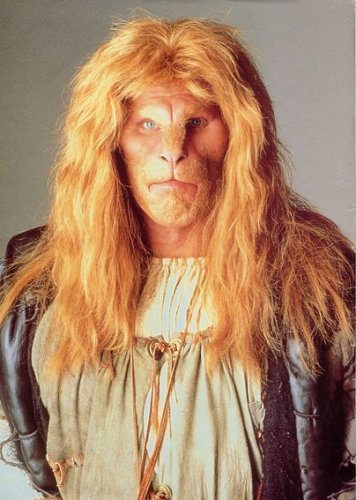
One last thing: There was a TV show called “Beauty and the Beast” that starred Ron Perlman as a leonine Beast. While the show got too strange and depressing for me to finish, I did dearly love his take on the Beast; mostly I just love his appearance! So here, because it seems appropriate for this post, is a picture of him.
See you next post!
This post I’d like to talk about one of my favorite fairy tales: Beauty and the Beast. Most of you are probably familiar with the story, but modern adaptations of it vary greatly from the original tale. For instance, Disney’s addition of Gaston to the movie (which is my second favorite Disney movie, if anyone is interested), or the fact that most films have Belle as an only child instead of having sisters. The core elements remain the same, but minor details are changed with every retelling. As such, I’d like to talk about the original story. Beauty and the Beast was written in the 1700’s by a French woman named Jeanne-Marie Leprince de Beaumont. The tale is as follows:
Once upon a time there was a wealthy merchant who had three daughters. The youngest of them, Belle, was the most beautiful and pure of heart. One day when the sisters were all fully-grown the merchant lost his ships at sea - and with them, his wealth. Used to living the high life, the sisters are suddenly forced to move to a farm and do manual labor. Belle bears this with remarkably good grace, but her sisters hate the work and complain all the time.
Eventually Belle’s father hears that one of his ships has appeared in port. He decides to travel back to the city to see if any of its cargo is intact. The father asks his daughters what they want him to bring back from the city. The two eldest ask for jewels and rich clothing; Belle requests a rose, since their farm has none.
When the father arrives at the port he is dismayed to find that all of the ship’s goods have been seized to repay his debts. Left with no money and nowhere to stay, he sets out to return home. Along the way he becomes lost in a great forest; seeking shelter from a storm, the father stumbles upon an enormous castle. The doors all somehow open as he approaches them, and he heads inside to find the master of the house. Instead the father finds a dining room with a rich meal laid out. When no one arrives, he eats the meal and spends the night on the couch.
The next morning the merchant has another meal and sets out to leave the castle. As he approaches the gate he notices a large, beautiful rose garden. Remembering Belle’s request, he cuts one of the roses to take home to her - only to be confronted by a hideous Beast!
The Beast is furious that the merchant has betrayed his hospitality by stealing one of his roses. He threatens to kill the man, but the girl’s father explains that he only picked the rose to fulfill a promise to his daughter. His explanation calms the Beast, who agrees to let the father return to his daughters and give Belle the rose...but only if the father will come back to the Beast’s castle.
When Belle’s father agrees, the Beast sends him back to the girls with saddlebags full of jewels and rich clothing. The Beast also forces the merchant to promise not to tell Belle of his agreement to come back. Of course, Belle eventually pries the story out of him when he returns home. Determined not to let her father go back to the Beast, Belle goes in his stead.
The Beast welcomes Belle to his castle, and proves to be quite civilized. He holds long conversations with her each day, gives her fine clothing, and declares her the mistress of his castle. Every night they share a meal together, and it is here that I must attach a picture.
This was one of the first illustrations of the Beast. Isn’t he adorable?!
*Ahem*, anyway! Each night after dinner the Beast asks Belle to marry him, and each night she declines. After her refusal Belle goes to bed, where she dreams of a handsome prince who asks her why she won’t marry the Beast. Belle responds that she only loves the Beast as a friend. Convinced that the Beast is holding the prince prisoner, Belle searches for him during the day, but never finds him.
Eventually Belle becomes homesick and begs the Beast to let her see her family. He agrees, but asks that she stay no longer than one week. When Belle agrees he sends her off with a magic mirror, which lets her see the Beast’s castle, and a magic ring that will instantly return her to the castle if she twists it on her finger three times.
Belle quickly arrives at her home and is overjoyed to see her father and sisters. Her sisters are shocked to see the finery Belle is dressed in, and quickly become jealous of her life at the castle. When they hear that Belle has promised to only stay with them for a week, they cajole her into staying for one extra day. The sisters hope that this will cause the Beast to become angry with Belle and kill her.
When the eighth day of her visit arrives Belle feels terribly guilty. She looks in the magic mirror to check in on the Beast - only to find him lying half-dead from heartbreak. Belle immediately uses the magic ring to return to him. She professes her love for him and begins to weep over the Beast. At her declaration he turns into the handsome prince from her dreams!
The prince explains that he was cursed by a fairy after he refused to let her take shelter from the rain. The curse would only be broken if he could find true love despite his ugly exterior. He and Belle marry, and they live happily ever after.
There you have the original story of Beauty and the Beast! I hope you enjoyed it. I’m actually a little disappointed that so many of its adaptations don’t include the sisters - in many ways, they’re more hateable than Gaston!
Beauty and the Beast has quite a few similarities to mythology. I’ve talked before about the Greek story of Hades and Persephone, and the Mesopotamian one of Ereshkigal and Nergal. In both cases, “Beauty” (who is a guy in the Mesopotamian myth) is sent to the Beast because of “her” father. The Beast turns out to not be as terrible as previously thought, and the myths end with Beauty and the Beast ruling together from their palace (at least for half of the year, in the case of Persephone). I love the similarities between the mythology and the fairy tale, but also the differences!
As far as modern adaptations of the story go, oh goodness...I have so many that I love! Robin McKinley is one of my favorite authors, and whenever I’m having a hard time I read one of her books. She has actually written two Beauty and the Beast stories, each of them quite different from one another. My favorite of the two is Rose Daughter, but Beauty is very nearly as good!
On the movie side of things, of course there’s Disney’s “Beauty and the Beast”. While I still haven’t read the book Beastly, I do enjoy the movie adaptation - it’s a modern take on Beauty and the Beast, and while it takes some liberties with the story, it’s worth it for Neil Patrick Harris alone! There’s also a fascinating film called “Blood of Beasts” which my dad and I found on Netflix and absolutely adored. It is a tragedy, but it’s really interesting to see a Viking take on Beauty and the Beast!
I hope you guys enjoyed this post, and I hope I’ll see you again next week! My next post will be about The White Cat, which is probably my favorite fairy tale. As always, please comment below or email me with anything you want to talk about; I’m still taking requests for fairy tales you want me to do a post about!
One last thing: There was a TV show called “Beauty and the Beast” that starred Ron Perlman as a leonine Beast. While the show got too strange and depressing for me to finish, I did dearly love his take on the Beast; mostly I just love his appearance! So here, because it seems appropriate for this post, is a picture of him.
See you next post!
Monday, March 30, 2015
The Snow Queen
Hello readers! I hope you all had a lovely weekend. It amuses me that I chose this week to write about The Snow Queen; over the past week the weather in Tucson has risen to over 90°! Oh, well. Perhaps writing about the snow will make it seem cooler.
The Snow Queen is an interesting fairy tale in that it did not exist before the 1840’s. The story is an original tale written by Hans Christian Andersen. Most fairy tales have some sort of conflict between good and evil; because of his beliefs, Andersen made the conflict in his story revolve around angels and demons.
Before I begin the tale, I want to address one issue: The Snow Queen is not Frozen. Not at all, not by a long shot. If you’re familiar with the story you likely know this already; if you’ve never heard it before, you’ll see it as you read it. I’ve heard some people talking about how similar the two stories are to one another, and it really bugs me. Frozen was originally intended to follow the plot of The Snow Queen, but the writers decided to make Elsa the main heroine instead of the main villain. The movie has very little in common with the original tale.
Now that I’ve gotten my pet peeve out of the way, let’s begin!
Once upon a time the devil created a magical mirror. This mirror distorted the vision of those who looked into it, allowing the viewer to see only the bad and the ugly instead of the good and the beautiful. The devil enjoyed taking a cohort of demons with him and traveling the world, warping the views of anyone who happened to look in the mirror.
Eventually this form of entertainment was not enough for the devil. He led his demons through the sky and attempted to take the mirror into Heaven, where he would force God and the angels to gaze into it. As they rose into the sky, the mirror began to shake with laughter. The devil and his demons attempted to keep going, but the mirror shook more the higher they rose. Eventually they lost their grip on it and the mirror slipped from their grasp, falling to Earth where it shattered into millions of pieces.
These pieces were tiny - some only the size of sand grains - and they blew around the world. Some of the pieces became lodged in people’s eyes, making the people see only the bad in their fellow man. Other pieces got stuck in people’s hearts, freezing them and stopping them from experiencing emotions.
Our story begins years later, with two children who grew up next door to one another. The boy was named Kai, and the girl Gerda; they were best friends. The buildings they lived in were so close together that one of them could get to the other’s home simply by stepping across the balconies each of their dwellings had. These balconies (called window-boxes) each had a garden that the children tended to.
One night Kai’s grandmother tells the children a story about the Snow Queen, a woman who rules over the snowflakes. During that winter Kai looks out of his window one night and sees the Snow Queen beckoning to him; he pulls away from the window in fear.
When spring arrives, so too does Gerda’s realization that she is in love with Kai. The gardens on their window-boxes have grown roses, and the sight of them never fails to remind Gerda of her love for her friend.
Unfortunately, everything changes during the summer (when the Fire Nation attacks? Sorry, couldn’t help it!). Splinters of the magical mirror from the beginning of the story get blown into Kai’s eyes and heart. Unable to feel, the boy only sees the ugliness in the world around him. He destroys the garden that he and Gerda have tended to all their lives. Kai also mocks his grandmother, thinking her nothing more than a foolish old woman. Despite the mirror fragment, Kai can still see perfection in one thing - snowflakes.
That winter Kai goes out to a festival and hitches his sled to the sleigh of a woman dressed in a white fur coat. The woman is in fact the Snow Queen!
After revealing this to Kai, she talks with him for a short time. Seeing his love of winter, the Snow Queen whisks Kai away from the city. (I wonder if C. S. Lewis drew any inspiration from this story? Andersen’s Snow Queen certainly seems similar to Lewis’ White Witch, Jadis.) Once outside its bounds she kisses him; once to make him immune to the cold, and a second time to take away his memories of Gerda and his family. She explains that a third kiss would kill him. The Snow Queen then takes Kai with her back to her palace.
Back in the town, it is believed that Kai drowned in a nearby river. Gerda is heartbroken, and sets out to determine the truth. She goes to the river and offers it her red shoes if it will give her back Kai; when it does not accept, she realizes that it does not have her friend. In exchange for her shoes, the river sends her to a sorceress who might know where Kai is.
(Remember - this is in the middle of winter. Gerda wanders around barefoot for the rest of the story. I’m amazed she didn’t lose her feet...)
Gerda travels to meet the sorceress, who lives in a land of eternal summer. The sorceress wants Gerda to stay with her, so she makes her forget Kai. Knowing that the sight of the rose bushes would remind her of her love for him, the sorceress also makes all of her rose bushes disappear under the earth. Fortunately for our heroine, Gerda begins to cry, and her tears raise one of the bushes from the ground. This brings back her memories of Kai. The bush tells Gerda that it was able to see the land of the dead while it was underground, and that Kai was not there.
Gerda flees the home of the sorceress, and eventually stumbles across a crow. The crow takes pity on the girl and tells her that Kai is in the palace of the princess. Gerda rushes to the palace, only to discover that Kai is not there. Instead she meets the prince, who looks remarkably like Kai. Gerda tells the prince and princess her story, and they provide her with warm clothes and a coach. (For some reason, she remains barefoot...) Gerda sets out from the palace, still determined to find Kai.
Unfortunately, her rich coach attracts robbers. Gerda is captured by them and taken back to their palace (So many palaces!!). While there, she manages to befriend a young robber girl. The girl keeps doves as pets, and they report having seen Kai being taken away by the Snow Queen towards Lapland. A reindeer that the robbers keep offers to take Gerda there, since Lapland was its home before it was captured.
Gerda’s robber friend frees both her and the reindeer. True to his word, he takes her to Lapland, and they begin the journey to the Snow Queen’s palace. Along the way they meet a Lapp woman and a Finn woman. Neither of them offer to help Gerda against the Snow Queen; as the Finn woman says, her kind heart has gotten her this far. If she cannot defeat the Snow Queen, no one can.
Gerda eventually makes it to the Snow Queen’s palace, which she finds guarded by snowflakes. Gerda recites the Lord’s Prayer, causing the fog from her breath to take the shape of angels. These angels fight the snowflakes, granting Gerda entrance to the palace. Once inside, she finds Kai sitting on a frozen lake. He has pieces of ice that he must use to spell the word “eternity”; if he can do this, the Snow Queen has promised to free him from her power and give him a pair of ice skates.
He is interrupted by Gerda running up and kissing him. As she cries, her warm tears melt the shard of mirror in his heart.
Kai also begins to weep, which dislodges the mirror shard from his eye. Overjoyed to see Gerda, Kai begins to dance with her. The children’s enthusiasm is so contagious that the pieces of ice Kai had been playing with also begin to dance; when they stop, they fall to the ground and spell out the word “eternity”, compelling the Snow Queen to free Kai.
The reindeer helps Gerda and Kai to escape, along with some help from the Lapp and Finn women. On their way home they meet the robber girl and thank her. They continue on to their town, which they find different from when they left. The couple eventually realize that it is not their home which changed: it is them. During their adventure Gerda and Kai grew up. The story ends as they settle into their homes during summertime.
I love the story of The Snow Queen! I wasn’t able to find a myth that it had similarities to - if you know any, please comment below or email me to let me know! I’d love to hear about it.
I find the ending of The Snow Queen to be quite similar to Phillip Pullman’s His Dark Materials series, which interests me. Having the children grow up and the world around them change because of it is an interesting literary tool that I don’t see used to often.
As to adaptations of The Snow Queen - well, hopefully you can see that Frozen isn’t one of them! Apart from the woman with snow powers, a reindeer (who is named Bae in the story instead of Sven), and shards in the heart (mirror shards, not ice, mind you), the stories are vastly different. Interestingly enough, the TV show Once Upon a Time did a story arc that took place after the events of Frozen. A Snow Queen comes to town with a plan to shatter a magical mirror that embeds itself in the eyes of everyone in town, forcing them to see only the bad in one another. I loved seeing a (mostly) accurate adaptation of The Snow Queen!
As far as books go, I’ve only read three that were based on The Snow Queen. Two are by Mercedes Lackey, and both are part of a series. The first, called The Snow Queen, is part of The Five Hundred Kingdoms series. The Snow Queen here is not really a villain, but it is a fascinating read. I recommend reading the other books in the series first, since the world the story is set in has a complicated system of magic that gets explained best in earlier books. All of the books in this series are actually based on fairy tales, each with a surprising twist!
The second book by Lackey is called The Wizard of London, and it is part of the Elemental Masters series. Chronologically I believe this book comes first, but it wasn’t the first published and it’s explanations of the magical system are not as good as other books in the series. Again, each book in this series is based off of fairy tales, and they’re quite an excellent read.
If you want something a bit shorter (and not part of a series!) Winter’s Child by Cameron Dokey is an excellent novel. Technically it is part of a series, but all of the books are standalone novels with nothing really in common.
Again, I hope you liked reading about The Snow Queen! If you have questions or comments, please post below or email me. This post was done at the request of a reader, and I’d love to do one about a fairy tale of your request too! Just let me know what you’d like me to cover.
I’ll be back next Monday with a post about Beauty and the Beast! See you then!
The Snow Queen is an interesting fairy tale in that it did not exist before the 1840’s. The story is an original tale written by Hans Christian Andersen. Most fairy tales have some sort of conflict between good and evil; because of his beliefs, Andersen made the conflict in his story revolve around angels and demons.
Before I begin the tale, I want to address one issue: The Snow Queen is not Frozen. Not at all, not by a long shot. If you’re familiar with the story you likely know this already; if you’ve never heard it before, you’ll see it as you read it. I’ve heard some people talking about how similar the two stories are to one another, and it really bugs me. Frozen was originally intended to follow the plot of The Snow Queen, but the writers decided to make Elsa the main heroine instead of the main villain. The movie has very little in common with the original tale.
Now that I’ve gotten my pet peeve out of the way, let’s begin!
Once upon a time the devil created a magical mirror. This mirror distorted the vision of those who looked into it, allowing the viewer to see only the bad and the ugly instead of the good and the beautiful. The devil enjoyed taking a cohort of demons with him and traveling the world, warping the views of anyone who happened to look in the mirror.
Eventually this form of entertainment was not enough for the devil. He led his demons through the sky and attempted to take the mirror into Heaven, where he would force God and the angels to gaze into it. As they rose into the sky, the mirror began to shake with laughter. The devil and his demons attempted to keep going, but the mirror shook more the higher they rose. Eventually they lost their grip on it and the mirror slipped from their grasp, falling to Earth where it shattered into millions of pieces.
These pieces were tiny - some only the size of sand grains - and they blew around the world. Some of the pieces became lodged in people’s eyes, making the people see only the bad in their fellow man. Other pieces got stuck in people’s hearts, freezing them and stopping them from experiencing emotions.
Our story begins years later, with two children who grew up next door to one another. The boy was named Kai, and the girl Gerda; they were best friends. The buildings they lived in were so close together that one of them could get to the other’s home simply by stepping across the balconies each of their dwellings had. These balconies (called window-boxes) each had a garden that the children tended to.
One night Kai’s grandmother tells the children a story about the Snow Queen, a woman who rules over the snowflakes. During that winter Kai looks out of his window one night and sees the Snow Queen beckoning to him; he pulls away from the window in fear.
When spring arrives, so too does Gerda’s realization that she is in love with Kai. The gardens on their window-boxes have grown roses, and the sight of them never fails to remind Gerda of her love for her friend.
Unfortunately, everything changes during the summer (when the Fire Nation attacks? Sorry, couldn’t help it!). Splinters of the magical mirror from the beginning of the story get blown into Kai’s eyes and heart. Unable to feel, the boy only sees the ugliness in the world around him. He destroys the garden that he and Gerda have tended to all their lives. Kai also mocks his grandmother, thinking her nothing more than a foolish old woman. Despite the mirror fragment, Kai can still see perfection in one thing - snowflakes.
That winter Kai goes out to a festival and hitches his sled to the sleigh of a woman dressed in a white fur coat. The woman is in fact the Snow Queen!
After revealing this to Kai, she talks with him for a short time. Seeing his love of winter, the Snow Queen whisks Kai away from the city. (I wonder if C. S. Lewis drew any inspiration from this story? Andersen’s Snow Queen certainly seems similar to Lewis’ White Witch, Jadis.) Once outside its bounds she kisses him; once to make him immune to the cold, and a second time to take away his memories of Gerda and his family. She explains that a third kiss would kill him. The Snow Queen then takes Kai with her back to her palace.
Back in the town, it is believed that Kai drowned in a nearby river. Gerda is heartbroken, and sets out to determine the truth. She goes to the river and offers it her red shoes if it will give her back Kai; when it does not accept, she realizes that it does not have her friend. In exchange for her shoes, the river sends her to a sorceress who might know where Kai is.
(Remember - this is in the middle of winter. Gerda wanders around barefoot for the rest of the story. I’m amazed she didn’t lose her feet...)
Gerda travels to meet the sorceress, who lives in a land of eternal summer. The sorceress wants Gerda to stay with her, so she makes her forget Kai. Knowing that the sight of the rose bushes would remind her of her love for him, the sorceress also makes all of her rose bushes disappear under the earth. Fortunately for our heroine, Gerda begins to cry, and her tears raise one of the bushes from the ground. This brings back her memories of Kai. The bush tells Gerda that it was able to see the land of the dead while it was underground, and that Kai was not there.
Gerda flees the home of the sorceress, and eventually stumbles across a crow. The crow takes pity on the girl and tells her that Kai is in the palace of the princess. Gerda rushes to the palace, only to discover that Kai is not there. Instead she meets the prince, who looks remarkably like Kai. Gerda tells the prince and princess her story, and they provide her with warm clothes and a coach. (For some reason, she remains barefoot...) Gerda sets out from the palace, still determined to find Kai.
Unfortunately, her rich coach attracts robbers. Gerda is captured by them and taken back to their palace (So many palaces!!). While there, she manages to befriend a young robber girl. The girl keeps doves as pets, and they report having seen Kai being taken away by the Snow Queen towards Lapland. A reindeer that the robbers keep offers to take Gerda there, since Lapland was its home before it was captured.
Gerda’s robber friend frees both her and the reindeer. True to his word, he takes her to Lapland, and they begin the journey to the Snow Queen’s palace. Along the way they meet a Lapp woman and a Finn woman. Neither of them offer to help Gerda against the Snow Queen; as the Finn woman says, her kind heart has gotten her this far. If she cannot defeat the Snow Queen, no one can.
Gerda eventually makes it to the Snow Queen’s palace, which she finds guarded by snowflakes. Gerda recites the Lord’s Prayer, causing the fog from her breath to take the shape of angels. These angels fight the snowflakes, granting Gerda entrance to the palace. Once inside, she finds Kai sitting on a frozen lake. He has pieces of ice that he must use to spell the word “eternity”; if he can do this, the Snow Queen has promised to free him from her power and give him a pair of ice skates.
He is interrupted by Gerda running up and kissing him. As she cries, her warm tears melt the shard of mirror in his heart.
Kai also begins to weep, which dislodges the mirror shard from his eye. Overjoyed to see Gerda, Kai begins to dance with her. The children’s enthusiasm is so contagious that the pieces of ice Kai had been playing with also begin to dance; when they stop, they fall to the ground and spell out the word “eternity”, compelling the Snow Queen to free Kai.
(I have no idea what this picture is from, but it was so adorable that I had to share it.)
The reindeer helps Gerda and Kai to escape, along with some help from the Lapp and Finn women. On their way home they meet the robber girl and thank her. They continue on to their town, which they find different from when they left. The couple eventually realize that it is not their home which changed: it is them. During their adventure Gerda and Kai grew up. The story ends as they settle into their homes during summertime.
I find the ending of The Snow Queen to be quite similar to Phillip Pullman’s His Dark Materials series, which interests me. Having the children grow up and the world around them change because of it is an interesting literary tool that I don’t see used to often.
As to adaptations of The Snow Queen - well, hopefully you can see that Frozen isn’t one of them! Apart from the woman with snow powers, a reindeer (who is named Bae in the story instead of Sven), and shards in the heart (mirror shards, not ice, mind you), the stories are vastly different. Interestingly enough, the TV show Once Upon a Time did a story arc that took place after the events of Frozen. A Snow Queen comes to town with a plan to shatter a magical mirror that embeds itself in the eyes of everyone in town, forcing them to see only the bad in one another. I loved seeing a (mostly) accurate adaptation of The Snow Queen!
As far as books go, I’ve only read three that were based on The Snow Queen. Two are by Mercedes Lackey, and both are part of a series. The first, called The Snow Queen, is part of The Five Hundred Kingdoms series. The Snow Queen here is not really a villain, but it is a fascinating read. I recommend reading the other books in the series first, since the world the story is set in has a complicated system of magic that gets explained best in earlier books. All of the books in this series are actually based on fairy tales, each with a surprising twist!
The second book by Lackey is called The Wizard of London, and it is part of the Elemental Masters series. Chronologically I believe this book comes first, but it wasn’t the first published and it’s explanations of the magical system are not as good as other books in the series. Again, each book in this series is based off of fairy tales, and they’re quite an excellent read.
If you want something a bit shorter (and not part of a series!) Winter’s Child by Cameron Dokey is an excellent novel. Technically it is part of a series, but all of the books are standalone novels with nothing really in common.
Again, I hope you liked reading about The Snow Queen! If you have questions or comments, please post below or email me. This post was done at the request of a reader, and I’d love to do one about a fairy tale of your request too! Just let me know what you’d like me to cover.
I’ll be back next Monday with a post about Beauty and the Beast! See you then!
Monday, March 23, 2015
East of the Sun, West of the Moon
East of the Sun, West of the Moon is one of the first non-mainstream fairy tales I remember reading and falling in love with. My family has a deep and abiding love of polar bears, and our gifts to one another tend to feature said animal. We also have a great love of books. One year for Christmas my mom found me a book called East, which had a girl and a polar bear on the front cover. The book was a retelling of East of the Sun, West of the Moon, and I devoured it during Christmas day. That was my introduction to the fairy tale.
Now, some of you may be wondering what in the world polar bears have to do with East of the Sun, West of the Moon. The answer is: a lot. The fairy tale is Norwegian in origin, and one of the main characters is a polar bear for a large portion of the story. Interested? Excellent! Let me tell you the tale.
Once upon a time there was a poor peasant with a large family. One cold winter’s night he heard knocking on the cottage door. Opening it, he found a large polar bear looming outside. The bear was quite polite and well spoken, despite the peasant’s fear, and offered the man an interesting proposition. In exchange for the peasant’s youngest daughter, the polar bear says he'll make the peasant and his family rich. The bear’s words win the man over to the idea, and he asks the bear to come back after he’s had a chance to convince his daughter.
The girl is understandably reluctant to be given to the bear, but her kind heart takes pity at her family’s poverty. She agrees for their sake, and the bear returns to claim her. He carries her upon his back to a land that is far away, eventually stopping at a castle.
The bear leaves her there, and she finds that all of her needs are met by invisible servants within the castle.
When the girl retires to her bed that night she gets a surprise - a man enters her chambers! It is dark, so she cannot see his face, but his words win her over. He returns every night, but leaves each morning before the light of dawn appears. During the day the girl is kept company by the bear.
Eventually the girl grows homesick. The bear reluctantly agrees to take her back to visit her family, on one condition: she must never speak to her mother alone. The girl agrees, and they begin the long trek back to her family.
She is surprised to find them living in an expensive, well-furnished house instead of the poor cottage she left. The bear had kept his promise and made her family rich. They are thrilled to see her, and insist that the girl tell them everything. She talks about the bear, the castle, and the invisible servants - but she leaves out the strange man who comes to her bed each night.
Throughout her visit the girl’s mother keeps trying to get her alone. Eventually she corners the girl and persuades her to tell everything. Upon hearing about the man, and the fact that the girl has never seen his face, the mother is horrified. After all, for all the girl knows it might be a troll sharing her bed! The mother gives the girl several candles and tells her to light them at night when the man is asleep in order to get a good look at him.
The girl leaves soon after, returning to the palace with the bear. That night she waits until the man is asleep and pulls out the candles from a hiding place in her room. She lights one and walks over to the bed...only to find not a troll, but a handsome man!
The girl is so captured by his beauty that she leans over him to get a better look at his face. Unfortunately, this tilts the candle, and three drops of hot wax fall onto him. This wakes the man, who gazes at her with dismay.
He tells her that he has been cursed by his wicked stepmother to be a bear during the day, only returning to his human form at night. If the girl had lasted for a year without looking at him, the curse would have been broken - but now she has seen his face, and he must return to his stepmother to marry her daughter (who is, unlike the man, a troll. And not just any troll...a princess troll!) The stepmother lives in a castle that is east of the sun and west of the moon - which is, of course, impossible. That’s the whole point; she doesn’t want to be easy to reach.
When the girl wakes up the next morning she finds that the castle has disappeared. (I’m wondering how she would fall asleep after the night’s revelations!) The man - and the bear - are also gone. Having fallen completely in love with him, she decides to set out and try to find him.
The girl travels for a time before coming to a tall mountain. An old woman lives there, and is sitting outside playing with a golden apple. (As in solid gold. Not just gold in color.) The girl asks her if she knows where the castle that is east of the sun and west of the moon is. The woman does not, but she offers to lend the girl a horse to travel to a neighbor’s house, in the hopes that the neighbor might know. She gives the girl the golden apple before she goes.
The neighbor lives on a nearby mountain, and is also an old woman. This one has a golden carding comb instead of an apple. She also doesn’t know the way to the castle east of the sun and west of the moon, but she has a neighbor who might...The process then repeats itself, with the girl being lent a horse and given the carding comb. She travels to yet another mountain, where there lives an old woman with a golden spinning wheel. She doesn’t know the way, but gives the girl the wheel and offers to lend her a horse to take her to the East wind - who might know.
The East wind doesn’t know where the castle is, but he blows her to the West wind, who might. The West wind doesn’t, but he takes her to the South wind. The South wind also does not know, but he transports her to the North wind. There, to the girl’s relief, she is told that the North wind once blew a leaf to the land east of the sun and west of the moon. If the girl would like, he is willing to take her there.
True to his word, the North wind deposits the girl outside the castle east of the sun and west of the moon.
She is unable to infiltrate the castle, so she sits outside and starts playing with the golden apple. The troll princess (the one the man/bear is set to marry) sees this from her window in the castle and desires it. She offers to buy it from the girl, who agrees to trade her golden apple in exchange for one night with the man. The troll agrees.
The troll, however, is not stupid. She gives the man a sleeping potion before bed. When the girl is allowed in to see him, she is unable to wake him up.
The next day goes much the same, with the girl trading the troll princess her golden carding comb in exchange for another night with the prince. The troll once again drugs him, and the girl is once more unable to wake him up. This time something is different, though - there are some townspeople imprisoned in the castle, and they hear the girl crying over the man. The next day they tell him about it. Realizing what’s happening, he only pretends to drink the sleeping draught that night.
During the day the girl trades the golden spinning wheel for one last night with the man. To her joy, she finds him awake. He tells her that he has a plan - he will tell his stepmother that he will only marry the woman who can wash the tallow (the candle wax she had previously dropped on his shirt, now dry and hard) off of his shirt.
The next day is to be the day of the wedding. The man tells his stepmother that he will only marry the woman who can clean the tallow off of his shirt. The troll princess attempts it, but is unable to get it off. So too is the stepmother; they’re royalty, after all, and don’t know how to clean.
The girl then steps up. Having been raised a peasant, she is well aware of how to get tallow out of a shirt, and swiftly does so.
The troll princess - and the man’s stepmother - are so enraged by this that they quite literally explode. (I’m picturing that scene from Big Trouble in Little China...) The townspeople within the castle are freed, and the man marries the girl after they leave the castle.
So ends the story of East of the Sun, West of the Moon. I forgot how long that one is! My plan had been to tell the story, and then to tell the Greek and Roman myth of Cupid and Psyche. I don’t want this post to be too huge, so I’ll have to postpone it for now and do a full post about Cupid and Psyche another time. However, I will say here that it is a myth that is highly similar to East of the Sun, West of the Moon, despite hailing from another part of the world. It deals with the god of love, Cupid, who takes a bride to a castle in the sky. She never sees his face, as he only comes to her at night. Psyche’s sisters are the ones who convince her to look upon him, and she does so with a lamp instead of a candle. As such, it is oil instead of wax that spills onto Cupid. He disappears, and she sets out on a quest to find him...all while being hindered by the goddess Aphrodite, Cupid’s mother. Can you say in-law problems? When I do a post series on Roman myths, I promise I’ll cover this one!
Now, some of you may be wondering what in the world polar bears have to do with East of the Sun, West of the Moon. The answer is: a lot. The fairy tale is Norwegian in origin, and one of the main characters is a polar bear for a large portion of the story. Interested? Excellent! Let me tell you the tale.
Once upon a time there was a poor peasant with a large family. One cold winter’s night he heard knocking on the cottage door. Opening it, he found a large polar bear looming outside. The bear was quite polite and well spoken, despite the peasant’s fear, and offered the man an interesting proposition. In exchange for the peasant’s youngest daughter, the polar bear says he'll make the peasant and his family rich. The bear’s words win the man over to the idea, and he asks the bear to come back after he’s had a chance to convince his daughter.
The girl is understandably reluctant to be given to the bear, but her kind heart takes pity at her family’s poverty. She agrees for their sake, and the bear returns to claim her. He carries her upon his back to a land that is far away, eventually stopping at a castle.
The bear leaves her there, and she finds that all of her needs are met by invisible servants within the castle.
When the girl retires to her bed that night she gets a surprise - a man enters her chambers! It is dark, so she cannot see his face, but his words win her over. He returns every night, but leaves each morning before the light of dawn appears. During the day the girl is kept company by the bear.
Eventually the girl grows homesick. The bear reluctantly agrees to take her back to visit her family, on one condition: she must never speak to her mother alone. The girl agrees, and they begin the long trek back to her family.
She is surprised to find them living in an expensive, well-furnished house instead of the poor cottage she left. The bear had kept his promise and made her family rich. They are thrilled to see her, and insist that the girl tell them everything. She talks about the bear, the castle, and the invisible servants - but she leaves out the strange man who comes to her bed each night.
Throughout her visit the girl’s mother keeps trying to get her alone. Eventually she corners the girl and persuades her to tell everything. Upon hearing about the man, and the fact that the girl has never seen his face, the mother is horrified. After all, for all the girl knows it might be a troll sharing her bed! The mother gives the girl several candles and tells her to light them at night when the man is asleep in order to get a good look at him.
The girl leaves soon after, returning to the palace with the bear. That night she waits until the man is asleep and pulls out the candles from a hiding place in her room. She lights one and walks over to the bed...only to find not a troll, but a handsome man!
The girl is so captured by his beauty that she leans over him to get a better look at his face. Unfortunately, this tilts the candle, and three drops of hot wax fall onto him. This wakes the man, who gazes at her with dismay.
He tells her that he has been cursed by his wicked stepmother to be a bear during the day, only returning to his human form at night. If the girl had lasted for a year without looking at him, the curse would have been broken - but now she has seen his face, and he must return to his stepmother to marry her daughter (who is, unlike the man, a troll. And not just any troll...a princess troll!) The stepmother lives in a castle that is east of the sun and west of the moon - which is, of course, impossible. That’s the whole point; she doesn’t want to be easy to reach.
When the girl wakes up the next morning she finds that the castle has disappeared. (I’m wondering how she would fall asleep after the night’s revelations!) The man - and the bear - are also gone. Having fallen completely in love with him, she decides to set out and try to find him.
The girl travels for a time before coming to a tall mountain. An old woman lives there, and is sitting outside playing with a golden apple. (As in solid gold. Not just gold in color.) The girl asks her if she knows where the castle that is east of the sun and west of the moon is. The woman does not, but she offers to lend the girl a horse to travel to a neighbor’s house, in the hopes that the neighbor might know. She gives the girl the golden apple before she goes.
The neighbor lives on a nearby mountain, and is also an old woman. This one has a golden carding comb instead of an apple. She also doesn’t know the way to the castle east of the sun and west of the moon, but she has a neighbor who might...The process then repeats itself, with the girl being lent a horse and given the carding comb. She travels to yet another mountain, where there lives an old woman with a golden spinning wheel. She doesn’t know the way, but gives the girl the wheel and offers to lend her a horse to take her to the East wind - who might know.
The East wind doesn’t know where the castle is, but he blows her to the West wind, who might. The West wind doesn’t, but he takes her to the South wind. The South wind also does not know, but he transports her to the North wind. There, to the girl’s relief, she is told that the North wind once blew a leaf to the land east of the sun and west of the moon. If the girl would like, he is willing to take her there.
True to his word, the North wind deposits the girl outside the castle east of the sun and west of the moon.
She is unable to infiltrate the castle, so she sits outside and starts playing with the golden apple. The troll princess (the one the man/bear is set to marry) sees this from her window in the castle and desires it. She offers to buy it from the girl, who agrees to trade her golden apple in exchange for one night with the man. The troll agrees.
The troll, however, is not stupid. She gives the man a sleeping potion before bed. When the girl is allowed in to see him, she is unable to wake him up.
The next day goes much the same, with the girl trading the troll princess her golden carding comb in exchange for another night with the prince. The troll once again drugs him, and the girl is once more unable to wake him up. This time something is different, though - there are some townspeople imprisoned in the castle, and they hear the girl crying over the man. The next day they tell him about it. Realizing what’s happening, he only pretends to drink the sleeping draught that night.
During the day the girl trades the golden spinning wheel for one last night with the man. To her joy, she finds him awake. He tells her that he has a plan - he will tell his stepmother that he will only marry the woman who can wash the tallow (the candle wax she had previously dropped on his shirt, now dry and hard) off of his shirt.
The next day is to be the day of the wedding. The man tells his stepmother that he will only marry the woman who can clean the tallow off of his shirt. The troll princess attempts it, but is unable to get it off. So too is the stepmother; they’re royalty, after all, and don’t know how to clean.
The girl then steps up. Having been raised a peasant, she is well aware of how to get tallow out of a shirt, and swiftly does so.
The troll princess - and the man’s stepmother - are so enraged by this that they quite literally explode. (I’m picturing that scene from Big Trouble in Little China...) The townspeople within the castle are freed, and the man marries the girl after they leave the castle.
So ends the story of East of the Sun, West of the Moon. I forgot how long that one is! My plan had been to tell the story, and then to tell the Greek and Roman myth of Cupid and Psyche. I don’t want this post to be too huge, so I’ll have to postpone it for now and do a full post about Cupid and Psyche another time. However, I will say here that it is a myth that is highly similar to East of the Sun, West of the Moon, despite hailing from another part of the world. It deals with the god of love, Cupid, who takes a bride to a castle in the sky. She never sees his face, as he only comes to her at night. Psyche’s sisters are the ones who convince her to look upon him, and she does so with a lamp instead of a candle. As such, it is oil instead of wax that spills onto Cupid. He disappears, and she sets out on a quest to find him...all while being hindered by the goddess Aphrodite, Cupid’s mother. Can you say in-law problems? When I do a post series on Roman myths, I promise I’ll cover this one!
(Update: I've now done the post on Cupid and Psyche! You can find it here if you're interested.)
I’ll wrap this post up with a few adaptations of East of the Sun, West of the Moon that I really love. I already mentioned East in this post, and I highly recommend that novel if you’re interested. It is a gorgeous retelling of the story, and I love the way the author (Edith Pattou) writes. If you’re looking for a shorter book, Sun and Moon, Ice and Snow by Jessica Day George is also a lovely retelling. Lastly, if you want a huge version of the story that’s also the first book in a series (and that manages to combine the story with Norse mythology, ‘cause it’s just awesome like that. Seriously. This is where I fell in love with the Norns!) check out Once Upon a Winter’s Night by Dennis L. McKiernan.
I hope you guys enjoyed this post! I’ll be back next week with one about The Snow Queen (which is definitely not Frozen!) Until then, as always, feel free to comment below or email me. I'm looking for people to tell me what fairy tales they're interested in seeing covered - The Snow Queen was a request, so I'm doing it, and I'd love to do posts on your suggestions! I'll see you in a week!
I’ll wrap this post up with a few adaptations of East of the Sun, West of the Moon that I really love. I already mentioned East in this post, and I highly recommend that novel if you’re interested. It is a gorgeous retelling of the story, and I love the way the author (Edith Pattou) writes. If you’re looking for a shorter book, Sun and Moon, Ice and Snow by Jessica Day George is also a lovely retelling. Lastly, if you want a huge version of the story that’s also the first book in a series (and that manages to combine the story with Norse mythology, ‘cause it’s just awesome like that. Seriously. This is where I fell in love with the Norns!) check out Once Upon a Winter’s Night by Dennis L. McKiernan.
I hope you guys enjoyed this post! I’ll be back next week with one about The Snow Queen (which is definitely not Frozen!) Until then, as always, feel free to comment below or email me. I'm looking for people to tell me what fairy tales they're interested in seeing covered - The Snow Queen was a request, so I'm doing it, and I'd love to do posts on your suggestions! I'll see you in a week!
Monday, March 16, 2015
Intro to Fairy Tales
I think all of us have heard (or seen, or read) at least one fairy tale in our lives. Some of them are familiar to us: Beauty and the Beast, or Snow White. Others may be more obscure (depending on where you live, of course). Examples of these include the Story of Sigurd, or The White Cat - these are two of my favorites, but are not often told in the US.
So what is a fairy tale? There’s a pretty broad range of stories that are counted as fairy tales. At their most basic definition, fairy tales are fantastical stories that are told by a culture - told, but not believed in. This is their primary distinction from mythology. Although many fairy tales feature royalty (normally princes or princesses) as their main characters, this is not always the case. Both Hansel and Gretel and Jack and the Beanstalk feature poor, lower class characters instead of royals.
A common misconception about fairy tales is that they all begin with the phrase “Once upon a time...” and end with “...and they lived happily ever after.” The first part is at least generally true. Setting a fairy tale in “once upon a time” instead of a specific timeframe is part of what gives fairy tales a timeless quality. Most fairy tales can be imagined happening now just as easily as a few hundred (or even thousand) years ago. By opening with “once upon a time”, the storyteller lets the listeners decide when the story is happening.
So while many fairy tales do begin with “once upon a time”, the “and they lived happily ever after” part is rarely heard. Oh, some fairy tales end with the line, to be sure. However, the vast majority of happy fairy tales end without it. Then you have those fairy tales that are not happy - and these unhappy fairy tales most certainly do not end with “and they lived happily ever after.”
Unhappy fairy tales can be as tragic as some of Shakespeare’s works. They rival both Doctor Who and Supernatural in terms of sheer depressing-ness. Want some examples? The Story of Sigurd, which I mentioned above, ends with the main character and his beloved dead. I personally hate the tale of The Steadfast Tin Soldier, despite how beautifully it is told. The story ends with the Tin Soldier melting, and the toy he loves being burned to a crisp. There are many more unhappy tales out there than those two examples, but I’ll leave it up to you to find them. In general they tend to not be as prominent as the happy fairy tales (in part because Disney tends to only give happy endings.)
One of the most interesting things about fairy tales (at least to me) is the fact that similar tales are told all over the world. I once checked out a book that was a series of essays on Cinderella stories from cultures all over Earth - over 50 versions of the story! A local kid’s shop in my town sells picture books like The Chinese Cinderella or The African Cinderella. Some of the versions of the story are almost identical to the Cinderella tale that we are familiar with. Others are highly different, but with the core elements of the story remaining the same.
The same is true of several other fairy tales. Cultures around the world tend to have tales that are remarkably similar to the stories told by cultures somewhere else in the world. Some of this can be chalked up to the story having migrated from its original home. However, one wonders how cultures that have been largely secluded from other people in the world have the same story as a culture that embraces immigrants. Is it possible that the stories sprang up independently from one another?
I personally would love to find that there are aliens in the universe, just so that I could ask people from another planet about the fairy tales they tell. Would they be similar to ours, I wonder?
Another interesting aspect of fairy tales is the similarity some of them bear to mythological stories. I’ll go into this in more detail in later posts, but several common fairy tales seem to have drawn inspiration from myths. The story East of the Sun, West of the Moon is remarkably similar to the Greek myth of Eros and Psyche. Beauty and the Beast shares some concepts with the Greek myth of Hades and Persephone, or the Mesopotamian one of Ereshkigal and Nergal. I am hardly the first person to remark on this, but I do find it fascinating. There’s a quote from a man named Max Muller that sums it up nicely:
And with that, I’ll wrap up this post. My plan for the foreseeable future is to do posts about individual fairy tales. In that post, I’ll give a rundown of the story, talk about any mythological ties that I can find for it, and end with a recommendation of an adaptation (book or movie) of the story that I particularly enjoyed.
I hope that this was interesting for you guys! I really love fairy tales, especially the more timeless ones, and I’m looking forward to talking about them with you. If you have a fairy tale that you’d like me to cover, please comment below or email me! I’ll be back next week with a post about East of the Sun, West of the Moon.
So what is a fairy tale? There’s a pretty broad range of stories that are counted as fairy tales. At their most basic definition, fairy tales are fantastical stories that are told by a culture - told, but not believed in. This is their primary distinction from mythology. Although many fairy tales feature royalty (normally princes or princesses) as their main characters, this is not always the case. Both Hansel and Gretel and Jack and the Beanstalk feature poor, lower class characters instead of royals.
A common misconception about fairy tales is that they all begin with the phrase “Once upon a time...” and end with “...and they lived happily ever after.” The first part is at least generally true. Setting a fairy tale in “once upon a time” instead of a specific timeframe is part of what gives fairy tales a timeless quality. Most fairy tales can be imagined happening now just as easily as a few hundred (or even thousand) years ago. By opening with “once upon a time”, the storyteller lets the listeners decide when the story is happening.
So while many fairy tales do begin with “once upon a time”, the “and they lived happily ever after” part is rarely heard. Oh, some fairy tales end with the line, to be sure. However, the vast majority of happy fairy tales end without it. Then you have those fairy tales that are not happy - and these unhappy fairy tales most certainly do not end with “and they lived happily ever after.”
Unhappy fairy tales can be as tragic as some of Shakespeare’s works. They rival both Doctor Who and Supernatural in terms of sheer depressing-ness. Want some examples? The Story of Sigurd, which I mentioned above, ends with the main character and his beloved dead. I personally hate the tale of The Steadfast Tin Soldier, despite how beautifully it is told. The story ends with the Tin Soldier melting, and the toy he loves being burned to a crisp. There are many more unhappy tales out there than those two examples, but I’ll leave it up to you to find them. In general they tend to not be as prominent as the happy fairy tales (in part because Disney tends to only give happy endings.)
One of the most interesting things about fairy tales (at least to me) is the fact that similar tales are told all over the world. I once checked out a book that was a series of essays on Cinderella stories from cultures all over Earth - over 50 versions of the story! A local kid’s shop in my town sells picture books like The Chinese Cinderella or The African Cinderella. Some of the versions of the story are almost identical to the Cinderella tale that we are familiar with. Others are highly different, but with the core elements of the story remaining the same.
The same is true of several other fairy tales. Cultures around the world tend to have tales that are remarkably similar to the stories told by cultures somewhere else in the world. Some of this can be chalked up to the story having migrated from its original home. However, one wonders how cultures that have been largely secluded from other people in the world have the same story as a culture that embraces immigrants. Is it possible that the stories sprang up independently from one another?
I personally would love to find that there are aliens in the universe, just so that I could ask people from another planet about the fairy tales they tell. Would they be similar to ours, I wonder?
Another interesting aspect of fairy tales is the similarity some of them bear to mythological stories. I’ll go into this in more detail in later posts, but several common fairy tales seem to have drawn inspiration from myths. The story East of the Sun, West of the Moon is remarkably similar to the Greek myth of Eros and Psyche. Beauty and the Beast shares some concepts with the Greek myth of Hades and Persephone, or the Mesopotamian one of Ereshkigal and Nergal. I am hardly the first person to remark on this, but I do find it fascinating. There’s a quote from a man named Max Muller that sums it up nicely:
“The gods of ancient mythology were changed into the demi-gods and heroes of ancient poetry, and these demi-gods again became, at a later age, the principal characters of our nursery tales.”
And with that, I’ll wrap up this post. My plan for the foreseeable future is to do posts about individual fairy tales. In that post, I’ll give a rundown of the story, talk about any mythological ties that I can find for it, and end with a recommendation of an adaptation (book or movie) of the story that I particularly enjoyed.
I hope that this was interesting for you guys! I really love fairy tales, especially the more timeless ones, and I’m looking forward to talking about them with you. If you have a fairy tale that you’d like me to cover, please comment below or email me! I’ll be back next week with a post about East of the Sun, West of the Moon.
Monday, March 9, 2015
What is a Myth/Fairy Tale/Legend/Folktale?
Hey guys!
Since I’m switching over for now from mythology to fairy tales, I thought it might be helpful to give an explanation of what falls into which categories. This was actually really interesting for me to take a closer look at; I hadn’t known all of the distinctions between the various terms.
Lets go ahead and start with mythology. Mythology is defined as a collection of stories explaining a culture, their history, and how they thought nature worked. To this end, you have stories about Zeus or Thor explaining the existence of lightning, and other gods that explain other aspects of nature. The story of Gilgamesh was how the later Mesopotamians explained the history of one of their kings. Most of what we know about the Mesopotamians actually comes from their mythology.
Fairy tales are vastly different from mythology, though they can seem just as fantastical at times. For starters, mythology is something that someone once believed in. Fairy tales (as much as we love to believe in them when we are young) are only stories. They generally feature some sort of magic or inhuman creature. I'll talk a lot more about them in my next post!
Legends are interesting in that they generally have some sort of historical grounding. While they can be just as wild and imaginative as fairy tales, they have ties to history that make them seem somewhat plausible. The story of King Arthur is both a myth and a legend, given that it has some grounding in history. Another example of a legend would be the more modern story of the survival of Anastasia. Though there is precious little hope that such a thing is possible, the story has historical ties and is thus a legend.
Folktales are interesting in that they can include things from any of the other categories. At its most basic definition, folktales are stories that the people of a culture tell. There may be small amounts of truth to the story, or none at all. The culture may believe in the stories that they tell, or simply tell tall tales for the fun of it. Fairy tales and legends both fall into the category of folktales, amongst other things. Folktales also have high similarities to mythology. Folktales are also sometimes called folklore.
I’m not sure if this has been any help, but I thought it was interesting to look at the distinctions (and crossovers!) between the different terms. There’s a lot more to each category, and if you’re interested I’d recommend looking it up! It’s a fascinating topic.
As a reminder, I am now on a once-a-week update schedule. I know this post was shorter than most of mine have been, but I’ll make it up to you next week. In that post, we’ll take a closer look at fairy tales - including some of the different stories, the types of characters, and the ties fairy tales have with mythology. I’ll see you then!
Since I’m switching over for now from mythology to fairy tales, I thought it might be helpful to give an explanation of what falls into which categories. This was actually really interesting for me to take a closer look at; I hadn’t known all of the distinctions between the various terms.
Lets go ahead and start with mythology. Mythology is defined as a collection of stories explaining a culture, their history, and how they thought nature worked. To this end, you have stories about Zeus or Thor explaining the existence of lightning, and other gods that explain other aspects of nature. The story of Gilgamesh was how the later Mesopotamians explained the history of one of their kings. Most of what we know about the Mesopotamians actually comes from their mythology.
Fairy tales are vastly different from mythology, though they can seem just as fantastical at times. For starters, mythology is something that someone once believed in. Fairy tales (as much as we love to believe in them when we are young) are only stories. They generally feature some sort of magic or inhuman creature. I'll talk a lot more about them in my next post!
Legends are interesting in that they generally have some sort of historical grounding. While they can be just as wild and imaginative as fairy tales, they have ties to history that make them seem somewhat plausible. The story of King Arthur is both a myth and a legend, given that it has some grounding in history. Another example of a legend would be the more modern story of the survival of Anastasia. Though there is precious little hope that such a thing is possible, the story has historical ties and is thus a legend.
Folktales are interesting in that they can include things from any of the other categories. At its most basic definition, folktales are stories that the people of a culture tell. There may be small amounts of truth to the story, or none at all. The culture may believe in the stories that they tell, or simply tell tall tales for the fun of it. Fairy tales and legends both fall into the category of folktales, amongst other things. Folktales also have high similarities to mythology. Folktales are also sometimes called folklore.
I’m not sure if this has been any help, but I thought it was interesting to look at the distinctions (and crossovers!) between the different terms. There’s a lot more to each category, and if you’re interested I’d recommend looking it up! It’s a fascinating topic.
As a reminder, I am now on a once-a-week update schedule. I know this post was shorter than most of mine have been, but I’ll make it up to you next week. In that post, we’ll take a closer look at fairy tales - including some of the different stories, the types of characters, and the ties fairy tales have with mythology. I’ll see you then!
Subscribe to:
Posts (Atom)