Hello all!
Today I wanted to take a look at a fairy tale I really enjoy. There's several different versions of it (the one by the Grimms is, of course, significantly more violent), but the one I know best comes from Andrew Lang's The Yellow Fairy Book. The story itself is called The Six Swans. Shall we begin?
Once upon a time there was a king who was out hunting with his court. The king got himself quite lost in the woods, and found himself hungry and thirsty, with no idea where he was or how to get back. He wandered for a time before he met an old woman - a witch.
The witch told the king that without her help, he would never find his way out of the woods. He would die of starvation, all alone. Left with no choice, the king begged the witch for help. She led him to her home, where her daughter, a beautiful maiden, sat waiting. (The book actually says "She received the King as if she were expecting him" - I've always wondered if the witch or her daughter cast some spell to get the king lost.)
A deal was offered by the witch. If the king married her daughter, she would show him the way out of the forest. On the surface, the deal was not a bad one; the witch's daughter was quite beautiful and well behaved. Yet a sense of dread filled the king every time he looked at her. Left with no choice, the king reluctantly accepted the witch's offer. He and the witch's daughter left the woods, and were soon married at his castle.
This was not the king's marriage. He was a widower, and his previous wife had given him seven children: six boys and one girl. The king's sense of unease about his new spouse lingered, and he feared for the safety of his children. Without telling her of their existence, he whisked the seven children away to a small castle in the woods, where they could live in safety.
But the king was a doting father, and he did not like to be separated from his children. Because of this, he visited them frequently, disappearing into the woods for hours at a time. The queen took note of this, and did not like his absences. Since the king refused to tell her where he went, she bribed some of his servants, who admitted to the existence of the children. (Since girls were considered inconsequential at the time, only the boys were mentioned. As such, the queen thought that there were only six kids.)
The queen did not like that at all. Her mother had taught her some of her witchcraft, so she set out for the castle with magic in hand - six enchanted shirts she had sewn. When the children saw a rider approaching they ran to meet it, expecting their father. However, the daughter was more cautious, and stayed back to watch. She was horrified to see the queen throw the shirts over her six brothers. One by one, the boys fell to the ground...where they transformed into swans!
The queen rode back to the castle, satisfied that her job was done. As for the swans, they flew off into the night, leaving the king's daughter all alone.
When the king came to visit the next day, he was horrified to find his sons missing. The princess explained everything that had happened to him, but she did not know that the attacker was the queen. Not wanting to lose his only remaining child, the king begged his daughter to return with him to the castle. However, she was afraid of the place, and instead ran away.
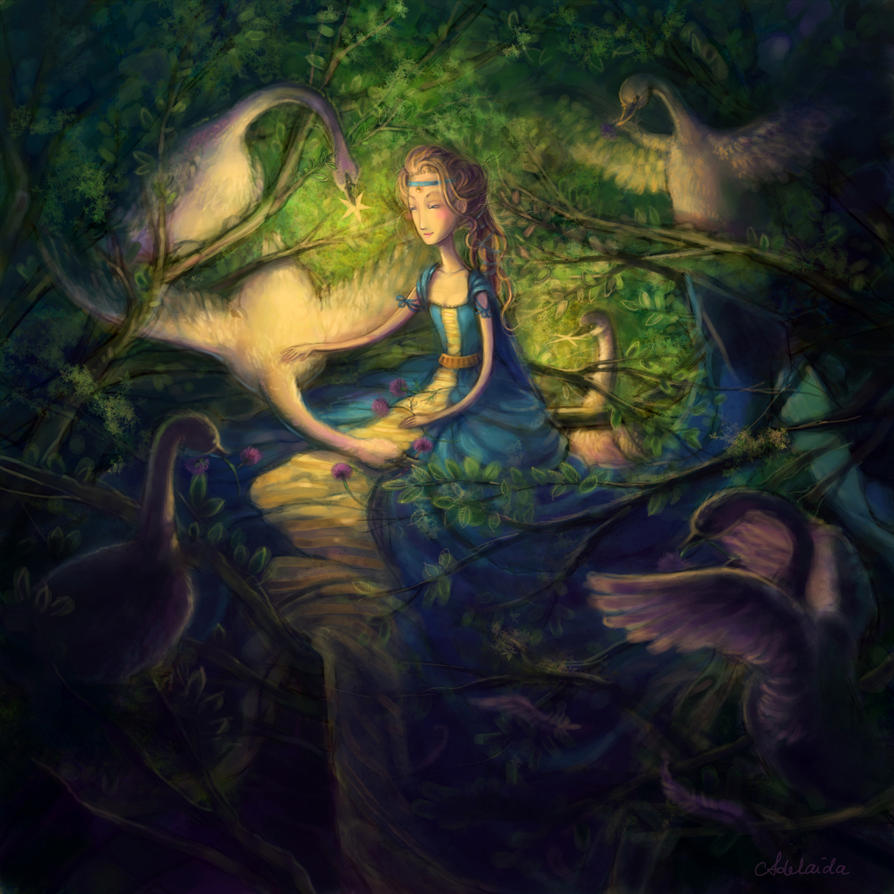
After she grew tired of running, the princess found shelter in a tiny cottage. There were six beds within the home, and she fell asleep underneath one of them. She awoke to the sound of wings. Six swans were flying in through the window. One by one they landed - and then they transformed into her brothers.
The boys were delighted to see their sister, and much hugging ensued. However, they warned her that she could not stay in the cottage, as its owners were rough brigands. They sadly told her that they would be unable to protect her, for the curse only allowed them to transform back into humans for fifteen minutes each evening.
The princess wanted nothing more than to find a way to break the curse on her brothers. They told her that such a thing was impossible, and that the effort required would be too great. Undaunted, she demanded to know what she needed to do.
In order to break the curse, the brothers explained, the princess would need to spend six years in complete silence. She could not speak a word, or even utter a laugh. In addition, she would need to sew six shirts out of starflowers. (In the Brothers Grimm version of the story, the shirts must be sewn out of nettles - a plant which would be significantly more painful to work with.) Despite their warnings about its difficulty, the princess vowed to do this in order to save her brothers.
With their fifteen minutes up, the brothers transformed back into swans and flew away.
With her brothers gone, the princess found a tree and climbed it to sleep. As soon as she awoke the next morning, she gathered as many starflowers as she could find. The princess began to sew.
Some time passed, and there came a day when huntsmen stumbled upon the tree the princess was sewing in. They hailed her, but she did not answer. Question after question they asked her, but the girl continued to sew in silence. When they continued to bother her, she threw down her jewelry in the hopes of quieting them; when that did not work, she began to throw down her clothing, one piece at a time.
The huntsmen were soon joined by their king, who ruled over a nearby land. He was struck with curiosity about the girl, who still refused to speak. The tree was climbed, and the princess carried down to be presented to the king. He flung his cloak around her and put her on his horse. They rode back to his castle together.
Even though she was voiceless, it didn't take long for the king to fall in love with the beautiful princess. Soon they were married, and she became his queen.
But not everyone in the kingdom was happy about this. The king's mother still lived in the castle, and she was an evil, conniving woman. She disliked the new queen, and was distrustful of her silence. She began to spread nasty rumors about the queen.
Time passed, and the queen kept true to her word - she never spoke, or laughed, and she sewed every day on the shirts. Eventually she became pregnant, and bore a child to the king. However, as soon as the child was born, the king's mother whisked it away. She spread a rumor that the queen had killed the child. The king refused to believe it, but the queen remained silent on the matter, simply taking up her sewing once more.
Again the queen became pregnant, and once more the king's mother stole away the child, claiming that the queen had killed it. The king still refused to believe that his gentle wife could do such a thing, but she was unable to speak up in her own defense. When the third child of the king and queen likewise disappeared, the king was left with no choice but to turn his wife over to the castle guards. She was sentenced to be burned at the stake the next day.
All the while, the queen continued to sew. When dawn came and she was lead away to the stake to face her punishment, she took the shirts with her. They were all finished, save for the left sleeve on the sixth shirt.
It so happened that the day she was to be burned alive was also the last day of the six years of her silence. As the queen was led to the stake, she looked up and saw six swans flying towards her. She smiled then.
The swans swooped in, and the queen flung a shirt onto each of them. One by one, the swans transformed back into her brothers. (One of them was left with a wing instead of a left arm, because he wore the shirt that she had been unable to complete.)
Her trial completed, the queen stepped down from the stake and approached her husband, who was staring in wonder at the swans-to-men. She spoke to him for the first time, and told him that she was now free to defend herself against the allegations of his mother. The queen explained that it was the king's mother who had stolen their children. The castle was searched, the children were found, and they were brought before their father.
The king's mother was punished for her wickedness. (In some versions of the story, she is attacked by the swans before they are turned back into princes. In others, she is so overcome with rage at her plan's failure that she falls into a fit and dies.)
As for the king and queen, they lived in joy and peace with the six brothers for the rest of their days.
What did you guys think of the story? If it sounds familiar, there's a good reason why. There are an enormous number of fairy tales in which the female is unable to speak for some reason (The Little Mermaid is a great example of this). There are also many in which children are transformed into birds. Sometimes these are other fowl, such as ravens - but this particular version of the story used swans for a reason. Its origins lie in the Celtic myth of The Children of Lir, which I discussed in an earlier post.
I hope you guys enjoyed! I had a great time looking for pictures to use for this post. I'll be back next week with another story!
Sunday, May 7, 2017
Monday, May 1, 2017
Happy Beltane!
Hey guys!
Today we're going to be taking a look at a Gaelic festival called Beltane. Beltane is an ancient holiday celebrating the coming of summer. You might be more familiar with the name May Day. Taking place on May 1st, Beltane falls between the spring equinox and the summer solstice. Where Samhain marks the beginning of winter and the arrival of the cold spell, Beltane celebrates the start of summer and the arrival of the heat wave. It's a time for fertility and the hope for renewal.
There are a number of characters involved in the rituals celebrating Beltane. There's a neutral party called the Blue Men who watch over everything. They don't take sides, but they defend the other players from outside forces. The central figure is the May Queen, whose job is to awaken the earth from winter by harnessing the four elements.
The May Queen is guarded by the White Warrior Women, who represent order. The May Queen is courted by the Winter King and takes him as her consort. However, the Winter King attempts to overpower the May Queen, aided by the Red Men, who represent chaos. The Red Men and the White Warrior Women counter one another, and are opponents.
(In behavior, the Red Men are very similar to the satyrs of Greek mythology, or to some of the earlier celebrations of Lupercalia. They eat, drink, make merry, seduce, bed, and act in excess on the night of Beltane...and they attempt to encourage everyone at the festival to do the same thing. A friend who has seen the Beltane festival described their behavior to me as "lewdness and lascivious.")
In the conflict which ensues, the Winter King is slain. The May Queen takes pity on her consort, and brings him back to life...but he is changed. He becomes the Green Man, a representation of the frozen winter earth being renewed for summer. The corpse of the Winter King is then thrown onto the Beltane bonfire, and traditional blessings are spoken.
I mentioned that I had a friend attend the Beltane festival. This festival occurs every year. In the darkness, bonfires are lit, and an enormous ceremony takes place. People dress as the May Queen, the Winter King, and all of the other characters. There are enormous amounts of red and white paint used. And then...they dance, and they perform the story. I have never been lucky enough to see it in person, though I hope to one day.
However, my friend is a professional photographer, and she takes pictures of Beltane. You can see her pictures from last year's celebration here, and this year's here. (Some of the pictures are not quite safe for work, as a warning.)
I hope you guys enjoyed the look at Beltane! My words do not do it justice. I highly recommend checking out pictures or video footage of the celebration; the images are absolutely stunning, and tell a breathtaking story.
See you guys next week!
Monday, April 24, 2017
I'm Going on an Adventure!
Heya guys!
I wanted to take a brief pause from my regular schedule to let you know what I have planned for the foreseeable future.
I just finished my series of posts on Chinese mythology, and I'm not planning on starting another series yet. Instead, for the next four weeks I'm planning on doing posts jumping from one culture to the next. If you have a specific fairy tale, myth, or deity you would like me to cover, hit me up in the comments, on Twitter, or via email to let me know!
Why the next four weeks? Because after that, I'm going on temporary hiatus!
I've been running this blog nonstop since October of 2014. It's a lot of fun, and I enjoy it immensely. However...it can also be stressful at times when I have other things going on. And oh boy, have I! I've (mostly) kept up with posting once a week, despite school, work, and four surgeries in the past two and a half years. As much as I love this blog, and you guys...I could really use a short break.
My final post for a little while will be on May 22nd. After that I'll be recovering from Phoenix Comic Con, packing, and then...out of the country, without my laptop or my mythology books.
I'm going to Japan for three weeks!
I'm really excited for this opportunity, and I'm sure I'll have a ton of stories to share when I get back home. However, I'm also sure that I'll need a week or two to recover.
So, I'll do a post on May 22nd, and then be on hiatus until probably July 17th.
I'll post a reminder about this a bit closer to the dates. Until then, if there's any posts you'd like to see in the next four weeks, please let me know!
Take care guys, and I'll see you next week!
Monday, April 17, 2017
Thor: Ragnarok Trailer Breakdown
Greetings readers! I hope you had a lovely Easter. If you're interested, I did a post about the Easter Bunny's origins a year ago; you can read it here.
Today I thought that I would try something a little bit different for a blog post. This past week has been a very good one for trailers, between Detroit, The Last Jedi, and Thor: Ragnarok. As a huge Marvel fan, I was very excited by the trailer for the new Thor...but, as a huge mythology nerd, I was even more excited. That trailer packed so much mythology into under two minutes, and I fangirled pretty hard at some of what was included.
But then I thought - I have a blog where I talk about mythology. Why not do a breakdown of the trailer? But, instead of focusing on the Marvel aspects, why not point out all the similarities to classical Norse mythology?
And so, without further ado, let's jump into the trailer!
First of all: The name. In Norse mythology, Ragnarok is literally "The Doom of the Gods". In traditional mythology, Ragnarok ends with most of the Norse pantheon (and all but a handful of mortals) dead. The name of the movie alone is setting the stage for a cataclysmic event.
Thor drops into the trailer right away. Mythological Thor isn't the brightest lightning bolt in the sky, but he's always game for a fight, and he fights hard to defend those close to him. Marvel movie Thor is pretty much the same in that aspect.
What really interested me were the red, glowing eyes and mouths that can be seen six seconds into the preview. In mythology, Ragnarok comes at the hands of the denizens of Muspelheim - fire Jotunn. These giants are led by a being named Surtr, and it's at their hands that the world ends in fire. The few seconds these dark figures are in the trailer doesn't say much about them, but it has me wondering if they might be the fire Jotunn. (Frost Jotunn have already appeared in the first Thor movie, and their world was explored by Thor and his companions. It wouldn't surprise me to have the fire Jotunn show up, and I'm wondering if Thor might be hanging upside down in Muspelheim.) If so, it's another way the trailer is tying back to Ragnarok.
The next character to appear in the trailer also supports Ragnarok; her name is Hela. This is the Marvel version of the Norse goddess Hel, who rules over (if her name didn't give it away) Hel, the Norse variant on the underworld. Mythological Hel is the goddess of death, as well as being the child of Loki. When Ragnarok arrives in mythology, the forces of Hel (led by Loki) rise up from the underworld and fight against the gods.
The trailer certainly sets Hela up to be a major villain. She destroys Mjolnir with what looks like very little effort. Then she is shown standing in front of the armies of Asgard, home of the gods. "Asgard...is dead." she declares dramatically, and then fire sweeps throughout Asgard, destroying everything. (Fire! Again, it all ties back to Ragnarok.) I'm very much looking forward to seeing what role she plays in the movie.
Next you have Thor being dragged away by a beautiful warrior woman. This woman is called Valkyrie in the Marvel comics, and she too has a mythological counterpart. I'll shamelessly borrow a line from my book to describe the valkyrie:
"The valkyr were the angels of the battlefield, fearsome women warriors who could sense the approach of death and were tasked by Odin to aid his chosen side in battle. When a warrior died they bore him up to the Halls of Valhalla, the Hall of the Slain, where he would join the ranks of the Einherjar. There he would be waited upon by the valkyr and never know sorrow until the coming of Ragnarök.”
Now, I highly doubt that Thor is dead in the trailer, and the arena he winds up in doesn't look much like any afterlife. However, it's worth noting that the Hall of the Slain, where all the valorous dead wound up, was known for its feasting, drinking, and brawling. To have a character named Valkyrie dragging Thor to a place where he's forced to fight isn't too far off from mythology. In addition, her very name is already setting this character up to fight on Thor's side against the bad guys during Ragnarok. She seems to be a pretty competent fighter, so I'm looking forward to that.
A few of the characters from previous Thor movies make a cameo in the trailer. Heimdall, the watcher of Asgard, is there - and so is Loki. Now, it's no surprise that they chose to show Loki in the trailer, since he seems to be a fangirl favorite of Marvel. The inclusion of Heimdall could just be a coincidence, one of many characters from the Thor franchise that they just so happened to pick. However...the myth nerd in me says otherwise. I think his inclusion, along with Loki, was a deliberate foreshadowing.
In the myths, during Ragnarok Heimdall plays an important role. The watcher was never particularly fond of mythological Loki, a trickster whose mischief often went a few steps too far. When Loki eventually was responsible for the murder of a god, Heimdall helped track him down and imprison him. During Ragnarok, Loki breaks free of his bonds and fights against the gods. Heimdall counters him.
In the myths, Heimdall and Loki kill each other.
I can't see Marvel killing off Loki. (At least, not permanently, at any rate.) Tom Hiddleston is a huge asset to them, and as previously mentioned, Loki has a lot of fangirls. My best friend is one of them, and I know she would riot if her favorite character died. (Just like I did when my favorite Marvel character was killed off by Loki...)
However, I can see Heimdall being killed off. It would lend additional emotional weight to the story. His sacrifice could inspire Thor to fight harder. And it would help to show again the villainous side of Loki, who tends to swing between villain and anti-hero in the movies.
And those are my thoughts on the trailer! It's a lot of text for less than two minutes of video, haha. I'm not sure if any of my speculation will pan out, but it's always interesting to me to see what they choose to draw on from the myths. What are you guys' thoughts?
Monday, April 10, 2017
The Haunted Pavilion
(Pictures to follow later - sorry everyone, I'm swamped with school.)
Hey guys! I hope you had a great week!
Unfortunately, there was one pavilion in which no one wanted to sleep. It was...haunted.
Anyone who slept within that pavilion was found dead the next morning, an expression of terrible agony contorting their face. Because of this, travelers sensibly began to avoid the pavilion.
Until one day, when a traveling scholar happened along. He was warned by the couple who managed the pavilion that it was haunted. The tales were told to him, and the scholar was pressed to move on, to find somewhere else to sleep.
Instead of being afraid, the scholar was intrigued. He decided to stay in the pavilion overnight to see if he could solve the mystery. The pavilion's managers tried to talk him out of it, but his mind was made up.
So they brought him food and then hastily retreated back to the safety of their own home. The scholar ate his meal and then settled down with a book. Darkness fell.
Quite a while after night had fallen, the scholar's reading was interrupted by footsteps outside. He could just barely see someone garbed all in black approaching the front of the pavilion. They stopped, and called out a greeting to the master of the pavilion. From inside, a voice returned the greeting. The mysterious guest asked who it was staying inside the pavilion, and the pavilion master responded that it was a scholar...but, unfortunately, he was reading and still awake. The strange guest let out a sigh of disappointment and left.
The scholar, now more cautious than he had been, returned to his book.
Some time later another figure, this one wearing a red hat, approached the pavilion. It too greeted the pavilion master, and inquired as to the man within. Like the first, it let out a sigh of disappointment and left when it heard that the scholar was still awake.
Once the second figure had gone, the scholar crept outside of the pavilion. He approached the front and called out a greeting to the master of the pavilion. Like the others had done, the scholar inquired as to who was “inside” the pavilion, and was told that it was a scholar who was reading and, unfortunately, still awake.
The scholar sighed like the others, but then he changed the dialogue. He asked who the figure in black had been, and the pavilion master replied that it had been the black sow who lived in a house nearby. When asked who the figure in the red hat was, the pavilion master responded that it was the rooster from yet another house. The scholar then asked who the pavilion master himself was, and was told that it was the old scorpion who lived within the pavilion.
The scholar snuck back to his spot in the pavilion, and was very careful to not fall asleep for the remainder of the night.
When the humans who ran the pavilion approached in the morning, they were shocked to find the scholar still alive. Their surprise grew when he asked for a sword, saying that he could solve all of their problems. He had figured out who was haunting the pavilion.
The sword was brought, and the scholar got down to business. He went first to one corner of the pavilion, where the manager's voice had seemed to emanate from. Inside a crack in the wall was a massive, angry scorpion, who was swiftly killed by the scholar. Next he went to two houses in the village. At one he killed a black sow, and at another he butchered a red-crested rooster.
The scholar explained his actions to the villagers, telling them how the demons had identified themselves. From that day on, the pavilion was no longer haunted. No more travelers died there, and it was once again a safe haven for those on the road.
And that's the story!
There are a lot of tales in Chinese mythology in which humans (or demons) are not what they seem to be – but rather are animals in disguise. We've already talked about the Heavenly Maidens, who can take the form of a crane or of a human. Unlike some other stories, these women are wed by men who know exactly what they are. There are stories of beautiful girls who are wooed and married, only for their husbands to later find out that they're foxes in disguise. Though the foxes often love their mortal husbands, these tales often end in tragedy. Then there are stories where a creature – a massive snake, for instance – takes human form and seduces a mortal to achieve her own ends.
Hey guys! I hope you had a great week!
This will be my last post dealing with Chinese mythology for a while.
For this post, I wanted to look at one of the stories from Chinese
folktales in which not all is as it seems to be. Let's look at the
story first, and then I'll talk about it afterward.
China is a huge country, and in olden days travelers would have to
walk for days or more to get between towns. Because of this,
pavilions were built alongside roads – think of them as a sort of
motel. Whoever owned the pavilion would provide a meal for a weary
traveler, and they could sleep inside it before continuing on their
journey the next day. Sounds nice, right?
Unfortunately, there was one pavilion in which no one wanted to sleep. It was...haunted.
Anyone who slept within that pavilion was found dead the next morning, an expression of terrible agony contorting their face. Because of this, travelers sensibly began to avoid the pavilion.
Until one day, when a traveling scholar happened along. He was warned by the couple who managed the pavilion that it was haunted. The tales were told to him, and the scholar was pressed to move on, to find somewhere else to sleep.
Instead of being afraid, the scholar was intrigued. He decided to stay in the pavilion overnight to see if he could solve the mystery. The pavilion's managers tried to talk him out of it, but his mind was made up.
So they brought him food and then hastily retreated back to the safety of their own home. The scholar ate his meal and then settled down with a book. Darkness fell.
Quite a while after night had fallen, the scholar's reading was interrupted by footsteps outside. He could just barely see someone garbed all in black approaching the front of the pavilion. They stopped, and called out a greeting to the master of the pavilion. From inside, a voice returned the greeting. The mysterious guest asked who it was staying inside the pavilion, and the pavilion master responded that it was a scholar...but, unfortunately, he was reading and still awake. The strange guest let out a sigh of disappointment and left.
The scholar, now more cautious than he had been, returned to his book.
Some time later another figure, this one wearing a red hat, approached the pavilion. It too greeted the pavilion master, and inquired as to the man within. Like the first, it let out a sigh of disappointment and left when it heard that the scholar was still awake.
Once the second figure had gone, the scholar crept outside of the pavilion. He approached the front and called out a greeting to the master of the pavilion. Like the others had done, the scholar inquired as to who was “inside” the pavilion, and was told that it was a scholar who was reading and, unfortunately, still awake.
The scholar sighed like the others, but then he changed the dialogue. He asked who the figure in black had been, and the pavilion master replied that it had been the black sow who lived in a house nearby. When asked who the figure in the red hat was, the pavilion master responded that it was the rooster from yet another house. The scholar then asked who the pavilion master himself was, and was told that it was the old scorpion who lived within the pavilion.
The scholar snuck back to his spot in the pavilion, and was very careful to not fall asleep for the remainder of the night.
When the humans who ran the pavilion approached in the morning, they were shocked to find the scholar still alive. Their surprise grew when he asked for a sword, saying that he could solve all of their problems. He had figured out who was haunting the pavilion.
The sword was brought, and the scholar got down to business. He went first to one corner of the pavilion, where the manager's voice had seemed to emanate from. Inside a crack in the wall was a massive, angry scorpion, who was swiftly killed by the scholar. Next he went to two houses in the village. At one he killed a black sow, and at another he butchered a red-crested rooster.
The scholar explained his actions to the villagers, telling them how the demons had identified themselves. From that day on, the pavilion was no longer haunted. No more travelers died there, and it was once again a safe haven for those on the road.
And that's the story!
There are a lot of tales in Chinese mythology in which humans (or demons) are not what they seem to be – but rather are animals in disguise. We've already talked about the Heavenly Maidens, who can take the form of a crane or of a human. Unlike some other stories, these women are wed by men who know exactly what they are. There are stories of beautiful girls who are wooed and married, only for their husbands to later find out that they're foxes in disguise. Though the foxes often love their mortal husbands, these tales often end in tragedy. Then there are stories where a creature – a massive snake, for instance – takes human form and seduces a mortal to achieve her own ends.
I hope you guys enjoyed this look at Chinese mythology! I know I
did. I'll see you next week!
Monday, April 3, 2017
The Monkey King: Journey to the West
Hey guys! Today I'm going to be wrapping up my series of posts about
the Monkey King.
Today's post is going to focus on what happened when those five hundred years were up. Unfortunately, it'll be a very brief overview. The entire adventure embarked upon by Sun Wukong can be read in the book Journey to the West, and is much too long for me to cover in a day (or even in a few posts). The entire history of the Monkey King I've discussed so far is basically just the prologue to the story. Still, I'll do my best to provide a rundown here so as to provide some closure to the story of the Monkey King.
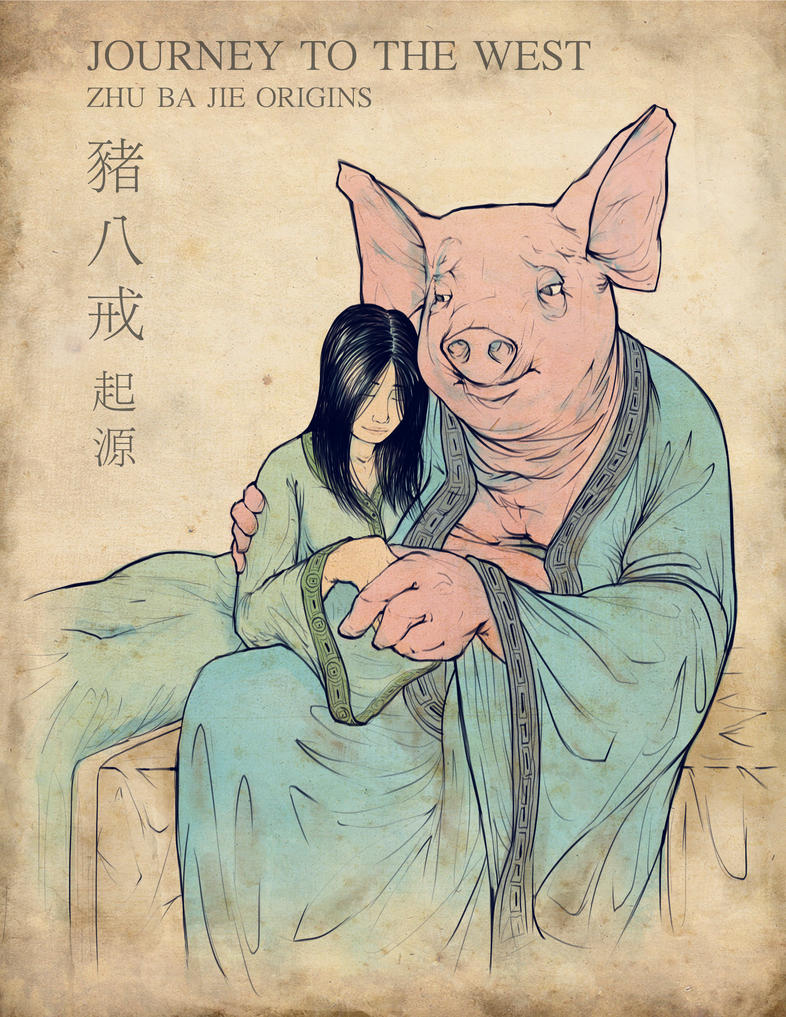
Each of the individuals were rewarded for their efforts. Yulong became a naga, a magical being who was a combination of dragon and man. Zhu Bajie was granted the status of altar cleanser, meaning that he got to eat all of the scraps of food left at altars – a wonderful holy position for someone with such a great love of eating. Sha Wujing achieved nirvana, attaining a position similar to that of a saint in Catholicism.
When we last saw Sun Wukong, things were looking pretty rocky for the
Monkey King (pun fully intended). He had angered the heavenly host
so much that they had gone to war with him. Unfortunately, the
monkey proved to be a competent adversary, and was able to handily
defeat the armies of heaven. At this point the Jade Emperor called
upon a higher power, begging the Buddha to come and stop the Monkey
King. When Sun Wukong failed to best the challenge of Buddha, he was
imprisoned under a mountain for five hundred years.
Today's post is going to focus on what happened when those five hundred years were up. Unfortunately, it'll be a very brief overview. The entire adventure embarked upon by Sun Wukong can be read in the book Journey to the West, and is much too long for me to cover in a day (or even in a few posts). The entire history of the Monkey King I've discussed so far is basically just the prologue to the story. Still, I'll do my best to provide a rundown here so as to provide some closure to the story of the Monkey King.
Five hundred years after Sun Wukong was imprisoned, it was decided
that the holy sutras of Buddhism needed to be retrieved from India
and brought to China. Guanyin, the bodhisattva of mercy, chose a
monk by the name of Xuanxang to make the pilgrimage to the west. (Xuangxang was actually a historical monk who did set out on a pilgrimage to India, and returned to China with holy teachings.)
However, Guanyin knew that the journey would be dangerous. Many
demons and monsters would seek to stop Xuanxang from completing his
task. To this end, she also found several noble guardians to ally
with the monk. One of these guardians was the Monkey King.
It is telling that it is Guanyin who chooses the traveling
companions, because she represents mercy. The whole story focuses
upon compassion, mercy, and redemption. Each individual chosen to
aid Xuanxang is flawed.
As my other posts about him showed, Sun Wukong was wild, rebellious,
and possessed of both ego and temper. He had been imprisoned for
these flaws by the Buddha himself.
Zhu Bajie was another of the companions, and he was both lazy and
gluttonous. He had flirted with a major goddess, and been banished
for his insatiable lust.
Sha Wujing had been exiled for angering the Jade Emperor by breaking
a precious object, and reincarnated as a man-eating demon. He wore
the skulls of a group of holy men he murdered.
The last companion was Yulong, the son of a mighty dragon king.
Yulong had destroyed his father's pearl (a symbol of longevity and
wisdom among the dragons) in a fit of anger, and had been sentenced
to death for his crime. He spent most of Journey to the West
transformed into a horse to aid the others.
(A very unlikely group of heroes, to be sure. I'm reminded of the
DC/CW tv show Legends of Tomorrow: “We are a team of outcasts and
misfits. So please, don't call us heroes. We're legends.”)
In an epic journey spanning dozens of chapters, Xuanxang and his
companions set out for India. They were constantly set upon by
monsters and demons, who sought to kill the monk and devour his
flesh. Each time Xuanxang's co-travelers managed to save the monk.
Their journey took over a decade, but after much fighting (and some
bickering betwixt one another), the group arrived at the temple in
India and claimed the sutras. They then returned to China,
delivering the sutras into the hands of the temple.
Each of the individuals were rewarded for their efforts. Yulong became a naga, a magical being who was a combination of dragon and man. Zhu Bajie was granted the status of altar cleanser, meaning that he got to eat all of the scraps of food left at altars – a wonderful holy position for someone with such a great love of eating. Sha Wujing achieved nirvana, attaining a position similar to that of a saint in Catholicism.
But the greatest rewards were for both Xuanxang and Sun Wukong. Sun
Wukong's impetuousness had been tamed, and he had given his life into
service to a higher power. The monk and the Monkey King were both
given the gift of enlightenment, and were raised to the positions of
Buddha. Ironically, this meant that the monkey finally achieved his
goal – he was given a rank equal to that of anyone in heaven.
And so ends the tale of the Monkey King.
I hope you guys enjoyed it!
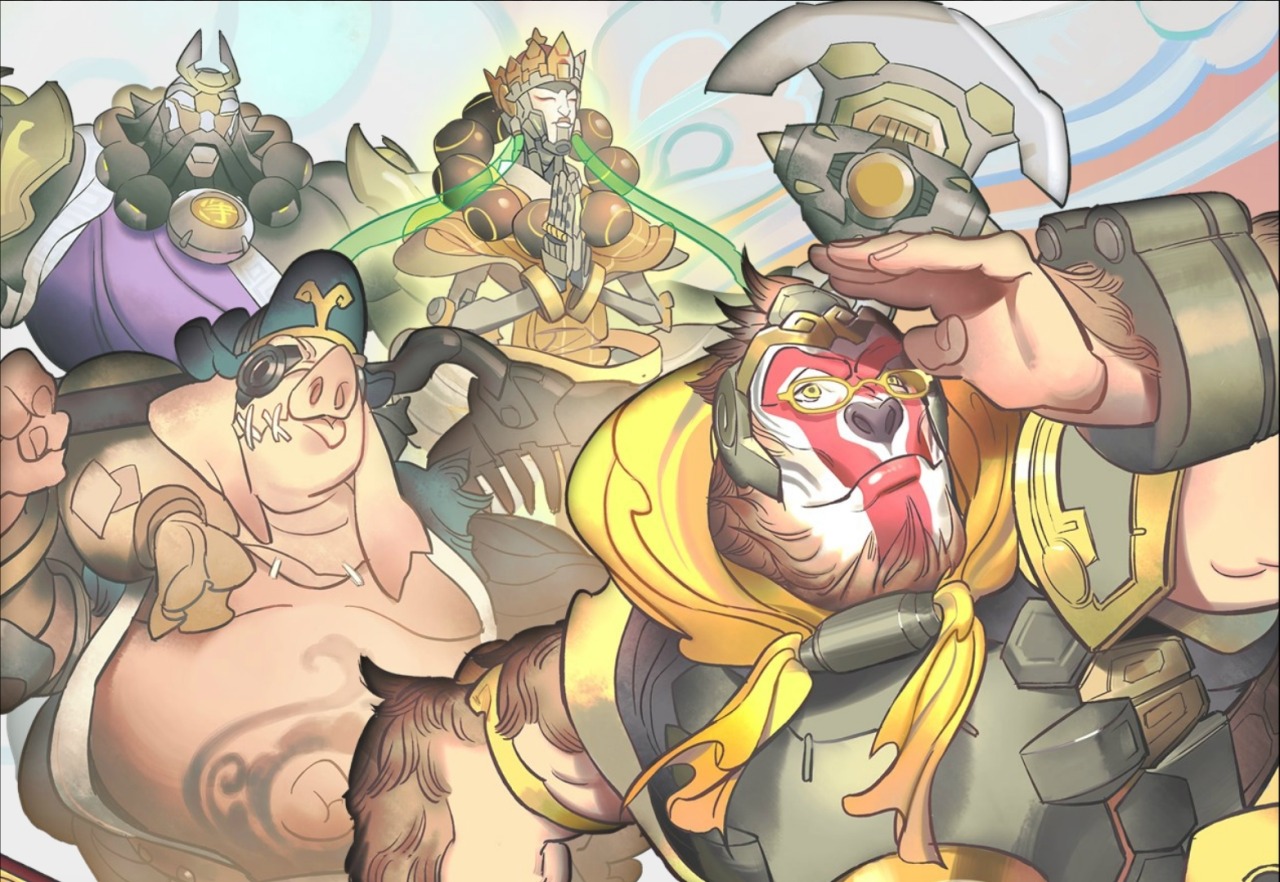
(Overwatch did a series of skins based on Journey to the West for their Lunar Festival event. They also did an animated comic, which can no longer be found on their website. However, some wonderful person uploaded it to YouTube, so you can watch it here. It's adorable.)
I'll see you guys next week!
Monday, March 27, 2017
The Monkey King: The Edge of the Earth
When we left off last week, the Monkey King's actions had become too
much for the Jade Emperor and his court. The gods had attempted to
stop Sun Wukong, but he had handily bested their armies and escaped.
Unable to do anything through their own actions, the gods appealed to
the mightiest being of all...Buddha.
(Religion in ancient China is very similar to that of Rome, or Japan,
or any number of non-Judeo-Christian countries. New gods were often
brought to the country through trade routes. Rather than getting rid
of the old gods, they were shuffled around to make room for the new
religion's joining them. When Buddhism arrived in China, the old
gods remained – but Buddha was added to many of the stories as the
supreme power.)
When he heard the dilemma of the gods, Buddha set out to help. He
approached the Monkey King and offered him a bet. Buddha challenged
Sun Wukong, saying that the Monkey King couldn't stand in the palm of
his hand and leap off of it. The Monkey King laughed and took up the
challenge.
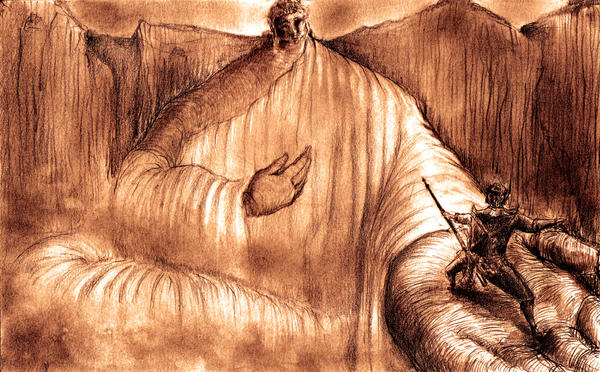
He leapt into the palm of Buddha. He sprang into the air,
somersaulting as he did so. It was a truly impressive leap – Sun
Wukong traveled thousands of miles in one bound. When he finally
landed the Monkey King found himself standing next to five massive
pillars rising from the mists. It looked like the edge of the earth,
with nothing visible beyond the pillars. That showed Buddha! The
Monkey King had traveled so far he'd nearly jumped off of the world!
Sun Wukong signed his name upon one of the pillars, to prove he had
been there.
Then he jumped back the way he had came, once again soaring for thousands of miles. When he landed, he was back in the Buddha's palm. But when the Monkey King declared that he had won the bet, Buddha only laughed at him.
The mighty Buddha declared that Sun Wukong had never even left his hand. He told the monkey to look closer at his fingers. When the Monkey King did so, he discovered writing on one of them – the same marks the Monkey King had made upon the “pillar”! It had been the Buddha's finger all along!
Having lost the bet, Sun Wukong was imprisoned beneath a mountain for
five hundred years. The Buddha had solved the Jade Emperor's
problem.
Subscribe to:
Posts (Atom)