Monday, January 2, 2017

New Year and Resolutions (Including a book announcement!)

Hey guys!  Welcome to my first post of 2017!

Most cultures around the world celebrate some form of new year festival.  These celebrations have been around for thousands of years.  Originally it wasn't so much the coming of a new year that was celebrated, but the changing of the seasons.  I was introduced to this concept thanks to the Redwall series, where events are said to have happened "four summers ago", or a cask is said to have aged "for three falls".  A more recent example can be found in the A Song of Ice and Fire series, where characters are asked how many winters they have lived to see.

As human societies became more intellectual, calendars were invented.  The most widely used nowadays is the Gregorian calendar, which marks the new year as beginning on January 1st.  However, not every country and group uses this calendar; for instance, the Chinese New Year is celebrated on a lunar cycle, meaning that it falls on January 28th this year.  Rosh Hashanah, a Jewish New Year festival, begins on September 20th.  There are many other variations throughout the world, falling on dates all over the calendar.

When many Americans think of the new year, resolutions are often associated with it.  Interestingly enough, New Year's resolutions are not practiced all over the world.  Most countries have their own unique spin on New Year's practices; for instance, the Japanese have small shrines called kadomatsu which act as a sort of temporary housing for the kami during the transition to the new year.


It is hoped that the family whose kadomatsu the kami stay in will be blessed by the grateful spirits.  I haven't been able to look into why Americans seem so fixated on making resolutions for the new year, but it is certainly a tradition we have embraced.

With that having been said, I thought I'd make my resolutions for 2017 here.

It is my goal to:
1. Finish Lips as Red as Blood, my current work in progress.
2. Get ahead on blog posts before the semester begins.
3. Publish Sleeping Love, a book I wrote in 2016 as a Christmas present for my mom.

(She's already read it, and it met with her approval!)

And since this is the official announcement of Sleeping Love, let me give you guys a sneak peek at what the story is about!  It's Sleeping Beauty...with a twist or two thrown in!

Justin's kiss may have awoken Rosalie, but it left the rest of her kingdom asleep.  Worse still, Rosalie has no memory of her life - she only knows her name because of Elliot, Justin's gruff and taciturn guard!
Seeing no other options, Rosalie agrees to let Justin take her home and wed her...but at night, she dreams of playing with a boy with green eyes - eyes almost precisely the same shade as Elliot's.
Are these only dreams, or are they remnants of her memory?  Is Elliot more than just a wandering knight?  Can Rosalie find a way to unlock her past...before her future is sealed?

Sleeping Love will be out fall 2017!

How do you guys celebrate the New Year?  Any fun resolutions made, or things you hope to try?  Let me know in the comments below!

Monday, December 26, 2016

Kwanzaa: Unity and Light

Hello everyone!

This past week has seen multiple holidays.  Today's post is going to be about Kwanzaa.  If you're looking for a Hanukkah post, I did one last year that you can read here.  If you're looking for Christmas posts, I've done three over the years.  Whatever you celebrate, I hope you have a lovely holiday season!

So, on to Kwanzaa!


Kwanzaa is an interesting holiday because it isn't associated with any specific religion.  Instead, Kwanzaa is a celebration of ethnicity.  It has its roots in African culture, but the holiday itself is actually fairly recent.  Despite drawing on traditions from many African tribes, including the Zulus and Yorubas, Kwanzaa was invented in 1966.  It was a time of racial strife in the United States, with serious riots taking place in LA the summer before.  Seeing the troubles of African Americans, an African American professor by the name of Maulana Karenga decided to take action.

Karenga had studied African tribes, their culture, and their customs rather extensively.  Many cultures from all around the world have harvest festivals of some sort or another, usually involving a celebration and light.  Hinduism has the Diwali festival; a Celtic harvest festival is Samhain.  There are so many cultures in Africa that there isn't a single harvest festival, but the many variations on such a holiday all have some things in common.  Karenga examined these similarities and came up with the concept for Kwanzaa.

So if Kwanzaa isn't associated with a religion, what exactly is it?  Well, it's a celebration of one's roots.  Kwanzaa examines the past to strengthen modern ties.

"It is a time to strengthen the bonds among people, just as the harvest was an occasion to gather together, and to give thanks tot he Creator for a bountiful life.  It is also a time for African Americans to honor their roots and heritage, and to commemorate the struggles and survival of their people."*
 
I'm actually very curious to see if there's been an increase in Kwanzaa celebrations in the past several years.  At its core, Kwanzaa is an African American celebration, though it has spread to other countries and cultures since its creation.  I wonder if the Black Lives Matter movement has increased the number of African Americans celebrants.
 
If you'd like to read about all of the customs and decorations associated with Kwanzaa, you can visit the official Kwanzaa website here.  However, I'd like to sum up a few parts of the holiday.
 
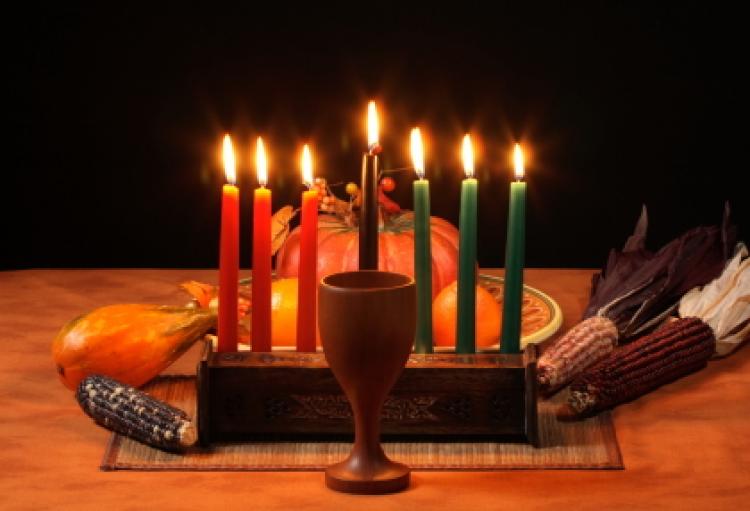
There are a number of decorations associated with Kwanzaa.  Within a house, they're usually all placed on one table to form a display.


Corn, or a bowl of other crops, are traditional to represent the harvest.  Ears of corn are also associated with the children of the family.  These are placed atop a mat woven out of straw, called a mkeka.  A cup is also placed in the display, and is filled each night with a wine which is passed around for everyone to take a sip of.
 
There are three pieces of Kwanzaa which are probably the most integral to the holiday, as well as the most easily recognizable.  These are the candles (and their holder, called a kinara), the colors, and the seven principles.
 
The official colors of Kwanzaa are black, red, and green - the colors of the pan-African flag.  Each color represents something important to the African culture.  Black represents their skin, and the unity between all Africans.  Red stands for struggle and the conflicts that Africans face.  Green symbolizes the future, and the hope that is held for it.
 
There are seven days of Kwanzaa (starting today and running until January 1st), and seven candles.  Each candle is associated with one of the seven principles, called the Nguzo Saba.  On each day a candle is lit, and the principle with which it is associated is explained.
 
 
The black candle is lit on the first day.  After that, the candle lighting alternates between the left side (the red candles) and the right (the green candles).  Because of this, the lighting ceremony shows that though there are always struggles, hope follows them.  I think that's a beautiful message.

Kwanzaa is celebrated in different ways by the many people who celebrate it.  Some wear traditional African dress during the seven days of the festival.  Others play African music.  Many families get together and cook up some African recipes for celebration feasts (because, like many harvest festivals, Kwanzaa has lots of feasting!).  Gift giving is also a tradition, though gifts are mostly for the children.  Originally Kwanzaa gifts were supposed to be either educational or African in origin, but the holiday has become more generally commercialized in recent years.

I hope this has been an interesting read for you guys!  If you celebrate, then Harambee! and happy Kwanzaa!

*Quote from Holiday Symbols and Customs.

Monday, December 19, 2016

Odin is Santa Claus

Hey guys! How are you doing? Did you see Rogue One yet? (I confess, I've already been twice and I'm going again on Thursday. Such a great Star Wars movie!!)

It's December, and a ton of holidays are about to kick off. Because of this, today's post and those of the next two weeks will each be taking a look at a different holiday.

Since Christmas Eve (and Santa's trip around the world) are less than a week away, let's take a look at the origins of the world's favorite fat, jolly man.


Except...Has he always been so fat and jolly? Could Santa Claus, good ol' Saint Nick, have his origins not in a Christian saint, but in a pagan deity?

The concept of Santa being Odin was first introduced to me in Jim Butcher's Dresden Files series, and the idea has stuck with me ever since. After a bunch of research, I finally decided to write up a post about the idea. Let's jump into it!

About this time last year I did a post about Yule, a Norse holiday which celebrates the end of the cold season and the returning of the sun. A large part of Yule revolves around worshiping Odin, who is sometimes called the Yule Father.

Part of Odin's role in Yule-time was the leading of the Wild Hunt. There are so many myths tied to this hunt that it unfortunately is somewhat difficult to explain. A common belief among many cultures is that the lands of the dead and the living are much closer together during times of equinox or solstice. Yule traditionally falls around the winter solstice. Some tales say that the Wild Hunt is a hunting party of monsters – such as witches and devils – who cross the barrier between worlds for this one night. Other stories say that the Wild Hunt is comprised of the souls of those who have died during the year, and that Odin is leading them into the next life. There are many variations in between those two extremes.


One near-constant amongst the Norse was the presence of Odin at the head of the Wild Hunt. Some old folk customs around Yule are tied to the god's presence.

Being American, a yearly tradition for my family is to leave out milk and cookies for Santa Claus. When I wake up on Christmas morning, the cookies have been eaten – and the stockings have been filled with presents. However, I have some friends whose family is Germanic, and they grew up leaving shoes stuffed with straw and carrots for Saint Nicholas' reindeer. The reindeer food disappears overnight, and when they wake up in the morning oranges and small toys are in their shoes instead.

Apparently this tradition stretches back beyond Christianity's influence on the Nordic folk. It was customary for small children to leave their shoes filled with hay and carrots around Yule – not for the reindeer or Santa, but for Odin and his horse, Sleipnir. Sleipnir would eat the goodies, and Odin would leave small presents in the shoes.  That's right - Odin and Santa are both known for distributing gifts to small children!


What I find most interesting about this whole theory is the explanation for how we went from Odin, riding atop Sleipnir, to Santa, with his chariot pulled by eight reindeer. Santa/Saint Nick has ridden many a creature in his travels throughout time and the world. Sometimes it has been a goat, or a donkey. Often it is a horse. The depiction of the reindeer did not appear until the early 1800s. The poem credited with introducing the eight reindeer is known in modern times as “ 'Twas the Night Before Christmas”, though it was called “A Visit from St. Nicholas” when it was first published in 1823. Why does the use of eight reindeer intrigue me so? Well, if you've read my previous posts about Odin, you might recall that Sleipnir has eight legs.
Imagine how different the poem could have been!
 
“When what to my wandering eyes should appear,

But Odin upon his great battle horse, Sleipnir!”

Perhaps the part that convinces me the most that Santa Claus has his roots in Odin lies in the appearance of the Christmas figure. Modern times have painted a picture of a jolly fat man, with a bushy white beard and a red suit. However, earlier pictures of Santa portrayed him as tall and slender – though he maintained the beard!  These depictions are eerily similar to those of the Norse god (as well as Gandalf, whom Tolkien based upon Odin. That's right – if this theory is correct, Gandalf is Santa!).


Again, if you've read my posts about Odin you might recall his tendency to wander the world disguised as an old human man, who roams about helping out mankind. That sounds rather like Santa Claus to me! More evidence of a connection between the two can be found in one of the most common myths about Santa Claus.

“He sees you when you're sleeping

He knows if you're awake

He knows if you've been bad or good -

So be good, for goodness' sake!”

In Norse mythology, Odin sacrificed one of his eyes for great wisdom and the ability to see into the future. He also possesses two ravens, Huginn and Muninn. Every day these ravens fly all over the world, and as the sun goes down they return to Odin to tell him everything they've seen. What better way to spy on children all over the world?
 
Personally, I think that the modern Santa Claus has been influenced by a lot of things. Christianity has certainly has certainly helped form his character, as has commercialism. Pop culture too has had a huge impact, as evidenced by Rudolph. Could Odin have been a part of the beginnings of Santa Claus' story? I'd like to think so. Even if you disagree, I hope this look at some of the parallels between the two has been interesting.
 
 
Merry Christmas and a happy Yule to you all! I'll be back next week with a post about Kwanzaa!

Monday, December 12, 2016

Maui and the Vagina of Death

Alright guys.  I try very hard to keep my posts kid friendly - which can be difficult, considering how sex and violence filled most mythologies are.  For this post...well, there really wasn't any way to make it PG.  You have been warned!

My final post about Maui is also the story of the demigod's death.  In the past several weeks, we've talked about a lot of the hero's exploits.  He raised the islands from beneath the sea; he stole fire for mankind; he tamed the sun.  All of these are pretty impressive accomplishments.

Unfortunately, Maui let his achievements go to his head.  He became very proud of all that he had done, and began to think himself invincible.


Now, at this point in time, things were a little different than they are now.  Mankind was mortal, but no one had died yet.  The goddess of the underworld, Hine-nui-te-pō, existed - but she hadn't yet taken anyone from the realm of the living.


When Maui heard of Hine-nui-te-pō's existence, he took it as a challenge.  For a hero so great as he, one who had accomplished so much already...well, defeating death ought to be easy, right?

Wrong.

Maui set out and found the place where Hine-nui-te-pō made her home.  He knew exactly what he had to do.  The ritual was...interesting, to say the least.

When a person enters this world, they exit their mothers womb.  Life therefore comes out of the vagina, right?  Well, in order to defeat death, Maui needed to reverse that ceremony.  He needed to climb into Hine-nui-te-pō's vagina, through her womb, and out of her mouth.  If he could do this, death would be defeated, and everyone would be immortal.

I'm not joking.  That was his plan.

Now, there were a couple of problems right off of the bat.  First off (in my mind, at least)...how was he even going to fit?  Second, was she just going to lay there and let him try this?  And lastly...did I mention that her vagina was lined with sharp, jagged obsidian teeth?

Yeah, this sounds like a great idea!

Maui arrived at Hine-nui-te-pō's lair and found the goddess fast asleep.  Well, that made life easier!  He wouldn't have to worry about sneaking up on her.  All he had to do was to make sure she didn't wake up.

In some versions of the story, Maui was accompanied by his brothers.  In others, there were birds sitting on a nearby tree.  Whichever it was, the demigod explained his plan to them.  He then warned the spectators that, whatever happened, they must not laugh.  If they laughed, Hine-nui-te-pō would awaken, and Maui would be killed.

The brothers/birds agreed.  Maui stripped and approached the goddess.

(For those of you who are curious and don't mind a NSFW image, you can find one here.)

At first everything seemed to be going well.  First Maui shoved his head inside Hine-nui-te-pō (who somehow remained asleep throughout this).  Next came his arms, then his shoulders.  At last he had made it halfway in!

Unfortunately, the spectacle proved to be too much for the brothers/birds.  They had been swallowing their laughter for as long as they could, but they could hold it in no longer.  One of them let out a loud chortle.

Immediately Hine-nui-te-pō awoke.  Her muscles clenched and her thighs slammed together.  The obsidian teeth of her vagina cut Maui in half.

And so it was that Maui's adventures ended.  He was the first being to die, and with his demise, death entered the world and from there on out would claim mortals.  To add insult to injury...the mighty hero was slain by a vagina.

I hope you guys enjoyed the story, and this look into Polynesian mythology!  Maui is a hilarious character.  What did you think of him?

See you next week!

Monday, December 5, 2016

Maui and the Stealing of Fire

Hello all!  How's your week going?  For those of you about to start finals, I wish you the best of luck.  If you're swamped with homework, hang in there - the end of the semester is in sight!

(On a non-mythological note...Star Wars.  Less than two weeks.  AAAHHHH!)

I've got two stories left that I want to tell about Maui.  Next week's will be one of the more interesting posts I've done.  For this week, however, I want to talk about fire.  There's a lot of variations on the story of how Maui stole fire, so I'll do a post about one story and then link you to another.

Having already raised the Polynesian islands and tamed the sun, one might think that Maui had done enough for humanity.  But no!  The hero was not yet done.  He wanted to be of more help to mankind.  So Maui decided that he was going to set out to steal fire, so that humans could warm themselves by its flames, cook their food, and have light even at night.

(Sound familiar?  The Greek Titan Prometheus stole fire and distributed it to mankind.)

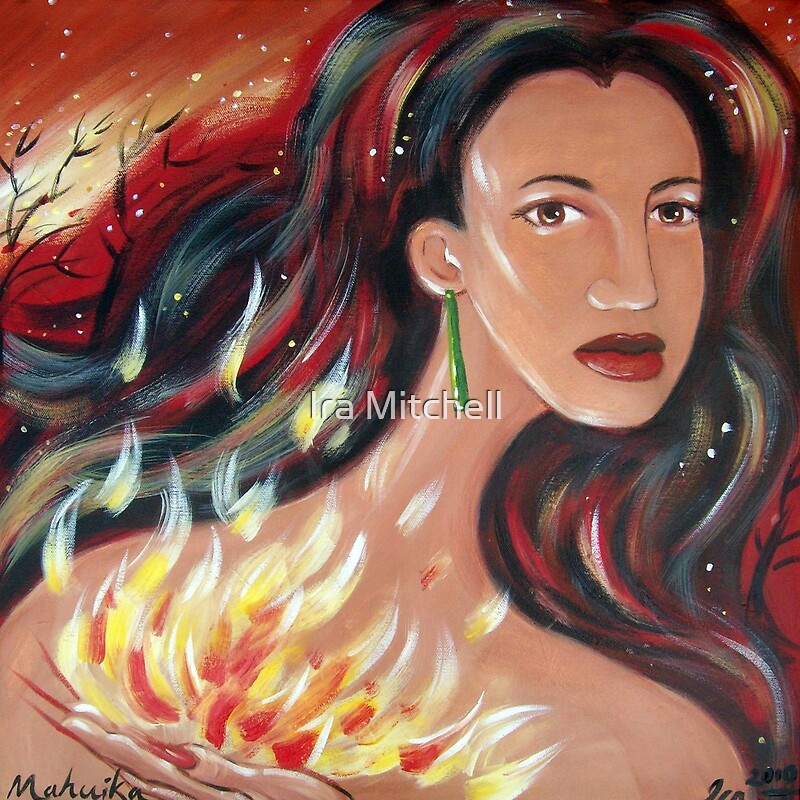
Maui went to visit Mahuika, the goddess of fire.  He asked her to send some fire with him so that he could light the villages of man.  Mahuika obligingly plucked out one of her fingernails - which was an ember - and gave it to Maui.


Remember that Maui is a trickster?  He didn't just take the fire back to humans and call his trip a success.  No, he had to figure out some way to trick Mahuika.  So Maui left the cave she called home, and, as soon as he was out of sight, extinguished the nail she had given him.  The demigod then reentered Mahuika's home and asked for more fire, since the last one had gone out.

Mahuika suspected nothing, and gave him another of her fingernails.  This continued until she eventually had only one left.  By now the goddess knew that she was being pranked, and she wasn't happy.  She threw the last fingernail at Maui, but it caught on some dried wood and created a massive flame.


The demigod was able to escape, but Maui had learned the secret of fire.  He returned to mankind and was able to teach them how to create flames of their own using dried wood.

That's the story I learned for how Maui found fire.  If you want to read another, here's a link!  In it, Maui is even more of a trickster - mankind already had fire, but he wanted to know where the flames came from, so he extinguished all of them to find out.

Interestingly enough, a couple of the Polynesian tribes in New Zealand have a variant on this story where Mahuika is actually Mahu-ika, and is a male giant.  In their stories Maui wrestles the giant and eventually breaks his neck, then beheads him to take a spark of flame (which sets the world on fire, endangering everyone until the gods step in to save the day).

I find the way Mahuika's home is described fascinating, because it sounds to me like she lives inside a mountain.  Though I've only ever heard her called the goddess of fires, I wonder if she's associated with volcanoes as well.  The small sparks of flame (her fingernails) culminating in a huge woodland fire sound like a volcano spitting lava.

What do you guys think?

I'll be back next week with my final (and hilarious!) story about Maui.  See you then!

Monday, November 28, 2016

Maui and the Taming of the Sun

Hello all! Welcome back to my series of posts about the Polynesian hero Maui!
I hope that my American readers had a lovely Thanksgiving week.  Did anyone get a chance to go and see Moana?  I still haven't, but I've heard some really great things about it from my friends!  I'm looking forward to checking it out (hopefully) over winter break.

Alright, on to this week's story!

Many Polynesian cultures have stories about Maui beating up the sun. That is the tale we're going to examine today. It helps to demonstrate that Maui is a compassionate demigod, even if the ways he shows that compassion are a little...violent.
 
Long ago there was a time when the days were exceptionally short. The sun moved quickly across the sky, and daylight fled before daytime tasks could be completed.
 
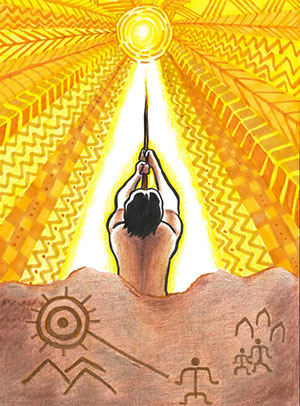
This issue came to Maui's attention. His mother complained that there was not enough time for her to dry her kapa (a type of fabric made out of bark). Other mortal women in the villages raised the same complaints. Upon hearing of their troubles, Maui determined to make the sun move more slowly so that the women would have more time to complete their tasks.
 
There are several variations on how he accomplished this task. In some versions of the story, Maui creates a lasso of sorts out of a female relative's hair. In others, it is his own hair that he uses to catch the sun and drag it towards him.


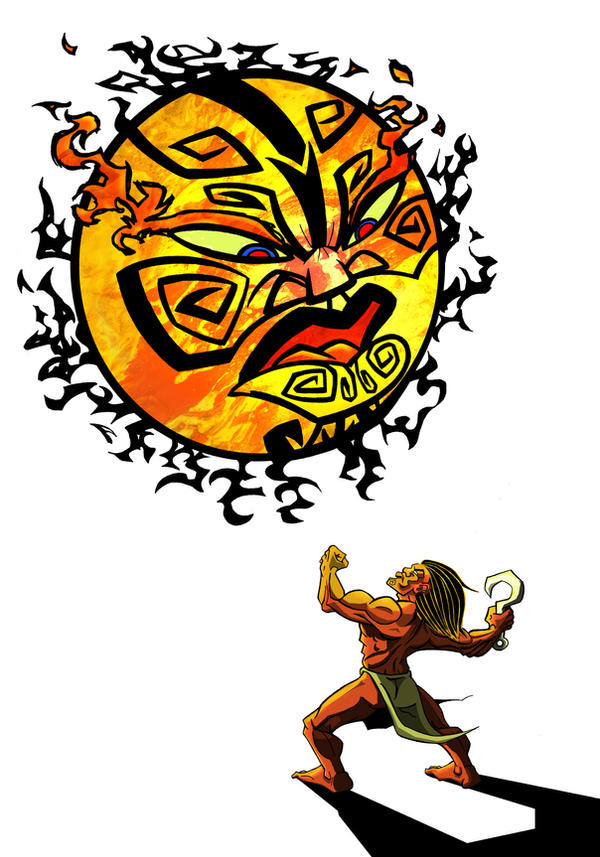
With the sun ensnared, Maui proceeds to beat it into submission. Several cultures say that he uses the magical jawbone of his grandmother to accomplish this task – how's that for a mental picture? (One version of the story I read even said that he starved his grandmother to death and took her jawbone for his weapon – but that was only one version of the story, so I'd take it with a grain of salt. None of the others mention him murdering his ancestress.)


The weakened sun is completely intimidated, and more than willing to give in to Maui's demands. Because of the demigod's actions, the sun begins to travel more slowly across the sky. Days are longer, and the women have the time they need to complete their chores.
 
What do you guys think? Maui was so nice and helpful for his mama!

(This picture had a bit more of a Greco-Roman feel to the armor, but I really love the concept and artwork.)
 
So the good news is that I have successfully completed NaNoWriMo!  That means that I'm no longer trying to cram 50,000 words into this month.  I'm still swamped with papers and finals for school, but I've got more time to devote to posts now.  That's very good news, because today's post is the last I had pre-written!

I'll be back next week with another post about Maui!  See you guys then.

Monday, November 21, 2016

Maui and the Raising of the Islands

(It was so tempting to name this one “Go Fish With a Demigod!”)

Howdy all! I hope you had a lovely week. I'm back today with a story about Maui, a Polynesian demigod whose actions literally shaped the lands the Polynesians live upon – at least according to their stories!

Shall we begin?

The Maori, Hawaiians, and the Te Arawa of New Zealand are a few of the cultures who have stories about their homeland being raised from the depths of the ocean by Maui. It must have taken several fishing trips to raise all of those islands!

The stories usually say that two of Maui's brothers were going on a fishing expedition. The demigod asked to join them, and tagged along in their boat. After a day without catching anything, the brothers began to nod off. Before they fell asleep, Maui asked them to not make any noises, as they might startle his catch.

In some versions of the tale, Maui used his own blood as bait. In others, the fishing hook he used was the enchanted jawbone of his grandmother ('cause that's not disturbing at all!).

Whatever he used, Maui was ultimately successful. His line grew taut with the weight of his catch. He began to haul upon the rope.

In some versions, Maui's brothers woke up and began to row backwards at his command, helping him drag up his catch. Unfortunately, upon seeing that Maui was hauling up not a fish, but a land mass, the brothers broke their silence. Despite Maui's warnings, they exclaimed their shock.

Whatever spell Maui had cast was broken. The land fell off of his hook, only partially out of the water. The Polynesians of New Zealand use this to explain why their islands are so lopsided compared to the rest of the landmass. I've heard Hawaiian stories claim that the multiple islands are because the land fell off of Maui's hook one piece at a time.

In each story, Maui was only partially successful. He had raised land from the depths of the ocean...but not as much as he wanted.


Thanks for reading guys! I hope you enjoyed the post.  Moana comes out this week - if you go see it, please let me know how it is!  I'm wondering how many mythology references will be in it.

Have a good week, and happy early Thanksgiving to all of my American readers! I'll be back next week with the tale of how Maui beat up the sun. See you then!