Monday, February 22, 2016

Anubis: The Cosmic Canine

Hey guys!

When last I did an Egyptian post we talked about the goddess of cats.  Today we're focusing on a dog-based deity.

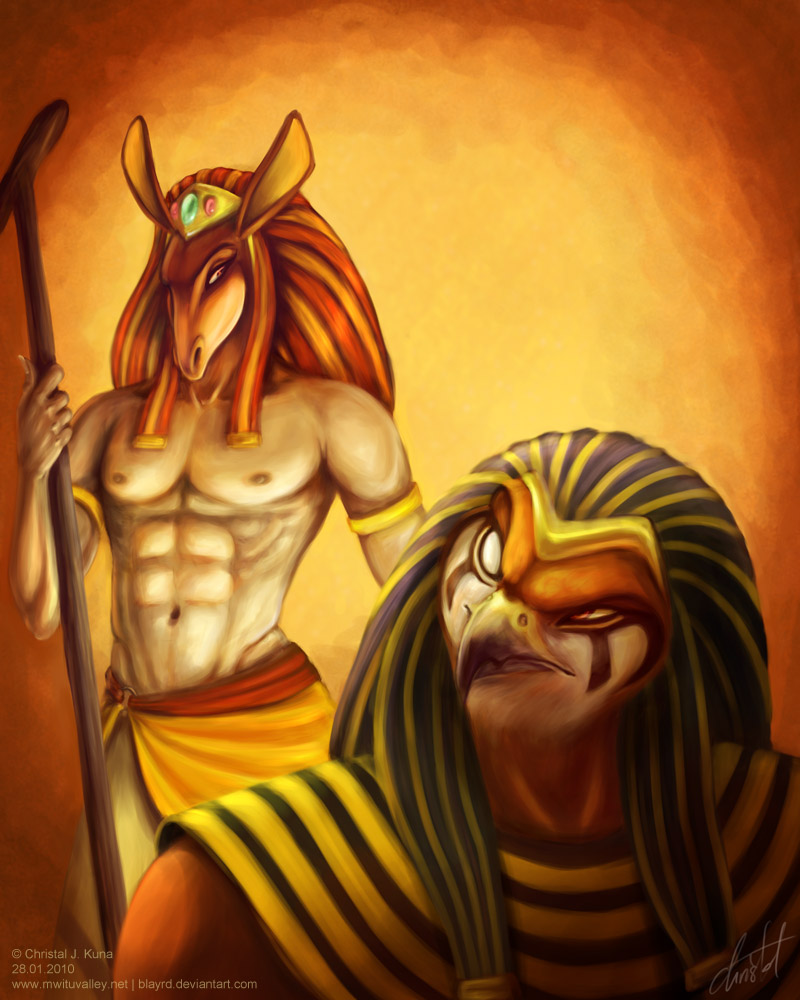
Anubis is a very cool mythological character, and is one of my favorite gods of the underworld.  He is said to have the head of a jackal and the body of a man, and artwork of him can be absolutely gorgeous.


The origins of Anubis explain part of his nature.  I mentioned in this post that part of why Set murdered his brother Osiris was because Osiris had slept with Set's wife Nepthys.  Nepthys is a funerary goddess and Osiris became the king of the dead, so it makes sense that the product of their union, Anubis, would be associated with death.

It is the way Anubis is tied to death that fascinates me.  He was viewed as a protector of the dead, having stood guard over Osiris while Isis (with the help of Nepthys) performed the rituals to restore her husband to life.  Because of this pictures and statues of Anubis can often be found in ancient Egyptian tombs.


Anubis' role as a defender of the dead also extended to cemeteries in ancient Egypt, which are often marked with depictions of the deity.  Cemeteries were sacred to him and were considered the home of Anubis, where he guarded the dead.

Anubis is viewed in Egyptian mythology as the watchdog of the gods.  He presides over the weighing of a soul in the afterlife, where if their heart is as light (and therefore innocent) as the feather of truth the dead will become immortal.


Anubis is fiercely loyal and is also seen as presiding over the rites of mummification.

In short, he's a pretty cool god - at least to me!


What did you guys think?

Well, I've now done cats and dogs.  Tune in next week for a special post for reptile lovers!

Sunday, February 14, 2016

Valentine's Day: Hearts, Wolves, and Christianity

Hey guys!  Given our proximity to Valentine's Day, I thought that I would interrupt our series on Egyptian mythology to take a look at the origins of the holiday.
 
To accomplish that, we'll have to take a look at several different things.  An ancient Roman festival called Lupercalia (a reference to which appears in Shakespeare's works), the story of Saint Valentine, the holidays of Candlemas/Groundhog Day, and the modern celebration distilled from all of those shall all be discussed in this post...along with several gods and goddesses from Roman mythology.
 
Interested?  Awesome!  Let's get started, then.
 
Lupercalia
 
Blood is crimson
Milk is white
Central to a holiday
Long out of sight.
 
Sorry.  I tried, alright?  Poetry and I are not close associates.
 
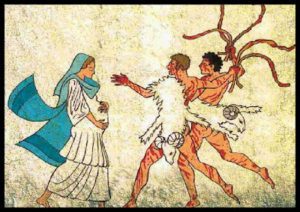
Alright!  So, Lupercalia.  Lupercalia was an ancient festival in Rome, celebrated around February 15th.  I know I haven't begun my series on Roman mythology yet, but the celebration was closely tied to several figures from the myths.  The most prominent of these are Romulus and Remus.
 
I'll talk more about the duo when I do a post about them, but let me give you the basics.  Romulus and Remus were born the children of Mars, god of war, and a woman who was sworn to be a virgin.  These twins were the rightful heir to the throne.  Enraged by their birth, the relative who had seized the throne and forced their mother to take the oaths of virginity in the first place had the babies abandoned, exposed by a river to die.
 
Instead, the two boys were found by a female wolf, one who had recently had pups of her own and was lactating.  She suckled the boys and raised them until they were taken in by a human shepherd.  The cave where she is said to have cared for them is called the Lupercal.

 
Romulus and Remus went on to become the founders of Rome (though one of them was killed by the other).  They were exceptionally powerful, virile young men, and this aspect of their personality is glorified in the celebration of Lupercalia.
 
The religious rituals during the celebration of Lupercalia are quite interesting to me.  At the beginning of the festival priests would gather in the Lupercal and sacrifice both a goat and a dog.  Two young males would then strip down to loincloths.  The blood of the goat and the dog was smeared onto their foreheads, and then wiped away by a cloth dipped in milk.
 
The use of the goat and the dog as the sacrificial animals interests me.  The goat was associated with both virility and lust.  The dog was seen as a protector of fields and herds.  Lupercalia was both a fertility festival, and a festival of protection - the young men who had blood and milk both smeared across their foreheads ran around the boundary of Rome to place a circle of protection around the city.
 
(I feel that here I should point out the two dominant colors of the holiday so far - red and white.  Both colors are often seen on modern Valentine's Day cards, but I was quite amused to find the reason behind those colors while researching for this post.  As one sourcebook I have says, assuming that Valentine's Day has its origins in Lupercalia...
"If this is the case, then the red that dominates so many modern Valentine cards may have derived from the sacrificial blood of the Lupercalia."
Think of that the next time you send a card to your sweetheart!)
 
The sacrificial goat was used for another purpose.  It was skinned, and its hide was used to make whips for both of the young men.  The men would then run through the city, still clad only in loincloths, and whip everyone that they saw.  These whips were called februa, and women very much wanted to be whipped, as it was believed that a lashing from the goat-skin could make them more fertile.


This practice in referenced in Shakespeare's Julius Caesar, in which Antony is advised to whip his wife during the holiday to cure her barren womb.  I thought that was a very interesting reference.
 
A few more tidbits of information about Lupercalia, and then we'll move on:
 
I discussed in a post about Greek mythology the story of Hades, Demeter, and Persephone.  The same tale can be found in Roman mythology, with the names replaced as Pluto, Ceres, and Proserpina.  A very brief rundown of the story is that Proserpina represents spring, while her mother Ceres is goddess of the harvest.  When Proserpina is carried to the Underworld to be the bride of Pluto, Ceres mourns for her and refuses to tend to her divine duties, allowing all plant life to die - thus causing winter.  Ceres wanders the earth in search of Proserpina, eventually managing to find her and return her to the earth for part of each year.
 
This tale is celebrated during Lupercalia, since it is a fertility festival and harvest deities are generally associated with fertility.  The celebration revolved around a torchlight procession, meant to represent Ceres searching for her daughter.  We'll talk a bit more about that in the next section of this post.

 
Lastly: Before the beginning of the festival it was common for a box to go around with the names of all of the young women.  The men would each pick a name from this box, and the girl whose name they chose would be paired with them for the celebration of Lupercalia.  This becomes a very important link between holidays as we move to:
 
Candlemas/Groundhog Day
 
Candlemas has its origins in the feast of Lupercalia.  It is intricately tied to the procession representing Ceres' search.  When Christianity and the church arrived in Rome they took issue with the pagan rituals they found in Lupercalia and sought to change them to something more appropriate to the church.
 
This led to the creation of Candlemas.
 
There is a tradition in Jewish culture that the firstborn son of a family is taken to the Temple to be dedicated to God 40 days after his birth, with a sacrificial offering taking place.  After the birth of Jesus, Mary took Him to be dedicated 40 days after His birth.
 
Candlemas is celebrated on February 2nd - 40 days after Christmas.  The celebration is marked by a procession in which the people all hold candles - replacing the torches used in Lupercalia.
 
(While this doesn't necessarily tie into Valentine's Day, I thought it was interesting to note that Candlemas eventually became Groundhog Day.  On this day in the US a groundhog is checked upon.  Whether or not it can see its shadow determines whether winter is still in swing or if spring is coming.  This tradition can be found in many countries, though groundhogs are not always the animals used - sometimes they are a hedgehog, a badger, or "the Candlemas Bear".  Kind of cool, right?)

 
You might be wondering why I'm mentioning Candlemas and Groundhog Day in a post about Valentine's Day - after all, wasn't Groundhog Day on February 2nd?  Well, according to what I've read Groundhog Day was originally held around February 14th, before shenanigans occurred as the type of calendar used was changed in some parts of the world.

All of this ties together to bring us to the original reason for the post...

Valentine's Day

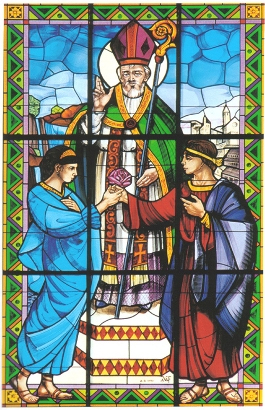
As is the case with so many holidays, a lot changed once the church arrived.  The Christian leaders of the early part of this millennia looked at the pagan rituals of Lupercalia and were horrified by what they saw.  The Pope at that time (469AD), one Pope Gelasius, decided to set aside the day of February 14th to honor a Saint who had been martyred on the same day centuries earlier.  That Saint was Valentine.

There are a lot of stories attached to Valentine.  He was a Christian living in Rome who refused to renounce his faith in God, and so was executed as punishment.  This was enough to make him a martyr, and he was later made a saint because of it.

However, stories also say that Valentine was associated with several romantic legends.  According to some he married young couples in love during a time when marriages were forbidden by the emperor (don't ask me why).
 
 
In others Valentine fell in love with a young woman who was blind.  His faith allowed her sight to be restored, and before he was executed he left her a note signed "From your Valentine."

This last story particularly suits Valentine's Day, though I have no idea how accurate it is.

Regardless of his accomplishments in life, Valentine was the saint tied to February 14th.  The day was declared the Feast of St. Valentine, later shortened to Valentine's Day.

The way Valentine's Day was celebrated changed throughout the centuries, but it retained many links to its earlier origins.  The Lupercalia tradition of drawing names from a jar to assign sweethearts remained, though those who were drawn were now dubbed valentines.

The cards which we now call valentines actually did not appear commercially until sometime around the 1800s, though records exist of individuals creating them long before - for instance, a Duke named Charles who was imprisoned over Valentine's Day wrote poems and sent them to his wife around the holiday.

Speaking of valentines...let's complicate matters a little more and throw in some:

Roman Mythology

Now, today a lot of valentines have ties to modern pop culture.  I myself gave out Star Wars valentines this holiday.  In the past I've handed out Avengers ones, Harry Potter ones, Pirates of the Caribbean valentines, additional Star Wars ones...you get the picture.  Tiny pieces of paper with geeky images and bad, vaguely flirtatious jokes are the norm now.

(I rest my case.)
 
But older valentines (and some of the classier ones, in addition to cards, that are around today), along with the thematic images still associated with the holiday, have their roots in Roman mythology.  Let's take a look at two things: doves and Cupid.

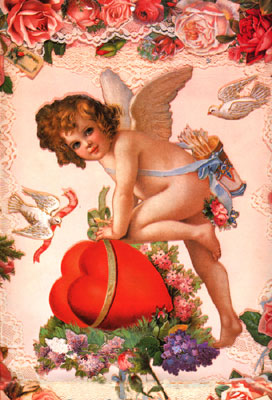
Doves are also called lovebirds.  These birds can be seen on many cards, balloons, and valentines around Valentine's Day.  Doves mate for life, and so are considered very romantic.  This is part of why they're tied to the holiday of Valentine's Day, but the other reason has to do with Roman mythology.  You see, doves were considered a sacred symbol of Venus, the goddess of love, and were offered to her as sacrifices.

Speaking of Venus...the Roman goddess of love is the mother of Cupid, god of love.  You can read more about Cupid in my post about him, but suffice it to say that he was not always depicted as the chubby winged baby with a bow and arrow that now graces many a card.  I've read theories that the god gained this appearance as Valentine's Day grew more commercial in order to better market to women, and that may or may not be so.

Still, a chubby baby he remains on most cards.  Cupid was famous in mythology for his skills with a bow and arrow - not because he was a fantastic archer, but because of what his shots could do.  Anyone struck with an arrow fired by Cupid would fall in love with the next person they saw.

This is another symbol commonly associated with Valentine's Day - that of a heart, pierced by an arrow.

(Behold!  Doves, heart, and Cupid!)
 
I hope you all enjoyed this post!  Did you enjoy your Valentine's Day?  What did you think of the origins of the holiday?

I'll see you next week with a return to the myths of Egypt!

Sunday, February 7, 2016

Bast: Feline Fury

Hello everyone!

For those of you who watched the Super Bowl, I hope you were happy with the outcome.  My thoughts were two-fold:
1. The orange guys won!  Woo?  (I don't watch much American football, if you couldn't tell...)
2. I tuned in too late to see the Civil War trailer, so I had to YouTube it after the show.  Curses!  Ah well.

On with the myth part of the blog!

If you've read my post about The White Cat, you probably know that I'm a cat lover.

In fact, as I'm typing this my blind kitty has just rolled upside down in her cat bed and is begging for belly rubbings.  Excuse me for a minute.

Alright, I have returned!  On with the post.

At any rate, I love most critters, but cats have always held a special place in my heart.  Because of this I rather adore Egyptian mythology, because it has a cat goddess.

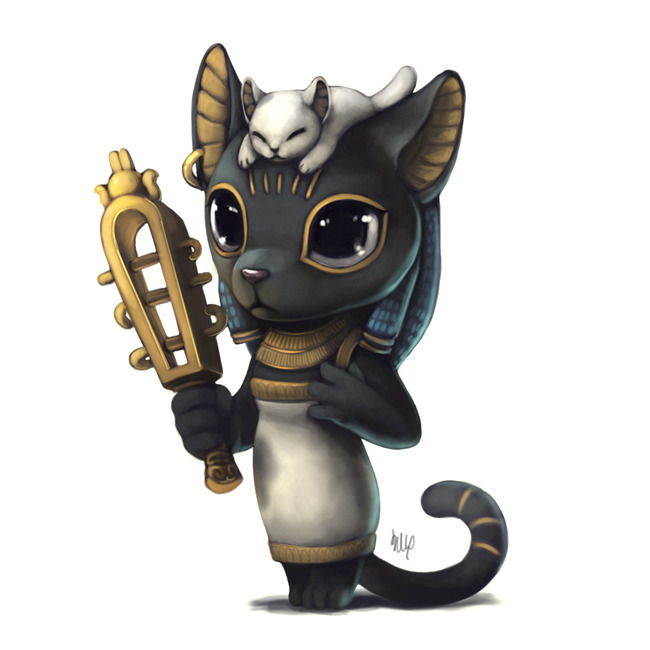
That goddess' name is Bast (also sometimes called Bastet), and she is rather fantastic.  Let me tell you about her.

Cats are rather fickle creatures.  They can be gentle and affectionate one minute, then fearsome hunters the next.  They demand, beg, or disdain everything from food to love to chew toys (all of which my hands have been used for...).  Bast is intriguing because she represents these multiple aspects of feline nature.


For starters, Bast is a goddess associated with dance and music.  She is frequently depicted holding a musical instrument called a sistrum, a sort of rattle.  Festivals to Bast were lively and featured much drinking, dancing, and merriment.

On the other hand, Bast is also a goddess of vengeance.  She is the daughter of Ra, god of the sun, and is shown to be the defender of her father in numerous occasions.  She can be wrathful and fierce, and she strikes fear into the hearts of her enemies.


Bast was also thought to be a protector of pregnant women, and was associated with both hearth and home.

Interesting mix, right?  I think it rather suits her feline persona.

 
I'll end this post with a bit of interesting trivia: Cats were considered sacred to Bast.  Statues and jewelry carved in the image of cats were often left as sacrifices in her temples.  So too were mummified cats sold especially for that purpose - something that I find fascinating.

I'll see you guys next week with a special holiday themed post!

Monday, February 1, 2016

Set: The Red Renegade

Greetings, readers!  I hope this post finds you well.

Ahhh.  We come at last to the end of our family drama - and today the tale focuses upon Set, god of Egypt, and his conflict with his nephew Horus.


Set is one of the more interesting characters in mythology.  Much like Loki in the Norse myths, he isn't always bad.  He is not necessarily evil (though he has had that label attached to him quite often).  It's more a case of Set being portrayed with the same emotions and impulses a human might have.  He was jealous of his brother Osiris' power, and so he stole his throne.  He feared that his nephew Horus might take it away from him, and so he sought to have him disposed of.  Just about every action that he takes is due to Set trying to maintain the position he feels rightly belongs to him.

When we begin our tale today, Set's efforts have thus far been pretty unsuccessful.  Sure, he's the king of Egypt.  Unfortunately for Set, that's about all he has going for him.  He murdered his brother Osiris...who was then brought back to life.  Set captured his sister Isis, only to have the pregnant goddess escape and give birth to Horus, the rightful heir to the throne.  Set tried to have Horus killed, only to have Thoth raise the kid from the dead. (Resurrections apparently run in the family.)

 
(I keep mentioning him, so I figured I should post a picture of Thoth.)

Our story begins when Horus is a fully grown man, at last ready to challenge his uncle's power.  The tale is long and somewhat convoluted (depending on what sources you read from), but I'll do my best to give you the Cliff notes.

As I mentioned in my last post, Horus had been raised in hiding to protect him from the wrath of his uncle Set.  When he at last reached adulthood the god came out of hiding and accused Set before the gods of having killed Osiris and taken his throne.  As Osiris' son Horus was the rightful heir, and he demanded that his father's throne be given to him.

Most of the gods were in agreement that Horus had the stronger claim to the throne, though some debate occurred.  It was pointed out that Set was the elder and had more experience; should not the youth defer to his uncle?  A counter argument ran that Set had seized the throne when he had no right to it, and should never have been allowed to rule.

Set himself arrived before the council of the gods and spoke in his own defense.  A furious Isis stepped forward to defend her son's claim, which made Set quite angry.  The debate raged on, and it was eventually decided that the two gods should continue the trial for the right of the throne on an island where Isis and her meddling could not intervene.

The council of the gods reconvened on this island, leaving the ferryman with strict orders to not ferry across Isis or any woman who might be the goddess.  Isis used her spells to disguise herself and managed to bribe the ferryman to shuttle her across the water nonetheless.  When she arrived on the island she made herself look like a beautiful widow, and the goddess then approached her brother Set.

Knowing that her brother could not resist a pretty face, Isis began to cry.  Set immediately asked what was wrong, and the goddess spun a tall tale about her husband, a herder of cattle, having been killed.  His possessions were left to her son, who would have done well had it not been for an awful stranger who stepped in and took the cattle that rightfully belonged to her child.

Isis is a cunning one.

Set, not thinking to clearly while distracted by the goddess' beauty, immediately swore to champion her son's honor.  He insisted that the stranger had no claim to the cattle, and that Set would see them returned to the woman's son.

At this point Isis busted out laughing and removed her magical disguise, revealing her true form.  I would imagine Set facepalmed as he realized that he had just condemned his own actions.

It was hard for Set to recover from having judged his own crime inexcusable, but he managed to sweet talk his way through it, leaving the gods in debate over who should rule.  The god is impressive at persuasion, I'll give him that!

The trial for the throne continued, and there are many variations in the stories of the tests given to Set and Horus to determine who should reign over Egypt.


In some accounts the two are pitted in a combative contest while shapeshifted into hippos.


In others, Set finds Horus wandering in the desert and rips out his eyes, leaving the young god blind and in agony.  The eyes are eventually returned to the falcon-headed god through the healing powers of the goddess Hathor.


Eventually the trial culminates in a sailing contest, wherein Set challenged Horus to see who could sail the farthest in a boat carved from stone.  Horus was sneaky and carved his boat from wood instead, merely plastering the outside to resemble stone.  Because of this Set's boat sank almost immediately, while Horus' carried on a ways down the water before an enraged Set broke the wooden vessel apart.

In the end the council of the gods grew weary of the animosity and the constant struggle.  (It helped that Osiris threatened to set the forces of the dead upon the gods should they not name Horus king, and pointed out that even the gods eventually die...Ahhh, the blackmail of angry fathers!)  Horus was granted his father's rule and made king of Egypt.

Set was given control of the desert and the barren lands, as well as being made the god of thunder.  While overtures were made towards peace, both gods remained somewhat hostile to one another throughout the myths.

I'm interested to report that the stories in this post may soon make it to the big screen (though, inevitably, they will be modified by Hollywood).  The conflict between Set and Horus is the main focus of the upcoming film Gods of Egypt, which I'll definitely be going to see in theatres.


As an interesting side note (coming from a red head), Set is associated in mythology with the color red.  The red sands of the desert, animals with red fur, and people with red hair were all considered to be tied to the god, either signifying him, being sacred to him, or being thought of as worshipping him.

I hope you guys enjoyed the big familial drama of Egyptian mythology!  I love how much of the myths are tied around the conflict between Set and Horus.

I'll see you next week with a post that's great for cat lovers!

Monday, January 25, 2016

Horus: The Baby Bird

Hey guys!  Hope you all had a lovely week.

So in my last two posts I talked about Osiris and his wife Isis, who became pregnant with Horus.  Even before Horus was born his life was plagued with trials and woe.  His uncle Set, who feared Horus as the rightful heir to the Egyptian throne, captured the pregnant Isis and held her hostage.  It was only through the aid of the god Thoth that she was able to escape with her unborn son.

Isis went into hiding, and Horus was born in the riverlands.  Thoth advised the goddess to keep her son hidden and allow him to grow away from the dangers of his uncle, and that was what Isis did.  Horus grew up a fugitive near the river.

It is here that I shall begin my story of the day.

First off - why the title of "The Baby Bird"?  Horus is often depicted in Egyptian mythology as having the head of a falcon and the body of a man, like so:


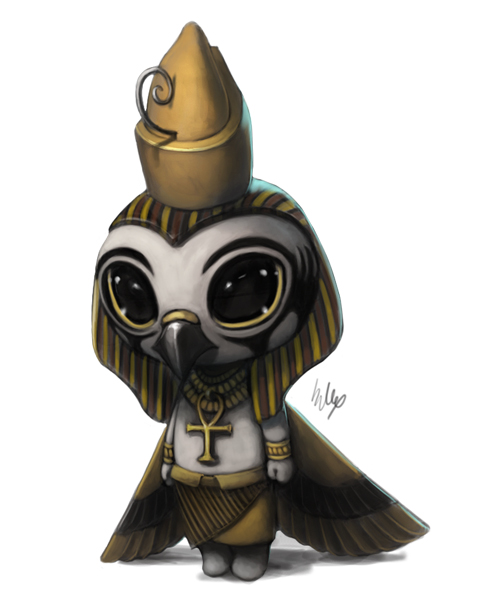
Since he is an infant in the story I'm about to tell, the title seemed apropos.  But, I'll admit...mostly I just wanted an excuse to share this picture:


One day Isis had to leave to run some heavenly errands - just because Set was hunting for her didn't mean she got to stop being a goddess!  So Isis tucked Horus away safely into the reeds of the river and then left for the day.

Unfortunately, Set was hunting for the child.

Ever since Isis had escaped his nefarious clutches Set had had scouts out looking for she and the child.  On this particular day one of the scouts, a highly venomous scorpion, happened across the baby Horus.  Recognizing its target the scorpion struck, stinging Horus before making its escape.

By the time Isis returned Horus was dead.  The goddess wept and wailed, for her child had been murdered.

(I find it interesting that in our post last week Isis saved another child from being killed by scorpion venom...but she was unable to save her own.)

As it turned out, Isis was in luck.  Her laments were so loud that Ra, god of the sun, heard them as he and his flaming barge were passing by overhead.

(Ra is awesome.  He rides a boat made of fire that serves as the sun, and fights an evil serpent every night to make sure that the sun rises once again in the morning.  Such a cool god!)

Ra paused his boat in the sky and sent one of his companions down to check on Isis.  As it happened, this god was Thoth.

I find it fascinating that Thoth is really responsible for so much of the good in these stories.  It was he who figured out a way for Nut to give birth to Isis and her siblings.  It was he who helped the pregnant Isis escape from Set's clutches.

It was also Thoth who would save Horus' life.

When the god of wisdom found Isis holding her son's lifeless body he took great pity on her.  Thoth used his magic (apparently stronger than Isis') to raise Horus from the dead.  The boy was returned to life, and Isis wept with gratitude.

I know we didn't actually talk much about Horus in this post, but I promise I'll go into more detail next week!  Tune in then for the awesome finale to our ongoing family drama, featuring the great showdown between Set and Horus.  I'll see you then!

Monday, January 18, 2016

Isis: The Mystic Mama

Hey all!  I hope you had a lovely weekend and are doing well.

Alright guys, let's talk serious for a moment.  I know that ISIS is currently a very uncomfortable topic for most people.  I've read articles about Nutella refusing to print a customized jar for a girl named Isis out of fear that it would be associated with ISIS.  I myself had a friend advise me to get rid of mentioning the goddess Isis in Lovesick out of worry that it would bring to mind the terrorist organization.

To quote a very wise fictional wizard: "Fear of a name only increases fear of the thing itself."

Isis was a goddess in ancient Egypt long before the acronym ISIS came into being.  She was a deity of duty, honor, and beauty, and is one of my favorite mythological characters.

I refuse to allow all mention of her to be automatically associated with ISIS, and so I'm going to do a blog post that instead focuses on the positive being behind the name.  I hope, in time, that more people will remember Isis the goddess than ISIS the group.

That having been said, here's the post:

The story of Isis' birth is very interesting to me, and it helps to explain some of the mysticism possessed by the goddess.  I mentioned in my post last week that the god of the earth, Geb, had four children with the goddess of the sky, Nut.  These children were Isis, Osiris, Nepthys, and Set.  While this is technically true, it is only true in some versions of the myth.  It is to another version of the story of their birth that I wish to turn.

The story goes that Nut was originally married to Ra, god of the sun.  Unfortunately for Ra, Nut fell in love with the god Geb.


The two conceived four children together, but Ra found out about their union before the babies could be born.  Enraged by Nut's infidelity, Ra cursed her so that her babies could not be born in any month of any year.

Now, most women who become pregnant eventually reach the point where they are fed up and just want the baby out of them.  This is especially true around the last trimester when the baby is biggest.

Imagine that there are four children inside of you.

Imagine that you have a due date for them.  The end is in sight, and there is much rejoicing!

Then imagine that you are cursed so that you can never get the kids out.  You'll have to carry them around, for all eternity.

Understandably, Nut freaked out.

Luckily for Nut, she was a very beautiful woman and a lot of gods loved her.  When she approached Thoth, the god of knowledge, she found her solution.  Thoth was willing to do anything for Nut, and he was very clever.  The god made a bet with the goddess of the moon and won, allowing him to take some of her light.  Thoth used this light to create 5 days outside of the normal calendar, allowing Nut to give birth to one child each day.  One of these children was Isis.


Isis grew up and embraced the mystical nature that surrounded her birth.  She became the goddess of magic, but she was also the embodiment of all that was considered good in both a wife and a mother.  She was dutiful and loyal above all else.  My post last week talked about Isis' quest to resurrect her husband/brother Osiris.  In the process she became pregnant with his child (possibly conceived while Osiris was dead, but hey, let's not dwell on the creepy past).  Let us turn now to an adventure Isis had while pregnant with Horus, one which highlights her more compassionate, mothering nature.

After reassembling Osiris' body and raising him from the dead (after a fashion), Isis was found by a furious Set.  The god trapped her in his house, intending to hold her prisoner until Horus was born.

Luckily for Isis, Thoth was looking out for her.  He found where she was imprisoned and set the goddess free, advising her to run to the Delta area and hide until Horus was born.  Isis took his advice and set out.

Another deity, the goddess Selket, also lent her aid to Isis.


Selket was the goddess of scorpions, but she was also represented as the protector of the throne and kings...and the unborn Horus was the rightful king of Egypt.  As such, Selket sent seven giant scorpions to escort Isis and Horus to safety.

In the midst of their journey night fell, and Isis grew weary.  She sought shelter at the home of one of the leaders of a town.  Unfortunately, when the wife of the owner saw the scorpions accompanying the goddess she panicked and refused.

This refusal really pissed Selket off.  After all, here was a goddess carrying the rightful king of the gods, and this mortal had the audacity to refuse her shelter?  Nuh-uh.  Not happening.  So Selket had six of her scorpions transfer their venom to the seventh (apparently making an uber-venom), and then sent that scorpion into the woman's home.  It sought out the woman's young son and stung him, immediately bringing him close to death.

When the woman realized what had happened she carried her son out into the street, crying and lamenting.  His demise was imminent, but Isis heard the cries of the grieving mother and took pity on her.  She went to the boy and used her magic, instantly healing him.  She and the scorpions then took their leave and hid far from civilization until Horus was born.

That is the Isis that I like to remember.

What do you guys think of the goddess?

I'll see you next week with a post continuing the adventures of the divine family!

Monday, January 11, 2016

Osiris: The Resurrected God

Hey guys!  Welcome back to my series about Egyptian mythology!  Today we're going to be taking a look at Osiris, one of the main Egyptian deities.

The story of Osiris is one of the more interesting ones in Egyptian mythology (at least to me).  Let's start at the beginning, shall we?  Two of the first Egyptian deities - Nut, goddess of the sky, and Geb, god of the earth - once had four children.  These heavenly kids were Nepthys, Isis, Set, and Osiris.  Once they had grown up, Osiris wound up being put in charge of the kingdom.


(As a note: before Osiris took the throne, the kids had split up into couples.  Nepthys and Set had married, as had Isis and Osiris.  Siblings getting married is actually pretty common in mythology - take a look at the Greek myths!)

Unfortunately, Osiris' rule was not to last.  His brother Set became incredibly jealous at the power given to Osiris...power which he thought should belong to him.  Set was quite cunning, and developed a plan to fool his brother.  After much shenanigans and conniving he tricked Osiris into laying down in a box.  Set then closed the box on his unsuspecting brother, nailed it shut, and sealed the edges with lead.  Osiris, and his prison, were then thrown into the Nile River.

Ahhh, sibling quarrels.  Always so much fun!

When she realized that something had happened to her husband, Isis immediately set out to look for him.


(By some accounts their sister Nepthys helped her search.  Of course, by some accounts Set murdered Osiris for sleeping with Nepthys, so...)  Eventually the box containing Osiris was found at the bottom of the river.  Isis pried off the lid and was heartbroken to find her husband dead within.

Now, we'll talk a little more about Isis and her abilities in a post specifically about her, but it is important to know that Isis is the goddess of magic.  When she discovered that Osiris was dead, instead of giving up she decided "There's a spell for that!"

Are you ready for the story to get really creepy?  Tell me, how do you guys feel about necrophilia?

While taking Osiris' body back to Egypt for burial, Isis conceived a child - Horus.  Now, according to some stories she used a magical scroll to raise Osiris from the dead for one night.  According to others...let's just leave it at "the child was conceived through magic" and move away from the creepiness, shall we?

At any rate, Osiris' body was returned to Egypt, but Isis had to go into hiding to prevent Set from killing her unborn son.  During the time she was hiding Set found Osiris' body and, in a rage, tore it into fourteen pieces.  These pieces were scattered by the angry Set throughout all of Egypt.

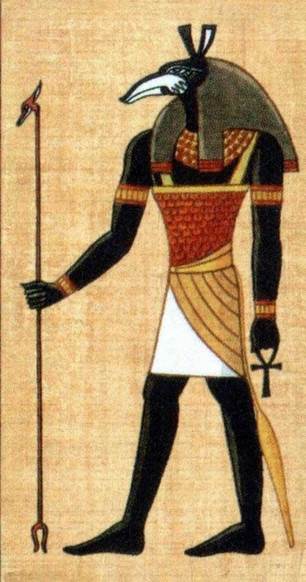
(This, for the record, is Set.  No one is entirely sure what animal Set's head is supposed to be based on.  There have been actual debates about it.)

Poor pregnant Isis once again landed the task of finding her husband's body - albeit in 14 different locations this time.  She managed to track down all of the pieces...save for one, a rather crucial part of male anatomy.  That particular appendage had been eaten by a fish, and Isis was not able to recover it.  Instead she reassembled her husband's body and had a golden phallus made in place of Osiris' missing flesh one.

Then Isis truly showed her mastery of magic.  She used her abilities to resurrect Osiris, though perhaps not in the way most people would think.  Osiris was returned to the realm of the living after a fashion, but was consigned to spend the rest of his new life in the Netherworld, the Egyptian afterlife.  Because of this Osiris effectively became king of the Underworld.  Unfortunately, that left him unable to reclaim his throne from Set, setting up (see what I did there?) a future conflict between Set and the rightful heir to the throne....Osiris' son, Horus.

(Yay, family photo time!  Mostly because I think baby Horus is just too adorable.)

We'll get to that story in a future post.

What I find most interesting about Osiris' story is the connection it has to the Egyptian practice of mummification and the journey to the afterlife.  Just about every detail in the tale of Osiris' resurrection has important ties to the process of mummification.  All parts of the body are to be assembled in a certain way.  Certain rituals (which are performed by Isis in the myth) must be performed.  If all is done properly, the spirit of the deceased will journey to the afterlife, just as the god Osiris did.

How interesting is it to have a god who actually died, and then returned to rule?  It's a motif not seen too often in mythology.  Hades, in the Greek myths, was a living being who nonetheless ruled over the dead.  Ereshkigal in Mesopotamia was also living.  Izanami, the Japanese goddess of death, died before begin given that title...but her death changed her and made her into a terrifying being.  Egyptian mythology is one of the only places where I have seen a god die, return, and reign without his nature changing - though it does have some interesting parallels to Christianity.

What did you guys think of Osiris?

I'll be back next week to tell the story of Isis and the birth of Horus, continuing the dramatic tale of this family's conflict.  See you then!