Sunday, January 3, 2016

Intro to Egyptian Mythology

Hey guys, welcome to 2016!  I hope you had a good 2015, and I'm looking forward to geeking out about mythology with you this coming year.  I've got some fun things planned, and I hope you'll enjoy!

To kick off 2016 let's take a look at Egyptian mythology.

Egyptian mythology has long interested me because of its unique view of animals.  Many of the deities in Egyptian mythology have the bodies of humans but the heads of animals.  For instance:

Anubis, a god of the underworld, is depicted as having a human body with the head of a jackal.


Bast, the goddess of music and warfare, is shown with the head of a cat but the body of a woman.


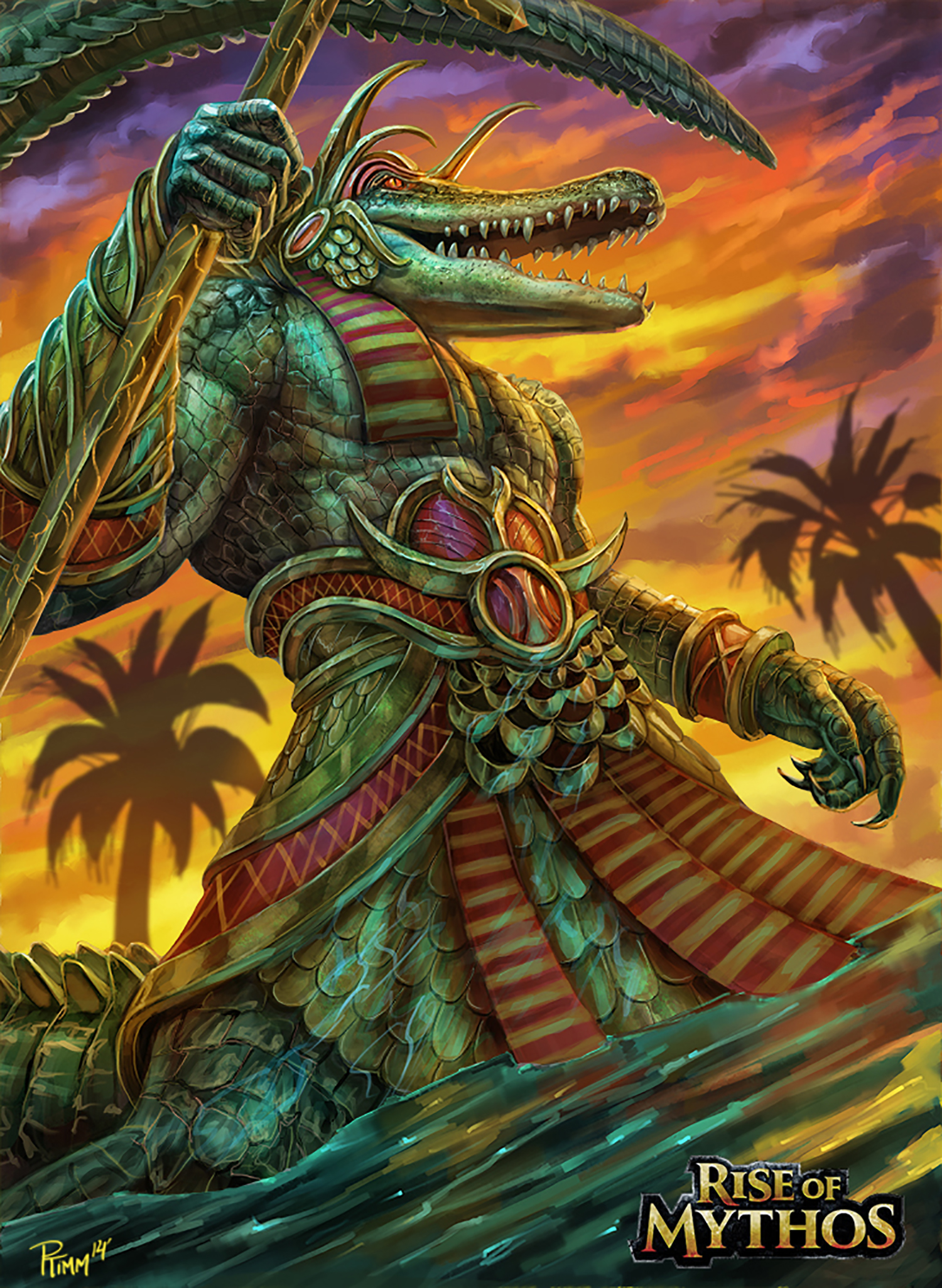
Perhaps my favorite is Sobek, a protective military god with the head of a crocodile.


All of the above gods are very interesting, and I plan to do posts on them in the coming weeks.  However, the main players of Egyptian mythology are Isis, Osiris, Set, and Horus.  You know how the Star Wars movies all focus around the adventures and drama of one family, the Skywalkers?  Osiris and his family are basically the Skywalkers of Egyptian mythology.

We'll talk more about this in future posts, but the main conflict of Egyptian mythology revolves around those four characters.  Set and Osiris are brothers, and a jealous Set murders Osiris and literally tears him into pieces, scattering him to the corners of the world.  Isis, Osiris' wife, puts her husband back together again (much like Humpty Dumpty!).  Their son Horus winds up in an eternal conflict with his nefarious uncle Set.  Sounds like fun, right?

Another aspect of Egyptian mythology which I find fascinating is the way it personifies some forces of nature.  A perfect example of this is the Nile River.  The land around the Nile is particularly fertile, and is fantastic for growing crops.  The river is also prone to flooding at certain times of the year, leaving those who dwell with it with a healthy respect for the water.  This respect was represented in early Egyptian mythology by creating the Nile into a sort of deity.  Praises and hymns were written in its honor, because the Nile provided life to the surrounding lands.  Appeasements were also offered to the river in the hopes of preventing early flooding.

I'll leave you guys with that.  Have a great week, and I'll see you next Monday with a post about one of the gods!

Sunday, December 27, 2015

The Romance of Reuben and Penina

Hey guys!  I hope you all had a wonderful Christmas!

This week I'm wrapping up my series on Jewish folklore with a special tale.

There's a story in Jewish folklore about a challenge between King Solomon - the wisest of Israel's kings - and the Queen of Sheba.  The Queen was a frequent guest of Solomon's, and she loved to question him and put his beliefs to the test.

One day Solomon was explaining that God has a perfect match for everyone - a marriage made in Heaven, as it were.  The Queen took issue with this, insisting that there were some circumstances wherein a person could not possibly find a mate.  She proposed a test, and Solomon agreed to her terms.  Together they would find an unmarried young woman.  She would be imprisoned in a tree on a deserted island for five years.  If, at the end of that time, God had found her a husband, the Queen of Sheba would believe that Solomon had spoken the truth.

The two royals walked through Jerusalem, looking for the perfect candidate.  At last they decided upon a lovely maiden named Penina.  Solomon and the Queen accompanied her to her home, where Solomon arranged to hire her for five years.  He paid her parents well for her employment, and then shipped Penina off to an isolated island.

Penina's home on the island was a single room inside a hollowed out tree trunk.  The room had a window - though it was too small for her to fit through - and a door that was sealed and locked from the outside.  Her tiny house had a loom for weaving and musical instruments to make her time there more pleasant.  Penina was not thrilled by her temporary exile, but she did resolved to do her best to bear it with good cheer.

Now, in this story King Solomon is able to speak with birds.  Every day he sent one to pass supplies through the window to Penina.  The birds reported to him of her doings, allowing Solomon to keep an eye on her from a distance.

Some time passed, and a ship happened to be sailing somewhat near the island.  The sea was calm that day, so the ship's captain went below to take a nap, leaving his son Reuben to steer the ship.  For a brief time all was well, but then a violent storm rose up out of nowhere!  Reuben did his best to control the ship, but a towering wave swept over it and knocked him into the water.  The young man managed to cling to a plank of wood, but he could do nothing but hold on as the waves carried him away from his father's vessel.

Can you guess where he wound up?

The storm carried Reuben to the banks of a strange island, where he was deposited on the sand.  Exhausted, Reuben nonetheless went on a search for food and water.  There was fresh fruit and spring water in abundance, so Reuben was able to sustain himself.

After several days the young man had explored nearly all of the island.  An enormous tree near its center had piqued his interested, and Reuben was determined to climb it.  (What else are you going to do on a deserted island?  After all, he didn't have a volleyball named Wilson!)  When he approached the tree he noticed something quite curious.  A bird had approached the foliage, laden down with a basket of fruit and other supplies.

As Reuben watched, the bird perched near a small opening carved into the tree trunk.  A hand reached through the opening and took the basket, and the bird flew away.

Reuben was amazed by this.  For several days he watched the window.  Every day at the same time the bird arrived with supplies.  Reassured at last that the bird only came once a day, Reuben approached the window right after it had flown away.  He climbed the tree and looked through the hole - and found a beautiful face looking back at him!

Penina was shocked to discover that she had company on the island.  The two struck up a conversation, and soon found that they liked one another very much.  They talked all day and all night, and then Reuben carved the window a little wider and climbed in side.  They were in love.

The birds reported all of this to King Solomon, who smiled and arranged for enough food for two to be sent to the island every day.

Time passed, and eventually Reuben and Penina married.  The birds told King Solomon of this, and he sent a wedding feast for the couple.  Despite having arguably won the test by the Queen of Sheba, Solomon did not tell her of the events on the island...at least, not yet.

Nine months after the wedding a child was born to Penina and Reuben.  They named her Sheba in honor of the woman who had brought them together.

When King Solomon heard the news he was delighted.  As it happened, his son was getting married soon and a huge feast was planned.  The Queen of Sheba would be attending, and the King wanted to surprise her.  Solomon arranged for Reuben and Penina to be taken from the island and brought to the feast.

When the couple arrived at the port the first thing Reuben saw was a picture of a handsome man.  He inquired after it, and was told that the man was the son of a sea captain.  He had been lost during a voyage, and though is father had searched for many days he could not find him.  Upon reaching town the captain had hung up pictures of his son in the hopes that someone would recognize him and reunite them.

Reuben began to cry, realizing that he was the man in the picture.

The group began to travel inland.  In a few days Penina, Reuben, and Sheba had arrived and Jerusalem.  King Solomon greeted them joyfully.  Upon hearing of Reuben's father the King sent for him, along with Penina's parents.  A tearful reunion followed, and the families enjoyed themselves immensely at the wedding feast.

As for the Queen of Sheba - she could not argue with the image of Reuben and Penina holding their baby daughter.  The Queen admitted that she had lost he wager, and that Solomon was right: God really does have a match for everyone.

I really love this story.  I think its message is charming and romantic.  I also adore the similarities to the story of Rapunzel.  What did you guys think?

I wish you all a happy New Year!  I'll see you in 2016 with a new series of posts!

Monday, December 21, 2015

Solstice and Christmas: Old Traditions Made New

Hey guys!

First off: oh my dear sweet goodness Star Wars!!!!  SO.  GOOD.
(If you're interested, you can check out two posts I've done in the past about the mythology behind Star Wars here and here.)

Now that I've got my fangirling out of the way, let's take a look at today's post!

I have a tradition of looking at different holidays in this blog - you can check out my Christmas post from last year here.  Due to that, I want to move away from Jewish folk tales to look at some of the ancient traditions and celebrations that have influenced the modern holiday of Christmas.  The holidays I've chosen to discuss today primarily come from Celtic, Norse, and Roman traditions, but if you're curious and go looking you might find that the mythologies of a lot of different cultures have influenced the current celebration of Christmas.  Should you do so, please shoot me a message - I'd be interested in seeing what you find!

Let us begin with the celebration of Yule.

Mention of Yule appears frequently in the celebration of Christmas.  A certain song immediately comes to my mind:


If, like me, you've sung this song while caroling, the words Yuletide carols being sung by a choir might have made you question their meaning.  After years of cheerfully singing along I began to wonder...just what is Yule?  The mention of a Yule log in several older books also piqued my curiosity, and so I began to research.

Yule is an old Norse holiday celebrating the end of the cold season.  Many cultures have festivities to celebrate the turning of the seasons (we'll talk more about another in a minute), and the Norse were no exception.  Yule was marked by feasting (particularly upon boar, which was hunted during the season), drinking, and praising Odin (called the Yule father at times) for victories and Freyr and his father Niord for successful harvests.


(Of course there was drinking at the feasts!)

Perhaps the most important aspect of Yule was the burning of the Yule log.  Yule is celebrated from November to January, which are the darkest and coldest parts of the year (in the region in which it is celebrated, at least).  Many cultures from around the world have celebrations during those months that revolve around light and fire.  A few older examples come to mind - the Egyptians praying for Ra, god of the sun, to rise again - but there are a considerable number of modernly celebrated festivals as well.  We talked about Hanukkah last week, which celebrates the miracle of light.  Kwanzaa begins later this week, and also revolves around the lighting of candles.  The Yule log, still commonly used in some parts of the modern world, is lit and then allowed to smolder for 12 days.  Should the fire go out, bad luck is signified.  The remnants of the log are then saved for a year and used to light the Yule log the following year.

(Modern versions of the Yule log tend to include the burning of candles instead of the actual log.  As such, they can be very beautifully decorated!)

Certain aspects of Yule can be seen in modern Christmas celebrations.  I know that ham is one of my favorite holiday foods, and while I don't pray to Odin, Freyr, or Niord I do tend to give thanks around Christmas.  My heater is currently broken, so fires in the fireplace have been a huge blessing this year...though I tend to look forward to a blazing fire every Christmas season.  What about you guys?  Do any of the practices of Yule show up in your own celebrations?

Lastly, we have the tradition of mistletoe.  While not specifically tied to Yule, mistletoe nonetheless has strong ties to both Norse and Celtic mythology.  When Loki goes full-on Dark Side and arranges the death of Baldr, it is mistletoe that ends the god.  As such, it was regarded as a very powerful plant.
 
 
(Death by mistletoe...gotta be an embarrassing way to go!)
 
Mistletoe was also considered sacred by the Celts and druids; enemies who met under it were required to stop fighting and make a temporary peace.

I'm not sure how we went from that to kissing under the mistletoe, but hey.  Whatever works?

If you're interested in learning more about Yule, I found this quick guide quite interesting, especially since it focuses more on the modern celebration of the holiday and some of its Celtic influences.  For a truly fantastic in-depth look at the Norse origins of Yule, check out this article.

We'll move now to a Roman holiday called Saturnalia.

Saturnalia is celebrated towards the middle/end of December - another solstice festival.  It is named for the Roman god Saturn, god of the harvest.  Candles were commonly used as both home decorations and gifts during this time - for it was a time of gift giving.  Sweets and goodies were exchanged, and both holly and ivy were used as decorations given their being sacred plants to Saturn.  All of these things show up in modern Christmas celebrations.

What I find most interesting about Saturnalia is the common reversal of roles, including the election of a Mock King.  During Saturnalia slaves and masters swapped places for a time, allowing the slaves to give the commands to their masters.  Of course, to quote Terry Pratchett: "We suspect that the slaves were magnanimous in office, though; tomorrow the masters would be the masters again."  After all, it isn't wise to antagonize the person who will soon rule over your life once again!

This custom of swapping roles is still alive in some places of the world.  It was adapted into Christianity in the form of the Boy Bishop.  Around the feast of Saint Nicholas (the patron saint of children), a church would elect a boy to be temporary bishop.  He would then elect many of his fellows to aid him in his duties.  The boy was allowed to give the sermons and lead the church for a time, before the actual bishop resumed his duties.  This practice is still held, primarily in Europe.


I hope you found this post interesting!  I was very intrigued to see just how much of what I celebrate has been influenced by past holidays.  If you're interested in learning more I recommend checking out a book on holidays symbols (if your library has one) - the one I flipped through is called Holiday Symbols and Customs.

If you haven't read anything by Terry Pratchett, I highly recommend all of his works.  I usually reread Hogfather during this time of year, which blends all of the traditions mentioned above with many others to create an entirely unique take on holidays - plus, Death is Santa!


I hope you all have a very merry Christmas, and whatever other holidays you might celebrate.  I'll leave you with a cheerfully burning Yule log of sorts, and I'll see you next week!

Sunday, December 13, 2015

Hanukkah: The Festival of Lights

Hey guys, I hope you all had a wonderful week!  I'm super happy - the semester is almost over, and this Friday is STAR WARS!!!!!!

(Not that I'm excited or anything.)

Ahem.  Anyway, on with the post!  The Jewish people celebrate several festivals throughout the year.  Last week we talked about the festival of Purim; this week, in keeping with the season, we're going to talk about Hanukkah.

Hanukkah, also known as the Festival of Lights, is celebrated in December.  I think most people know at least that much about the holiday.  Menorahs, the eight-branched candleholders used in the festival, may also be familiar to some.


But how many of us know the history behind the holiday, or the reason for the candles?  I know I didn't until I took an Old Testament class last year.  I found the story of the origins of Hanukkah beautiful, and I wanted to share it with you.

The story of Hanukkah takes place after the end of the book of Isaiah.  In the Christian Bible, Isaiah is the last book of what Christians call the Old Testament.  Following Isaiah is the period of several hundred years before the next book in the Christian Bible - the gospel of Matthew.  This is quite a large time gap, with nothing there to fill in the blanks.

The Jewish Bible ends at Isaiah, but they have several writings to fill in the centuries-long period that follows.  These writings are not actually part of the Hebrew Bible, but are considered historical instead of sacred.  Their stories are commonly taught in synagogues, for they focus on a part of history that is particularly important to the Jews.

The story of the origins of Hanukkah is contained in the books of 1st and 2nd Maccabee.  Its events take place between 200-150BC, when Greece took over Jewish lands and attempted to outlaw their religion.

The Greek leader in charge of this expansion was named Antiochus; texts more commonly refer to him as Antiochus Epiphanes.  "Epiphanes" translates to "God Manifest", and it was a title Antiochus had given to himself.

Yeah.  He was slightly full of himself.

Antiochus hated the Jews because they refused to acknowledge the Greek gods.  As revenge, he passed laws forbidding the Jews from practicing their faith.  One law forbade the Jewish custom of circumcision, something their beliefs required of them.  Another set a death sentence for any Jew found worshipping their God.

Then Antiochus did something truly horrific: he stormed the Temple of Jerusalem and desecrated it.  He raised a statue of Zeus within the Temple, and sacrificed a pig upon its altar.  These acts were known as the Abomination of Desolation.

I don't know how familiar you guys are with the Jewish religion, so I'd like to explain why these acts were so awful.  One of the 10 Commandments given by the Hebrew God is "You shall have no other God before me."  Raising a statue of a heathen god within God's own Temple was a huge violation of that commandment.

Certain foods are considered unclean in the Jewish faith.  Eating them is forbidden.  This includes anything with cloven hooves - including pigs.  The act of sacrificing an unclean animal upon the Temple's altar made the entire Temple unclean.  No additional sacrifices could be made to God, because they would be tainted and unpure.  At the time, animal sacrifice was a huge part of the Jewish faith - and it had to be done at that Temple.  Antiochus' act made that nigh impossible.

One of the books I have on the subject calls this act "abhorrent".  The word does not do the deed justice.

For some Jews, this was the last straw.  Instead of subduing them, it made them rise up.

In a village near Jerusalem there lived an old priest named Mattathias.  His temper was at the breaking point, and it snapped completely when a group of Greek soldiers attempted to force him to make sacrifices to the Greek gods.  He rose up and killed the soldiers, then escaped into the country with his five sons.

(These sons were called the Maccabees, commonly translated as "hammer".  It is from them that the books of Maccabee get their names, along with the Maccabean revolution I'm about to talk about.)

Jews began to flock to Mattathias, who led them in rebellion against the Greeks.  The Jewish army was small, but its members knew the land well.  They used their knowledge of the area to make hit-and-run attacks against the larger forces of the Greeks.  The tactic was quite successful.

Eventually Mattathias died of his age and his son Judas took his place.  Under his leadership Jews who had fled when the Greek army first came returned to take up arms.  Judas was a genius at military strategies; after many defeats Antiochus began to consider the Jews a serious threat.

Antiochus raised an army of tens of thousands to crush the Jewish rebellion.  Several generals commanded this army, and one of them led a few thousand men to make a surprise attack on the Jewish camp.

Judas got wind of this before it happened and moved his army.  Instead of running, he headed straight for the main part of Antiochus' army, hoping to catch them unawares.  The plan worked beautifully - after all, the Greeks expected Judas and his army to be under attack!  Though vastly outnumbered, the element of surprise left the Jews victorious and sent the unprepared Greek army fleeing.

When the general who had planned to ambush Judas' forces returned to camp his found it in ruins.  Realizing that the Jews had bested his allies, the general retreated with is remaining soldiers.

With no forces left to oppose them, Judas and his men made for Jerusalem.  They retook the city and began to ritually cleanse the Temple - a process that would be quite lengthy and difficult.  Eventually the work was completed, and Judas began to rededicate the Temple to God.


After he had lighted the menorah Judas made a nasty discovery.  Once lit, the menorah was supposed to stay aflame.  This was a problem, because here was only one jar of oil left - and that was only enough for the light to burn for one day!  It would take eight days to prepare more oil.

There was nothing the Jews could do.

And then...a miracle occurred.

The oil that was only enough for one day somehow kept the lights burning for eight days.  It was enough time for more oil to be prepared.  The menorah was able to stay lit.

And so it is that the Jews celebrate Hanukkah, the Festival of Lights - a festival which revolves around the lighting of a menorah for eight days.

Whether you guys celebrate Hanukkah or are just reading this post because you were curious, I hope you have a happy Hanukkah, since today is the last day of the holiday this year.  And, given the approaching movie, I'll end with this picture:


Have a great week!

Monday, December 7, 2015

Esther and the Festival of Purim

Hey guys!  My last post was an Intro to Jewish Folktales.  Following in that vein, today I'm going to be talking about the Jewish folk hero named Esther.

The Jewish people have quite a few festivals that they celebrate every year.  These festivals are to commemorate special events in the history of the Jews.  One such celebration, the Festival of Purim, remembers the story of a girl named Esther and the way she saved her people from destruction.  The full tale can be read in the Book of Esther (interestingly the only book in the Bible to not mention God) or in the movie One Night with the King [for those of you who prefer visuals over text (or just like John Rhys-Davies)], but I'll give you a condensed version.

The story goes like so:

There was once a Persian king named Ahasuerus.  (This king has been historically identified with Xerxes I - does the name sound familiar?  A certain movie involving three hundred Spartans might explain why...)


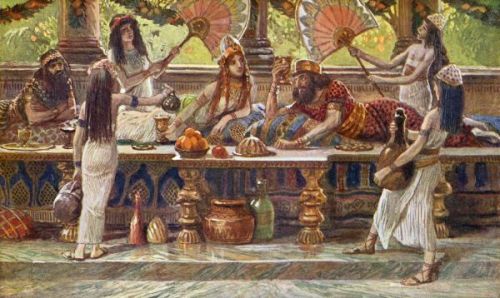
King Ahasuerus had a beautiful wife, Queen Vashti.  At that time men and women often dined separately from one another.  During a party with some friends (and after a few drinks) Ahasuerus began to boast of Vashti's beauty.  His friends wanted to see her looks for themselves, so Ahasuerus sent a messenger commanding the queen to make herself beautiful and come to him.


When the message reached Vashti she was less than pleased to be told to parade her looks before the king's guests like a common dancing girl.  To make a long story short, she refused to come before the king.  He was frustrated by this, and his guests were worried that their own wives might decide that they could refuse their husbands if the queen set a precedent for it, so Ahasuerus dismissed Vashti.

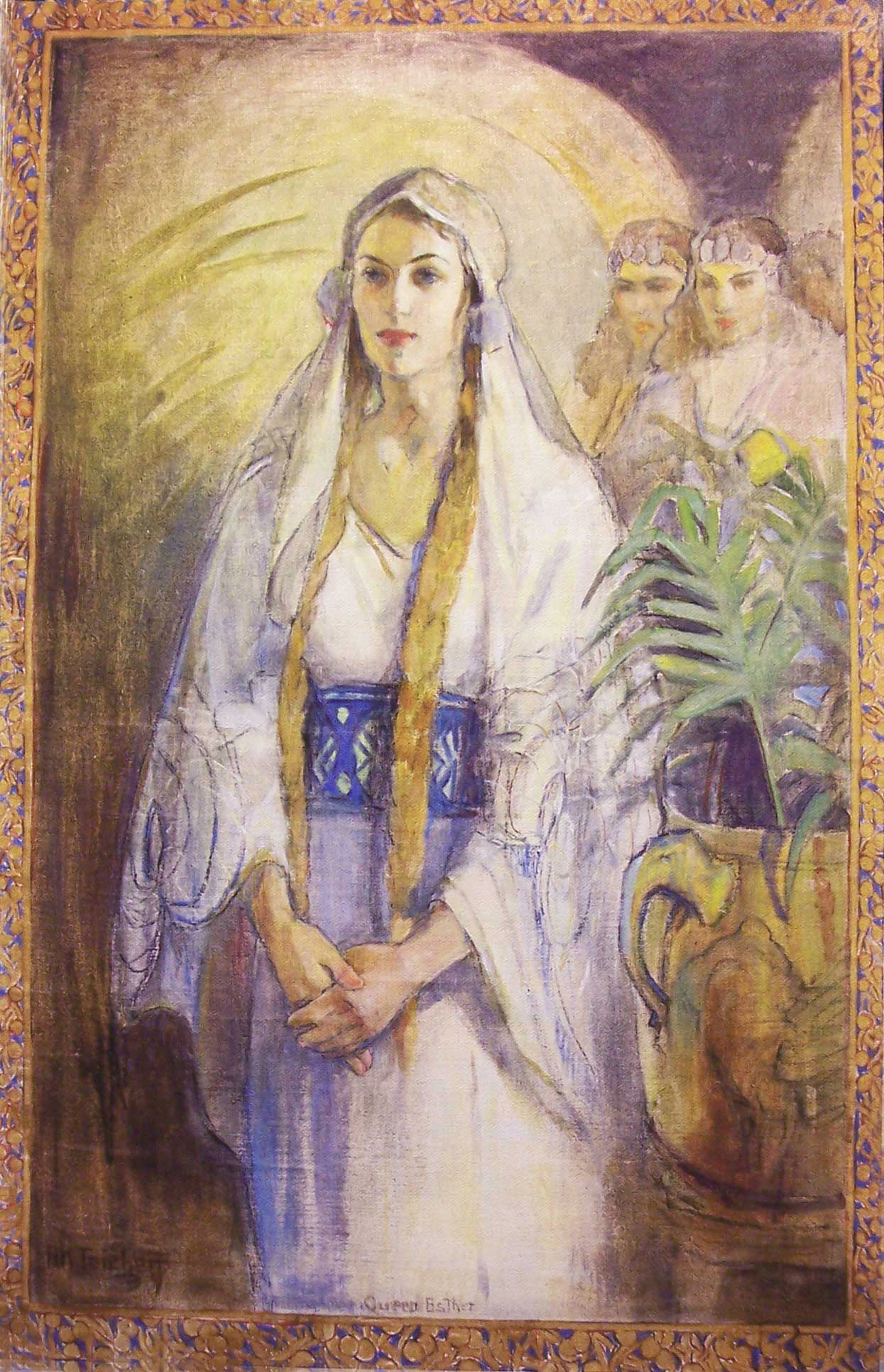
Of course, this left the king without a queen - and that could not be.  All of the beautiful maidens in the land were summoned so that the king could choose a new bride from amongst them.  One of these women was a girl named Esther, born Hadassah.  Esther had been orphaned and fostered by her cousin Mordecai.  Mordecai and Esther were both Jewish, though Esther kept this fact hidden from the king.  The girl was very beautiful, and she was chosen to be the new queen.


Around this time Mordecai overheard two members of the palace plotting to kill Ahasuerus.  He sent a message to Esther, who warned the king, and in so doing saved Ahasuerus' life.  The event was recorded with credit going to Mordecai, but the king forgot to reward the Jew.

Now, Ahasuerus had an advisor - a vizier - named Haman. (Of course he would be a vizier!  So many of the best villains are!)  Haman was passing through the town outside the castle walls one day, and everyone fell before him and bowed...except for one man.  That man was Mordecai.  Mordecai, as a Jew, did not wish to show obeisance to a man who was descended from the enemies of the Jews.

Haman was furious at this lack of respect, and rushed to Ahasuerus.  He told the king that there was a culture who refused to bow to their betters and serve them, and that they must be disposed of to preserve the king's reign.  Ahasuerus granted Haman permission to kill the Jews.  The vizier cast lots to determine the day on which the extermination would take place.  It is from the Jewish word for lot - "purim" - that the name of the festival comes from.

Bans were posted announcing the date that the extermination was to take place.  Mordecai tore his clothes and rubbed his face with ash (a sign of mourning) when he saw the signs.  He took the news to Esther and begged her to use her influence with the king to try and stop the genocide that was scheduled - but the queen was afraid.  There was a rule in the court that no one could approach the king without permission on pain of death.  She did not want to lose her life by attempting to speak to Ahasuerus.

Despite her fear, Esther was loyal to her people.  She asked Mordecai to have the Jews fast for three days and pray for her.  At the end of these three days Esther approached Ahasuerus.  To her relief, he extended his rod of command upon seeing her approach - a sign that he would allow her to speak to him, and would not take her life as punishment.


Esther invited the king and Haman to come to a banquet she had prepared.  They came and dined, and she extended a similar invitation for the following night.  After dinner Ahasuerus found himself unable to sleep.  He ordered a servant to read documents of the court to him, and in so doing heard of Mordecai's previous efforts to save the king from assassination.  The king realized that he had never rewarded Mordecai for his actions.

The following morning Haman entered the king's chambers in a great mood.  He was so sure of Mordecai's coming destruction that he had constructed a gallows in front of his home from which to hang the Jew.  As Haman came before Ahasuerus the king asked him how the vizier would honor a man who had aided the king.  Thinking that Ahasuerus was speaking of Haman, the man proudly answered that he would have the savior dressed in one of the king's robes and paraded through the city for all to see.  Haman was horrified when Ahasuerus ordered him to honor Mordecai in this way!

That night Ahasuerus and a seething Haman went to Esther's dinner.  At the second banquet Esther told the king that she was a Jew, and that Haman was seeking to end her life and the lives of her people.  Ahasuerus stepped outside to think, and Haman flung himself before Esther and begged for his life.  Unfortunately, Ahasuerus walked back in at this moment and thought that Haman was attacking the queen.  Furious, the king ordered Haman killed - and, when he was informed that Haman had a gallows ready-made outside his home, ordered him hung there.

I believe that's what is called irony, folks.

The story ends on a happy note.  Unable to get rid of a rule he had already created, Ahasuerus instead issued a new proclamation that gave the Jews the right to defend themselves on the designated day of their destruction.  The Jews survived, and many Persians who attempted to kill them - including some of Haman's family - were killed instead.  It is this survival, and the victory over their enemies, that Jews today still celebrate in March during the Festival of Purim.


I'll end my post there - I hope you guys enjoyed it!  As I said in my last post, next week I'll be talking about Hanukkah.  I'm very excited, and I hope you'll like what I have written!  What did you think of the story of Esther?

Monday, November 30, 2015

Intro to Jewish Folktales

Hey guys! For those of you who celebrate, I hope you all had a lovely Thanksgiving, and that you survived the frenzy of Black Friday. Happy Cyber Monday, by the way! The Kindle version of Hammerfall is on sale for today only; you can check it out here.

Today we're taking a look at the rich and complex stories told by the Jewish people. Their faith, known as Judaism, is often simplified when talked about as being “just the Old Testament”. In reality, Judaism is far more than their 24 books that make up what Christians term the Old Testament (which is actually 39 books for Protestants, because they split several of the books from the Hebrew Bible into smaller books). Let's take a look at some of the different writings found in Judaisim.

The 24 books I mentioned above form what is called the Tanakh.
 

(If you guys have never seen written Aramaic...well, it is gorgeous, as you can see above.)

The first five books of this series of writings are termed the Torah, or the Pentateuch. In addition to these core tenants of their faith, Jews have an enormous amount of literature that they consider central to their religion. These writings most notably include laws, but also can be songs, proverbs, and stories. As with many old religions, all of the books of Judaism began as oral traditions. They were not recorded for many centuries.

Now, I do not feel I have studied enough of religion to tell you about the Jewish faith. The series of posts I have planned aren't going to talk about the Jewish God, called Yahweh, or their prophecies, or anything central to Judaism. I focus on mythology, so talking about religions that are still widely practiced today is a little difficult for me. Instead, I plan on talking about the stories found in Jewish literature. Because of this I have dubbed this series of posts “Jewish Folktales”, because they are about the tales those folks tell (see what I did there?).

Next week I'll be talking about the story of Esther, one of the strong women found in the Tanakh. Her actions and bravery led to the celebration of what is called Purim – a festival that is still celebrated in modern times. Since Monday the 14th is the last day of Hanukkah this year, I plan to talk about the origins of that holiday on that day. After that I have a special post planned, and then we'll hop back into Jewish folktale with the beautiful story of Reuben and Penina to round out the year.
 

I'm really excited for this, guys! I think the stories are absolutely lovely, and there's such a wide variety for me to choose from. I hope you're looking forward to this as well. I'll see you guys next week!

Sunday, November 22, 2015

Morgan, Morgause, Mordred, and the Fall of King Arthur

Hello!  I hope you had a lovely week!  Today's post takes us back to wrap up Arthurian legend.  Beginning next week I'm going to be taking a look at Jewish folklore.  Before I begin this post, there's a couple of things I'd like to talk about.

First off, I totally forgot about this blog's anniversary, so we missed it!  My first post, an Intro to Norse Mythology, was published on October 28th, 2014.  That's right - mythdancer has been around for over a year now!  During that time you guys have been amazingly friendly and supportive, and I've loved seeing your enthusiasm for mythology, fairy tales, and folklore.  So, whether you've been reading since the start (thanks Mom!) or have only recently found this blog, thank you for your support.  You're the reason I keep writing these posts.

Next, we are very nearly to 4000 pageviews!  I can't believe it!  Thank you, thank you, thank you!

Last thing before I get into the post: This coming Saturday I will be at the Bookmans on Speedway and Wilmot for their last Local Author's Fair of the year.  I'll have copies of both Hammerfall and Lovesick, along with a massive number of lightsaber earrings (Come to the dark side!  We have fashionable jewelry!).  If you're in the neighborhood, you should swing by and see me!  You never know who might be there...


Now, on with the post!

Arthurian legend is full of honor, chivalry, and strict ties between knights and their lords.  Unfortunately, it is also fraught with convoluted familial relationships and romances that at times tear the court apart.  One such situation leads to the fall of King Arthur's court, and his disappearance from this world.

I mentioned in my post about Uther that Igraine, the mother of Arthur, had several daughters with her first husband (before Uther killed him).  These girls were married off by Uther to various vassals and lords that he wanted brought under his control.  One of the daughters, Elaine, doesn't really figure into Arthurian legend after this.  Unfortunately, she is the only girl who disappears from the stories.  Her sisters Morgan le Fay and Morgause appear quite prominently.

Now, when I see the name Morgan le Fay I tend to go "Boo!  Hiss!  Evil!"  This reaction is because Morgan is portrayed as a villain in so many parts of popular culture nowadays.  She has been the evil responsible for Arthur's downfall in books, television shows, movies, and videogames.


This is very interesting, because in the original legends Morgan le Fay actually wasn't that bad of a person.  She was depicted in the beginning as a healer who often aided King Arthur and his court. Later the myths changed to make her an opponent of Queen Guinevere (largely because Morgan loved Lancelot, Guinevere's lover), and by extension King Arthur - but she eventually exiles herself to the land called Avalon to study magic and ceases to plague the court.  She even shows up in the end to escort a mortally wounded Arthur to his rest in Avalon.

So how did the Morgan le Fay from the legends become the one now featured so evilly in pop culture?  The answer lies in her other sister, Morgause.  The two women are often combined into one, with Morgan's name and magical prowess merged with the story of Morgause.  It is to Morgause that we now turn.

Morgause, like her two sisters, was married off to a vassal of King Uther.  When the king died she was unaware that he had sired her half-brother, Arthur.  Arthur, being raised away from the court and his heritage, was unaware that he had any half-sisters.  Upon his coronation a dramatic turn of events saw he and Morgause share an incestuous night together - a night that resulted in the birth of a son, Mordred.


In truth, that is about the extent of Morgause's importance to the story.  She bears several sons to her husband, and they and Mordred (raised without knowing his heritage) go on to become knights in King Arthur's court.  Morgause pretty much disappears from Arthurian Legend at this point.

It is to Mordred that we now must turn.  He became a seemingly noble knight for King Arthur, but in reality he often sought to undermine the king's power.  Mordred is often depicted as trying to alert Arthur to the adultery of Guinevere and Lancelot, hoping to plunge the knights into a civil war.  This usually fails, luckily for the court!

Unfortunately, Mordred gets his chance to overturn the order of things when Arthur leaves him in charge while the King wages war far away (sometimes this war is upon Lancelot and his army, since Arthur finally discovered the betrayal of his knight).  Left with no one to stop him, Mordred crowns himself king and seizes Arthur's throne for himself.  He also tries to marry Guinevere - depending on which story you read, she sometimes willingly marries him and sometimes flees to a convent rather than wed him.  In any case, Mordred takes the power of Camelot and has no intention of giving it back.


This is problematic, because when Arthur hears of his young knight's betrayal he marches his army straight back to Camelot to reclaim his throne.  The battle that ensues is known as the Battle of Camlann.  Many died during this battle, which culminated in a confrontation between Mordred and Arthur.  Arthur managed in the end to kill Mordred, but he was struck a mortal blow in the process.

Lying on the battlefield dying, Arthur sends one of his knights to return Excalibur to the Lady of the Lake.  The knight tries several times to keep the blade for himself, but Arthur sees through his lies each time.  He eventually gives in to his King's orders and throws the sword into the Lake, where it is reclaimed by the hand of the Lady rising from the deeps.

What happens next is one of the more interesting parts of Arthurian legend (at least to me).  Arthur is taken by a group of women - their identities vary, but they generally include at least one Lady of the Lake and Arthur's half-sister Morgan le Fay.


These women carry the dying king to a boat and escort him to the isle of Avalon, a mystical land of healing.  According to legend, the great king does not actually die.  Instead, he lies on Avalon, regaining his strength until the day of his return.

(Which sounds an awful lot like the story of Fionn, doesn't it?)

With that, I'll end my posts about Arthurian legend for now.  What did you guys think?

As I said at the beginning of the post, next week I'll be starting to take a look at Jewish folklore.  Until then, you guys have a great week!  Happy Thanksgiving!