Monday, June 29, 2015

Skadi: Frost and Feet

Hey guys! I hope everyone in the northern hemisphere is surviving the summer heat. This past week has actually been pretty nice in Arizona; the monsoons have hit, so the rain has made it a little cooler.

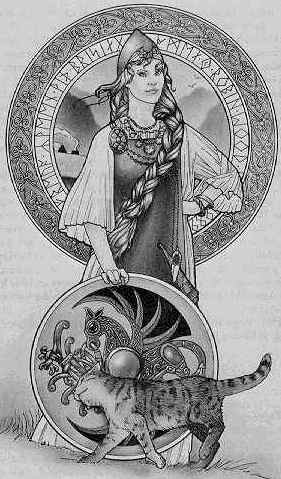
This is the last Norse mythology post I’ll do for a little while, but I saved a cool character for today (pun intended, since she’s a frost giant!). She’s the goddess of winter, hunting, and skiing - Skadi!


Skadi is an interesting figure in Norse mythology. Her name translates to “destruction”, but she’s not actually a bad guy in the myths. Instead, Skadi marries a god and stays faithful to the Æsir afterwards, aiding them in capturing and imprisoning one of their oldest enemies. Let me tell you about it.

In a story that takes place before this one, Skadi’s father is killed by the gods after stealing something from them. The item is reclaimed, and the gods return to Asgard thinking all is well. Unfortunately for them, Skadi isn’t the sort of daughter to sit by quietly and let her father’s death go unavenged. She girds herself in armor, takes up arms, and storms Asgard itself in search of vengeance.

The gods are a little nervous when they see Skadi, so they attempt to work out a deal with her. A common practice of the time was a blood price - the family of one who was slain would be paid money to compensate them for their loss. The gods offer Skadi a blood price of gold in exchange for her father’s death. The goddess scoffs at their offer; she is her father’s only heir, and he left her quite a tidy sum of gold upon his demise. After some consideration, Skadi decides upon a blood price she will accept - a husband of her choice from amongst the gods.

Still intimidated by her warlike stance, the gods agree to her demands. However, they tell Skadi that she must choose her husband without seeing his face: all she will be allowed to see are his feet.

(One of the gods, Balder, was famed for his beauty. If Skadi had been able to see all of the gods, and take her choice from amongst them, she likely would have picked the handsomest. By only allowing her to see the feet of the gods, all stood an equal chance of being picked.)

Skadi agreed to this strange condition, but had one final demand to make. Before she would put her thirst for revenge aside, the gods had to make her laugh. The death of Skadi’s father had made her bitter and cold, and she wanted to feel joy again.

Once the terms had been agreed upon, the gods set up a curtain. All of the gods stood behind it, so that only their feet were visible. Skadi was then shown the feet and told to pick her husband.

One set of feet immediately stood out to Skadi. They were the cleanest and most beautiful of the bunch, so she assumed they must belong to Balder. Desiring him for her husband, she immediately swore that she would marry whoever those feet belonged to.


Skadi was to be disappointed. (Insert joke about cold feet here.)  It was Niord, god of the sea, who stepped out from behind the curtain. In retrospect, it makes sense that his feet would be the cleanest of all - he probably spent more time in the water than any of the other gods!

(If you’re interested, Niord is a Vanir and the father of Freyr and Freya.)

Frustrated at having sworn to marry a god other than Balder, Skadi demanded that the gods meet her other condition. They must make her laugh.

Loki was prepared for this demand. The trickster god had been partly responsible for the death of Skadi’s father, so he took it upon himself to be the one to make Skadi laugh. For some reason, Norse mythology features strange creatures drawing chariots for the gods. Freyr has his giant golden boar; Freya has a chariot pulled by cats; Thor...well, Thor has two billy goats.

Loki “borrowed” one of these goats and immediately began to play with it in front of Skadi.

(In my mind, it looks something like this...)

 (...combined with this!)
 
The two rumpused around and had so much fun that Skadi could not help but laugh. Her demands met, the goddess put aside her anger at the gods and became one of them.

As a wedding present for she and Niord, Odin took the eyes of Skadi’s father and placed them in the sky as two bright stars.

The marriage was not without its challenges. Skadi hated Niord’s home by the sea, and Niord hated her home in the freezing, snow-coated mountains. The duo split their time between the two homes, and did find some happiness together. In fact, when Niord’s son Freyr became lovesick for his future wife, Skadi worried for him just as much as her husband did. Cool step-mom, right?

There is one more part to Skadi’s story that I’d like to tell you about. Eventually, Loki became truly evil. He arranged for the death of Balder - an event that was the first sign of Ragnarok. When the gods realized what Loki had done, they hunted him down. The trickster was eventually captured and imprisoned. Skadi put the final touch on his prison - a snake from her homeland that she wrapped around a branch draped above Loki’s head. The snake was wound so tightly around the branch that it began to drip venom in its agony...straight onto Loki’s face.  Ouch!


Perhaps Skadi was simply doing her duty as one of the gods. Or, perhaps she was still a little in love with Baldr. Vengeance is a dish best served cold, right?  And Skadi is the daughter of a frost giant.  I think that the snake was her revenge for his death.

What do you guys think?

I believe I’ve mentioned before that World of Warcraft’s Wrath of the Lich King expansion draws quite a lot from Norse mythology. If you look, you’ll find Skadi there - though for some reason this goddess is a male in the game! WoW’s Skadi is one of the bosses of Utgarde Pinnacle, and drops a much-desired blue dragon mount. Interestingly, he appears to be a frost giant - perhaps as a tribute to the mythological Skadi’s father.

I hope you guys enjoyed the post! I am still planning on doing a series on Celtic mythology, but events with my grandmother have left me without as much time to research as I had hoped for. I’ll probably do a couple of fairy tale and Greek mythology posts before I get around to that series. I apologize for this, but I’ll do my best to keep things interesting!

Got a request or suggestion? Have questions or comments for this post? Please post below or email me!

I’ll see you guys in a week! Stay cool!

Monday, June 22, 2015

Yggdrasil and the Nine Realms

Hello readers!

I realized when I was talking about Freyr being a Vanir that I haven’t really talked about the different races and realms that can be found in Norse mythology. With this post, I hope to rectify that.

All of Norse mythology is tied around a giant tree named Yggdrasil - the World Tree.  The tree-cities of the Night Elves in World of Warcraft are based upon this. Yggdrasil is an enormous ash tree upon which all of the realms can be found. Each realm is a different plane of existence, in which beings of various races reside.  All of these realms are tied together via the branches of Yggdrasil. The tree has three wells that water it, one of which is tended to by the Norns.


My favorite part about Yggdrasil? In its branches sits a huge eagle; around its roots curls an evil dragon. These two beings hate one another, and send messages of their disdain to each other. These messages are carried by a huge squirrel named Ratatosk. I’m not sure why this makes me as happy as it does. I think it’s because I picture a squirrel dashing between a dragon and an eagle, both of which would gladly eat it, and yelling “Neener neener!” with its cheeks stuffed full of nuts.


Anyway! Lets move on to the realms themselves.

The first and most important realm in Norse mythology is Asgard. This is the home of the gods - called the Æsir - , and where quite a few of their adventures take place. Valhalla, the hall where valiant dead warriors have an eternal party, resides in Asgard. The rainbow bridge known as the Bifrost has a gate in Asgard.


Next comes Vanaheim. Vanaheim is the home of the Vanir - Freyr’s race, if you recall. While these beings are also gods, few of them are famous. Freyr and his sister Freya are the two best known.


The Vanir and the Æsir had once been at war, leading to the construction of a giant wall between Asgard and Vanaheim. The events surrounding this wall being built led to Loki giving birth to a horse - good luck getting that image out of your head!

I don’t know very much about the next realm, Alfheim, save that it is the home of the elves. Freyr was made king of this realm, despite his being a Vanir instead of an elf.

(Looks like Rivendell to me!)

Midgard is the realm we can probably most relate to - after all, Midgard is Earth! It was here where humans roamed in the tales of the gods. Odin often took off for adventures on Midgard, appearing to help mortals in need by giving them cryptic clues and aid. Other Æsir interact with the mortals of Midgard as well, though none so frequently as Odin. Circled around the realm of Midgard is Jormungander, the giant serpent who is a child of Loki and will rise up during Ragnarok to devour his enemies.

Interestingly enough, Midgard translates to “Middle Earth”. The runes (and many of the names) that Tolkein used for his dwarves come straight from Norse mythology - so, one might assume that the name for his epic land in The Lord of the Rings found its origins in Midgard!

Thor often visited another realm - Jotunheim. This land was cold and fierce, and was the home of the giants (called Jotun in the stories.). It was here that Thor challenged their kings to drinking contests, was baited into traps by Loki, and cross-dressed. Fun times, right?


Svartalfheim was the land of the dark elves - so you can blame Dritz on Norse mythology as well! Curiously, the dark elves are actually referred to as dwarfs. These dwarfs were master craftsmen who could make just about anything out of precious gems and metals. Examples include Odin’s spear, Thor’s hammer Mjolnir, Sif’s hair (Loki shaved her while she slept, so the dwarfs made her a wig out of gold), and Freyr’s boar and ship. The dwarfs are described to be ugly and small; the gods were revolted when Freya slept with them.


Nidavellir, the next realm, is also said to be the home of the dwarfs. This realm isn’t always mentioned; sometimes there are only eight realms, with Nidavellir left off of the list. It is sometimes considered to be a subsection of Svartalfheim.  Because of this, I don't have a picture of it for you.  Sorry!

The most dreaded of the realms is Muspelheim. This realm, like Jotunheim, is the home of giants - but these giants belong to the fire instead of the frost. When Ragnarok comes, the doom of the gods will come from Muspelheim in the form of Surtr, leader of the fire Jotun. He is prophesied to kill Freyr in the final battle. Then Surtr and his fire Jotun will burn Yggdrasil - it’s the end of the world as we know it!

Last up is Niflheim, a frozen realm covered in fog. This realm is almost as feared as Muspellheim, for it is here that the dead reside - those who are not good enough to go to Valhalla. Niflheim is ruled over by Hel, queen of the dead and daughter of Loki. During Ragnarok the dead will rise up and take up arms against the gods. Lovely place for a vacation!

 
(Yeah, I'm totally joking about the vacation part.)

There you have Yggdrasil and the nine realms upon it! I hope this was interesting. It does intrigue me that there’s so little information about Alfheim. I’ll definitely have to look into it more!

Sorry this post went up so late in the day. Things are still a bit crazy between my grandma’s health and me having allergy attacks. I’ll try to do better next week!

Anyone got any requests for a post? Any questions or comments? Post below or email me! I’ll see you next time!

Monday, June 15, 2015

Freyr: Slain by the Fire (of Love)

Most of us can relate to having a crush.

Most of us can probably also relate to doing something stupid to impress said crush.

I personally went through a phase where I pretended to despise country music because the object of my affection hated it. Sorry, Stephen - I actually really, REALLY like country music. For a different crush, I tried to make it seem like I thought the Transformer movies were works of fine art instead of two-and-a-half hour long explosions of sound and metal with questionable story and acting.  Don't get me wrong, I liked the first one well enough - it was the ones after it that I had some problems with.

You guys probably have similar stories of things you’ve done - or tried to do - to garner the attention of your crush.

Well, not even the gods are immune to that sort of behavior. Case in point: Freyr, the Norse god of plants and fertility. Freyr is famous for a story in which he pines (heh - plant god, pines. Heheh!) away for a beautiful woman he has only glimpsed from afar. Unfortunately, he does something pretty stupid to win her over...and in the long run, it costs him his life.

In fact, the whole world dies because of Freyr’s mistake.

I hope none of us can relate to that!

In last week’s post I talked about the similarities between the goddesses Frigg and Freya. Freyr and Freya are siblings, and they’re not quite like the other gods. Several tales call them “Vanir”, whereas the other gods are referred to as “Æsir”. The Vanir hail from the Norse realm of the elves, Alfheim. In fact, Freyr was the Lord of Alfheim.

As I said before, Freyr is the Norse god of fertility and plants. He is also attributed as being the god of the sun, the rain, and the harvests. Freyr possessed several magical relics. Perhaps the best known is the boar Gullinbursti - the image of this boar is frequently found on shields and armor of Norse warriors. 


Gullinbursti was made out of gold, and his skin reflected the light of the sun, allowing crops to grow. Gullinbursti is also credited with teaching man how to plough the ground, because his tusks dug up furrows in the ground in which seeds could be planted.

The second relic of Freyr is the ship Skidbladnir, a truly magical vessel. It was capable of holding all of the armies of the gods, yet could fold up incredibly small and fit into Freyr’s pouch.


The ship also possessed the ability to sail on sea, air, or land.  Why am I picturing this?


Freyr’s final relic - and the most important one - was his magical sword. The blade was endowed with the ability to fight against the giants without anyone needing to hold it. This sword had long been prophesied to be incredibly important during Ragnarok, the doom of the gods. During Ragnarok, Freyr was foretold to fight against this guy:

Surtr, leader of the fire giants.

With his sword, Freyr might have been able to defeat Surtr. Unfortunately, the Norns knew long before he did that the fertility god would give away his sword for love of a woman, dooming himself to fall at the hands of Surtr.

This is the story which I wish to tell you.

Once, while the other gods were off on some business, Freyr decided to climb onto Odin’s throne. From here all of the realms could be seen, and the god was able to oversee everyone and everything. It was while he was in this chair that Freyr happened to glimpse a woman named Gerda, daughter of one of the giants. Her beauty so dazzled him that Freyr immediately fell in love with her.

Unfortunately, Freyr also knew that he would never be able to woo Gerda. After all, she was a giantess, enemies of the gods! What chance could their relationship ever have?

Because of this, Freyr fell into a deep depression. He pined for Gerda so badly that he could not eat, drink, or sleep. The god was so distracted by his love for Gerda that he failed to tend to his heavenly duties. As such, the crops began to fail on the earth. Nature grieved with the god, so the plants all started to die.

At these events Freyr’s father, already worried for his son, grew frantic. He sent Freyr’s loyal friend and servant Skirnir to find out what was wrong. Freyr confessed his love for Gerda, but also his knowledge that he could never possibly hope to have her.

Skirnir refused to give up so easily. He offered to go in Freyr’s stead to win over the beautiful maiden. After a while Freyr agreed to let him try, and lent Skirnir his sword to keep him safe on his journey.

His friend immediately set off, and eventually came to the home of Gerda and her father. Skirnir was granted an audience, where he told Gerda of Freyr’s love for her. However, Gerda was one of the frost giants - and her heart was as cold as ice. She was unmoved by Skirnir’s pleas on his friend’s behalf.

Noticing this, Skirnir changed tactics. He offered Gerda gold and jewels if she would return with him and become Freyr’s bride. Once again, the frost giant turned him down.

Desperate, Skirnir began to threaten the maiden. When threats of death did not phase her, he threatened to curse her to a life of eternal misery and loneliness. That struck a note of fear in Gerda, who relented and agreed to return with Skirnir and marry Freyr. (Gentlemen, please don’t take your cues from Skirnir. Threatening a lady is NOT an appropriate way to woo her.)

It is here that Skirnir makes a very foolish mistake - a mistake that Freyr does not chastise him for when he returns. In olden days there was a tradition called a bride price - sort of like a reverse dowry. The man who wished to marry gave a gift to the parents of the woman he sought. Essentially, he bought her off of them.

(I read a great Marvel fanfiction a while ago in which Thor approaches Dr. Selvig, Jane’s father figure, and gives him a few hundred cattle in exchange for Jane’s hand in marriage. Of course, he’s working in Stark Tower at the time, so Iron Man walks downstairs in the morning and sees a TON of cattle randomly standing there. Hilarious! Hopefully that helps you to picture a bride price.)

Skirnir offers Freyr’s sword as the bride price for Gerda.

So, I suppose Skirnir is the one to blame for everyone dying during Ragnarok. But still! Freyr sent him off to represent him, and gave him the sword for the journey. He doesn’t even try to get the sword back when Skirnir returns without it! What fools we are for love...

Anyway, Gerda and Freyr are married soon after, and the giantess quickly falls in love with the god. The poem this story is contained in was interpreted as the sun (Freyr) melting the frozen earth (Gerda’s heart), which is kind of sweet, and beautiful.

What happens next? Not so much.

During Ragnarok, Freyr has no weapon with which to face Surtr. Depending on the story, he fights with his bare hands, a tree branch, or an antler. None of those fare very well against fire.


Surtr wins. We all die.

But at least Freyr got the girl, right?

I hope you guys enjoyed the post! I love that the gods are as fallible in love as we mortals are. It makes them easier to relate to, and also probably made those who worshipped them feel less foolish when they acted stupid to win someone over - after all, they were just following the example of the gods!

Got any requests, questions, or comments? Feel free to enter them below, or to email me! I’ll be back with another post next week, though it’s still a mystery (to you and me both!) what it’ll be! See you then!

Monday, June 8, 2015

Frigg: She's Friggin' Awesome

(Sorry.  I couldn't help the title.  Once I thought of it, I had to do it!)

Hello, my readers! I hope you’re doing well this week!
Many thanks to my reader(s) in Australia - you are the 25th country to check out my blog!

We’re back to Norse mythology for this post. I mentioned in my Mother’s Day post that mythology has quite a lot of cool moms. Unfortunately, at that time I hadn’t really talked about any. Last week I spoke about Demeter and her devotion to her daughter; this time, I’m doing Frigg.

In Norse mythology Frigg is credited as being the mother of Baldr, and possibly of Thor and Hodur.  When Baldr is killed she mourns deeply for him.  If you've seen the Thor movies (especially the second one), then you have a pretty good idea of what a mother Frigg looks like.  Marvel may mess with the backstories of its mythological characters, but they got Frigg down pretty darn well.  (Of course, Frigg isn't actually Loki's mother - Loki is a blood-brother of Odin, and has no relation to Thor in the original myths.)

Besides being an awesome mother, Frigg is also a pretty swell wife.  Frigg is married to Odin, chief of the Norse gods. If Odin is the All-father, Frigg is the All-mother; in fact, she’s referred to in the myths as the Earth Mother.

Frigg is an interesting goddess because of the duality of her nature. On the one hand, she’s a goddess of love, marriage, and mothers (a little bit like the Greek Hera, but minus the petty revenge schemes.). In this role Frigg is represented as a great stay-at-home mom. She takes care of her kids, and is frequently depicted weaving with her handmaidens - a skill that was prized in wives of the time.


On the other hand, Frigg is also shown to be a powerful sorceress (something Marvel got right!) who could change her shape. She was able to transform herself into a falcon whenever she desired - not something your average mom could do! (I think. Right? Are your moms different than mine?)


Frigg also possessed the ability to see into the future, a skill that her husband Odin also had. Of course, Odin worked really hard and sacrificed an eye to get that gift - Frigg, on the other hand, is said to just possess it!

What makes Frigg truly interesting to me is the similarities between she and another Norse goddess.  I'd like to talk about a few of them.

Frigg was known by several different names, depending on the dialect of those who worshipped her. Sometimes she was called Frigga; at other times, Frija.

Norse mythology also features a goddess named Freya. Freya, Frija - pretty similar, right?

The two goddesses have more in common than just their names. Freya was worshipped as a fertility/love goddess, which fits nicely with Frigg’s traits. Freya was also said to be married to a man named Od (a word that means wanderer or roamer), who mysteriously disappears partway through mythology. Od sounds pretty similar to Odin, at least to me. Odin was well-known for roaming the earth and interacting with mortals.

Like Frigg, Freya also had a not-so-nurturing side. She was able to perform feats of powerful magic. She was a war goddess - Freya shared rule over battle with Odin, collecting half of the deceased warriors to take to her own version of Valhalla.


Just like Frigg, Freya was able to turn herself into a falcon thanks to a falcon cloak she possessed.

My favorite part about Freya?  Her battle chariot was pulled by two enormous cats.


Yes. Cats.


Frigg and Freya share one more very important thing. Both are portrayed in the myths as coveting gold - often in an unflattering way. While the stories on Frigg’s love of the metal are a little harder to find, there is a very famous one about Freya.

Norse mythology often has the gods interacting with giants, elves, and dwarves. Dwarves in the Norse myths are said to be short, ugly creatures - but they possess a great skill for making beautiful things from metal, be they weapons, jewelry, or anything else. Freya once paid a visit to a group of dwarves and found them around a gorgeous golden necklace they had just crafted. Struck with desire for the bauble, Freya begged the dwarves to allow her to purchase it.

Unfortunately for the goddess, the dwarves already had more gold and gems than they knew what to do with. They would not part with the necklace for any amount of treasure. After conferring, the dwarves told Freya that they would give her the necklace if she spent a full day and night with each of them.

The goddess agreed, and the poem which speaks of this myth shows her walking out of the cave several days later wearing the necklace.


Freya was unlucky in that Loki had seen the entire exchange (creepy, right?) and reported her doings back to Odin. The necklace was taken from her as a punishment, but was eventually returned to her.

So here we have two goddesses, each reigning over similar things - love, marriage, family, etc. They are each competent in ways one wouldn’t necessarily expect, and are skilled sorceresses. The duo are married to men who have similar names - Od and Odin. Lastly, they both share a passionate (and sometimes awkward) love of gold.

(Interestingly enough, the days of our weeks are named after the Norse gods. Sunday is named for the sun, Monday was originally Moon Day, Tuesday was Tyr’s Day, Wednesday was Woden’s [Odin’s] Day, Thursday = Thor’s Day, and Friday...well, Friday is interesting. Depending on which scholars you listen to, Friday was named for Freyr, his sister Freya, or Frigg. Frigg’s Day seems the closest to me, but the fact that she and Freya both might have been the origin of Friday’s name fascinates me.)

Some scholars believe that Freya and Frigg are in fact the same goddess - they just represent different aspects of the same divine being.

One last interesting thing about the duo?  I did a Google image search for Frigg and Freya.

I wasn't able to find a picture of the two of them together.

What do you guys think? The similarities are pretty striking, and I’m pretty intrigued by the thought of them being the same being at their core. Do you agree? Disagree?

Sorry for the short post today. My grandmother is in the hospital, and things have been hectic at my home. I’ll do my best to have an update up every Monday, but it might be delayed a day or two depending on circumstances here.

As always, questions or comments can go below or be emailed to me. I hope you guys enjoyed the post, and I’ll see you all next week!

Monday, June 1, 2015

Demeter, Persephone, and Hades

Hey guys! I hope everyone had a lovely weekend. I for one did! I got to go to Phoenix Comicon and meet two of my favorite actors - Jason Momoa and Karl Urban.  There were a ton of awesome costumes and vendors.  I'm definitely planning on returning next year!

(Me killing Sauron.  Definitely a highlight of the con!)

While I was gone, this blog got views from its 20th country! Thanks, Taiwan! That was wonderful to come home to.

I’m here today to talk a little bit more about Greek mythology. I was looking back through my Greek posts and I wound up re-reading the one I did for Hades. I was so busy defending his character that I actually didn’t fully go into the myth involving Persephone! Luckily, I was already planning on talking about Demeter today - it was easy to add Persephone’s story to hers, since the two are definitely intertwined. Of course, I can’t tell their story without also talking about Hades.

So, to begin with: This is Demeter.

Demeter is the Greek goddess of the harvest. A night spent with Zeus (who is king of the gods, and Demeter’s brother...creepy, I know) produced a daughter named Persephone.

This is Persephone.

Persephone followed in the footsteps of her mother. She’s the goddess of spring and vegetation, amongst other things.

Both of these goddesses are beautiful. They’re associated with flowers, plants, and any form of crop. (I actually just realized that Demeter is basically my arch nemesis - I’m gluten intolerant, and she’s the goddess of grain! WHY, Demeter? WHY?!) The goddesses are often depicted as holding these things, and are normally shown in daylight.

This is Hades.

Hades is the Greek god of the Underworld. He rules over the dead, and he seldom leaves his kingdom - which is dark, often considered depressing, and definitely not full of beautiful growing things.

Thanks to Zeus, these three characters end up wrapped up in a tale of drama. Ready for it? Let’s get started, then!

As usual, all of the problems began with Zeus. Being the father of Persephone, Zeus had the right to determine who she would marry. The king of the gods chose to betroth her to his brother, Hades. This was all very well and good - except that Zeus failed to mention Persephone’s betrothal to Persephone or Demeter!

Because of this, Persephone was taken unaware when Hades came to claim her. She was out picking flowers when he pulled up on his chariot, grabbed her, and dragged her down to the Underworld.

(As I mentioned in my Hades post - not an uncommon practice in those times, despite the bad rap it gets him nowadays.)

Demeter was frantic at her daughter’s disappearance. She searched the entire earth for Persephone, but ultimately found no sign of her. One place that she searched was the region of Eleusis. Demeter stayed in the home of the king for some time, disguised as an old servant. In gratitude for his hospitality, she sought to make the king’s son immortal. Unfortunately, this process required bathing him in ambrosia and then holding him over the fire. The queen walked in during this process and screamed, interrupting the ceremony. (Imagine seeing a crazy old lady smiling and cooing as she holds your baby over an open fire. I’d probably have screamed too!)

Despite being unable to carry out her original plan, Demeter still took care of Eleusis. She taught its people how to plant and harvest grain before she left.

Interestingly enough, the story of Demeter at Eleusis sparked a mystery religion. Mystery religions in ancient Greece differed from the normal belief in the gods. Typical prayers were accompanied by a sacrifice, and the supplicant expected to get immediate results from their prayer. Crops need water? Pray to Zeus and it will rain! Looking for love (in all the wrong places)? Call upon Aphrodite and you’ll find it! Prayers focused on immediate gain, and didn’t give a lot of thought to what would happen in the next life.

Mystery religions were quite different. Instead of promising a gain in the mortal life, they offered a better afterlife. Demeter’s mystery religion was called the Eleusinian Mysteries, and it wasn’t the only mystery religion in ancient Greece. Another revolved around Isis, an Egyptian goddess. Interestingly enough, both goddesses have myths in which they bring people back from the Underworld - this likely was the reason people thought they could better the afterlife.

Anyway, back to the main myth!

While Demeter was searching for her daughter, Persephone was languishing in the Underworld. She refused to eat or drink anything, and longed for living things. Poor Hades tried his best, but his wife just wasn’t interested in him.

Eventually the other gods began to take notice - largely because of humanity. With the goddess of spring trapped in the Underworld, and Demeter focused only on her search for Persephone, plants began to die.  Eventually all the crops failed, and the world was plunged into an endless winter. Unable to find Persephone, Demeter mourned for the loss of her daughter. It didn’t matter to her if the world died - hers already had.


Depending on which version of the story you read, a god or goddess associated with the sun or moon sometimes tells Demeter that Persephone was taken by Hades. This leads her to confront Zeus. In other versions, Zeus himself steps in and speaks to Demeter, pleading with her to stop the endless winter. Without crops, the mortals have no food; without food, they will die; without mortals, who will worship the gods? (Yeah, Zeus is pretty self-centered.)

Either way, Demeter is pissed off when she finds out that Zeus gave Persephone to Hades without telling her. She refuses to allow plants to grow so long as her daughter remains in the Underworld. Try as he might, Zeus can’t get her to change his mind. Eventually he caves in and sends Hermes to the Underworld to bargain with Hades.

Now, imagine you’re a lonely guy. You live alone, and no one (living) ever comes to see you. You’re an introvert, so you never leave your house. Then, one day, your brother comes to see you! He tells you that he’s found this really pretty girl, and that she’s going to be your wife. Imagine she comes and the two of you get married, and you’re living together, and she’s kind of sad but at least you’re not alone anymore.

Then imagine that your brother sends someone (he can’t even come to tell you himself, the jerk) to tell you that the girl’s mom is really mad and wants her back. And your brother - who technically is your boss as well - wants you to give up your wife.

I’ve mentioned in my post about Hades that I think he’s a pretty swell guy. He doesn’t argue, like I would. He doesn’t say no. Imagine if he did - Zeus probably couldn’t change his mind, and Hades is just as powerful as Zeus. What does he care if everyone on the earth is going to die? That just means Hades will get more subjects and become more powerful! But, no. He’s too good of a guy. He doesn’t want the power. Instead, Hades says that he’ll give up Persephone on one condition: she can’t have eaten anything in the Underworld.

(This is actually a pretty common condition in mythology. Eating or drinking food in the Underworld often ties you to that realm, so it’s something you don’t want to do. Japanese mythology warns of it, as does Mesopotamian. Similar instructions apply to the land of the fae in Celtic mythology.)

Unfortunately for Persephone, she had eventually caved in and eaten a few seeds from a pomegranate. Depending on the myth, she did this in secret hoping that Hades wouldn’t notice; or, Hades gave her the pomegranate and tricked her into eating the seeds.

I’m more inclined to believe the former, given that poor Persephone must have been starving from months without food, but hey.  That picture was just too adorable to not post it.

Despite Persephone not meeting Hades' condition for release, he still lets her go. It isn’t a permanent release, however. Persephone is required to return for a few months each year; these months match the number of pomegranate seeds she ate.

During the months when Persephone is on earth, the plants grow and the flowers bloom. Spring, summer, and fall happen as normal thanks to Persephone’s reunion with Demeter. However, each year when Persephone returns to the Underworld Demeter mourns her loss. The plants die, and winter overtakes the world.

I hope you enjoyed the story! I love the myth, and I loved the pictures I was able to find for it. I feel bad for everyone within the myth, though; Hades gets all the blame and only has a wife for a few months out of the year, Demeter is miserable and has to go through her child being kidnapped, and Persephone is kidnapped and held against her will! Seriously, people! All of that could have been avoided if Zeus had just told his daughter and Demeter about her engagement! Or, you know, if he had actually confessed once Persephone went missing! But no, the king of the gods had to let Demeter wander around in grief for months before saying anything - and then it was only for his own selfish reasons.

You might notice that I really dislike Zeus.

I’m planning on doing a post about Norse mythology next week, but after that I'm open to suggestions. Got a myth you’d like to see (or a fairy tale?)? Let me know in a comment below, or hit me up in an email! Same goes for any questions or comments on this post.

I’ll see you guys next week!

Monday, May 25, 2015

Cupid and Psyche

Hey everyone! This week I’m back to talking about mythology. I promised back when I did this post that I’d tell the story of Cupid and Psyche, due to its similarities to East of the Sun, West of the Moon. It also has a lot in common with Beauty and the Beast. The story of Cupid and Psyche is found within a Latin book called The Golden Ass; as(s) such, the gods are called by their Roman names. However, scholars think that the work was inspired by a similar Greek book that has been lost to time. Despite their Roman names, the gods within the story seem to resemble more their Greek counterparts.

Let me explain that a little more before I start the story. When you hear the name Cupid, you probably picture something like this, right?

 
I mean, those things are called cupids. Of course Cupid looks like a cupid!

In fact, the cupids modern society is familiar with bear little resemblance to the Cupid within this story. While later Greek art (mostly beginning in the Hellenistic period) and most Roman art depicts Cupid in a child-like, cherubic manner, that was not always the case. Instead of looking like this sissy thing:


Cupid in fact originally looked a lot more like this:


The Greek version of Cupid is called Eros; like Cupid, he is the god of love. In early mythology, Eros was depicted as being one of the first gods to crawl out of a swirling mass of chaos. He pre-dates Zeus, king of the gods. Later on the Greeks changed his origin story and made him far less powerful. They assigned Aphrodite (her Roman name is Venus) as his mother, and made her the goddess of love. Eros was left to be her glorified errand boy. It is this figure which is depicted as being a fat baby with a bow, and which carried over into Roman mythology.

As to the story of Cupid and Psyche - well, the Cupid it depicts looks an awful lot like the original Eros. If you go looking for additional pictures, you’ll no doubt find some really creepy ones with a cherub-like Cupid seducing an adult Psyche (spare yourself the horror. Don’t go looking!). However, most pictures show the adult form of Cupid.

With all of that out of the way, I’ll tell you the story! Despite the Greek similarities, I’ll stick with the Roman names for the gods found within The Golden Ass.

Once there lived a king and queen who had three beautiful daughters. Two of them were married, but the third - Psyche, the most beautiful - remained single. Her beauty was so great that the people of her parents’ kingdom began to worship her. They thought she was the reincarnation of Venus, or a child of that goddess. While they worshipped the daughter, they neglected to worship Venus. This did not escape the goddess’ notice...

Venus was filled with wrath at being ignored in favor of a mortal. Her son, Cupid, possessed a bow whose arrows made whoever he struck fall in love with the first thing they saw. Venus ordered Cupid to take his bow and shoot Psyche, forcing her to fall in love with a hideous creature.

Cupid hastened to fulfill his mother’s command. He traveled to where Psyche lived and prepared to shoot her - but the sight of her beauty stunned him, and the god accidentally cut his finger on the tip of his arrow. This small nick caused Cupid to fall in love with Psyche. He ignored his mother’s order and left without shooting Psyche.

Terrible events within her kingdom lead Psyche’s parents to believe that the gods are angry with them. Part of this conclusion comes from the fact that Psyche remains unmarried. They consult an oracle (a prophet who delivered messages from the gods) and are horrified by what they are told: Psyche will not bear a human son, but rather a strange, dragon-like creature that will be feared by even the gods and the dead. (Sounds like Daenerys’ child in Game of Thrones!)

To prevent this from happening, the king and queen make the only choice they feel they have. Psyche is dressed for a funeral and led to the nearby cliffs. There, she is exposed - tied to a stake and left to die. (While horrible, this was not at all uncommon in Greek or Roman mythology. Most heroes in the myths were exposed as babies, including Romulus and Remus, the founders of Rome.)

Luckily for Psyche, Cupid is watching out for her. He arranges for the West Wind, a being called Zephyr, to carry Psyche away from the cliffs and up to his home. Psyche falls asleep in beautiful meadows, and awakens to find a well-kept forest nearby. She explores it and soon finds a mansion made of fine woods, stones, and precious metals. A voice with no discernable source welcomes her and tells her to make herself at home. That night, a meal serves itself to Psyche while a lyre plays by itself.

After dinner Psyche is led to a bedchamber kept so dark that she cannot see. A man enters and introduces himself as her host - and her husband. They sleep together, and he departs before the sun rises. This happens every night, and Psyche is told that she can never look upon him. Soon she becomes pregnant.

Eventually Psyche’s sisters- who know that she did not die from exposure - begin to long to see her. After listening to many prayers, Cupid finally relents. Zephyr carries Psyche down to see her sisters. When they see the splendor of her clothing and jewelry they are struck by jealousy. In an attempt to ruin her happiness, they try to convince Psyche that her mysterious husband is a terrible winged serpent. She is unsympathetic to their pleas to look upon him during the night, until her sisters point out that the terrible serpent-thing might devour her child when it is born.

Psyche returns to Cupid not long after. One night, while he sleeps, she takes a dagger and a lamp from where she has hidden them in her room. She lights the lamp and moves to the bed, ready to kill her husband if he truly is a monster. Instead, she sees the most beautiful being she has ever beheld. Psyche is so distracted by his beauty that she accidentally cuts herself on an arrow from Cupid’s quiver, flung aside carelessly when he first entered her chamber. Struck with passion for her husband, Psyche accidentally spills hot oil from the lamp onto his skin.

Oddly enough, this wakes Cupid up! When he sees that Psyche has seen him he runs away. She tries to pursue him, but he flies away from her, leaving her alone in the wilderness.

Eventually Psyche goes to see her sisters. She tells them the identity of her husband, and they become even more envious than before. After Psyche leaves, the sisters separately try to offer themselves as replacements for her to Cupid. They go to the cliffs where Psyche was exposed and fling themselves off, counting on the mercy of Zephyr.

Zephyr doesn’t catch them.
They fall to their deaths.
Do we pity them?
Nah!

Back to the main story - Psyche wanders around the earth in search of Cupid. She comes to a temple of Ceres and finds its offerings in disarray. Psyche straightens things up and cleans the temple. Ceres takes note and visits her. Though she is moved by Psyche’s prayers for help finding Cupid, Ceres tells her that she cannot aid her against another goddess - Venus.

Psyche leaves Ceres’ temple and soon comes across a temple of Juno. Similar things occur, and Psyche is told once again that she will not find help against Venus from another goddess. Seeing no other recourse, Psyche decides to go and offer herself in service to Venus.

Venus is thrilled when the girl who was worshipped more than her comes into the goddess’ power. She orders Psyche whipped and beaten, and humiliates her over and over. (Remember, Psyche is pregnant at this point. Gotta hate Venus, right?) Eventually Venus declares that if Psyche can complete her tasks she will be reunited with Cupid.

The girl is thrilled at this promise, but horrified when she is given the first task. A hodgepodge of various grains and seeds are spilled around her. As Venus leaves for a party she orders Psyche to have them all separated by the time she comes back.

The goddess departs, and Psyche is filled with despair at the seemingly hopeless task. Luckily for her, a nearby ant takes pity on her. It offers to help, and summons its brethren to assist it in separating the grains from one another. By the time Venus returns, the ants have cleared out - leaving Psyche alone with neat, separated piles.

Enraged at Psyche having somehow completed her task, Venus assigns an even more impossible one the next day. She tells Psyche that she must collect the wool from sheep across a river. These sheep are the flock of Sol, god of the sun, and are carnivorous man-killers. Psyche knows that she cannot complete the task, and intends to drown herself in the river.

Again, outside forces intervene on her behalf. A reed within the river stops her from drowning herself, and tells her of an area where the wool of the sheep has been caught on nearby thorny plants. She is able to collect this wool, and it is enough to satisfy Venus’ demands - much to the rage of the goddess!

The third task is the most impossible of all. Psyche is given a container and told to go to a cliff from which pours two of the rivers of the Underworld. She is to gather their water and return to Venus. Inevitably, the task is more complicated than that. The waters are guarded by dragon-like creatures. Psyche climbs the cliff, but is unable to fend them off.

Jupiter steps in, sending an eagle that fights off the dragons. (Apparently a god can meddle in the affairs of a goddess!) Psyche returns to Venus with the waters of the rivers. The goddess then decides to make her last task truly unattainable.

If you’re familiar with the story, this is probably the task you best know. Psyche is sent to the Underworld with a box and told to ask Proserpina (the Roman version of Persephone) for some of her beauty. It is revealed that Cupid is within Venus’ house, and that she has spent so much of her energy tending to curing his “wound” (the burn from the hot oil) that she cannot replenish her own beauty. Since she must appear beautiful for a party, she needs to borrow some of Proserpina’s beauty.

Psyche knows that she doesn’t stand a chance of getting into the Underworld. She climbs a tower with the intention of flinging herself off of the top, but the tower speaks up and stops her. It tells her how to get to the Underworld, and to bring honeyed cakes and coins in order to survive the journey.

She travels to the place the tower told her of. Sure enough, therein lies the entrance to the Underworld. The honeyed cakes allow her to slip past Cerberus, the three-headed dog that guards the entrance. The coins pay for a boat ride with Charon the ferryman.

(Among the tower’s instructions is one important rule - Psyche must not talk to several people she encounters. One of these people is an old woman with a spinning wheel. This amuses me, since in East of the Sun, West of the Moon the heroine does talk to a woman with a spinning wheel!)

Psyche pleads her case to Proserpina, explaining what Venus requests of her. Proserpina willingly puts some of her beauty into the box, but warns Psyche that she must not open it. Psyche is then able to leave the Underworld without any problems.

She becomes quite excited as she travels back to Venus, for she knows that this is her last task before she’ll be reunited with Cupid. Then Psyche realizes that everything she’s gone through has her looking a little haggard. Not wanting to appear less than her best for her husband, Psyche decides that sneaking a little bit of Proserpina’s beauty couldn’t hurt. She cracks open the box - only to find that it contains not beauty, but a death-like sleep!

At this point in the story Cupid’s wounds have finally healed. He flees from his mother’s house and goes to find Psyche. When the god finds her lying on the ground he removes the sleep from her and puts it back into the box.


Cupid then takes her back to Venus’ house, where she presents the “unopened” box to the goddess.


Meanwhile, Cupid goes to visit Jupiter and strikes a bargain with him. In exchange for helping Jupiter with any future romantic conquests, Psyche will be freed from Venus, reunited with Cupid, and given immortal life. The story ends with Jupiter telling Venus to lay off of Psyche, and a wedding feast being given for the immortal pair of Cupid and Psyche.

That’s the story! I hope you guys enjoyed it. It’s amazing how similar the story is to East of the Sun, West of the Moon!

I’m still taking requests for different tales from mythology you guys want to hear. I’m open to any mythology! Please feel free to post below or email me with suggestions, or with questions/comments.

See you guys next week!

(Oh, and as a fun side note - Psyche is often depicted in art with either butterfly wings or a butterfly above her.  This was to symbolize her innocence.)


Monday, May 18, 2015

The Story of Hok Lee and the Dwarfs

I got a request over the weekend for a post about a fairy tale by George MacDonald. Unfortunately, I only own one of his books (The Princess and the Goblin), and its a full sized book. I’ve looked up his shorter fairy tales, and am highly interested in both The Light Princess and The Shadows, but I don’t have access to either of them. I don’t want to base my post off of just what I read on Wikipedia (which wasn’t much, in the case of The Shadows)...So, eldarai, I will remember this and write you a post about one of those two fairy tales - as soon as I find a print version of it! I’ll hit up some used bookstores this week.

Today’s post is on a shorter fairy tale, one that I absolutely adore. It’s a Chinese story called Hok Lee and the Dwarfs.

Once upon a time in a small town in China, there lived a man named Hok Lee. Hok Lee’s neighbors heaped much praise upon him, for he was an industrious man who worked hard at his trade. He had no wife, so Hok Lee also did all of his own housework. Because of how hard-working he was, the town held him in high esteem.

What they did not know was that Hok Lee was, in fact, a criminal! At night he joined up with a band of robbers and stole from the rich houses in town. Of course, no one would ever suspect Hok Lee of doing such a thing, so he was able to get away with his misdeeds for quite some time.

One morning Hok Lee woke up and went to the marketplace. While there, a neighbor commented on his face - one side of it was quite swollen! Hok Lee was surprised, but went home and bound his cheek in the hope of curing the swelling.

It was to no avail. The swelling became larger and larger each day, until one of Hok Lee’s cheeks was nearly as big as his entire head! Nothing could cure him!

Hok Lee’s cheek throbbed and ached, and the neighbors that had once respected him now laughed whenever they saw him. When a traveling doctor came to town, Hok Lee jumped at the chance to see him, hoping that he would have a cure.

The doctor Hok Lee saw specialized in charms as well as in medicines. After examining Hok Lee, he slowly said that he thought he knew what was wrong. The doctor was convinced that Hok Lee had done something wrong, something that had angered the spirits. It was they who had given Hok Lee his affliction; because of this, no medicine would cure him. The doctor did know of something that might help, but he would not part with it cheaply.

Hok Lee bargained for a time, but was still forced to give over much of his stolen money to the doctor in exchange for his secret. The doctor then told him of a tree nearby. On the night of the full moon, Hok Lee was to go to this tree and watch. Dwarfs and spirits would come out and dance; if Hok Lee joined them and danced well, they might be convinced to cure him.

However, the doctor warned, if Hok Lee danced poorly, they might make his affliction worse!

It was nearly the full moon, so Hok Lee didn’t have to wait long to test the cure. He set out before moonrise and found the tree, then climbed up into its branches. Not long after a large number of dwarfs appeared, dancing and capering about beneath the tree! Hok Lee was amazed to see them, and crept further out onto his branch to watch. Unfortunately, in his eagerness he went too far, and the tree branch gave a loud crack! beneath him.

The dwarfs immediately stopped dancing, and Hok Lee held very still. One of the dwarfs looked up and demanded that whoever was in the tree come down - or they would come up and get him!

Well, Hok Lee was very nervous at that statement. He immediately climbed out of the tree, but slipped and wound up rolling out in front of the dwarfs. He picked himself up and bowed before them, still shaking in fear.

The dwarfs demanded to know who he was and why he had come. Hok Lee explained what had happened to him, and begged the dwarfs to cure his face. They nodded their understanding, but demanded that he first dance for them. If he danced well, they might be willing to cure him - but, if he danced poorly, they would punish him!

Hok Lee found himself surrounded by a circle of dwarfs, all of them waiting and watching. They began to yell at him to dance. Poor Hok Lee tried, he really did, but he was so scared and shaking that he quite bungled every move he made.

When he had finished, the dwarfs were quite angry. They vowed that he should have two matching, swollen cheeks, and then disappeared.

The road home seemed very long to Hok Lee, who was quite nervous about the dwarfs’ statement.

Sure enough, the following morning Hok Lee awoke to find both of his cheeks swollen. The swelling squeezed his eyes mostly shut, leaving him mostly unable to see His neighbors laughed uproariously when they saw him. The doctor who had told him of the dwarfs had long since departed the town, so Hok Lee decided to wait until the next full moon and then try once more to convince the dwarfs to help him.

A month passed in abject misery, and then the night of the full moon was at hand. Hok Lee left early for the forest, and settled beneath the tree as soon as he found it. Not long after the dwarfs appeared, looking around uneasily as they approached. They sensed the presence of a human and said as much.

At this Hok Lee stood and bowed before the dwarfs, who cracked up at his silly appearance. They asked him what he wanted this time, and Hok Lee explained everything that had befallen him. He begged for one last chance to dance for their amusement. The dwarfs readily agreed, for they thought it would be amusing to see him try.

Hok Lee summoned as much cheer as he could and began a slow dance. Little by little he sped up, dancing as gracefully as he knew how. Soon he was leaping and bounding, creating new steps that the dwarfs delighted to see.


They clapped for him, and begged him to dance more. Hok Lee continued for as long as he could before collapsing in exhaustion, vowing that he could dance no more.

The dwarfs were well pleased with Hok Lee and told him that they would cure him in exchange for the dance he had given them. They vanished into thin air. A surprised Hok Lee put his hand to his face and found that his cheeks were no longer swollen! Overjoyed, he returned home.

The next day, the town was understandably curious as to how Hok Lee had been cured. He smiled at the questions, but refused to tell anyone what had happened - only that he had discovered a wonderful cure for any disease.

Hok Lee stopped his practice of robbing - but he soon found a new source of income. After a while one of Hok Lee’s neighbors, one who had been ill for many years, came to Hok Lee and begged him to tell him how he had been cured. The neighbor was very rich, and offered Hok Lee quite a sum of money in exchange for the information. After making him vow to remain silent, Hok Lee agreed and told him about the dwarfs and their moonlit dances.

The neighbor left and was cured by the dwarfs after dancing for them. Soon more friends began to come to Hok Lee, also swearing to secrecy and parting with a large sum in exchange for the information. This happened often enough that Hok Lee was soon a very wealthy man, and remained so for the rest of his days.

I hope you liked the story! I saw the picture before I ever read the tale, and I had to know what was happening. What did you think? Please comment below or email me!

As I said in my last post, this is my last fairy tale post for a time. (Until I find a George MacDonald book, at least!) For now, I’m going to be switching back to mythology. Next week’s post will be about Cupid and Psyche, as promised back in this post! Then I’ll be jumping around mythologies for a few weeks before finally doing a series on Celtic mythology.

Oh - and I've now gotten pageviews from 18 different countries! Welcome, everyone! Thanks a ton for being here! I hope you stick around.

I’ll see you guys next Monday!