Hey guys, how are you all doing today? I hope everyone is having a nice weekend! We passed the 2000 pageview mark here, so I'm pretty happy. Thank you, my readers!
Our story today is called The Children of Lir. It's a little more well-known than some of the other stories I've been talking about in Celtic mythology, so you might have heard of it. The Children of Lir is one of those interesting stories that somehow blends Celtic mythology and Christianity. Its main characters are children of the Tuatha De Danann, the Celtic gods. Despite this, they build a friendship with the Irish monk Mo Chaemoc, and ultimately convert to Christianity.
The children of gods become Christian.
This intrigues me to no end.
Anyway: the story. It begins in ancient times, but ends after Saint Patrick brings Christianity to Ireland - sometime around the fifth or sixth century. The spelling of its characters' names can vary drastically. I'm sticking with what's in the books I have, but if you're interested you should look up the characters. For example, even Lir, which is by far the shortest name in this story, is sometimes spelled Lear. (You might be familiar with that version of spelling. Yes, he's that Lear - or, at least, the inspiration for him.)
The story also has some truly fascinating parallels to certain fairy tales - both Cinderella and Snow White come to mind when I read it, as does the tale of Hase-Hime. Of course, there's also some similarities to The Black Swan. Keep an eye out for them!
The story begins when the Tuatha De Danann are electing a king. Lir, a prominent member of the group, fully expects the crown to fall to him. As such, he is quite furious when another member named Bobd is named king instead. Lir storms out of the assembly in a huff, and keeps to himself for quite some time.
Well, not entirely to himself. Lir has a wife whom he loves very much, and she keeps him company as he sulks. Then, one day, she falls ill. It is not long before she dies, leaving Lir heartbroken by his loss.
While Lir mourns his wife, Bobd begins to think. Lir's long absence from the Tuatha De Danann has not gone unnoticed, and King Bobd wants to bring him back into the fold. To this end, Bobd offers to let Lir marry his choice of one of Bobd's foster daughters.
The prospect of a new wife cheers Lir up considerably; he accepts Bobd's offer and takes his eldest foster daughter, Aeb, to be his wife. A great wedding feast is held, and the couple are happy together...for a time.
Not long after the wedding, Aeb becomes pregnant. Soon she gives birth to twins - a boy and a girl, named Luke and Leia.
(Kidding. Their actual names are Aed and Fionnguala.)
Shortly thereafter, Aeb becomes pregnant again. Once more she gives birth to twins. This time they're both boys, who are named Fiachra and Conn. Sadly, their birth is a difficult one. Both boys survive, but Aeb does not.
The loss of a second wife pushes Lir into despair. Only his children are capable of comforting the grief-stricken man, who clings to his remaining family.
(I love that he doesn't blame the children for their mother's death. That's actually pretty common in stories, particularly in fairy tales - both Snow White and Donkeyskin/Tattercoats come to mind.)
Wanting to help, Bobd once again offers Lir his choice of wife from amongst Bobd's foster daughters. (Pretty generous, right? At this point, Lir has outlived two wives. I'm not sure I'd be offering him any more with that kind of bad luck! Then again, Bobd might not like his foster daughters too much...)
Lir takes Aoife to be his wife, and she returns with him to his home. Lir dotes on his children as they grow up, and often takes them to see their grandfather Bobd. The youths are kind and intelligent, and everyone loves them...except for one person.
In the beginning Aoife tried to care for her step-children. She wanted to please her husband and honor her sister, so she cared for the four young ones as if they were her own brood. Over time, however, Aoife began to grow jealous. Everyone was so enamored with the children that they failed to notice the step-mother - even her husband, Lir.
One day Aoife couldn't stand it anymore. She faked an illness (which I'm sure made Lir pretty nervous, given what happened to his previous wives...) and took to her bed. She spent a year there, "resting" - when in fact she was plotting the downfall of her step-children.
When the year was over Aoife was convinced she had a scheme that would work. She sprang from her bed, cured - look! It's a miracle! - and announced that she wanted to take the children to visit Bobd.
Lir was thrilled to see his wife recovered and agreed to the idea at once, despite the protestations of his daughter Fionnguala. (Alright, I finally got curious and looked up the pronunciation of her name. I might be messing this up, but I think it's "Fin-ooh-la". Pretty, right?) Fionnguala had a sense that her stepmother was planning something evil. Unfortunately, her premonitions were dismissed. She and her brothers were sent with Aoife and some servants for their journey to Bobd's castle.
When they were some distance away from the castle, Aoife called some servants to her. She offered them whatever they wanted if they would kill Lir's children for her.
(It took her a year to think up that plan?!?)
The servants were horrified and refused, calling the mere idea evil. Yet, for some reason, they didn't warn the kids, and they didn't turn around and head straight back to Lir. Gee, nice going, servants...
Instead, the group marched on. Aoife considered killing the children herself, but couldn't quite work up the nerve. Then, as they neared a lake, an idea struck her. Aoife stopped the group and told the children to take a bath in the nearby waters. As soon as they were in the lake she used her druidic powers and turned them into swans!
Fionnguala was horrified when she realized what had happened. Unable to reverse the curse herself, Lir's daughter turned to her step-mother. She pleaded with Aoife, begging her to set a time limit on the transformation so that they would not remain cursed for all eternity. I'm sure Fionnguala was hoping that Aoife would make the curse only last for a year or two. Unfortunately, Aoife really hated her step-children. She condemned them to spend 300 years trapped on that lake in swan form. After that the four siblings would be forced to fly to another lake, where they would spend another 300 years. When the time was up they would fly to one last lake and spend an additional 300 years there. There would be no escaping the curse; because Fionnguala herself had requested a time limit, the spell could not possibly be lifted before the 900 years were up.
Evil Aoife left her distressed swan step-children (the victims of fowl play) and continued on to Bobd's palace. Immediately the king wanted to know where his grandchildren were. Aoife told him that Lir would not let her take the children, for he did not trust her. Perhaps Aoife was hoping that her foster-father would attack Lir for this insult, and her misdeeds would be hidden in the chaos of war. If so, she was out of luck. Bobd, while furious, did not take up arms against Lir.
Instead the king sent Lir an angry message demanding an explanation. A confused Lir responded that he had sent the children with Aoife. Before too long, the woman's treachery was revealed. Horrorstruck by what she had done to his grandchildren, Bobd used his own druidic powers to turn Aoife into a wind demon. She was forever cursed to roam the skies as recompense for her actions.
Bobd and Lir then raced for the lake, where they found four beautiful swans. The swan children sensed the distress of their relatives, so they swam to the edge of the lake and began to sing. The music was unlike anything the listeners had ever heard before. It was so sweet and pure that all negative emotions were driven away by its sound.
Word of the swan children of Lir - and their beautiful songs - soon spread. For the next 300 years they were never alone. People travelled from all over the country just to hear their song and be healed by it. The lilting music made all of their cares melt away; it was well worth the trip.
Eventually the 300th year passed, and the swans were forced by their curse to move to a new lake far from home. This one was a far less pleasant place, for its waters were often tossed by violent storms. There were times when the siblings were separated by fierce winds and feared that the others had drowned, only to be reunited when the storm ended.
Their torment was eventually broken by visitors from the Tuatha De Danann. They told Fionnguala and her brothers about their family, and that all was well with their people. The news cheered the swans, but the messengers soon departed. Fionnguala and her brothers were once again left to the mercy of the storms.
The swans were grateful when their 300 years were up. They flew to their new home, which was a little more bearable than the last. During their time there Christianity spread to Ireland, and a small oratory was built by the waters of the lake. The monk that built it, Mo Chaemoc, had never heard the stories of the magical swans. He was quite surprised to hear them begin singing one morning after the monks had finished their own songs.
Mo Chaemoc inquired after the swans, and soon he knew the story of the Children of Lir. He called the swans to him and kept them as his companions. In Mo Chaemoc's company Fionnguala and her brothers learned of Christ, and found themselves hopeful.
They passed the last of their cursed years as friends, until their curse at last was lifted. Mo Chaemoc watched as his swan friends transformed back into humans - but humans who rapidly aged 900 years before his eyes. Though old and wizened, the siblings held on to life long enough for Mo Chaemoc to baptize them. Then they passed on and were buried - Fionnguala in the center, with her brothers surrounding her.
I think the story is beautiful (albeit somewhat depressing). It's an immensely popular tale, too - there are still statues of the Children of Lir
and the story continues to be told. I hope you guys enjoyed it!
As a few sidenotes - spell check really hated me on this post. Interestingly enough, the only name it didn't try to tell me was misspelled was Aoife. I wonder why?
As far as the monks and their singing goes...have you guys ever heard the singing of monks? It is astonishingly lovely. I first heard it through the mystery TV show Cadfael. Here's a link to a video of the opening theme; the episodes often feature the monks singing.
I'll be back next week with a post about Cath Palug, who is one of my favorite characters in Celtic mythology. He's an evil kitty cat! After that I've got one more Celtic post planned, and then we'll switch to a different set of legends. I'll let you know next week what it'll be; see you then!
Monday, August 17, 2015
Monday, August 10, 2015
Fionn the Fearless Fenian
Hey guys! Any of you still enjoying summer vacation, or has school started for you yet? I've got another two weeks of break before my semester starts, and I'm hoping to write up drafts of most of the posts for this year before then. Do you guys have any plans for your remaining freedom? Or are you already shackled with homework? Either way, I think it's awesome you're here reading this! I'll do my best to keep the posts entertaining.
Be warned - most of the names in this post begin with the letter F.
The character we're going to focus on today is named Fionn. (Fionn means "fair"; he was named for his looks.) Fionn is a very interesting character in Celtic mythology, and his story is one of my favorites. Much like Cu Chulainn, there are a lot of stories about Fionn. I'm going to tell you a very compressed version of his life, but I'd like to set the stage first.
First off: the gods. The Tuatha De Danann aren't seen in this story until the very end. The stories of Fionn were written much later than several of the other tales we've talked about, and so the Tuatha De Danann have evolved. Ireland is famous for its stories of the sidhe, or the fae - they are what the ancient Celtic gods became as stories changed with the times. The sidhe mostly stay in their own realms, hidden underground beneath magic mounds, but they sometimes come to our world to meddle with (or, occasionally, help) mortals.
Next up: Fionn himself. He's a fascinating character, because people have wondered for some time if he was based upon a historical person. The same question surrounds King Arthur. Did these men actually exist? Are their stories embellished truth, or pure fantasy? Another question often asked is whether Fionn and Arthur are human personifications of gods. Whatever the case, their stories sure are interesting!
Lastly: The Fenians. All of the other stories we've talked about so far have revolved around kings and their warriors; the same hierarchy exists even among the Tuatha De Danann. Celtic society had a high king, who ruled over all of the lesser kings. Warriors served these kings...except for one specific type of warrior. These fighters were called Fenians, and they operated out side of the normal structure of Celtic society. They served no king, but were warriors under the command of those fighters who were strongest.
As a side note: There are so very many different ways of spelling the names of the various Celtic gods and heroes. I'm going with the versions I have in my books, but upon trying to find images for this post I discovered a lot of other variations. For instance, you may see Fionn spelled as Finn if you go looking, and there are tons of ways to spell his last name. The group I refer to as the Fenians are also called the Fianna. I'm just an enthusiast, not an expert, so I can't tell you which is the proper way to refer to any of these people. I'm just sticking with the terms I know.
Our story begins with the birth of Fionn, called Demne at the time. He was born into a time of strife, for his father had been killed when Demne was still in his mother's womb. There was a long-standing feud between Demne's family and that of his father's killers, the mac Morna clan. Fearing for her child's safety, Demne's mother sent him away to be raised in the wilds.
There, Demne was raised by a druidess and a warrior who taught him magic and how to fight. He had many adventures in his youth, and eventually a king gifted him with the name of Fionn due to his appearance. Fionn often left the women who were raising him to seek out adventure, and spent much of his childhood roaming the country with bands of warriors.
Once, Fionn came across a poet named Finneces who was fishing in a pool. This pool was said to be the home of a special salmon; whoever caught and ate the fish would know the future. A prophecy had been made about the salmon - it would be caught and eaten by a man named Fionn.
Finneces figured his name was close to Fionn, so he had spent years trying to catch the fish. Not long after Fionn met him, Finneces finally managed to fish up the salmon. Overjoyed, he asked Fionn to cook it for him, but cautioned him not to eat it.
Fionn did as he was asked, but he burned his finger while cooking the fish. Ouch! Anyone else ever burnt their finger? What's the first thing you do? Most people, myself included, immediately put the burn in their mouth to try and soothe the pain. Fionn was no different. He sucked on his finger to try and ease his discomfort, and then brought the fish to Finneces.
The old poet asked if Fionn had eaten any of the fish, and he truthfully explained about his burn. Only then did Finneces think to ask Fionn's name. Upon hearing that his companion was called Fionn (maybe he should have checked on that before handing him the fish!) Finneces gave up and told Fionn to eat the fish, explaining the prophecy. From then on, any time Fionn sucked his burn he could see the future.
Fionn had many adventures from that point forward. He slew an evil goblin, became leader of the Fenians, loved and lost two women, and had both children and grandchildren. If you're interested in these stories, you can find a concise version of them here. Fionn even managed to kill Goll mac Morna, the man who had killed Fionn's father.
Unfortunately, this act was to be his undoing.
A glimpse into the future had told Fionn that he would die in Ireland during a certain year. When this year arrived the old warrior decided to leave Ireland and head for Scotland, hoping to escape his prophesized demise. Upon hearing of this, the Fenians begged their leader to come to their homes and be feasted by them before he departed - sort of a series of farewell parties, if you will. Fionn was touched by the friendship of his warriors and agreed.
He probably should have sucked his finger first.
The very first home Fionn visited was that of the warrior Fer-tai. Fer-tai was a friend of Fionn's, as was his wife - but she was the daughter of Goll mac Morna, and her son Fer-li had loved his grandfather well. Fer-li had hated Fionn ever since the Fenian had killed his grandfather. Upon haring that Fionn would be staying in his father's house, Fer-li began to plot revenge.
(Dun dun dunnnnn!)
Fer-li's desire for blood was complicated by the fact that Fionn was a guest. Most ancient cultures had strong rules of hospitality, and the Celts were no exception. A guest was under the protection of his host, so Fer-li had to be careful or risk finding himself fighting his own father.
Fionn arrived at Fer-tai's house with a small group of warriors - less than two hundred men. He had most of these remain outside while he entered Fer-tai's home, where a splendid feast began.
The party was in full swing when the doors were flung open and a group of men stormed inside. These men were in cahoots with Fer-li; according to his plot, they accused Fionn's men of having killed many of the local villagers and animals. As their leader, Fionn could be held responsible for the Fenians' actions. Fer-li hoped to be able to kill him for the Fenians' "crime".
Fionn knew his men well, and so he knew that the accusations were false. Still, he wanted to appear willing to make amends. Fionn promised to give Fer-tai two animals to make up for every one slaughtered - a generous offer.
Seeing that his plan had not worked, Fer-li became enraged. He yelled that Fionn had come to kill he and his father just as the Fenian had killed Goll mac Morna. Overcome with rage, Fer-li then flung himself at Fionn, attacking the great warrior. Fionn's men rose up to defend him, but Fer-li's men countered them.
Fer-tai tried to break up the fight, but was unable to do so before blood was shed. The warriors only stopped fighting when Fer-tai's wife ran into the hall, naked and with her hair loose as a sign of peace. (Don't ask me why, but this is pretty common in Celtic mythology - something similar happens with Cu Chulainn. Naked women show up, and the fighting stops. Hey, at least it works!)
As soon as the brawl ended, Fer-li's mother began to berate him. How dare he attack a guest under his father's roof! And not just any guest - Fionn, who was dearly loved by all!
Nothing quite like being lectured in front of your warriors by your mom...who then proceeded to kick Fer-ti out of the hall. Ouch. That's gotta hurt your image...
Unfortunately, it was too late. Fer-li's plot had succeeded - Fionn had slain several of Fer-tai's subjects during the fight. As he left, Fer-li challenged Fionn to a battle the next day, secure in the knowledge that his father would have to side with him.
In the morning Fionn and his men approached the battlefield. They found themselves hopelessly outnumbered - a few hundred versus several thousand. Unable to withdraw from the fight without ruining both his honor and his reputation, Fionn attempted to buy peace. His offer was generous, and Fer-tai urged his son to accept it. Fer-li refused, still full of wrath at his grandfather's death. Fionn tried to negotiate peace once again, but still Fer0li refused to step down.
Left with no other choice, the battle began. Fionn and his Fenians fought bravely against the thousands who opposed them, but they could not hope to prevail against such numbers. One by one the Fenians fell - until all, even Fionn, were dead.
In the end, the mac Morna clan prevailed.
But the story does not end there. It is said that Fionn and his loyal warriors did not truly die. Instead, the sidhe came and took them from where they lay upon the battlefield. They carried the brave fighters back to the fairy realms, where their wounds were healed. To this day Fionn and the Fenians lie sleeping there, garbed for war. One day Ireland will again be in danger - and on that day, Fionn and his men will rise up to defend it.
Kind of a cool story, right? I love the ending; it reminds me of the dead Norse warriors, the Einherjar, who are fated to rise up and defend Asgard during Ragnarok. What do you guys think? Shoot me an email or post below to let me know!
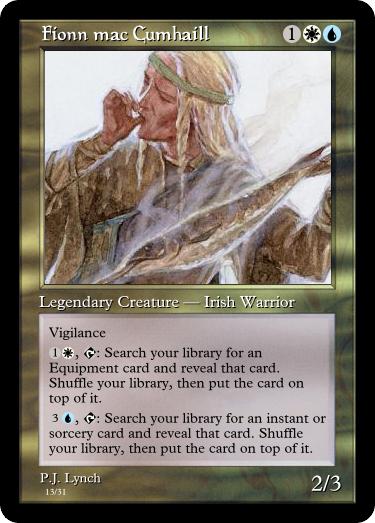
Also, as a fun little aside - apparently Fionn showed up on an old card for Magic: The Gathering. I discovered the image while searching for other pictures, and I just had to share it with you guys. Any Magic players reading this?
I'll see you guys next week!
Be warned - most of the names in this post begin with the letter F.
The character we're going to focus on today is named Fionn. (Fionn means "fair"; he was named for his looks.) Fionn is a very interesting character in Celtic mythology, and his story is one of my favorites. Much like Cu Chulainn, there are a lot of stories about Fionn. I'm going to tell you a very compressed version of his life, but I'd like to set the stage first.
First off: the gods. The Tuatha De Danann aren't seen in this story until the very end. The stories of Fionn were written much later than several of the other tales we've talked about, and so the Tuatha De Danann have evolved. Ireland is famous for its stories of the sidhe, or the fae - they are what the ancient Celtic gods became as stories changed with the times. The sidhe mostly stay in their own realms, hidden underground beneath magic mounds, but they sometimes come to our world to meddle with (or, occasionally, help) mortals.
Next up: Fionn himself. He's a fascinating character, because people have wondered for some time if he was based upon a historical person. The same question surrounds King Arthur. Did these men actually exist? Are their stories embellished truth, or pure fantasy? Another question often asked is whether Fionn and Arthur are human personifications of gods. Whatever the case, their stories sure are interesting!
Lastly: The Fenians. All of the other stories we've talked about so far have revolved around kings and their warriors; the same hierarchy exists even among the Tuatha De Danann. Celtic society had a high king, who ruled over all of the lesser kings. Warriors served these kings...except for one specific type of warrior. These fighters were called Fenians, and they operated out side of the normal structure of Celtic society. They served no king, but were warriors under the command of those fighters who were strongest.
As a side note: There are so very many different ways of spelling the names of the various Celtic gods and heroes. I'm going with the versions I have in my books, but upon trying to find images for this post I discovered a lot of other variations. For instance, you may see Fionn spelled as Finn if you go looking, and there are tons of ways to spell his last name. The group I refer to as the Fenians are also called the Fianna. I'm just an enthusiast, not an expert, so I can't tell you which is the proper way to refer to any of these people. I'm just sticking with the terms I know.
Our story begins with the birth of Fionn, called Demne at the time. He was born into a time of strife, for his father had been killed when Demne was still in his mother's womb. There was a long-standing feud between Demne's family and that of his father's killers, the mac Morna clan. Fearing for her child's safety, Demne's mother sent him away to be raised in the wilds.
There, Demne was raised by a druidess and a warrior who taught him magic and how to fight. He had many adventures in his youth, and eventually a king gifted him with the name of Fionn due to his appearance. Fionn often left the women who were raising him to seek out adventure, and spent much of his childhood roaming the country with bands of warriors.
Once, Fionn came across a poet named Finneces who was fishing in a pool. This pool was said to be the home of a special salmon; whoever caught and ate the fish would know the future. A prophecy had been made about the salmon - it would be caught and eaten by a man named Fionn.
Finneces figured his name was close to Fionn, so he had spent years trying to catch the fish. Not long after Fionn met him, Finneces finally managed to fish up the salmon. Overjoyed, he asked Fionn to cook it for him, but cautioned him not to eat it.
(Who knew you could look so heroic cooking a fish?)
Fionn did as he was asked, but he burned his finger while cooking the fish. Ouch! Anyone else ever burnt their finger? What's the first thing you do? Most people, myself included, immediately put the burn in their mouth to try and soothe the pain. Fionn was no different. He sucked on his finger to try and ease his discomfort, and then brought the fish to Finneces.
The old poet asked if Fionn had eaten any of the fish, and he truthfully explained about his burn. Only then did Finneces think to ask Fionn's name. Upon hearing that his companion was called Fionn (maybe he should have checked on that before handing him the fish!) Finneces gave up and told Fionn to eat the fish, explaining the prophecy. From then on, any time Fionn sucked his burn he could see the future.
Fionn had many adventures from that point forward. He slew an evil goblin, became leader of the Fenians, loved and lost two women, and had both children and grandchildren. If you're interested in these stories, you can find a concise version of them here. Fionn even managed to kill Goll mac Morna, the man who had killed Fionn's father.
Unfortunately, this act was to be his undoing.
A glimpse into the future had told Fionn that he would die in Ireland during a certain year. When this year arrived the old warrior decided to leave Ireland and head for Scotland, hoping to escape his prophesized demise. Upon hearing of this, the Fenians begged their leader to come to their homes and be feasted by them before he departed - sort of a series of farewell parties, if you will. Fionn was touched by the friendship of his warriors and agreed.
He probably should have sucked his finger first.
The very first home Fionn visited was that of the warrior Fer-tai. Fer-tai was a friend of Fionn's, as was his wife - but she was the daughter of Goll mac Morna, and her son Fer-li had loved his grandfather well. Fer-li had hated Fionn ever since the Fenian had killed his grandfather. Upon haring that Fionn would be staying in his father's house, Fer-li began to plot revenge.
(Dun dun dunnnnn!)
Fer-li's desire for blood was complicated by the fact that Fionn was a guest. Most ancient cultures had strong rules of hospitality, and the Celts were no exception. A guest was under the protection of his host, so Fer-li had to be careful or risk finding himself fighting his own father.
Fionn arrived at Fer-tai's house with a small group of warriors - less than two hundred men. He had most of these remain outside while he entered Fer-tai's home, where a splendid feast began.
The party was in full swing when the doors were flung open and a group of men stormed inside. These men were in cahoots with Fer-li; according to his plot, they accused Fionn's men of having killed many of the local villagers and animals. As their leader, Fionn could be held responsible for the Fenians' actions. Fer-li hoped to be able to kill him for the Fenians' "crime".
Fionn knew his men well, and so he knew that the accusations were false. Still, he wanted to appear willing to make amends. Fionn promised to give Fer-tai two animals to make up for every one slaughtered - a generous offer.
Seeing that his plan had not worked, Fer-li became enraged. He yelled that Fionn had come to kill he and his father just as the Fenian had killed Goll mac Morna. Overcome with rage, Fer-li then flung himself at Fionn, attacking the great warrior. Fionn's men rose up to defend him, but Fer-li's men countered them.
Fer-tai tried to break up the fight, but was unable to do so before blood was shed. The warriors only stopped fighting when Fer-tai's wife ran into the hall, naked and with her hair loose as a sign of peace. (Don't ask me why, but this is pretty common in Celtic mythology - something similar happens with Cu Chulainn. Naked women show up, and the fighting stops. Hey, at least it works!)
As soon as the brawl ended, Fer-li's mother began to berate him. How dare he attack a guest under his father's roof! And not just any guest - Fionn, who was dearly loved by all!
Nothing quite like being lectured in front of your warriors by your mom...who then proceeded to kick Fer-ti out of the hall. Ouch. That's gotta hurt your image...
Unfortunately, it was too late. Fer-li's plot had succeeded - Fionn had slain several of Fer-tai's subjects during the fight. As he left, Fer-li challenged Fionn to a battle the next day, secure in the knowledge that his father would have to side with him.
In the morning Fionn and his men approached the battlefield. They found themselves hopelessly outnumbered - a few hundred versus several thousand. Unable to withdraw from the fight without ruining both his honor and his reputation, Fionn attempted to buy peace. His offer was generous, and Fer-tai urged his son to accept it. Fer-li refused, still full of wrath at his grandfather's death. Fionn tried to negotiate peace once again, but still Fer0li refused to step down.
Left with no other choice, the battle began. Fionn and his Fenians fought bravely against the thousands who opposed them, but they could not hope to prevail against such numbers. One by one the Fenians fell - until all, even Fionn, were dead.
In the end, the mac Morna clan prevailed.
But the story does not end there. It is said that Fionn and his loyal warriors did not truly die. Instead, the sidhe came and took them from where they lay upon the battlefield. They carried the brave fighters back to the fairy realms, where their wounds were healed. To this day Fionn and the Fenians lie sleeping there, garbed for war. One day Ireland will again be in danger - and on that day, Fionn and his men will rise up to defend it.
Kind of a cool story, right? I love the ending; it reminds me of the dead Norse warriors, the Einherjar, who are fated to rise up and defend Asgard during Ragnarok. What do you guys think? Shoot me an email or post below to let me know!
Also, as a fun little aside - apparently Fionn showed up on an old card for Magic: The Gathering. I discovered the image while searching for other pictures, and I just had to share it with you guys. Any Magic players reading this?
I'll see you guys next week!
Monday, August 3, 2015
Manawydan: Of Mice and Men
Hello again, readers! How are you doing today? Did you have a nice week? I certainly hope so!
Earlier today I updated my post about East of the Sun, West of the Moon. If you want to see the awesome pictures I found for it, you can check it out here!
We also hit 1900 pageviews today! Thank you all so much. Getting close to the 2k mark!
Our story today is of a man named Manawydan. It is a strange tale, full of magic and loneliness. To my mind, it is one of the weirder stories of Celtic mythology - and that's saying a lot, as you'll see in the next couple of weeks! The unique events within this story are quite entertaining, despite being somewhat depressing, so I felt I should tell you the tale.
When we meet Manawydan in this story he has survived a great and terrible battle, and has buried his friend and leader. Now an outcast from his homeland, Manawydan has nowhere to go. He says as much to a young friend of his named Pryderi.
Pryderi has a solution for his pal. The young man is lord of a land named Dyfed, and has a beautiful widowed mother to boot. He offers to let Manawydan journey home with him. If the lands - and his mother - are to Manawydan's liking, Pryderi will give his mother to him in marriage and make Manawydan lord of Dyfed.
Good friend, right?!
Manawydan eagerly - and thankfully - agrees to this arrangement. He travels with Pryderi to the land of Dyfed, which he finds quite pleasing. He feels the same way about Riannon, Pryderi's mother.
She and Manawydan talk late into the night, and he falls in love with the mature, intelligent woman.
Pryderi is pleased when Manawydan tells him of his feelings. The matter of marriage is broached to Riannon, who is quite pleased by the idea. She and Manawydan are married, and the duo live quite happily with Pryderi and his wife Cigfa.
Ideally, the story would end here with "And they all lived happily ever after."
Of course, if you read my post about fairy tales, you'll see that few stories ever end that way. (After all, that wouldn't be as entertaining!) Such is the case here.
Some time passes happily, and one night the four friends decide to throw a celebratory feast. (All of my Celtic posts so far have had feasts - I'm guessing they were pretty common in ancient Britain, at least for the wealthy.) In the midst of the feast, the two couples slip away for some fresh air. They go and sit on a special enchanted mound and are lost in thought for some time.
Suddenly, a crash of thunder splits the air! A heavy mist swiftly surrounds the group, cutting them off from one another. The mist soon fades away, but the sight that greets the party is one of horror...for all that they see is ruined and barren.
Shocked, the four stumble back to their home. They find it empty - all of their friends seem to have vanished. Despite searching all over the land of Dyfed, they do not find any living souls. Only wild beasts and animals remain.
Luckily Manawydan and Pryderi are skilled hunters, and so the group lives off of wild game for several years. Eventually Manawydan tires of this existence. At his suggestion, the group decides to leave Dyfed and journey to distant lands. These lands, unlike their own, are still populated by humans, so the four friends find a small town and decide to learn a craft.
At first Manawydan tries making saddles. Unfortunately, his work is so fine that he becomes the only person anyone is willing to buy saddles from. Enraged, the other craftsmen plot to kill him. When word of this reaches the group, they quickly flee.
In the next city, Manawydan decides to start making shields - but the same thing happens! The same is true of cobbling (you've heard the phrase, "I'd kill for those shoes?), and at last the group give up and decide to return to their life in Dyfed.
Manawydan, Riannon, Pryderi, and Cigfa survive for several more years by hunting in Dyfed. Then, one day, something different happens. Pryderi and Manawydan awaken tot he sound of their hunting hounds baying. Hoping to catch some game, they follow them into a forest, where they find themselves pursuing a large, silver boar. It leads them on a merry chase before disappearing into a magnificent fortress, the hounds close behind it.
Manawydan and Pryderi stop to stare at the fortress. By this time, they have been hunting the lands of Dyfed for years. They know every inch of it - and yet, the two friends have never seen this fort before.
Sensing something magical afoot, Manawydan begs Pryderi to leave. His friend, however, is concerned about the hounds. Pryderi refuses to be deterred, and so enters the fortress alone.
Within, all is eerily silent. There is no trace of either the hounds or the boar. In his search for them, Pryderi comes across a magnificent courtyard. In its center lies a flowing marble fountain. Next to this sits a block of marble, upon which rests a large golden bowl. Four chains are attached to this bowl, and they rise up, up into the sky...where they disappear into thin air.
I told you this was a strange tale, didn't I? Just wait!
The sight of the bowl makes Pryderi curious - it is obviously magical, but he can't figure out what it does. The man kneels before the bowl and stretches out one hand to touch it -
- which promptly becomes stuck to the bowl.
(Guess he failed that "Knowledge: Magical Item" check!)
Pryderi soon finds that his feet are stuck to the ground. When he attempts to call Manawydan for help, he discovers that he cannot make any noise. Left with no other choice, he waits in silence.
Outside, Manawydan paces with worry. When Pryderi fails to emerge from the keep by the beginning of sunset, Manawydan returns home alone.
Big mistake.
When she sees him approaching alone, Riannon immediately wants to know where her son is. Manawydan tells her what happened, and she is furious that he left Pryderi behind. Riannon brands him a bad friend (a great insult) and immediately sets off to find Pryderi.
Mommy to the rescue!
It isn't long before Riannon finds the keep, and within it her son. Unfortunately, Pryderi is unable to speak to warn her. He can only watch in horror as his mother grabs the bowl, intending to wrest it from his grasp...and becomes just as stuck as Pryderi.
When the sun finishes setting, there comes a clap of thunder and a thick mist reminiscent of the night the group's woes began. When the mist disperses, the fortress is gone...and so are Pryderi and Riannon.
Depressed and not wanting to stay in the land that took their loved ones, Manawydan and Cigfa soon depart from Dyfed once again. Unfortunately, they are once more driven from their trade by jealous (and murderous) rivals. Seeing no other choice, the duo sadly return to Dyfed - but this time, Manawydan brings with him seeds of grain so that they can start a farm.
Time passes, and Manawydan's crops grow well; as it turns out, he is as good of a farmer as he is a shoe/saddle/shield-maker. When the harvest time comes, Manawydan goes out to reap what he has sown - only to find that all of the crops in the first field he planted are gone!
The next day Manawydan goes to his second field, only to find it likewise bare. Manawydan is furious, but he realizes that the thieves are likely to raid his third field that night. He decides to lie in wait for them and catch them in the act.
Ready for the story to get really weird?
Sure enough, that night the culprits come. To Manawydan's surprise - they're a bunch of mice! He watches, shocked, as they gather up his crop and begin to run off with it. His shock turns to rage, and Manawydan begins to chase the mice. They manage to evade him...all save one, who moves too slowly and is snatched up by the angry Manawydan, who stashes it in his glove.
He returns to Cigfa and tells her what occurred, ending his tale by swearing to hang the mouse he caught - a common punishment for thieves, perhaps, but not for rodent thieves. Cigfa is horrified by his declaration and begs Manawydan not to hang the mouse - it wouldn't be proper for one of his rank! - but Manawydan angrily refuses to listen to her.
The next day he sets out with his tiny captive and begins to construct a miniscule gallows. As he does so, two men walk by. Each echoes Cigfa's statement that it would not befit a lord to hang a mouse, and each offers to buy the mouse's freedom to preserve Manawydan's dignity. He refuses to listen to either man, sending them on their way.
Then a third man comes by - a bishop, accompanied by a large group of people.
Now, before today Dyfed has seemed cursed, for no people (save Manawydan's group) lived in it. Today a large number of people have passed through Dyfed, each requesting that the mouse be freed. Because of this, Manawydan becomes suspicious.
The bishop also offers to pay Manawydan to release the mouse.
Convinced that the bishop is not what he seems, Manawydan agrees to release the blasted rodent - but only if the curse is lifted from Dyfed, and Pryderi and Riannon are returned to him.
The bishop - actually a druid - agrees. As it turns out, the curse was his revenge on Pryderi fro osme action of his parent's against the druid's. The mice that destroyed Manawydan's crops were the druid's warriors. The mouse Manawydan managed to catch is his pregnant wife (no wonder she couldn't run very fast!). In exchange for her, the druid agrees to forget his feud, and he releases Pryderi and Riannon. The curse is lifted, and Dyfed is returned to its former beauty.
The two couples are reunited...and this time, they do live happily ever after.
Weird, right?
I hope you guys enjoyed the story! I've never read anything quite like it. The scene with the mice always makes me happy, because I grew up reading the Redwall series and always think of that.
Did you guys like Manawydan's story? Hate it? Let me know below, or email me!
I'll be back next week with a look at the life of Fionn, one of the greatest Celtic heroes who ever was. Until then, take care!
(And watch out for strange bowls and mice!)
Monday, July 27, 2015
Cu Chulainn: The Naming of the Hound
Hey guys! How was your week? I got to kick back and watch some movies/play some games over the weekend; I hope you got to do something fun too!
I wanted to let you know that I'm slowly going through my old posts and adding pictures to them. On Friday I updated my post about The Snow Queen. If I've got some spare time this week I'll try to do another!
Now, on to the post:
Our story today centers on a young boy known as Setanta. Looking at the name of this post, you might be wondering why we aren't discussing Cu Chulainn - but we are. The naming process of the ancient Celts is fascinating. You see, a boy was given a name at his birth. He was called by this name throughout his childhood, up until the point where he did something to distinguish himself. When that happened, the boy was given a new name, one that signified his deeds.
So, although this story is about the boy called Setanta, it is also about Cu Chulainn - for they are one and the same person.
Setanta was conceived and born amidst odd circumstances. His mother was a woman named Dechtire, who was the sister of a great king named Conchobar. (Spell check reeeeally hates all of these names!) During a time of prosperity in the Conchobar's lands, Dechtire vanished. She returned three years later with a son named Setanta. Dechtire had spent those three years in the land of the Tuatha De Danann, where she was wooed and impregnated by none other than Lugh Long-Arm.
It quickly became obvious that Setanta was not a normal boy. His strength and agility were well beyond that of any other child his age, as was his intellect. Despite this, he was only a boy. Setanta wanted to be around other youngsters and play games with them.
When he was six years old, Setanta heard of a game played near the king's keep. The books I've read call this game either shinty or hurling. Both games involve teams, a ball, and goals - they also utilize a stick. These games were designed to prepare youngsters for their training as warriors, and were quite violent. The boys who played it were all significantly older than Setanta.
None of these facts deterred Setanta. His heart was set on playing shinty/hurling, so one day he set off for the castle. When he arrived on the playing field Setanta was mocked for his youth. King Conchobar happened to be watching from his window, and sent for the young stranger to find out who he was.
Imagine the king's surprise when Setanta introduced himself as Conchobar's nephew! He asked permission to be allowed to play with the other boys. Initially reluctant because of Setanta's youth, Conchobar eventually gave in to his pleading and granted him leave to play.
On the field, Setanta was pitted against twelve boys. They sneered at him and mocked his size, but Setanta soon made them eat their words. The blood of his father ran strong in his veins, for Setanta handily bested the other boys! He scored goal after goal, and nothing they did could stop him.
(Other versions of this story have Setanta single-handedly besting 150 boys at a time. One wonders why anyone agreed to play with him...)
King Conchobar was quite pleased by his nephew's prowess and wanted to reward him. It so happened that Conchobar had been invited to a great feast at the home of Culann, a successful smith. He invited Setanta to accompany him to this feast.
The boy was thrilled, but reluctantly told Conchobar that he couldn't go with him. He had been interrupted mid-game, and didn't want to leave without finishing. (In video game terms: "Just one more level! Please!") Conchobar was amused by Setanta's competitiveness and told him not to worry; he could follow whenever he finished his game.
Shortly after, Conchobar set out with his men and arrived at the house of Culann. Tired from the trip and quite ravenous, the king completely forgot that his nephew would be coming later. This was unfortunate, because Culann chose that moment to ask the king if all of his men were present.
I mentioned that Culann was a very successful smith? Well, with great success comes great wealth. Culann needed his wealth and lands to be guarded, and he had a fearsome hound for that job. He carefully explained to Conchobar just how terrifying it was: how it took multiple men to restrain the hound even when it was kept chained; how the beast would attack anyone it found on Culann's lands; and how even one hundred men could not hope to best it.
Conchobar, of course, still didn't remember that Setanta was coming. The hound was set loose to guard Culann's lands. Inside his home, the feast began.
Setanta knew nothing of any of this. He had finished his game (which he won, of course) and was on his way back to Culann's house, still carrying his stick and ball. He was within sight of Culann's home when the hound came for him, snarling and howling.
At the sound of the vicious hound's snarls, king Conchobar abruptly remembered that his nephew was supposed to be joining him. Horrified, he and the other guests ran to the windows. What they saw made their blood run cold, for the enormous hound was about to attack a six year old boy.
(One wonders what Conchobar would have told Setanta's mother if the hound killed the boy. "Oh, hey sis...I kind of invited Setanta to a party and then forgot, so he got eaten by a hound. My bad!"
Worst uncle EVER. And he runs a kingdom with that memory!)
Setanta was unphased by the approach of the hound. When it attacked, he calmly rammed his shinty/hurling ball down its throat, picked the dog up while it choked, and beat it to death against a rock.
Within Culann's house, everyone was speechless. When it became obvious that the hound was dead, the guests raced out of the house, cheering for Setanta. Conchobar, relieved that his nephew was safe and immensely proud of the boy, turned to Culann - but his words died in his throat at the look of sorrow on the smith's face.
The cheering died down as Culann slowly, sadly walked to his hound. His eyes filled with tears as he knelt beside the dog, stroking its fur as he remembered how loyal the hound was, how faithfully it had protected him.
(I always tear up here. There's a quote from Culann in one of the books I have, where he says, "My best friend has been destroyed." That's when the waterworks begin. I kind of hate Setanta for killing the dog.)
Upon seeing this, Setanta was kind instead of cruel. He approached Culann and swore to find a hound to equal the one he had slain. In some versions of the story, the hound itself had a pup, which Setanta promises to raise and train until it can take it's father's place.
Until the hound can be replaced, Setanta promises to guard Culann's lands himself, and to be just as loyal as the hound.
Culann agrees to this arrangement, but the story does not end there. A druid who had been at the party steps forward, looks at Setanta, and gives him his new name: Cu Chulainn, "The Hound of Culann".
Cu Chulainn went on to have many more adventures. The epic that tells his story is actually comparable in length to Greek works like The Iliad or The Odyssey. Other tales of Cu Chulainn include the wooing of his wife, Emer; the battle between Cu Chulainn and his best friend, Ferdiad; the death of Connla, son of Cu Chulainn, at the hands of his own father; and, eventually, the death of Cu Chulainn himself.
The story of Cu Chulainn is a tragedy that bears great resemblance to the Greek story of Achilles. Both are part mortal, part god. More importantly, both are given a choice - and both choose a short life, but a famous one.
I could do a whole series of posts on Cu Chulainn - and I do plan to return to him in the future. However, for now I'd like to step away from him and let my next post focus on one of the stranger stories in Celtic mythology. Tune in next Monday and I'll tell you about Manawydan, and the curious things that happen to him.
Questions? Comments? Want to rant about Setanta killing the poor loyal hound? I'd love to hear from you! Please post below or shoot me an email.
I'll see you guys next week!
I wanted to let you know that I'm slowly going through my old posts and adding pictures to them. On Friday I updated my post about The Snow Queen. If I've got some spare time this week I'll try to do another!
Now, on to the post:
Our story today centers on a young boy known as Setanta. Looking at the name of this post, you might be wondering why we aren't discussing Cu Chulainn - but we are. The naming process of the ancient Celts is fascinating. You see, a boy was given a name at his birth. He was called by this name throughout his childhood, up until the point where he did something to distinguish himself. When that happened, the boy was given a new name, one that signified his deeds.
So, although this story is about the boy called Setanta, it is also about Cu Chulainn - for they are one and the same person.
Setanta was conceived and born amidst odd circumstances. His mother was a woman named Dechtire, who was the sister of a great king named Conchobar. (Spell check reeeeally hates all of these names!) During a time of prosperity in the Conchobar's lands, Dechtire vanished. She returned three years later with a son named Setanta. Dechtire had spent those three years in the land of the Tuatha De Danann, where she was wooed and impregnated by none other than Lugh Long-Arm.
It quickly became obvious that Setanta was not a normal boy. His strength and agility were well beyond that of any other child his age, as was his intellect. Despite this, he was only a boy. Setanta wanted to be around other youngsters and play games with them.
When he was six years old, Setanta heard of a game played near the king's keep. The books I've read call this game either shinty or hurling. Both games involve teams, a ball, and goals - they also utilize a stick. These games were designed to prepare youngsters for their training as warriors, and were quite violent. The boys who played it were all significantly older than Setanta.
None of these facts deterred Setanta. His heart was set on playing shinty/hurling, so one day he set off for the castle. When he arrived on the playing field Setanta was mocked for his youth. King Conchobar happened to be watching from his window, and sent for the young stranger to find out who he was.
Imagine the king's surprise when Setanta introduced himself as Conchobar's nephew! He asked permission to be allowed to play with the other boys. Initially reluctant because of Setanta's youth, Conchobar eventually gave in to his pleading and granted him leave to play.
On the field, Setanta was pitted against twelve boys. They sneered at him and mocked his size, but Setanta soon made them eat their words. The blood of his father ran strong in his veins, for Setanta handily bested the other boys! He scored goal after goal, and nothing they did could stop him.
(Other versions of this story have Setanta single-handedly besting 150 boys at a time. One wonders why anyone agreed to play with him...)
King Conchobar was quite pleased by his nephew's prowess and wanted to reward him. It so happened that Conchobar had been invited to a great feast at the home of Culann, a successful smith. He invited Setanta to accompany him to this feast.
The boy was thrilled, but reluctantly told Conchobar that he couldn't go with him. He had been interrupted mid-game, and didn't want to leave without finishing. (In video game terms: "Just one more level! Please!") Conchobar was amused by Setanta's competitiveness and told him not to worry; he could follow whenever he finished his game.
Shortly after, Conchobar set out with his men and arrived at the house of Culann. Tired from the trip and quite ravenous, the king completely forgot that his nephew would be coming later. This was unfortunate, because Culann chose that moment to ask the king if all of his men were present.
I mentioned that Culann was a very successful smith? Well, with great success comes great wealth. Culann needed his wealth and lands to be guarded, and he had a fearsome hound for that job. He carefully explained to Conchobar just how terrifying it was: how it took multiple men to restrain the hound even when it was kept chained; how the beast would attack anyone it found on Culann's lands; and how even one hundred men could not hope to best it.
Conchobar, of course, still didn't remember that Setanta was coming. The hound was set loose to guard Culann's lands. Inside his home, the feast began.
Setanta knew nothing of any of this. He had finished his game (which he won, of course) and was on his way back to Culann's house, still carrying his stick and ball. He was within sight of Culann's home when the hound came for him, snarling and howling.
At the sound of the vicious hound's snarls, king Conchobar abruptly remembered that his nephew was supposed to be joining him. Horrified, he and the other guests ran to the windows. What they saw made their blood run cold, for the enormous hound was about to attack a six year old boy.
(One wonders what Conchobar would have told Setanta's mother if the hound killed the boy. "Oh, hey sis...I kind of invited Setanta to a party and then forgot, so he got eaten by a hound. My bad!"
Worst uncle EVER. And he runs a kingdom with that memory!)
Setanta was unphased by the approach of the hound. When it attacked, he calmly rammed his shinty/hurling ball down its throat, picked the dog up while it choked, and beat it to death against a rock.
(Sorry, animal lovers.)
Within Culann's house, everyone was speechless. When it became obvious that the hound was dead, the guests raced out of the house, cheering for Setanta. Conchobar, relieved that his nephew was safe and immensely proud of the boy, turned to Culann - but his words died in his throat at the look of sorrow on the smith's face.
The cheering died down as Culann slowly, sadly walked to his hound. His eyes filled with tears as he knelt beside the dog, stroking its fur as he remembered how loyal the hound was, how faithfully it had protected him.
(I always tear up here. There's a quote from Culann in one of the books I have, where he says, "My best friend has been destroyed." That's when the waterworks begin. I kind of hate Setanta for killing the dog.)
Upon seeing this, Setanta was kind instead of cruel. He approached Culann and swore to find a hound to equal the one he had slain. In some versions of the story, the hound itself had a pup, which Setanta promises to raise and train until it can take it's father's place.
(This is why a lot of pictures of Cu Chulainn show him with a wolf or dog beside him.)
Until the hound can be replaced, Setanta promises to guard Culann's lands himself, and to be just as loyal as the hound.
Culann agrees to this arrangement, but the story does not end there. A druid who had been at the party steps forward, looks at Setanta, and gives him his new name: Cu Chulainn, "The Hound of Culann".
Cu Chulainn went on to have many more adventures. The epic that tells his story is actually comparable in length to Greek works like The Iliad or The Odyssey. Other tales of Cu Chulainn include the wooing of his wife, Emer; the battle between Cu Chulainn and his best friend, Ferdiad; the death of Connla, son of Cu Chulainn, at the hands of his own father; and, eventually, the death of Cu Chulainn himself.
(I just loved this artwork! It looks like it belongs in Brave!)
I could do a whole series of posts on Cu Chulainn - and I do plan to return to him in the future. However, for now I'd like to step away from him and let my next post focus on one of the stranger stories in Celtic mythology. Tune in next Monday and I'll tell you about Manawydan, and the curious things that happen to him.
Questions? Comments? Want to rant about Setanta killing the poor loyal hound? I'd love to hear from you! Please post below or shoot me an email.
I'll see you guys next week!
Monday, July 20, 2015
Lugh Long-Arm
Hey everyone! I hope you all had a lovely week. The site had views from its 35th country yesterday - many thanks to whoever is reading this in Argentina!
Today we’re going to be talking about one of the primary gods in the Celtic pantheon: Lugh Long-Arm.
Lugh Long-Arm (called such because of his skill with a spear) appears early in the Celtic myths, during a time of war. A little bit of backstory is needed to set the stage for his coming.
I mentioned in my Intro that the Celtic gods (the Tuatha De Danann) were often opposed by a race of warriors called the Fomorians. After a long period of fighting the two races struck an uneasy truce with one another. Ostensibly at peace, marriages took place between the two peoples. Two notable births resulted from these unions - Bres, who was eventually named King of both peoples, and Lugh. The father of Lugh’s father was Diancecht, Celtic god of medicine. Despite being part Fomorian, Lugh would soon come to be worshipped as one of the Tuatha De Danann.
(Something interesting that I hadn’t considered - Lugh was only Fomorian on his mother’s side. I wonder if it was only the race of the father that counted for the child?)
When our story begins, the Tuatha De did not know of Lugh’s existence. They were distracted, perhaps, by the actions of King Bres. When he was made king Bres was an honest, fair man. He promised to give up his crown if the people he ruled ever asked him to. Soon, however, Bres began to favor the Fomorians. He treated the Tuatha De quite unfairly, essentially making them into his servants; it was not long before they demanded that he give up his crown.
Haven given his word, Bres was forced to agree to abdicate - but he struck a deal with the Tuatha De Danann to allow him to rule for another seven years before stepping down. Bres wanted this extension of his reign so that he would have time to raise an army to crush the Tuatha De - after all, if no one was left to demand that he step down, he could remain king forever...
(Insert maniacal laughter here.)
Ahem. Sorry. Bres found a willing army in the Fomorians, who hated the Tuatha De passionately despite their peace treaty. Bres’ father, a Fomorian, finally met and claimed his son before sending him to gain the support of various Fomorian kings - because, while Bres was the high king, various tribes and factions had kings of their own who ruled over them but answered to the high king.
(An interesting part of Celtic mythology - and an interesting look into the culture of the time - are the references to adults finally being “claimed” by their real parents. Fostering was a common practice at the time; children, even infants, would be sent away to be raised by a family not their own. When they became adults, they returned home to their birth families.
Sometimes children were raised by an enemy of their family in an attempt to force peace - think Theon and the Starks in Game of Thrones. At other times, fostering was a way for the child to learn things their parents couldn’t teach them and to see more of the world - sort of like studying abroad while staying in a foster home. I’d imagine this was especially useful for the working-class families who practiced fostering; a boy could learn shepherding from his birth-father and blacksmithing from his foster-father, giving him knowledge of two trade professions instead of just one. Pretty nifty, right?)
While Bres was raising an army, the Tuatha De Danann were having a party. (Seems like the thing to do when someone’s trying to kill you, right?) This party was actually unrelated to Bres’ actions. Nuada, king of the Tuatha De, was celebrating because an old injury of his had been healed. He threw a feast in his home, Tara, and invited all of the Tuatha De Danann for a roaring good time.
Someone had to guard the party, of course - and so it was that Nuada’s doorkeeper remained outside and saw Lugh approaching. Lugh introduced himself as the grandson of Diancecht, member of the Tuatha De Danann, and requested entrance to the party.
The doorkeeper held him back, insisting that no one was allowed to enter Tara unless they had a skill that would benefit the Tuatha De Danann. When asked what he could do to aid his people, Lugh replied that he was a carpenter. The doorman refused him entrance, since there was already a carpenter inside. Lugh then claimed to be a blacksmith, a warrior, a sorcerer, and a strategist, amongst many, many other things. Each time the doorkeeper shot him down, saying that someone with such skills could already be found within Tara.
At last Lugh stopped listing his merits. He told the doorkeeper to go to King Nuada and tell him of Lugh’s presence. It was true that the king had blacksmiths and fighters, medicine makers and historians - but did Nuada have one man who was all of those things?
Nuada was thrilled when he heard of all that Lugh claimed he could do. He sent out his best player of chess to test Lugh, who bested him handily. King Nuada then welcomed Lugh to Tara and gave him a seat of honor.
When the evil plans of Bres and the Fomorians became known to Nuada, he appointed Lugh as head strategist for the Tuatha De Danann. This was a very wise choice. Lugh assessed each of the Tuatha De and came up with a plan that played to their strengths. They spent the rest of Bres’ seven year extension finalizing strategies, making weapons, and learning about the tactics of the Fomorians.
When the seven years were up, the armies of the Fomorians and the Tuatha De assembled - but
the Tuatha De Danann were missing one of their members. It had been decided that Lugh was too valuable to risk losing on the battlefield. Against his will, Lugh found himself under armed guard, forced to stay away from the battle.
This speaks to how highly the Tuatha De valued Lugh. Their own king, Nuada, was allowed to fight on the front lines - but the newcomer to their ranks was forced to stay behind for his safety.
The battle was finally joined during the evening of Samhain (an old Celtic celebration that was converted to Halloween in more recent years). The fighting waged fiercely for several days, at which point the Fomorians began to notice something strange. Casualties had been almost equal on both sides...and yet, each morning the same number of Tuatha De Danann rose to fight against the Fomorians. There was never any sign of injured or dead in the morning, despite there being plenty of both in the evenings. Confused, and beginning to be outnumbered, the Fomorians sent a spy into the camp of the Tuatha De Danann in an attempt to figure out what was happening.
The spy was horrified by what he saw. Lugh had come up with a brilliant strategy. His grandfather Diancecht worked with other Tuatha De who had healing powers; they had enchanted a well so that any who were dropped into it were healed...even the dead. Each night the dead and wounded members of the Tuatha De Danann were taken to the well, and they emerged from it as good as new - rather like a video game respawn point! Their gear was repaired overnight by Tuatha De who specialized in blacksmithing and carpentry, so that there was never a shortage of weapons or armor.
Desperate to put a stop to this, the Fomorian spy chucked his spear at Goibniu, the god who was manning the forge. Only wounded, Goibniu pulled the spear out of his side and cast it at the Fomorian. Though mortally injured, the spy still managed to make it back to the Fomorian camp and tell them about the healing well of the Tuatha De Danann. During the night the Fomorian army came and filled the well with stones, depriving the Tuatha De of their source of healing.
After that the battle was more equal - save for one thing. Lugh Long-Arm had managed to escape his guards and now fought on the front lines, shouting encouragement to the Tuatha De Danann.
The battle was furious, and many died. Then one of the Fomorians kings Bres had recruited stepped forward: Balor, the grandfather of Lugh. He attacked King Nuada and managed to slay the ruler of the Tuatha De. Enraged, Lugh fought his way to Balor and killed him in revenge. Spurred on by this victory, the Tuatha De Danann doubled their efforts. Bit by bit they pushed back the Fomorians, eventually driving them into the sea. Bres was among the retreating army, which fled from the wrath of the Tuatha De Danann.
At last, Ireland was free from the Fomorians.
I’ll end my story there. I find it interesting that Lugh went from being completely unknown to being the most important of the Tuatha De Danann (he gets named King and succeeds Nuada) - rather like Marduk from Mesopotamian mythology. What did you guys think of his strategy? Pretty clever, right?
This introduction to Lugh was important, because next week we’re going to be talking about his son: Cu Chulainn, often called the boy hero of Ireland. I’m excited! I’ll see you guys in a week!
Today we’re going to be talking about one of the primary gods in the Celtic pantheon: Lugh Long-Arm.
Lugh Long-Arm (called such because of his skill with a spear) appears early in the Celtic myths, during a time of war. A little bit of backstory is needed to set the stage for his coming.
I mentioned in my Intro that the Celtic gods (the Tuatha De Danann) were often opposed by a race of warriors called the Fomorians. After a long period of fighting the two races struck an uneasy truce with one another. Ostensibly at peace, marriages took place between the two peoples. Two notable births resulted from these unions - Bres, who was eventually named King of both peoples, and Lugh. The father of Lugh’s father was Diancecht, Celtic god of medicine. Despite being part Fomorian, Lugh would soon come to be worshipped as one of the Tuatha De Danann.
(Something interesting that I hadn’t considered - Lugh was only Fomorian on his mother’s side. I wonder if it was only the race of the father that counted for the child?)
When our story begins, the Tuatha De did not know of Lugh’s existence. They were distracted, perhaps, by the actions of King Bres. When he was made king Bres was an honest, fair man. He promised to give up his crown if the people he ruled ever asked him to. Soon, however, Bres began to favor the Fomorians. He treated the Tuatha De quite unfairly, essentially making them into his servants; it was not long before they demanded that he give up his crown.
Haven given his word, Bres was forced to agree to abdicate - but he struck a deal with the Tuatha De Danann to allow him to rule for another seven years before stepping down. Bres wanted this extension of his reign so that he would have time to raise an army to crush the Tuatha De - after all, if no one was left to demand that he step down, he could remain king forever...
(Insert maniacal laughter here.)
Ahem. Sorry. Bres found a willing army in the Fomorians, who hated the Tuatha De passionately despite their peace treaty. Bres’ father, a Fomorian, finally met and claimed his son before sending him to gain the support of various Fomorian kings - because, while Bres was the high king, various tribes and factions had kings of their own who ruled over them but answered to the high king.
(An interesting part of Celtic mythology - and an interesting look into the culture of the time - are the references to adults finally being “claimed” by their real parents. Fostering was a common practice at the time; children, even infants, would be sent away to be raised by a family not their own. When they became adults, they returned home to their birth families.
Sometimes children were raised by an enemy of their family in an attempt to force peace - think Theon and the Starks in Game of Thrones. At other times, fostering was a way for the child to learn things their parents couldn’t teach them and to see more of the world - sort of like studying abroad while staying in a foster home. I’d imagine this was especially useful for the working-class families who practiced fostering; a boy could learn shepherding from his birth-father and blacksmithing from his foster-father, giving him knowledge of two trade professions instead of just one. Pretty nifty, right?)
While Bres was raising an army, the Tuatha De Danann were having a party. (Seems like the thing to do when someone’s trying to kill you, right?) This party was actually unrelated to Bres’ actions. Nuada, king of the Tuatha De, was celebrating because an old injury of his had been healed. He threw a feast in his home, Tara, and invited all of the Tuatha De Danann for a roaring good time.
(Wondering where you've heard Nuada's name before? He was the main villain in
Hellboy II: The Golden Army)
Someone had to guard the party, of course - and so it was that Nuada’s doorkeeper remained outside and saw Lugh approaching. Lugh introduced himself as the grandson of Diancecht, member of the Tuatha De Danann, and requested entrance to the party.
The doorkeeper held him back, insisting that no one was allowed to enter Tara unless they had a skill that would benefit the Tuatha De Danann. When asked what he could do to aid his people, Lugh replied that he was a carpenter. The doorman refused him entrance, since there was already a carpenter inside. Lugh then claimed to be a blacksmith, a warrior, a sorcerer, and a strategist, amongst many, many other things. Each time the doorkeeper shot him down, saying that someone with such skills could already be found within Tara.
At last Lugh stopped listing his merits. He told the doorkeeper to go to King Nuada and tell him of Lugh’s presence. It was true that the king had blacksmiths and fighters, medicine makers and historians - but did Nuada have one man who was all of those things?
Nuada was thrilled when he heard of all that Lugh claimed he could do. He sent out his best player of chess to test Lugh, who bested him handily. King Nuada then welcomed Lugh to Tara and gave him a seat of honor.
When the evil plans of Bres and the Fomorians became known to Nuada, he appointed Lugh as head strategist for the Tuatha De Danann. This was a very wise choice. Lugh assessed each of the Tuatha De and came up with a plan that played to their strengths. They spent the rest of Bres’ seven year extension finalizing strategies, making weapons, and learning about the tactics of the Fomorians.
When the seven years were up, the armies of the Fomorians and the Tuatha De assembled - but
the Tuatha De Danann were missing one of their members. It had been decided that Lugh was too valuable to risk losing on the battlefield. Against his will, Lugh found himself under armed guard, forced to stay away from the battle.
This speaks to how highly the Tuatha De valued Lugh. Their own king, Nuada, was allowed to fight on the front lines - but the newcomer to their ranks was forced to stay behind for his safety.
The battle was finally joined during the evening of Samhain (an old Celtic celebration that was converted to Halloween in more recent years). The fighting waged fiercely for several days, at which point the Fomorians began to notice something strange. Casualties had been almost equal on both sides...and yet, each morning the same number of Tuatha De Danann rose to fight against the Fomorians. There was never any sign of injured or dead in the morning, despite there being plenty of both in the evenings. Confused, and beginning to be outnumbered, the Fomorians sent a spy into the camp of the Tuatha De Danann in an attempt to figure out what was happening.
The spy was horrified by what he saw. Lugh had come up with a brilliant strategy. His grandfather Diancecht worked with other Tuatha De who had healing powers; they had enchanted a well so that any who were dropped into it were healed...even the dead. Each night the dead and wounded members of the Tuatha De Danann were taken to the well, and they emerged from it as good as new - rather like a video game respawn point! Their gear was repaired overnight by Tuatha De who specialized in blacksmithing and carpentry, so that there was never a shortage of weapons or armor.
Desperate to put a stop to this, the Fomorian spy chucked his spear at Goibniu, the god who was manning the forge. Only wounded, Goibniu pulled the spear out of his side and cast it at the Fomorian. Though mortally injured, the spy still managed to make it back to the Fomorian camp and tell them about the healing well of the Tuatha De Danann. During the night the Fomorian army came and filled the well with stones, depriving the Tuatha De of their source of healing.
After that the battle was more equal - save for one thing. Lugh Long-Arm had managed to escape his guards and now fought on the front lines, shouting encouragement to the Tuatha De Danann.
The battle was furious, and many died. Then one of the Fomorians kings Bres had recruited stepped forward: Balor, the grandfather of Lugh. He attacked King Nuada and managed to slay the ruler of the Tuatha De. Enraged, Lugh fought his way to Balor and killed him in revenge. Spurred on by this victory, the Tuatha De Danann doubled their efforts. Bit by bit they pushed back the Fomorians, eventually driving them into the sea. Bres was among the retreating army, which fled from the wrath of the Tuatha De Danann.
At last, Ireland was free from the Fomorians.
I’ll end my story there. I find it interesting that Lugh went from being completely unknown to being the most important of the Tuatha De Danann (he gets named King and succeeds Nuada) - rather like Marduk from Mesopotamian mythology. What did you guys think of his strategy? Pretty clever, right?
This introduction to Lugh was important, because next week we’re going to be talking about his son: Cu Chulainn, often called the boy hero of Ireland. I’m excited! I’ll see you guys in a week!
Monday, July 13, 2015
Intro to Celtic Mythology
Hello readers!
As you can probably guess from this post’s title, this week I’m finally going to start talking about Celtic mythology! I’d like to voice a disclaimer before I begin: I am far less well-versed in the Celtic myths than I am in any of the other mythologies we’ve discussed. I’ve been researching them a lot, and I’ll do my best to be as accurate as possible - but, if you spot an error in any of my posts, please let me know (either through email or in the comments.).
The influence of Celtic mythology upon American culture is rather more subtle than that of Greek or Norse mythology. Movies these days often feature stories from those cultures, but seldom show the gods of the Celts. Those deities can be found more often - though still infrequently - in books. Since book four The Dresden Files has featured characters from the Celtic myths; a more recent series, The Iron Druid Chronicles, features a main character who hails from ancient Britain and regularly interacts with the Celtic deities he worships. (I’m only on book 4, so please - no spoilers!) Speaking of druids - they have their origin in the Celtic myths, and can now be found in many role-playing games, stories, and even video games. (*cough*World of Warcraft*cough*)
Apart from those, I don’t know of many modern representations of Celtic mythology. An argument can be made that Arthurian legend is of Celtic origin, but the stories of King Arthur bear far more references to the Christian God than to any Celtic deities, despite stemming from the same part of the world as the Celtic myths. No, the Celtic stories are really a force unto themselves...a force which American pop culture seems uninterested in.
Perhaps part of the reason for this disinterest lies in the names of the Celtic gods and heroes. Their names, and their spelling, are completely unfamiliar to most modern audiences. Other mythologies have it far easer - it’s relatively simple to pronounce Zeus or Thor (though his hammer Mjolnir is a little trickier, as evidenced by the number of people calling it “Mewmew”.). But how in the world does one say Matholwch, or Dindshenchas, or even Medb? (Jim Butcher, author of The Dresden Files, solves this problem by spelling Medb’s name as Maeve, which is roughly how it would be pronounced. Kevin Hearne, author of The Iron Druid Chronicles, gives you a pronunciation guide at the start of his book but tells you to say the names however you please.)
I won’t try to tell you how to say the names of the characters we’ll discuss, since I’m pretty sure I’d bungle the job. If you’re interested, here are a few guides - good luck! I will end this discussion of names by telling you that when my brother David was born, my dad (a fan of Celtic mythology) wanted to spell his name Daffyd - it’s pronounced the same way.
My mom (not a fan of Daffy Duck) wouldn’t let him, haha!
But I digress - on to the myths.
Celtic mythology is somewhat unique amongst the various mythologies I’ve studied. A lot of things within the myths look like they could be a counterpart to, say, Greek mythology - but the way they are referenced is quite different. Take its deities, for example. They are rarely referred to as gods within the myths; instead, they go by the name “the Tuatha De Danann”, meaning “the Children of Danu”. Danu, according to the myths, is a mother goddess from whom everyone is born.
Often, the Celtic gods are simply referred to as “the Tuatha De”, or “the Children”. You’ll get to hear more about their members in the coming weeks.
There is a force in the myths set to oppose to Tuatha De - the Fomorians. The Fomorians were a fierce ancient tribe who fought against the Tuatha De Danann for possession of Ireland. There were several occasions where one of the two factions ruled over the other, but it was always during an uneasy peace truce that inevitably ended up broken. We’ll talk more about one such time in my next post.
Like many other mythologies, the Celtic myths feature demigods - but they are never referred to as such in the books I’ve read. Instead, they are the children, or the grandchildren, or even further descendants of one of the Tuatha De Danann. They possess powers greater than those of ordinary mortals, but they are not immortal.
Also unique in Celtic mythology is the role of the druid. Druids are sort of like priests, ones who worship the Tuatha De. However, druids appear in the Celtic myths before the Tuatha De Danann show up to settle Ireland. How can you have priests before you have gods? The answer likely lies with Danu, mother of the Tuatha De. The druids probably worshipped Danu and other earlier gods before the birth of the Tuatha De Danann.
Druids are not your typical priests. Their ranks are comprised of both male and female members (called druidesses), and they possess magic. They can use their powers to shapeshift themselves or others, bring life to inanimate objects (one story tells of a druid creating a bride out of flower petals), and move between their realm and the land of the gods - amongst other things. Pretty cool, right?
Perhaps my favorite part of Celtic mythology is the relationship between it and Christianity. The dichotomy between the two is pretty stark - and yet, the two mingle amongst the Celtic myths after the rise of Christianity. Priests find themselves under attack by magical creatures, or providing a home for beings cursed by druids. They even talk around a campfire with those who fought alongside descendants of the Tuatha De Danann. I find the coexistence of the two religions fascinating!
With that, I’ll wrap up this brief introduction. In the coming weeks we’ll be talking about several characters from Celtic mythology: some of the Tuatha De Danann, their descendants, and druids. I’ll also talk about some magical creatures found within the Celtic myths. I hope you guys stick around - I’m excited for this!
You know the drill - if you have questions or comments, please post below or email me. I’d love to hear from you! Are you familiar with Celtic mythology?
As you can probably guess from this post’s title, this week I’m finally going to start talking about Celtic mythology! I’d like to voice a disclaimer before I begin: I am far less well-versed in the Celtic myths than I am in any of the other mythologies we’ve discussed. I’ve been researching them a lot, and I’ll do my best to be as accurate as possible - but, if you spot an error in any of my posts, please let me know (either through email or in the comments.).
The influence of Celtic mythology upon American culture is rather more subtle than that of Greek or Norse mythology. Movies these days often feature stories from those cultures, but seldom show the gods of the Celts. Those deities can be found more often - though still infrequently - in books. Since book four The Dresden Files has featured characters from the Celtic myths; a more recent series, The Iron Druid Chronicles, features a main character who hails from ancient Britain and regularly interacts with the Celtic deities he worships. (I’m only on book 4, so please - no spoilers!) Speaking of druids - they have their origin in the Celtic myths, and can now be found in many role-playing games, stories, and even video games. (*cough*World of Warcraft*cough*)
Apart from those, I don’t know of many modern representations of Celtic mythology. An argument can be made that Arthurian legend is of Celtic origin, but the stories of King Arthur bear far more references to the Christian God than to any Celtic deities, despite stemming from the same part of the world as the Celtic myths. No, the Celtic stories are really a force unto themselves...a force which American pop culture seems uninterested in.
Perhaps part of the reason for this disinterest lies in the names of the Celtic gods and heroes. Their names, and their spelling, are completely unfamiliar to most modern audiences. Other mythologies have it far easer - it’s relatively simple to pronounce Zeus or Thor (though his hammer Mjolnir is a little trickier, as evidenced by the number of people calling it “Mewmew”.). But how in the world does one say Matholwch, or Dindshenchas, or even Medb? (Jim Butcher, author of The Dresden Files, solves this problem by spelling Medb’s name as Maeve, which is roughly how it would be pronounced. Kevin Hearne, author of The Iron Druid Chronicles, gives you a pronunciation guide at the start of his book but tells you to say the names however you please.)
I won’t try to tell you how to say the names of the characters we’ll discuss, since I’m pretty sure I’d bungle the job. If you’re interested, here are a few guides - good luck! I will end this discussion of names by telling you that when my brother David was born, my dad (a fan of Celtic mythology) wanted to spell his name Daffyd - it’s pronounced the same way.
My mom (not a fan of Daffy Duck) wouldn’t let him, haha!
But I digress - on to the myths.
Celtic mythology is somewhat unique amongst the various mythologies I’ve studied. A lot of things within the myths look like they could be a counterpart to, say, Greek mythology - but the way they are referenced is quite different. Take its deities, for example. They are rarely referred to as gods within the myths; instead, they go by the name “the Tuatha De Danann”, meaning “the Children of Danu”. Danu, according to the myths, is a mother goddess from whom everyone is born.
Often, the Celtic gods are simply referred to as “the Tuatha De”, or “the Children”. You’ll get to hear more about their members in the coming weeks.
There is a force in the myths set to oppose to Tuatha De - the Fomorians. The Fomorians were a fierce ancient tribe who fought against the Tuatha De Danann for possession of Ireland. There were several occasions where one of the two factions ruled over the other, but it was always during an uneasy peace truce that inevitably ended up broken. We’ll talk more about one such time in my next post.
Like many other mythologies, the Celtic myths feature demigods - but they are never referred to as such in the books I’ve read. Instead, they are the children, or the grandchildren, or even further descendants of one of the Tuatha De Danann. They possess powers greater than those of ordinary mortals, but they are not immortal.
Cu Chulainn, perhaps the best known child of the Tuatha De Danann.
Also unique in Celtic mythology is the role of the druid. Druids are sort of like priests, ones who worship the Tuatha De. However, druids appear in the Celtic myths before the Tuatha De Danann show up to settle Ireland. How can you have priests before you have gods? The answer likely lies with Danu, mother of the Tuatha De. The druids probably worshipped Danu and other earlier gods before the birth of the Tuatha De Danann.
Druids are not your typical priests. Their ranks are comprised of both male and female members (called druidesses), and they possess magic. They can use their powers to shapeshift themselves or others, bring life to inanimate objects (one story tells of a druid creating a bride out of flower petals), and move between their realm and the land of the gods - amongst other things. Pretty cool, right?
Perhaps my favorite part of Celtic mythology is the relationship between it and Christianity. The dichotomy between the two is pretty stark - and yet, the two mingle amongst the Celtic myths after the rise of Christianity. Priests find themselves under attack by magical creatures, or providing a home for beings cursed by druids. They even talk around a campfire with those who fought alongside descendants of the Tuatha De Danann. I find the coexistence of the two religions fascinating!
With that, I’ll wrap up this brief introduction. In the coming weeks we’ll be talking about several characters from Celtic mythology: some of the Tuatha De Danann, their descendants, and druids. I’ll also talk about some magical creatures found within the Celtic myths. I hope you guys stick around - I’m excited for this!
You know the drill - if you have questions or comments, please post below or email me. I’d love to hear from you! Are you familiar with Celtic mythology?
Monday, July 6, 2015
Hestia: Hearth and Home
Hey guys! I hope you’re all doing well. I’ve got a short post today, ’cause it’s my dad’s birthday and I want to spend time with him.
This post is about a Greek goddess: Hestia. Hestia is a very interesting character in Greek mythology. She rules over the hearth, the home, and is a goddess of family and architecture.
Comparing her to some of the other Greek gods, you might think she isn’t too special - after all, what good is the home when Apollo commands something as powerful as the sun, or Poseidon the sea?
The answer: very.
Hestia was one of the first gods to be born. Her siblings include Zeus (ruler of the sky), Poseidon, Hades (god of the dead), Hera (queen of the gods), and Demeter (commands plants). All of these are pretty powerful gods. Hestia? She was the firstborn of them.
I always loved that the Greeks thought of Hestia as being more important than the later gods. She came before war, before love, before the sun...that tells you that the Greeks thought very highly of home.
You don’t see very much of Hestia in Greek mythology. She was tied to her hearthstone - Mount Olympus - and so rarely featured in the myths. What little we do see of her shows a goddess who wasn’t afraid of any of the gods. Poseidon and later Apollo both try to marry her; Hestia turns them down. Any human who rejected the suit of a god generally got raped or turned into something horrible - but Hestia gets away with it. She is known as one of the virgin goddesses because she, like Athena and Artemis, took an oath of virginity - thus declaring herself no servant of Aphrodite, goddess of love.
That’s about the extent you see of Hestia in the myths, save for a few references to her. Records of ancient Greek life tell more of her story. Sacrifices were routinely offered to the gods by the Greeks, often accompanied by prayers for that god’s favors. When in a house, the first sacrifice always went to Hestia - she came before more powerful gods such as Zeus!
My favorite part about the Percy Jackson book series was always Hestia’s role in events. I love that she was overlooked, almost forgotten - but, in the end, she was the most powerful of all of the gods.
There’s a line from World of Warcraft that I’d like to end today’s post with; it seemed appropriate. The game features a race called Pandaren who are very mellow and easy-going. They have a line that seems to describe Hestia’s role in the pantheon pretty well:
“Friends. Family. These are what matter most.”
I’ll see you guys next week.
This post is about a Greek goddess: Hestia. Hestia is a very interesting character in Greek mythology. She rules over the hearth, the home, and is a goddess of family and architecture.
(Hestia is often associated with fire. This is because she rules over the hearth. Do you guys have a fireplace, or know someone who does? Those stones in front of it are called hearthstones - the fireplace itself is known as the hearth.)
Comparing her to some of the other Greek gods, you might think she isn’t too special - after all, what good is the home when Apollo commands something as powerful as the sun, or Poseidon the sea?
The answer: very.
Hestia was one of the first gods to be born. Her siblings include Zeus (ruler of the sky), Poseidon, Hades (god of the dead), Hera (queen of the gods), and Demeter (commands plants). All of these are pretty powerful gods. Hestia? She was the firstborn of them.
I always loved that the Greeks thought of Hestia as being more important than the later gods. She came before war, before love, before the sun...that tells you that the Greeks thought very highly of home.
You don’t see very much of Hestia in Greek mythology. She was tied to her hearthstone - Mount Olympus - and so rarely featured in the myths. What little we do see of her shows a goddess who wasn’t afraid of any of the gods. Poseidon and later Apollo both try to marry her; Hestia turns them down. Any human who rejected the suit of a god generally got raped or turned into something horrible - but Hestia gets away with it. She is known as one of the virgin goddesses because she, like Athena and Artemis, took an oath of virginity - thus declaring herself no servant of Aphrodite, goddess of love.
That’s about the extent you see of Hestia in the myths, save for a few references to her. Records of ancient Greek life tell more of her story. Sacrifices were routinely offered to the gods by the Greeks, often accompanied by prayers for that god’s favors. When in a house, the first sacrifice always went to Hestia - she came before more powerful gods such as Zeus!
My favorite part about the Percy Jackson book series was always Hestia’s role in events. I love that she was overlooked, almost forgotten - but, in the end, she was the most powerful of all of the gods.
There’s a line from World of Warcraft that I’d like to end today’s post with; it seemed appropriate. The game features a race called Pandaren who are very mellow and easy-going. They have a line that seems to describe Hestia’s role in the pantheon pretty well:
“Friends. Family. These are what matter most.”
I’ll see you guys next week.
Subscribe to:
Posts (Atom)