My Intro to Arthurian Legend will have to go up later in the week. I apologize. I went into the ER last week and wound up getting my appendix removed, and I'm still pretty out of it as I recover from the surgery. I'll make sure and let you know on Facebook and Twitter as soon as I get the post out.
UPDATE: Came down with an ear infection on top of my recovery. Head spins like crazy when I look at the computer. Intro to Arthurian Legend will go up on Monday the 21st. Sorry for the delay.
Monday, September 14, 2015

Monday, September 7, 2015
Lovesick Sneak Peek
Hey guys! I believe I promised you something exciting this week!
I announced several months ago that my second book, Lovesick, would be coming out later this year. I am pleased to report that it will be coming out a month sooner than I had anticipated, so look for it on Amazon in mid October! (Don't worry, I'll do a post as soon as it comes out.)
For today, I'd like to give you an exclusive sneak peek at Lovesick. Without further ado, here is the first chapter!
It wasn't supposed to be like this.
Flynn Carter sat in front of his computer, his office darkened around him. The screen glared brightly at him as the black cursor blinked in white emptiness, taunting him with his failure.
It should have been so easy; the first novel was the one that ought to have caused him problems. He had started off with some cheesy supernatural romance novel, knowing that there was a market for it. The publishers had leapt on the story and the populace had loved it. Flynn was given his big break, and knew that he could now write anything he wanted - it would be so much easier to get it published as an already successful author.
That had been over a year ago. He had enjoyed a few months off and then sworn to the reporters that something new and even better was coming. A deadline had been set, and he had sat down and prepared to write.
And then - it struck. The dreaded writer's block.
Now Flynn sat before his computer, with only two weeks left before he was supposed to hand something over to his agent. He had tried everything, from historical action to sci-fi mystery, and even another paranormal romance like his first. Nothing clicked; no story seemed as good as his first book, and that had been terrible. He was stuck, and swiftly running out of time.
His watch chirped three and Flynn cursed softly, running a hand through his slick black hair. His page stared blankly at him, the cursor still silently mocking him from its emptiness. Flynn groaned as he leaned back, wishing that the inspiration he had once felt would return to him.
There was a soft knock on the front door, and Flynn blinked. He looked again at his watch, verifying the time, and then glanced incredulously down the hall towards the door. Perhaps he was imagining things.
Flynn heaved a sigh and turned back to his monitor, refusing to call it a night until he had written something, however bad. He reached for the keyboard -
Again there came a knock on the door, this time more insistent. Flynn turned to look at it, grumbling to himself. He obviously was not imagining things, which made this an all-time low for the reporters. Sure, they had ambushed him before, but never this late - or rather, this early, he corrected himself. Maybe if he ignored them they would go away, buying him a little more time before he had to admit his failure. Logically speaking he should be asleep at three in the morning, right? Hopefully they would take his silence as a sign of his slumber.
Flynn turned to his computer once more, determined. Perhaps he would write a story about a nosy reporter who got caught up in nasty business and received their comeuppance...it was a better idea than some he'd had, and the thought of it filled him with a certain vindictive pleasure. He reached for the keyboard again -
A fist pounded hard on his door several times, and Flynn let out a loud curse. He shoved back his rolling chair so hard that it hit the bookshelf on the opposite wall and stood, seething as he walked towards the door. This reporter was going to get what was coming to him, that was for sure. Flynn was not amused at being bothered this late, and he would make sure that he made that clear. Flynn flung open his door with murderous intent...and found his tirade brought up short.
Before him stood the most beautiful woman he had ever seen. Her auburn hair fell in gentle waves to her slender waist, and her long white dress showed off her tanned skin. A simple golden band wrapped its way up her forearm, perfectly matching the metal of her intricately woven belt. Her bodice was low cut but tasteful, a thin chain necklace dangling just low enough to make Flynn wonder. Her lips were full, her cheekbones stunning. Wide olive eyes gazed at him without any hint of self-consciousness. If the woman wore any makeup, it was subtle enough to not be noticeable - but Flynn doubted she wore any. She simply didn't need it; she was honestly perfect. Had she been a character in his book, Flynn could not have described her in any way to make her seem more beautiful. Even her bare feet added to her elegance and mystery.
Flynn finally realized that he was staring and blinked. "You're not a reporter," he guessed.
She threw back her head and laughed, which did interesting things to her neckline. Flynn fought to keep his focus on her face. "Indeed not, Flynn Carter. But I do very much wish to interview you."
He frowned, disappointed. "I'm sorry, lady, but maybe another time. It's pretty late."
She pouted, just a little, and Flynn's heart skipped a beat. "I understand, but I really do need to talk to you. You see, I'm in terrible trouble."
Flynn raised an eyebrow. "I don't know how I can help you, then. I'm just a writer."
The woman breathed a sigh. "Oh, you're much more than that, Flynn. Please, can we not sit down?" She breezed past him and glided into his apartment as though she owned it, and Flynn didn't even try to stop her. He was obviously hallucinating - why not just let it play out? He nudged the door shut behind him as he followed her into the living room.
The woman was already stretched out and lounging on the couch when he entered, and Flynn gingerly sat across from her, afraid that any sudden moves would make her disappear. She smiled languidly at him as he settled down, and once again he had to blink and force himself to stay focused.
"What kind of trouble are you in, my lady?" he asked.
She beamed at him. "Ooh, such a gentleman! Well, it is a matter of some delicacy. You see, my son has been stolen, and I fear that you are the only one who will believe me."
Flynn's eyes widened, his disappointment at her motherhood - and possible husband - outweighed by his concern. "If your son has been kidnapped, then you should be talking to the police! I'd be happy to take you down to the station -"
She shook her head, her hair flowing behind her as she did so. "No, you still don't see. Perhaps it would be simpler if you knew who my son is. His name is Eros."
The writer frowned as his mind turned. The name was familiar, but he couldn't think where he knew it from. The woman leaned forward as if she sensed his confusion. "Yes, Eros - but you might know him better by his Roman form, Cupid. And I, noble sir, and Aphrodite."
Flynn felt his eyebrows climb as she settled back onto the couch. For some reason his subconscious had decided to introduce him to Aphrodite, the Greek goddess of love. Well, fine - this was a story just begging to be told, and he wanted to see where his hallucination led him. "Alright, sure. Who took your son?"
She beamed and clapped her hands. "Oh, I just knew you would believe me! But you see, that's the thing. I don't know who took him. All I know is that he disappeared a week ago, and I'm terribly worried. None of the other gods know anything - or if they do they're keeping quiet."
Flynn frowned and leaned forward in his chair, struggling to channel some mystery novel hero. What would they do in this situation? What would Nathan Fillion do? "Well, it's true that I believe you, but how do you think I could possibly help?" he hedged.
Her smile grew. "Ah, but that is the easy part! You will be my champion. I'm going to send you on a quest. We gods have been doing that for quite some time now, you know."
"Hold on - I'd love to help you, but I don't think I'm qualified for a quest-"
She cut him off. "Oh, nonsense! Besides, I doubt you'll be alone. Other heroes always seem to show up to help on quests like this. I just need you to be the one to lead the quest; you see, you possess the mind of a writer, always dissecting and looking for plot and motivation. You'll be able to get to the bottom of this, I just know it!"
Flynn stared at her incredulously. "And just where would you suggest I start looking for a stolen god?"
Aphrodite frowned delicately, not seeming to catch his sarcasm. "Well, that is the question! I don't know who took my son, but it must have been someone of some power. I would think another god the mostly likely suspect, maybe even one of the other pantheons. I'm afraid I just can't think who would do this to me! Unless..."
"Unless?" he prompted eagerly.
She bit her lip, a move that made her look incredibly vulnerable. "Well, you see - you do know the myths, don't you?"
Flynn nodded. "I'm a bit rusty on my Greek mythology, but I remember the basics."
She bestowed an angelic smile upon him. "Oh, good! That will help considerably. Well, you see, I have a husband - Hephaestus. I was forced into the marriage, and neither of us have made it too easy on the other. I'm afraid that Eros isn't his son...and I wonder if Hephaestus might be behind all of this."
The writer frowned, his mind turning. "Where would I find Hephaestus? And why not confront him yourself?"
Aphrodite gave a shudder, her eyes widening with fear. "Oh, but he is a brute! I don't know what I could do if he was the one who took my baby...and I'm afraid I don't know where to look. You would need to have some way of contacting him, I suppose. Perhaps someone in the Order?"
"What Order? And what am I supposed to do if it is him? I can't exactly take on a god!"
The goddess covered her mouth. "Oh, I'm so embarrassed! I haven't mentioned the Order yet? Well, no need to worry, I'm sure someone will be along soon to explain it to you. You'll need this, by the way." Daintily she slipped off her bracelet, handing it to Flynn. He stared in surprise as it changed from a feminine gold band to a thick masculine watch, almost an exact match of the one he wore. Aphrodite smiled at him as he gawked at her. "Don't worry, dear, that should help you. As to what you should do when you find the kidnapper, well - as I said, I doubt you'll be alone. And now I really must be off!"
Flynn stood as she headed for the door, his mind full of questions. "Wait, but - please, I don't understand!"
She turned to him and gave him a stunning smile - literally stunning, as it stopped him in his tracks. "You will understand soon enough. Be well, Flynn; and please, find my son. You're my only hope."
Flynn stared helplessly as she closed the door, shutting herself out of his apartment. The room seemed dark without her there, as though all of the beauty had left with her. Flynn hesitated for a moment before he made up his mind and flung open the door, determined to get some answers - only to find the outside hallway empty. All that was left was the subtle scent of her perfume.
The writer heaved a sigh and closed his door, leaning against it as he slowly sunk to the floor. This was definitely the most interesting dream he'd had in quite some time, and he couldn't wait to write it all down when he woke up. This would make a great story! Still, Flynn wished it made a little more sense. He had too many questions and not enough answers - and he had absolutely no idea where to start.
He frowned, his eyes closed as he tried to sort things out. What was this Order she had mentioned? Who was going to explain it to him, and what, exactly, where they going to explain? How in the world were other people going to join his quest when he himself didn't fully understand what the quest was?
Flynn opened his eyes and fingered the watch she had given him, eventually slipping it on in place of his old one. It seemed to glow with a rainbow light, and Flynn ran a finger across the watch's prismatic glass face before standing.
Flynn blinked as he looked around. It wasn't just the watch that shone with all the colors of the rainbow - it was his entire apartment. The author stared as the beams grew more solid, the colors more vibrant. A sort of cheer seemed to fill the air, though not nearly so strong as the emotions the goddess had brought with her.
The writer frowned, struggling to remember the name of the goddess who ruled over the rainbow image he saw before him. Isis? he thought. No, no Isis - "Iris! Is that you?"
The rainbow shimmered and a sound like a thousand soft windchimes filled the air. Flynn gazed in wonder as the rainbow before him solidified into a gate, which swung open to reveal a glimmering opalescent bridge that arced into the ceiling. A pair of shoes appeared at the top, walking down slowly to reveal black slacks, a casual shirt with a flannel jacket overtop, and a head of curly black hair. The man smiled shyly at Flynn as he descended, a glass pan that smelled strongly of cinnamon held out in front of him. Flynn backed up, more to give the stranger room to get off of the bridge than out of fear. At this point, he was way too interested to be afraid.
"Hello," the man said as he stepped into the living room, the rainbow bridge slowly fading behind him. He seemed completely calm, as if he found himself transported by a rainbow goddess to a stranger's living room all the time. Maybe he did, mused Flynn, as the man held out his hand. "My name is Tom."
I hope you guys enjoyed chapter one of Lovesick! I'd love to hear what you thought of it - please comment below or email me! Your input is always appreciated. As I said before, Lovesick will be coming out October of this year. If you guys haven't read the first Chosen of the Gods book, Hammerfall, you can find links to Amazon and Barnes & Noble on the right. Thank you for your support!
I'll be back with an Intro to Arthurian Legend next week. I hope you have a wonderful week, and I'll see you then!
Monday, August 31, 2015
The Morrigan: Goddess(es) of Death
Happy Monday, readers! How was your week? Classes have begun, so mine was pretty busy. Four history classes = lots of reading homework. Still, I'm having fun so far!
This week we're going to be talking about one of the best known characters in Celtic mythology. She is a fearsome warrior with an affinity for birds, and she is feared and respected by both gods and men. Her name is the Morrigan.

The Morrigan is a truly interesting character in Celtic mythology due to her...unique nature. You could say she has a split personality. You see, while the Morrigan is often referred to using singular pronouns - "she", "her" - she is, in fact, more than one person. The Morrigan is made up of three distinct goddesses.
This isn't necessarily something new in mythology, particularly when one looks at what the Morrigan is goddess of. She rules over death, and calls the battlefield her home. Some of my previous posts have talked about triple goddesses who fulfilled a similar purpose in their own mythology. The Greeks had the Moirai, the Fates; the Norse believed in the Norns. Both the Moirai and the Norns were three women, sisters, who were each part of a greater purpose - Fate. Each group had one sister who specifically represented death: the Greek Atropos and the Norse Skuld.
However, that's about where the similarities end. While the Norns and the Moirai have some things in common with the Morrigan, they also have striking differences. For one thing, the two non-Celtic trio goddesses were worshipped as separate beings; the Morrigan is worshipped as only one.
I'm sorry if this sounds confusing. Describing the Morrigan in a way that makes sense is definitely complicated, haha!
Like I said, the Morrigan is referred to using singular pronouns. Art of her usually shows only one woman. I'm not entirely sure how that works, since she's made up of three women, but somehow it does. In fact, this is one of the only pictures I was able to find that showed three goddesses instead of one.

As to who those women are - well, there's some debate on that subject. They're generally agreed to be sisters, but can be related through blood, fostering, or marriage. One of the possible candidates for the Morrigan, Anand, has her name used interchangeably with that of the Morrigan. Other possible members of the goddess include the goddesses Badb, Macha, and Nemain.
I'll stop talking about the somewhat confusing split personality of the Morrigan now. Instead, let us take a look at what the Morrigan can do.
The Morrigan is a goddess of war. Much like the Norse Valkyries, the Morrigan's allegiance greatly effects the outcome of a battle. Whichever group she sides with almost always wins. Because of this, Lugh Long-Arm made sure to win the Morrigan's favor before attacking Bres.
 The various personas who make up the Morrigan are known for many things associated with death. They can strike confusion into the hearts of warriors who do not have the Morrigan's favor - and confusion is never a good thing in the midst of a battle. The goddesses who make up the Morrigan are also known for shapeshifting. The Morrigan can take several forms, but she is most often seen as a crow. Ancient cultures associated crows with death and war, since the birds circle above fields of carnage and are known for eating the dead.

All told, the Morrigan sounds like a fun and cheery person, right? Just wait. We haven't even gotten to my favorite part!
The Morrigan (or one of her members) frequently appears as a portent of doom. Warriors who see her know that their death is approaching; she's a little like the Grim in Harry Potter. Of course, the warriors don't just see a beautiful woman and know that their death is coming. No, that wouldn't be creepy enough for the Morrigan!
Instead, the myths frequently show fighters walking past a lake or a stream. They'll look over and see a lovely woman staring at them as she washes something. In the more PG versions of the stories, the Morrigan is washing the warrior's blood-stained armor, signaling his death.
In the more NC-17 versions, the Morrigan is washing the warrior's entrails.
Lovely, right?
I'll end my post there. I hope you guys enjoyed reading about the Celtic goddess of war! She is definitely not someone you want to have on your bad side.
This will be my final post (for now) about Celtic mythology. I'll have something special for you next week. After that I'm going to be posting a series about...
(Dramatic pause!)
...Arthurian legend!
The stories of King Arthur and his knights are pretty numerous, so I've got a lot of material to draw on. I'm planning on talking about several of the main characters and events from the legends. I'm really excited for this, and I hope you guys are too!
I'll see you next week!
This week we're going to be talking about one of the best known characters in Celtic mythology. She is a fearsome warrior with an affinity for birds, and she is feared and respected by both gods and men. Her name is the Morrigan.
The Morrigan is a truly interesting character in Celtic mythology due to her...unique nature. You could say she has a split personality. You see, while the Morrigan is often referred to using singular pronouns - "she", "her" - she is, in fact, more than one person. The Morrigan is made up of three distinct goddesses.
This isn't necessarily something new in mythology, particularly when one looks at what the Morrigan is goddess of. She rules over death, and calls the battlefield her home. Some of my previous posts have talked about triple goddesses who fulfilled a similar purpose in their own mythology. The Greeks had the Moirai, the Fates; the Norse believed in the Norns. Both the Moirai and the Norns were three women, sisters, who were each part of a greater purpose - Fate. Each group had one sister who specifically represented death: the Greek Atropos and the Norse Skuld.
However, that's about where the similarities end. While the Norns and the Moirai have some things in common with the Morrigan, they also have striking differences. For one thing, the two non-Celtic trio goddesses were worshipped as separate beings; the Morrigan is worshipped as only one.
I'm sorry if this sounds confusing. Describing the Morrigan in a way that makes sense is definitely complicated, haha!
Like I said, the Morrigan is referred to using singular pronouns. Art of her usually shows only one woman. I'm not entirely sure how that works, since she's made up of three women, but somehow it does. In fact, this is one of the only pictures I was able to find that showed three goddesses instead of one.
As to who those women are - well, there's some debate on that subject. They're generally agreed to be sisters, but can be related through blood, fostering, or marriage. One of the possible candidates for the Morrigan, Anand, has her name used interchangeably with that of the Morrigan. Other possible members of the goddess include the goddesses Badb, Macha, and Nemain.
I'll stop talking about the somewhat confusing split personality of the Morrigan now. Instead, let us take a look at what the Morrigan can do.
The Morrigan is a goddess of war. Much like the Norse Valkyries, the Morrigan's allegiance greatly effects the outcome of a battle. Whichever group she sides with almost always wins. Because of this, Lugh Long-Arm made sure to win the Morrigan's favor before attacking Bres.
(I love the Wonder Woman look of this picture.)
(This one, on the other hand, looks more like Morticia Addams!)
All told, the Morrigan sounds like a fun and cheery person, right? Just wait. We haven't even gotten to my favorite part!
The Morrigan (or one of her members) frequently appears as a portent of doom. Warriors who see her know that their death is approaching; she's a little like the Grim in Harry Potter. Of course, the warriors don't just see a beautiful woman and know that their death is coming. No, that wouldn't be creepy enough for the Morrigan!
Instead, the myths frequently show fighters walking past a lake or a stream. They'll look over and see a lovely woman staring at them as she washes something. In the more PG versions of the stories, the Morrigan is washing the warrior's blood-stained armor, signaling his death.
In the more NC-17 versions, the Morrigan is washing the warrior's entrails.
Lovely, right?
I'll end my post there. I hope you guys enjoyed reading about the Celtic goddess of war! She is definitely not someone you want to have on your bad side.
This will be my final post (for now) about Celtic mythology. I'll have something special for you next week. After that I'm going to be posting a series about...
(Dramatic pause!)
...Arthurian legend!
The stories of King Arthur and his knights are pretty numerous, so I've got a lot of material to draw on. I'm planning on talking about several of the main characters and events from the legends. I'm really excited for this, and I hope you guys are too!
I'll see you next week!
Monday, August 24, 2015
Cath Palug: The Kitten...of TERROR
I love cats.
I am, in fact, what you might call a cat person. I've volunteered at a cat shelter for half of my life. I cat-sit for friends. I have the Crazy for Cats achievement in World of Warcraft (so yes, I am a Crazy Cat Lady!). I even have two cats of my own: Elli, who is blind but somehow always knows where shadows are (the better to lurk in and pounce on my poor unsuspecting toes), and Tali, who loves to curl up and trap my hand rubbing her belly whenever I try to get any work done.
My friends all know that I love to talk about cats - even cats who aren't mine. (I go for walks in my neighborhood to visit with various cats who live close to me.) Because of this, I was thrilled when I remembered that Celtic mythology featured a famous cat, and I had to write a post about him.
(Yes, this entire post is an excuse for me to talk about cats. Stick around, though! Even if you're not a cat person, this particular feline is awesome!)
Meet Cath Palug.

Cath Palug is ridiculously huge - the size of a horse, if not bigger. Cat claws hurt even when they're normal sized, so imagine the kind of damage a cat with claws the size of large daggers could do! In fact, in the stories about him Cath Palug puts his claws to good use, killing quite a few knights.
There are actual several giant, vicious cats in Celtic mythology. Another famous one is Cat Sith, a feline member of the sidhe who is quite vicious.
 Cat Sith shows up in Cold Days by Jim Butcher, where he's pretty terrifying. If I remember correctly, Butcher attributes most of the giant, scary cat stories in Celtic mythology to Cat Sith. However, the most famous stories I know are all about Cath Palug.
What are those stories? Let me tell you what I know.
The stories of Cath Palug's birth vary. In some he is a mysterious kitten fished up from a river. In others, Cath Palug is the spawn of a faerie who was raped by a goblin. However, that version of the story is French and was written considerably later than the others. Generally, Cath Palug is thought to be the child of a cow. This particular cow gave birth to many strange litters - wheat, bees, and a wolf, amongst other things - but Cath Palug was the last to be born.
It was near the island of Anglesey that Cath Palug was birthed. The shepherd who was guarding the cow was filled with horror when he saw the cat. Though still only a kitten, Catch Palug was the size of a horse! (The poor cow! That must have been a very painful birth.) Gazing into his menacing yellow eyes, the shepherd became convinced that nothing but evil could come from the cat.
 (Humph! He was obviously more of a dog person.) The shepherd seized Cath Palug and flung him into the sea, determined to drown him.
Bad move, shepherd.
Now, I don't know about your cats, but mine don't like water. Elli flat out hates it. Tali will dip her paw into her waterbowl and lick it off of her paw whenever she's thirsty - so dainty! - but she is terrified whenever she sees water in the bathtub. I've seen videos of cats who like to take baths, and I've heard of cats who enjoy swimming, but I haven't seen one in person.
Turns out, Cath Palug loves to swim.
Imagine the look on the shepherd's face when the kitten he tried to drown immediately began paddling in the water. He swam away from the man (can you blame him?) and headed to the shore of Anglesey, where he was found by the sons of a man named Palug. The boys took pity on the poor wet kitten and took him home, where he received the name of Cath Palug - "Palug's Cat".
Unfortunately, Cath Palug did turn out to be evil, just as the shepherd had feared. He slaughtered cattle and other livestock; he terrorized the denizens of the island; eventually, he began to kill. Cath Palug became known as one of the three plagues of Anglesey.
Tales of Cath Palug's exploits vary. If you listen to the origin story in which he was fished out of a river, Cath Palug murders the fisherman and all of his family. In some stories everyone on Anglesey are either dead or in hiding. Monks attempt to visit but are warned away by the survivors - only to be pursued through the sea by Cath Palug, who appears to be able to control storms.
Most interestingly, Cath Palug also appears in Arthurian legend. Here he is said to have fought and defeated quite a lot of knights. When the number of the dead continues to rise, King Arthur himself travels in search of Cath Palug. Eventually he finds the dreaded giant feline. They fight, but it is Arthur who eventually emerges victorious, killing the fell beast and at last ending the great plague of Anglesey.
(I was quite amused to find out that there is a French poem written in the 12th century which pokes fun at this story. I haven't been able to find a copy of it, so my knowledge is coming from Wikipedia; as such, this might be inaccurate. However, according to Wikipedia the poem features King Arthur getting his butt kicked by Cath Palug, who slays the king, takes his crown, and goes back to Camelot to rule in his stead. Quite funny!)
What did you guys think? I'm quite partial to the story of Cath Palug, but that might just be because I'm a crazy cat lady. Did you like it? I especially love the pictures of him, because he always looks so adorably fierce and angry.
I'll be back next week with my last post (for now) about Celtic mythology. I'll see you guys then!
I am, in fact, what you might call a cat person. I've volunteered at a cat shelter for half of my life. I cat-sit for friends. I have the Crazy for Cats achievement in World of Warcraft (so yes, I am a Crazy Cat Lady!). I even have two cats of my own: Elli, who is blind but somehow always knows where shadows are (the better to lurk in and pounce on my poor unsuspecting toes), and Tali, who loves to curl up and trap my hand rubbing her belly whenever I try to get any work done.
My friends all know that I love to talk about cats - even cats who aren't mine. (I go for walks in my neighborhood to visit with various cats who live close to me.) Because of this, I was thrilled when I remembered that Celtic mythology featured a famous cat, and I had to write a post about him.
(Yes, this entire post is an excuse for me to talk about cats. Stick around, though! Even if you're not a cat person, this particular feline is awesome!)
Meet Cath Palug.

Cath Palug is ridiculously huge - the size of a horse, if not bigger. Cat claws hurt even when they're normal sized, so imagine the kind of damage a cat with claws the size of large daggers could do! In fact, in the stories about him Cath Palug puts his claws to good use, killing quite a few knights.
There are actual several giant, vicious cats in Celtic mythology. Another famous one is Cat Sith, a feline member of the sidhe who is quite vicious.
(Sadly, he doesn't have a red lightsaber - though that would be amazing!)
What are those stories? Let me tell you what I know.
The stories of Cath Palug's birth vary. In some he is a mysterious kitten fished up from a river. In others, Cath Palug is the spawn of a faerie who was raped by a goblin. However, that version of the story is French and was written considerably later than the others. Generally, Cath Palug is thought to be the child of a cow. This particular cow gave birth to many strange litters - wheat, bees, and a wolf, amongst other things - but Cath Palug was the last to be born.
It was near the island of Anglesey that Cath Palug was birthed. The shepherd who was guarding the cow was filled with horror when he saw the cat. Though still only a kitten, Catch Palug was the size of a horse! (The poor cow! That must have been a very painful birth.) Gazing into his menacing yellow eyes, the shepherd became convinced that nothing but evil could come from the cat.
Bad move, shepherd.
Now, I don't know about your cats, but mine don't like water. Elli flat out hates it. Tali will dip her paw into her waterbowl and lick it off of her paw whenever she's thirsty - so dainty! - but she is terrified whenever she sees water in the bathtub. I've seen videos of cats who like to take baths, and I've heard of cats who enjoy swimming, but I haven't seen one in person.
Turns out, Cath Palug loves to swim.
Imagine the look on the shepherd's face when the kitten he tried to drown immediately began paddling in the water. He swam away from the man (can you blame him?) and headed to the shore of Anglesey, where he was found by the sons of a man named Palug. The boys took pity on the poor wet kitten and took him home, where he received the name of Cath Palug - "Palug's Cat".
Unfortunately, Cath Palug did turn out to be evil, just as the shepherd had feared. He slaughtered cattle and other livestock; he terrorized the denizens of the island; eventually, he began to kill. Cath Palug became known as one of the three plagues of Anglesey.
Tales of Cath Palug's exploits vary. If you listen to the origin story in which he was fished out of a river, Cath Palug murders the fisherman and all of his family. In some stories everyone on Anglesey are either dead or in hiding. Monks attempt to visit but are warned away by the survivors - only to be pursued through the sea by Cath Palug, who appears to be able to control storms.
Most interestingly, Cath Palug also appears in Arthurian legend. Here he is said to have fought and defeated quite a lot of knights. When the number of the dead continues to rise, King Arthur himself travels in search of Cath Palug. Eventually he finds the dreaded giant feline. They fight, but it is Arthur who eventually emerges victorious, killing the fell beast and at last ending the great plague of Anglesey.
(I was quite amused to find out that there is a French poem written in the 12th century which pokes fun at this story. I haven't been able to find a copy of it, so my knowledge is coming from Wikipedia; as such, this might be inaccurate. However, according to Wikipedia the poem features King Arthur getting his butt kicked by Cath Palug, who slays the king, takes his crown, and goes back to Camelot to rule in his stead. Quite funny!)
What did you guys think? I'm quite partial to the story of Cath Palug, but that might just be because I'm a crazy cat lady. Did you like it? I especially love the pictures of him, because he always looks so adorably fierce and angry.
I'll be back next week with my last post (for now) about Celtic mythology. I'll see you guys then!
Monday, August 17, 2015
The Children of Lir: Here Today, Swan Tomorrow
Hey guys, how are you all doing today? I hope everyone is having a nice weekend! We passed the 2000 pageview mark here, so I'm pretty happy. Thank you, my readers!
Our story today is called The Children of Lir. It's a little more well-known than some of the other stories I've been talking about in Celtic mythology, so you might have heard of it. The Children of Lir is one of those interesting stories that somehow blends Celtic mythology and Christianity. Its main characters are children of the Tuatha De Danann, the Celtic gods. Despite this, they build a friendship with the Irish monk Mo Chaemoc, and ultimately convert to Christianity.
The children of gods become Christian.
This intrigues me to no end.
Anyway: the story. It begins in ancient times, but ends after Saint Patrick brings Christianity to Ireland - sometime around the fifth or sixth century. The spelling of its characters' names can vary drastically. I'm sticking with what's in the books I have, but if you're interested you should look up the characters. For example, even Lir, which is by far the shortest name in this story, is sometimes spelled Lear. (You might be familiar with that version of spelling. Yes, he's that Lear - or, at least, the inspiration for him.)
The story also has some truly fascinating parallels to certain fairy tales - both Cinderella and Snow White come to mind when I read it, as does the tale of Hase-Hime. Of course, there's also some similarities to The Black Swan. Keep an eye out for them!
The story begins when the Tuatha De Danann are electing a king. Lir, a prominent member of the group, fully expects the crown to fall to him. As such, he is quite furious when another member named Bobd is named king instead. Lir storms out of the assembly in a huff, and keeps to himself for quite some time.
Well, not entirely to himself. Lir has a wife whom he loves very much, and she keeps him company as he sulks. Then, one day, she falls ill. It is not long before she dies, leaving Lir heartbroken by his loss.
While Lir mourns his wife, Bobd begins to think. Lir's long absence from the Tuatha De Danann has not gone unnoticed, and King Bobd wants to bring him back into the fold. To this end, Bobd offers to let Lir marry his choice of one of Bobd's foster daughters.
The prospect of a new wife cheers Lir up considerably; he accepts Bobd's offer and takes his eldest foster daughter, Aeb, to be his wife. A great wedding feast is held, and the couple are happy together...for a time.
Not long after the wedding, Aeb becomes pregnant. Soon she gives birth to twins - a boy and a girl, named Luke and Leia.
(Kidding. Their actual names are Aed and Fionnguala.)
Shortly thereafter, Aeb becomes pregnant again. Once more she gives birth to twins. This time they're both boys, who are named Fiachra and Conn. Sadly, their birth is a difficult one. Both boys survive, but Aeb does not.
The loss of a second wife pushes Lir into despair. Only his children are capable of comforting the grief-stricken man, who clings to his remaining family.
(I love that he doesn't blame the children for their mother's death. That's actually pretty common in stories, particularly in fairy tales - both Snow White and Donkeyskin/Tattercoats come to mind.)
Wanting to help, Bobd once again offers Lir his choice of wife from amongst Bobd's foster daughters. (Pretty generous, right? At this point, Lir has outlived two wives. I'm not sure I'd be offering him any more with that kind of bad luck! Then again, Bobd might not like his foster daughters too much...)
Lir takes Aoife to be his wife, and she returns with him to his home. Lir dotes on his children as they grow up, and often takes them to see their grandfather Bobd. The youths are kind and intelligent, and everyone loves them...except for one person.
In the beginning Aoife tried to care for her step-children. She wanted to please her husband and honor her sister, so she cared for the four young ones as if they were her own brood. Over time, however, Aoife began to grow jealous. Everyone was so enamored with the children that they failed to notice the step-mother - even her husband, Lir.
One day Aoife couldn't stand it anymore. She faked an illness (which I'm sure made Lir pretty nervous, given what happened to his previous wives...) and took to her bed. She spent a year there, "resting" - when in fact she was plotting the downfall of her step-children.
When the year was over Aoife was convinced she had a scheme that would work. She sprang from her bed, cured - look! It's a miracle! - and announced that she wanted to take the children to visit Bobd.
Lir was thrilled to see his wife recovered and agreed to the idea at once, despite the protestations of his daughter Fionnguala. (Alright, I finally got curious and looked up the pronunciation of her name. I might be messing this up, but I think it's "Fin-ooh-la". Pretty, right?) Fionnguala had a sense that her stepmother was planning something evil. Unfortunately, her premonitions were dismissed. She and her brothers were sent with Aoife and some servants for their journey to Bobd's castle.
When they were some distance away from the castle, Aoife called some servants to her. She offered them whatever they wanted if they would kill Lir's children for her.
(It took her a year to think up that plan?!?)
The servants were horrified and refused, calling the mere idea evil. Yet, for some reason, they didn't warn the kids, and they didn't turn around and head straight back to Lir. Gee, nice going, servants...
Instead, the group marched on. Aoife considered killing the children herself, but couldn't quite work up the nerve. Then, as they neared a lake, an idea struck her. Aoife stopped the group and told the children to take a bath in the nearby waters. As soon as they were in the lake she used her druidic powers and turned them into swans!

Fionnguala was horrified when she realized what had happened. Unable to reverse the curse herself, Lir's daughter turned to her step-mother. She pleaded with Aoife, begging her to set a time limit on the transformation so that they would not remain cursed for all eternity. I'm sure Fionnguala was hoping that Aoife would make the curse only last for a year or two. Unfortunately, Aoife really hated her step-children. She condemned them to spend 300 years trapped on that lake in swan form. After that the four siblings would be forced to fly to another lake, where they would spend another 300 years. When the time was up they would fly to one last lake and spend an additional 300 years there. There would be no escaping the curse; because Fionnguala herself had requested a time limit, the spell could not possibly be lifted before the 900 years were up.
Evil Aoife left her distressed swan step-children (the victims of fowl play) and continued on to Bobd's palace. Immediately the king wanted to know where his grandchildren were. Aoife told him that Lir would not let her take the children, for he did not trust her. Perhaps Aoife was hoping that her foster-father would attack Lir for this insult, and her misdeeds would be hidden in the chaos of war. If so, she was out of luck. Bobd, while furious, did not take up arms against Lir.
Instead the king sent Lir an angry message demanding an explanation. A confused Lir responded that he had sent the children with Aoife. Before too long, the woman's treachery was revealed. Horrorstruck by what she had done to his grandchildren, Bobd used his own druidic powers to turn Aoife into a wind demon. She was forever cursed to roam the skies as recompense for her actions.
Bobd and Lir then raced for the lake, where they found four beautiful swans. The swan children sensed the distress of their relatives, so they swam to the edge of the lake and began to sing. The music was unlike anything the listeners had ever heard before. It was so sweet and pure that all negative emotions were driven away by its sound.
Word of the swan children of Lir - and their beautiful songs - soon spread. For the next 300 years they were never alone. People travelled from all over the country just to hear their song and be healed by it. The lilting music made all of their cares melt away; it was well worth the trip.

Eventually the 300th year passed, and the swans were forced by their curse to move to a new lake far from home. This one was a far less pleasant place, for its waters were often tossed by violent storms. There were times when the siblings were separated by fierce winds and feared that the others had drowned, only to be reunited when the storm ended.

Their torment was eventually broken by visitors from the Tuatha De Danann. They told Fionnguala and her brothers about their family, and that all was well with their people. The news cheered the swans, but the messengers soon departed. Fionnguala and her brothers were once again left to the mercy of the storms.
The swans were grateful when their 300 years were up. They flew to their new home, which was a little more bearable than the last. During their time there Christianity spread to Ireland, and a small oratory was built by the waters of the lake. The monk that built it, Mo Chaemoc, had never heard the stories of the magical swans. He was quite surprised to hear them begin singing one morning after the monks had finished their own songs.
Mo Chaemoc inquired after the swans, and soon he knew the story of the Children of Lir. He called the swans to him and kept them as his companions. In Mo Chaemoc's company Fionnguala and her brothers learned of Christ, and found themselves hopeful.
They passed the last of their cursed years as friends, until their curse at last was lifted. Mo Chaemoc watched as his swan friends transformed back into humans - but humans who rapidly aged 900 years before his eyes. Though old and wizened, the siblings held on to life long enough for Mo Chaemoc to baptize them. Then they passed on and were buried - Fionnguala in the center, with her brothers surrounding her.
I think the story is beautiful (albeit somewhat depressing). It's an immensely popular tale, too - there are still statues of the Children of Lir


and the story continues to be told. I hope you guys enjoyed it!
As a few sidenotes - spell check really hated me on this post. Interestingly enough, the only name it didn't try to tell me was misspelled was Aoife. I wonder why?
As far as the monks and their singing goes...have you guys ever heard the singing of monks? It is astonishingly lovely. I first heard it through the mystery TV show Cadfael. Here's a link to a video of the opening theme; the episodes often feature the monks singing.
I'll be back next week with a post about Cath Palug, who is one of my favorite characters in Celtic mythology. He's an evil kitty cat! After that I've got one more Celtic post planned, and then we'll switch to a different set of legends. I'll let you know next week what it'll be; see you then!
Our story today is called The Children of Lir. It's a little more well-known than some of the other stories I've been talking about in Celtic mythology, so you might have heard of it. The Children of Lir is one of those interesting stories that somehow blends Celtic mythology and Christianity. Its main characters are children of the Tuatha De Danann, the Celtic gods. Despite this, they build a friendship with the Irish monk Mo Chaemoc, and ultimately convert to Christianity.
The children of gods become Christian.
This intrigues me to no end.
Anyway: the story. It begins in ancient times, but ends after Saint Patrick brings Christianity to Ireland - sometime around the fifth or sixth century. The spelling of its characters' names can vary drastically. I'm sticking with what's in the books I have, but if you're interested you should look up the characters. For example, even Lir, which is by far the shortest name in this story, is sometimes spelled Lear. (You might be familiar with that version of spelling. Yes, he's that Lear - or, at least, the inspiration for him.)
The story also has some truly fascinating parallels to certain fairy tales - both Cinderella and Snow White come to mind when I read it, as does the tale of Hase-Hime. Of course, there's also some similarities to The Black Swan. Keep an eye out for them!
The story begins when the Tuatha De Danann are electing a king. Lir, a prominent member of the group, fully expects the crown to fall to him. As such, he is quite furious when another member named Bobd is named king instead. Lir storms out of the assembly in a huff, and keeps to himself for quite some time.
Well, not entirely to himself. Lir has a wife whom he loves very much, and she keeps him company as he sulks. Then, one day, she falls ill. It is not long before she dies, leaving Lir heartbroken by his loss.
While Lir mourns his wife, Bobd begins to think. Lir's long absence from the Tuatha De Danann has not gone unnoticed, and King Bobd wants to bring him back into the fold. To this end, Bobd offers to let Lir marry his choice of one of Bobd's foster daughters.
The prospect of a new wife cheers Lir up considerably; he accepts Bobd's offer and takes his eldest foster daughter, Aeb, to be his wife. A great wedding feast is held, and the couple are happy together...for a time.
Not long after the wedding, Aeb becomes pregnant. Soon she gives birth to twins - a boy and a girl, named Luke and Leia.
(Kidding. Their actual names are Aed and Fionnguala.)
Shortly thereafter, Aeb becomes pregnant again. Once more she gives birth to twins. This time they're both boys, who are named Fiachra and Conn. Sadly, their birth is a difficult one. Both boys survive, but Aeb does not.
The loss of a second wife pushes Lir into despair. Only his children are capable of comforting the grief-stricken man, who clings to his remaining family.
(I love that he doesn't blame the children for their mother's death. That's actually pretty common in stories, particularly in fairy tales - both Snow White and Donkeyskin/Tattercoats come to mind.)
Wanting to help, Bobd once again offers Lir his choice of wife from amongst Bobd's foster daughters. (Pretty generous, right? At this point, Lir has outlived two wives. I'm not sure I'd be offering him any more with that kind of bad luck! Then again, Bobd might not like his foster daughters too much...)
Lir takes Aoife to be his wife, and she returns with him to his home. Lir dotes on his children as they grow up, and often takes them to see their grandfather Bobd. The youths are kind and intelligent, and everyone loves them...except for one person.
In the beginning Aoife tried to care for her step-children. She wanted to please her husband and honor her sister, so she cared for the four young ones as if they were her own brood. Over time, however, Aoife began to grow jealous. Everyone was so enamored with the children that they failed to notice the step-mother - even her husband, Lir.
One day Aoife couldn't stand it anymore. She faked an illness (which I'm sure made Lir pretty nervous, given what happened to his previous wives...) and took to her bed. She spent a year there, "resting" - when in fact she was plotting the downfall of her step-children.
When the year was over Aoife was convinced she had a scheme that would work. She sprang from her bed, cured - look! It's a miracle! - and announced that she wanted to take the children to visit Bobd.
Lir was thrilled to see his wife recovered and agreed to the idea at once, despite the protestations of his daughter Fionnguala. (Alright, I finally got curious and looked up the pronunciation of her name. I might be messing this up, but I think it's "Fin-ooh-la". Pretty, right?) Fionnguala had a sense that her stepmother was planning something evil. Unfortunately, her premonitions were dismissed. She and her brothers were sent with Aoife and some servants for their journey to Bobd's castle.
When they were some distance away from the castle, Aoife called some servants to her. She offered them whatever they wanted if they would kill Lir's children for her.
(It took her a year to think up that plan?!?)
The servants were horrified and refused, calling the mere idea evil. Yet, for some reason, they didn't warn the kids, and they didn't turn around and head straight back to Lir. Gee, nice going, servants...
Instead, the group marched on. Aoife considered killing the children herself, but couldn't quite work up the nerve. Then, as they neared a lake, an idea struck her. Aoife stopped the group and told the children to take a bath in the nearby waters. As soon as they were in the lake she used her druidic powers and turned them into swans!
Fionnguala was horrified when she realized what had happened. Unable to reverse the curse herself, Lir's daughter turned to her step-mother. She pleaded with Aoife, begging her to set a time limit on the transformation so that they would not remain cursed for all eternity. I'm sure Fionnguala was hoping that Aoife would make the curse only last for a year or two. Unfortunately, Aoife really hated her step-children. She condemned them to spend 300 years trapped on that lake in swan form. After that the four siblings would be forced to fly to another lake, where they would spend another 300 years. When the time was up they would fly to one last lake and spend an additional 300 years there. There would be no escaping the curse; because Fionnguala herself had requested a time limit, the spell could not possibly be lifted before the 900 years were up.
Evil Aoife left her distressed swan step-children (the victims of fowl play) and continued on to Bobd's palace. Immediately the king wanted to know where his grandchildren were. Aoife told him that Lir would not let her take the children, for he did not trust her. Perhaps Aoife was hoping that her foster-father would attack Lir for this insult, and her misdeeds would be hidden in the chaos of war. If so, she was out of luck. Bobd, while furious, did not take up arms against Lir.
Instead the king sent Lir an angry message demanding an explanation. A confused Lir responded that he had sent the children with Aoife. Before too long, the woman's treachery was revealed. Horrorstruck by what she had done to his grandchildren, Bobd used his own druidic powers to turn Aoife into a wind demon. She was forever cursed to roam the skies as recompense for her actions.
Bobd and Lir then raced for the lake, where they found four beautiful swans. The swan children sensed the distress of their relatives, so they swam to the edge of the lake and began to sing. The music was unlike anything the listeners had ever heard before. It was so sweet and pure that all negative emotions were driven away by its sound.
Word of the swan children of Lir - and their beautiful songs - soon spread. For the next 300 years they were never alone. People travelled from all over the country just to hear their song and be healed by it. The lilting music made all of their cares melt away; it was well worth the trip.
Eventually the 300th year passed, and the swans were forced by their curse to move to a new lake far from home. This one was a far less pleasant place, for its waters were often tossed by violent storms. There were times when the siblings were separated by fierce winds and feared that the others had drowned, only to be reunited when the storm ended.
Their torment was eventually broken by visitors from the Tuatha De Danann. They told Fionnguala and her brothers about their family, and that all was well with their people. The news cheered the swans, but the messengers soon departed. Fionnguala and her brothers were once again left to the mercy of the storms.
The swans were grateful when their 300 years were up. They flew to their new home, which was a little more bearable than the last. During their time there Christianity spread to Ireland, and a small oratory was built by the waters of the lake. The monk that built it, Mo Chaemoc, had never heard the stories of the magical swans. He was quite surprised to hear them begin singing one morning after the monks had finished their own songs.
Mo Chaemoc inquired after the swans, and soon he knew the story of the Children of Lir. He called the swans to him and kept them as his companions. In Mo Chaemoc's company Fionnguala and her brothers learned of Christ, and found themselves hopeful.
They passed the last of their cursed years as friends, until their curse at last was lifted. Mo Chaemoc watched as his swan friends transformed back into humans - but humans who rapidly aged 900 years before his eyes. Though old and wizened, the siblings held on to life long enough for Mo Chaemoc to baptize them. Then they passed on and were buried - Fionnguala in the center, with her brothers surrounding her.
I think the story is beautiful (albeit somewhat depressing). It's an immensely popular tale, too - there are still statues of the Children of Lir
and the story continues to be told. I hope you guys enjoyed it!
As a few sidenotes - spell check really hated me on this post. Interestingly enough, the only name it didn't try to tell me was misspelled was Aoife. I wonder why?
As far as the monks and their singing goes...have you guys ever heard the singing of monks? It is astonishingly lovely. I first heard it through the mystery TV show Cadfael. Here's a link to a video of the opening theme; the episodes often feature the monks singing.
I'll be back next week with a post about Cath Palug, who is one of my favorite characters in Celtic mythology. He's an evil kitty cat! After that I've got one more Celtic post planned, and then we'll switch to a different set of legends. I'll let you know next week what it'll be; see you then!
Monday, August 10, 2015
Fionn the Fearless Fenian
Hey guys! Any of you still enjoying summer vacation, or has school started for you yet? I've got another two weeks of break before my semester starts, and I'm hoping to write up drafts of most of the posts for this year before then. Do you guys have any plans for your remaining freedom? Or are you already shackled with homework? Either way, I think it's awesome you're here reading this! I'll do my best to keep the posts entertaining.
Be warned - most of the names in this post begin with the letter F.
The character we're going to focus on today is named Fionn. (Fionn means "fair"; he was named for his looks.) Fionn is a very interesting character in Celtic mythology, and his story is one of my favorites. Much like Cu Chulainn, there are a lot of stories about Fionn. I'm going to tell you a very compressed version of his life, but I'd like to set the stage first.
First off: the gods. The Tuatha De Danann aren't seen in this story until the very end. The stories of Fionn were written much later than several of the other tales we've talked about, and so the Tuatha De Danann have evolved. Ireland is famous for its stories of the sidhe, or the fae - they are what the ancient Celtic gods became as stories changed with the times. The sidhe mostly stay in their own realms, hidden underground beneath magic mounds, but they sometimes come to our world to meddle with (or, occasionally, help) mortals.
Next up: Fionn himself. He's a fascinating character, because people have wondered for some time if he was based upon a historical person. The same question surrounds King Arthur. Did these men actually exist? Are their stories embellished truth, or pure fantasy? Another question often asked is whether Fionn and Arthur are human personifications of gods. Whatever the case, their stories sure are interesting!
Lastly: The Fenians. All of the other stories we've talked about so far have revolved around kings and their warriors; the same hierarchy exists even among the Tuatha De Danann. Celtic society had a high king, who ruled over all of the lesser kings. Warriors served these kings...except for one specific type of warrior. These fighters were called Fenians, and they operated out side of the normal structure of Celtic society. They served no king, but were warriors under the command of those fighters who were strongest.
As a side note: There are so very many different ways of spelling the names of the various Celtic gods and heroes. I'm going with the versions I have in my books, but upon trying to find images for this post I discovered a lot of other variations. For instance, you may see Fionn spelled as Finn if you go looking, and there are tons of ways to spell his last name. The group I refer to as the Fenians are also called the Fianna. I'm just an enthusiast, not an expert, so I can't tell you which is the proper way to refer to any of these people. I'm just sticking with the terms I know.
Our story begins with the birth of Fionn, called Demne at the time. He was born into a time of strife, for his father had been killed when Demne was still in his mother's womb. There was a long-standing feud between Demne's family and that of his father's killers, the mac Morna clan. Fearing for her child's safety, Demne's mother sent him away to be raised in the wilds.
There, Demne was raised by a druidess and a warrior who taught him magic and how to fight. He had many adventures in his youth, and eventually a king gifted him with the name of Fionn due to his appearance. Fionn often left the women who were raising him to seek out adventure, and spent much of his childhood roaming the country with bands of warriors.
Once, Fionn came across a poet named Finneces who was fishing in a pool. This pool was said to be the home of a special salmon; whoever caught and ate the fish would know the future. A prophecy had been made about the salmon - it would be caught and eaten by a man named Fionn.
Finneces figured his name was close to Fionn, so he had spent years trying to catch the fish. Not long after Fionn met him, Finneces finally managed to fish up the salmon. Overjoyed, he asked Fionn to cook it for him, but cautioned him not to eat it.

Fionn did as he was asked, but he burned his finger while cooking the fish. Ouch! Anyone else ever burnt their finger? What's the first thing you do? Most people, myself included, immediately put the burn in their mouth to try and soothe the pain. Fionn was no different. He sucked on his finger to try and ease his discomfort, and then brought the fish to Finneces.
The old poet asked if Fionn had eaten any of the fish, and he truthfully explained about his burn. Only then did Finneces think to ask Fionn's name. Upon hearing that his companion was called Fionn (maybe he should have checked on that before handing him the fish!) Finneces gave up and told Fionn to eat the fish, explaining the prophecy. From then on, any time Fionn sucked his burn he could see the future.
Fionn had many adventures from that point forward. He slew an evil goblin, became leader of the Fenians, loved and lost two women, and had both children and grandchildren. If you're interested in these stories, you can find a concise version of them here. Fionn even managed to kill Goll mac Morna, the man who had killed Fionn's father.
Unfortunately, this act was to be his undoing.
A glimpse into the future had told Fionn that he would die in Ireland during a certain year. When this year arrived the old warrior decided to leave Ireland and head for Scotland, hoping to escape his prophesized demise. Upon hearing of this, the Fenians begged their leader to come to their homes and be feasted by them before he departed - sort of a series of farewell parties, if you will. Fionn was touched by the friendship of his warriors and agreed.
He probably should have sucked his finger first.
The very first home Fionn visited was that of the warrior Fer-tai. Fer-tai was a friend of Fionn's, as was his wife - but she was the daughter of Goll mac Morna, and her son Fer-li had loved his grandfather well. Fer-li had hated Fionn ever since the Fenian had killed his grandfather. Upon haring that Fionn would be staying in his father's house, Fer-li began to plot revenge.
(Dun dun dunnnnn!)
Fer-li's desire for blood was complicated by the fact that Fionn was a guest. Most ancient cultures had strong rules of hospitality, and the Celts were no exception. A guest was under the protection of his host, so Fer-li had to be careful or risk finding himself fighting his own father.
Fionn arrived at Fer-tai's house with a small group of warriors - less than two hundred men. He had most of these remain outside while he entered Fer-tai's home, where a splendid feast began.
The party was in full swing when the doors were flung open and a group of men stormed inside. These men were in cahoots with Fer-li; according to his plot, they accused Fionn's men of having killed many of the local villagers and animals. As their leader, Fionn could be held responsible for the Fenians' actions. Fer-li hoped to be able to kill him for the Fenians' "crime".
Fionn knew his men well, and so he knew that the accusations were false. Still, he wanted to appear willing to make amends. Fionn promised to give Fer-tai two animals to make up for every one slaughtered - a generous offer.
Seeing that his plan had not worked, Fer-li became enraged. He yelled that Fionn had come to kill he and his father just as the Fenian had killed Goll mac Morna. Overcome with rage, Fer-li then flung himself at Fionn, attacking the great warrior. Fionn's men rose up to defend him, but Fer-li's men countered them.
Fer-tai tried to break up the fight, but was unable to do so before blood was shed. The warriors only stopped fighting when Fer-tai's wife ran into the hall, naked and with her hair loose as a sign of peace. (Don't ask me why, but this is pretty common in Celtic mythology - something similar happens with Cu Chulainn. Naked women show up, and the fighting stops. Hey, at least it works!)
As soon as the brawl ended, Fer-li's mother began to berate him. How dare he attack a guest under his father's roof! And not just any guest - Fionn, who was dearly loved by all!
Nothing quite like being lectured in front of your warriors by your mom...who then proceeded to kick Fer-ti out of the hall. Ouch. That's gotta hurt your image...
Unfortunately, it was too late. Fer-li's plot had succeeded - Fionn had slain several of Fer-tai's subjects during the fight. As he left, Fer-li challenged Fionn to a battle the next day, secure in the knowledge that his father would have to side with him.
In the morning Fionn and his men approached the battlefield. They found themselves hopelessly outnumbered - a few hundred versus several thousand. Unable to withdraw from the fight without ruining both his honor and his reputation, Fionn attempted to buy peace. His offer was generous, and Fer-tai urged his son to accept it. Fer-li refused, still full of wrath at his grandfather's death. Fionn tried to negotiate peace once again, but still Fer0li refused to step down.
Left with no other choice, the battle began. Fionn and his Fenians fought bravely against the thousands who opposed them, but they could not hope to prevail against such numbers. One by one the Fenians fell - until all, even Fionn, were dead.
In the end, the mac Morna clan prevailed.
But the story does not end there. It is said that Fionn and his loyal warriors did not truly die. Instead, the sidhe came and took them from where they lay upon the battlefield. They carried the brave fighters back to the fairy realms, where their wounds were healed. To this day Fionn and the Fenians lie sleeping there, garbed for war. One day Ireland will again be in danger - and on that day, Fionn and his men will rise up to defend it.
Kind of a cool story, right? I love the ending; it reminds me of the dead Norse warriors, the Einherjar, who are fated to rise up and defend Asgard during Ragnarok. What do you guys think? Shoot me an email or post below to let me know!
Also, as a fun little aside - apparently Fionn showed up on an old card for Magic: The Gathering. I discovered the image while searching for other pictures, and I just had to share it with you guys. Any Magic players reading this?
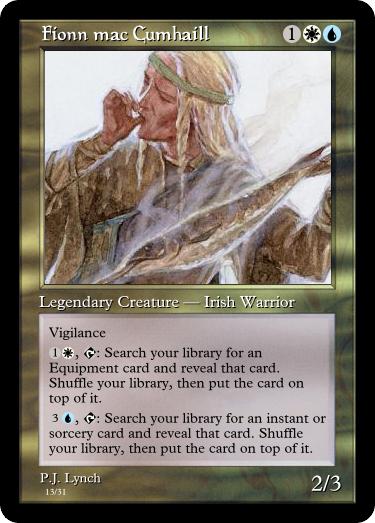
I'll see you guys next week!
Be warned - most of the names in this post begin with the letter F.
The character we're going to focus on today is named Fionn. (Fionn means "fair"; he was named for his looks.) Fionn is a very interesting character in Celtic mythology, and his story is one of my favorites. Much like Cu Chulainn, there are a lot of stories about Fionn. I'm going to tell you a very compressed version of his life, but I'd like to set the stage first.
First off: the gods. The Tuatha De Danann aren't seen in this story until the very end. The stories of Fionn were written much later than several of the other tales we've talked about, and so the Tuatha De Danann have evolved. Ireland is famous for its stories of the sidhe, or the fae - they are what the ancient Celtic gods became as stories changed with the times. The sidhe mostly stay in their own realms, hidden underground beneath magic mounds, but they sometimes come to our world to meddle with (or, occasionally, help) mortals.
Next up: Fionn himself. He's a fascinating character, because people have wondered for some time if he was based upon a historical person. The same question surrounds King Arthur. Did these men actually exist? Are their stories embellished truth, or pure fantasy? Another question often asked is whether Fionn and Arthur are human personifications of gods. Whatever the case, their stories sure are interesting!
Lastly: The Fenians. All of the other stories we've talked about so far have revolved around kings and their warriors; the same hierarchy exists even among the Tuatha De Danann. Celtic society had a high king, who ruled over all of the lesser kings. Warriors served these kings...except for one specific type of warrior. These fighters were called Fenians, and they operated out side of the normal structure of Celtic society. They served no king, but were warriors under the command of those fighters who were strongest.
As a side note: There are so very many different ways of spelling the names of the various Celtic gods and heroes. I'm going with the versions I have in my books, but upon trying to find images for this post I discovered a lot of other variations. For instance, you may see Fionn spelled as Finn if you go looking, and there are tons of ways to spell his last name. The group I refer to as the Fenians are also called the Fianna. I'm just an enthusiast, not an expert, so I can't tell you which is the proper way to refer to any of these people. I'm just sticking with the terms I know.
Our story begins with the birth of Fionn, called Demne at the time. He was born into a time of strife, for his father had been killed when Demne was still in his mother's womb. There was a long-standing feud between Demne's family and that of his father's killers, the mac Morna clan. Fearing for her child's safety, Demne's mother sent him away to be raised in the wilds.
There, Demne was raised by a druidess and a warrior who taught him magic and how to fight. He had many adventures in his youth, and eventually a king gifted him with the name of Fionn due to his appearance. Fionn often left the women who were raising him to seek out adventure, and spent much of his childhood roaming the country with bands of warriors.
Once, Fionn came across a poet named Finneces who was fishing in a pool. This pool was said to be the home of a special salmon; whoever caught and ate the fish would know the future. A prophecy had been made about the salmon - it would be caught and eaten by a man named Fionn.
Finneces figured his name was close to Fionn, so he had spent years trying to catch the fish. Not long after Fionn met him, Finneces finally managed to fish up the salmon. Overjoyed, he asked Fionn to cook it for him, but cautioned him not to eat it.
(Who knew you could look so heroic cooking a fish?)
Fionn did as he was asked, but he burned his finger while cooking the fish. Ouch! Anyone else ever burnt their finger? What's the first thing you do? Most people, myself included, immediately put the burn in their mouth to try and soothe the pain. Fionn was no different. He sucked on his finger to try and ease his discomfort, and then brought the fish to Finneces.
The old poet asked if Fionn had eaten any of the fish, and he truthfully explained about his burn. Only then did Finneces think to ask Fionn's name. Upon hearing that his companion was called Fionn (maybe he should have checked on that before handing him the fish!) Finneces gave up and told Fionn to eat the fish, explaining the prophecy. From then on, any time Fionn sucked his burn he could see the future.
Fionn had many adventures from that point forward. He slew an evil goblin, became leader of the Fenians, loved and lost two women, and had both children and grandchildren. If you're interested in these stories, you can find a concise version of them here. Fionn even managed to kill Goll mac Morna, the man who had killed Fionn's father.
Unfortunately, this act was to be his undoing.
A glimpse into the future had told Fionn that he would die in Ireland during a certain year. When this year arrived the old warrior decided to leave Ireland and head for Scotland, hoping to escape his prophesized demise. Upon hearing of this, the Fenians begged their leader to come to their homes and be feasted by them before he departed - sort of a series of farewell parties, if you will. Fionn was touched by the friendship of his warriors and agreed.
He probably should have sucked his finger first.
The very first home Fionn visited was that of the warrior Fer-tai. Fer-tai was a friend of Fionn's, as was his wife - but she was the daughter of Goll mac Morna, and her son Fer-li had loved his grandfather well. Fer-li had hated Fionn ever since the Fenian had killed his grandfather. Upon haring that Fionn would be staying in his father's house, Fer-li began to plot revenge.
(Dun dun dunnnnn!)
Fer-li's desire for blood was complicated by the fact that Fionn was a guest. Most ancient cultures had strong rules of hospitality, and the Celts were no exception. A guest was under the protection of his host, so Fer-li had to be careful or risk finding himself fighting his own father.
Fionn arrived at Fer-tai's house with a small group of warriors - less than two hundred men. He had most of these remain outside while he entered Fer-tai's home, where a splendid feast began.
The party was in full swing when the doors were flung open and a group of men stormed inside. These men were in cahoots with Fer-li; according to his plot, they accused Fionn's men of having killed many of the local villagers and animals. As their leader, Fionn could be held responsible for the Fenians' actions. Fer-li hoped to be able to kill him for the Fenians' "crime".
Fionn knew his men well, and so he knew that the accusations were false. Still, he wanted to appear willing to make amends. Fionn promised to give Fer-tai two animals to make up for every one slaughtered - a generous offer.
Seeing that his plan had not worked, Fer-li became enraged. He yelled that Fionn had come to kill he and his father just as the Fenian had killed Goll mac Morna. Overcome with rage, Fer-li then flung himself at Fionn, attacking the great warrior. Fionn's men rose up to defend him, but Fer-li's men countered them.
Fer-tai tried to break up the fight, but was unable to do so before blood was shed. The warriors only stopped fighting when Fer-tai's wife ran into the hall, naked and with her hair loose as a sign of peace. (Don't ask me why, but this is pretty common in Celtic mythology - something similar happens with Cu Chulainn. Naked women show up, and the fighting stops. Hey, at least it works!)
As soon as the brawl ended, Fer-li's mother began to berate him. How dare he attack a guest under his father's roof! And not just any guest - Fionn, who was dearly loved by all!
Nothing quite like being lectured in front of your warriors by your mom...who then proceeded to kick Fer-ti out of the hall. Ouch. That's gotta hurt your image...
Unfortunately, it was too late. Fer-li's plot had succeeded - Fionn had slain several of Fer-tai's subjects during the fight. As he left, Fer-li challenged Fionn to a battle the next day, secure in the knowledge that his father would have to side with him.
In the morning Fionn and his men approached the battlefield. They found themselves hopelessly outnumbered - a few hundred versus several thousand. Unable to withdraw from the fight without ruining both his honor and his reputation, Fionn attempted to buy peace. His offer was generous, and Fer-tai urged his son to accept it. Fer-li refused, still full of wrath at his grandfather's death. Fionn tried to negotiate peace once again, but still Fer0li refused to step down.
Left with no other choice, the battle began. Fionn and his Fenians fought bravely against the thousands who opposed them, but they could not hope to prevail against such numbers. One by one the Fenians fell - until all, even Fionn, were dead.
In the end, the mac Morna clan prevailed.
But the story does not end there. It is said that Fionn and his loyal warriors did not truly die. Instead, the sidhe came and took them from where they lay upon the battlefield. They carried the brave fighters back to the fairy realms, where their wounds were healed. To this day Fionn and the Fenians lie sleeping there, garbed for war. One day Ireland will again be in danger - and on that day, Fionn and his men will rise up to defend it.
Kind of a cool story, right? I love the ending; it reminds me of the dead Norse warriors, the Einherjar, who are fated to rise up and defend Asgard during Ragnarok. What do you guys think? Shoot me an email or post below to let me know!
Also, as a fun little aside - apparently Fionn showed up on an old card for Magic: The Gathering. I discovered the image while searching for other pictures, and I just had to share it with you guys. Any Magic players reading this?
I'll see you guys next week!
Monday, August 3, 2015
Manawydan: Of Mice and Men
Hello again, readers! How are you doing today? Did you have a nice week? I certainly hope so!
Earlier today I updated my post about East of the Sun, West of the Moon. If you want to see the awesome pictures I found for it, you can check it out here!
We also hit 1900 pageviews today! Thank you all so much. Getting close to the 2k mark!
Our story today is of a man named Manawydan. It is a strange tale, full of magic and loneliness. To my mind, it is one of the weirder stories of Celtic mythology - and that's saying a lot, as you'll see in the next couple of weeks! The unique events within this story are quite entertaining, despite being somewhat depressing, so I felt I should tell you the tale.
When we meet Manawydan in this story he has survived a great and terrible battle, and has buried his friend and leader. Now an outcast from his homeland, Manawydan has nowhere to go. He says as much to a young friend of his named Pryderi.
Pryderi has a solution for his pal. The young man is lord of a land named Dyfed, and has a beautiful widowed mother to boot. He offers to let Manawydan journey home with him. If the lands - and his mother - are to Manawydan's liking, Pryderi will give his mother to him in marriage and make Manawydan lord of Dyfed.
Good friend, right?!
Manawydan eagerly - and thankfully - agrees to this arrangement. He travels with Pryderi to the land of Dyfed, which he finds quite pleasing. He feels the same way about Riannon, Pryderi's mother.

She and Manawydan talk late into the night, and he falls in love with the mature, intelligent woman.
Pryderi is pleased when Manawydan tells him of his feelings. The matter of marriage is broached to Riannon, who is quite pleased by the idea. She and Manawydan are married, and the duo live quite happily with Pryderi and his wife Cigfa.
Ideally, the story would end here with "And they all lived happily ever after."
Of course, if you read my post about fairy tales, you'll see that few stories ever end that way. (After all, that wouldn't be as entertaining!) Such is the case here.
Some time passes happily, and one night the four friends decide to throw a celebratory feast. (All of my Celtic posts so far have had feasts - I'm guessing they were pretty common in ancient Britain, at least for the wealthy.) In the midst of the feast, the two couples slip away for some fresh air. They go and sit on a special enchanted mound and are lost in thought for some time.
Suddenly, a crash of thunder splits the air! A heavy mist swiftly surrounds the group, cutting them off from one another. The mist soon fades away, but the sight that greets the party is one of horror...for all that they see is ruined and barren.
Shocked, the four stumble back to their home. They find it empty - all of their friends seem to have vanished. Despite searching all over the land of Dyfed, they do not find any living souls. Only wild beasts and animals remain.
Luckily Manawydan and Pryderi are skilled hunters, and so the group lives off of wild game for several years. Eventually Manawydan tires of this existence. At his suggestion, the group decides to leave Dyfed and journey to distant lands. These lands, unlike their own, are still populated by humans, so the four friends find a small town and decide to learn a craft.
At first Manawydan tries making saddles. Unfortunately, his work is so fine that he becomes the only person anyone is willing to buy saddles from. Enraged, the other craftsmen plot to kill him. When word of this reaches the group, they quickly flee.
In the next city, Manawydan decides to start making shields - but the same thing happens! The same is true of cobbling (you've heard the phrase, "I'd kill for those shoes?), and at last the group give up and decide to return to their life in Dyfed.
Manawydan, Riannon, Pryderi, and Cigfa survive for several more years by hunting in Dyfed. Then, one day, something different happens. Pryderi and Manawydan awaken tot he sound of their hunting hounds baying. Hoping to catch some game, they follow them into a forest, where they find themselves pursuing a large, silver boar. It leads them on a merry chase before disappearing into a magnificent fortress, the hounds close behind it.
Manawydan and Pryderi stop to stare at the fortress. By this time, they have been hunting the lands of Dyfed for years. They know every inch of it - and yet, the two friends have never seen this fort before.
Sensing something magical afoot, Manawydan begs Pryderi to leave. His friend, however, is concerned about the hounds. Pryderi refuses to be deterred, and so enters the fortress alone.
Within, all is eerily silent. There is no trace of either the hounds or the boar. In his search for them, Pryderi comes across a magnificent courtyard. In its center lies a flowing marble fountain. Next to this sits a block of marble, upon which rests a large golden bowl. Four chains are attached to this bowl, and they rise up, up into the sky...where they disappear into thin air.
I told you this was a strange tale, didn't I? Just wait!
The sight of the bowl makes Pryderi curious - it is obviously magical, but he can't figure out what it does. The man kneels before the bowl and stretches out one hand to touch it -
- which promptly becomes stuck to the bowl.

(Guess he failed that "Knowledge: Magical Item" check!)
Pryderi soon finds that his feet are stuck to the ground. When he attempts to call Manawydan for help, he discovers that he cannot make any noise. Left with no other choice, he waits in silence.
Outside, Manawydan paces with worry. When Pryderi fails to emerge from the keep by the beginning of sunset, Manawydan returns home alone.
Big mistake.
When she sees him approaching alone, Riannon immediately wants to know where her son is. Manawydan tells her what happened, and she is furious that he left Pryderi behind. Riannon brands him a bad friend (a great insult) and immediately sets off to find Pryderi.
Mommy to the rescue!
It isn't long before Riannon finds the keep, and within it her son. Unfortunately, Pryderi is unable to speak to warn her. He can only watch in horror as his mother grabs the bowl, intending to wrest it from his grasp...and becomes just as stuck as Pryderi.
When the sun finishes setting, there comes a clap of thunder and a thick mist reminiscent of the night the group's woes began. When the mist disperses, the fortress is gone...and so are Pryderi and Riannon.
Depressed and not wanting to stay in the land that took their loved ones, Manawydan and Cigfa soon depart from Dyfed once again. Unfortunately, they are once more driven from their trade by jealous (and murderous) rivals. Seeing no other choice, the duo sadly return to Dyfed - but this time, Manawydan brings with him seeds of grain so that they can start a farm.
Time passes, and Manawydan's crops grow well; as it turns out, he is as good of a farmer as he is a shoe/saddle/shield-maker. When the harvest time comes, Manawydan goes out to reap what he has sown - only to find that all of the crops in the first field he planted are gone!
The next day Manawydan goes to his second field, only to find it likewise bare. Manawydan is furious, but he realizes that the thieves are likely to raid his third field that night. He decides to lie in wait for them and catch them in the act.
Ready for the story to get really weird?
Sure enough, that night the culprits come. To Manawydan's surprise - they're a bunch of mice! He watches, shocked, as they gather up his crop and begin to run off with it. His shock turns to rage, and Manawydan begins to chase the mice. They manage to evade him...all save one, who moves too slowly and is snatched up by the angry Manawydan, who stashes it in his glove.
He returns to Cigfa and tells her what occurred, ending his tale by swearing to hang the mouse he caught - a common punishment for thieves, perhaps, but not for rodent thieves. Cigfa is horrified by his declaration and begs Manawydan not to hang the mouse - it wouldn't be proper for one of his rank! - but Manawydan angrily refuses to listen to her.
The next day he sets out with his tiny captive and begins to construct a miniscule gallows. As he does so, two men walk by. Each echoes Cigfa's statement that it would not befit a lord to hang a mouse, and each offers to buy the mouse's freedom to preserve Manawydan's dignity. He refuses to listen to either man, sending them on their way.
Then a third man comes by - a bishop, accompanied by a large group of people.
Now, before today Dyfed has seemed cursed, for no people (save Manawydan's group) lived in it. Today a large number of people have passed through Dyfed, each requesting that the mouse be freed. Because of this, Manawydan becomes suspicious.
The bishop also offers to pay Manawydan to release the mouse.

Convinced that the bishop is not what he seems, Manawydan agrees to release the blasted rodent - but only if the curse is lifted from Dyfed, and Pryderi and Riannon are returned to him.
The bishop - actually a druid - agrees. As it turns out, the curse was his revenge on Pryderi fro osme action of his parent's against the druid's. The mice that destroyed Manawydan's crops were the druid's warriors. The mouse Manawydan managed to catch is his pregnant wife (no wonder she couldn't run very fast!). In exchange for her, the druid agrees to forget his feud, and he releases Pryderi and Riannon. The curse is lifted, and Dyfed is returned to its former beauty.
The two couples are reunited...and this time, they do live happily ever after.
Weird, right?
I hope you guys enjoyed the story! I've never read anything quite like it. The scene with the mice always makes me happy, because I grew up reading the Redwall series and always think of that.
Did you guys like Manawydan's story? Hate it? Let me know below, or email me!
I'll be back next week with a look at the life of Fionn, one of the greatest Celtic heroes who ever was. Until then, take care!
(And watch out for strange bowls and mice!)
Earlier today I updated my post about East of the Sun, West of the Moon. If you want to see the awesome pictures I found for it, you can check it out here!
We also hit 1900 pageviews today! Thank you all so much. Getting close to the 2k mark!
Our story today is of a man named Manawydan. It is a strange tale, full of magic and loneliness. To my mind, it is one of the weirder stories of Celtic mythology - and that's saying a lot, as you'll see in the next couple of weeks! The unique events within this story are quite entertaining, despite being somewhat depressing, so I felt I should tell you the tale.
When we meet Manawydan in this story he has survived a great and terrible battle, and has buried his friend and leader. Now an outcast from his homeland, Manawydan has nowhere to go. He says as much to a young friend of his named Pryderi.
Pryderi has a solution for his pal. The young man is lord of a land named Dyfed, and has a beautiful widowed mother to boot. He offers to let Manawydan journey home with him. If the lands - and his mother - are to Manawydan's liking, Pryderi will give his mother to him in marriage and make Manawydan lord of Dyfed.
Good friend, right?!
Manawydan eagerly - and thankfully - agrees to this arrangement. He travels with Pryderi to the land of Dyfed, which he finds quite pleasing. He feels the same way about Riannon, Pryderi's mother.
She and Manawydan talk late into the night, and he falls in love with the mature, intelligent woman.
Pryderi is pleased when Manawydan tells him of his feelings. The matter of marriage is broached to Riannon, who is quite pleased by the idea. She and Manawydan are married, and the duo live quite happily with Pryderi and his wife Cigfa.
Ideally, the story would end here with "And they all lived happily ever after."
Of course, if you read my post about fairy tales, you'll see that few stories ever end that way. (After all, that wouldn't be as entertaining!) Such is the case here.
Some time passes happily, and one night the four friends decide to throw a celebratory feast. (All of my Celtic posts so far have had feasts - I'm guessing they were pretty common in ancient Britain, at least for the wealthy.) In the midst of the feast, the two couples slip away for some fresh air. They go and sit on a special enchanted mound and are lost in thought for some time.
Suddenly, a crash of thunder splits the air! A heavy mist swiftly surrounds the group, cutting them off from one another. The mist soon fades away, but the sight that greets the party is one of horror...for all that they see is ruined and barren.
Shocked, the four stumble back to their home. They find it empty - all of their friends seem to have vanished. Despite searching all over the land of Dyfed, they do not find any living souls. Only wild beasts and animals remain.
Luckily Manawydan and Pryderi are skilled hunters, and so the group lives off of wild game for several years. Eventually Manawydan tires of this existence. At his suggestion, the group decides to leave Dyfed and journey to distant lands. These lands, unlike their own, are still populated by humans, so the four friends find a small town and decide to learn a craft.
At first Manawydan tries making saddles. Unfortunately, his work is so fine that he becomes the only person anyone is willing to buy saddles from. Enraged, the other craftsmen plot to kill him. When word of this reaches the group, they quickly flee.
In the next city, Manawydan decides to start making shields - but the same thing happens! The same is true of cobbling (you've heard the phrase, "I'd kill for those shoes?), and at last the group give up and decide to return to their life in Dyfed.
Manawydan, Riannon, Pryderi, and Cigfa survive for several more years by hunting in Dyfed. Then, one day, something different happens. Pryderi and Manawydan awaken tot he sound of their hunting hounds baying. Hoping to catch some game, they follow them into a forest, where they find themselves pursuing a large, silver boar. It leads them on a merry chase before disappearing into a magnificent fortress, the hounds close behind it.
Manawydan and Pryderi stop to stare at the fortress. By this time, they have been hunting the lands of Dyfed for years. They know every inch of it - and yet, the two friends have never seen this fort before.
Sensing something magical afoot, Manawydan begs Pryderi to leave. His friend, however, is concerned about the hounds. Pryderi refuses to be deterred, and so enters the fortress alone.
Within, all is eerily silent. There is no trace of either the hounds or the boar. In his search for them, Pryderi comes across a magnificent courtyard. In its center lies a flowing marble fountain. Next to this sits a block of marble, upon which rests a large golden bowl. Four chains are attached to this bowl, and they rise up, up into the sky...where they disappear into thin air.
I told you this was a strange tale, didn't I? Just wait!
The sight of the bowl makes Pryderi curious - it is obviously magical, but he can't figure out what it does. The man kneels before the bowl and stretches out one hand to touch it -
- which promptly becomes stuck to the bowl.

(Guess he failed that "Knowledge: Magical Item" check!)
Pryderi soon finds that his feet are stuck to the ground. When he attempts to call Manawydan for help, he discovers that he cannot make any noise. Left with no other choice, he waits in silence.
Outside, Manawydan paces with worry. When Pryderi fails to emerge from the keep by the beginning of sunset, Manawydan returns home alone.
Big mistake.
When she sees him approaching alone, Riannon immediately wants to know where her son is. Manawydan tells her what happened, and she is furious that he left Pryderi behind. Riannon brands him a bad friend (a great insult) and immediately sets off to find Pryderi.
Mommy to the rescue!
It isn't long before Riannon finds the keep, and within it her son. Unfortunately, Pryderi is unable to speak to warn her. He can only watch in horror as his mother grabs the bowl, intending to wrest it from his grasp...and becomes just as stuck as Pryderi.
When the sun finishes setting, there comes a clap of thunder and a thick mist reminiscent of the night the group's woes began. When the mist disperses, the fortress is gone...and so are Pryderi and Riannon.
Depressed and not wanting to stay in the land that took their loved ones, Manawydan and Cigfa soon depart from Dyfed once again. Unfortunately, they are once more driven from their trade by jealous (and murderous) rivals. Seeing no other choice, the duo sadly return to Dyfed - but this time, Manawydan brings with him seeds of grain so that they can start a farm.
Time passes, and Manawydan's crops grow well; as it turns out, he is as good of a farmer as he is a shoe/saddle/shield-maker. When the harvest time comes, Manawydan goes out to reap what he has sown - only to find that all of the crops in the first field he planted are gone!
The next day Manawydan goes to his second field, only to find it likewise bare. Manawydan is furious, but he realizes that the thieves are likely to raid his third field that night. He decides to lie in wait for them and catch them in the act.
Ready for the story to get really weird?
Sure enough, that night the culprits come. To Manawydan's surprise - they're a bunch of mice! He watches, shocked, as they gather up his crop and begin to run off with it. His shock turns to rage, and Manawydan begins to chase the mice. They manage to evade him...all save one, who moves too slowly and is snatched up by the angry Manawydan, who stashes it in his glove.
He returns to Cigfa and tells her what occurred, ending his tale by swearing to hang the mouse he caught - a common punishment for thieves, perhaps, but not for rodent thieves. Cigfa is horrified by his declaration and begs Manawydan not to hang the mouse - it wouldn't be proper for one of his rank! - but Manawydan angrily refuses to listen to her.
The next day he sets out with his tiny captive and begins to construct a miniscule gallows. As he does so, two men walk by. Each echoes Cigfa's statement that it would not befit a lord to hang a mouse, and each offers to buy the mouse's freedom to preserve Manawydan's dignity. He refuses to listen to either man, sending them on their way.
Then a third man comes by - a bishop, accompanied by a large group of people.
Now, before today Dyfed has seemed cursed, for no people (save Manawydan's group) lived in it. Today a large number of people have passed through Dyfed, each requesting that the mouse be freed. Because of this, Manawydan becomes suspicious.
The bishop also offers to pay Manawydan to release the mouse.

Convinced that the bishop is not what he seems, Manawydan agrees to release the blasted rodent - but only if the curse is lifted from Dyfed, and Pryderi and Riannon are returned to him.
The bishop - actually a druid - agrees. As it turns out, the curse was his revenge on Pryderi fro osme action of his parent's against the druid's. The mice that destroyed Manawydan's crops were the druid's warriors. The mouse Manawydan managed to catch is his pregnant wife (no wonder she couldn't run very fast!). In exchange for her, the druid agrees to forget his feud, and he releases Pryderi and Riannon. The curse is lifted, and Dyfed is returned to its former beauty.
The two couples are reunited...and this time, they do live happily ever after.
Weird, right?
I hope you guys enjoyed the story! I've never read anything quite like it. The scene with the mice always makes me happy, because I grew up reading the Redwall series and always think of that.
Did you guys like Manawydan's story? Hate it? Let me know below, or email me!
I'll be back next week with a look at the life of Fionn, one of the greatest Celtic heroes who ever was. Until then, take care!
(And watch out for strange bowls and mice!)
Subscribe to:
Posts (Atom)